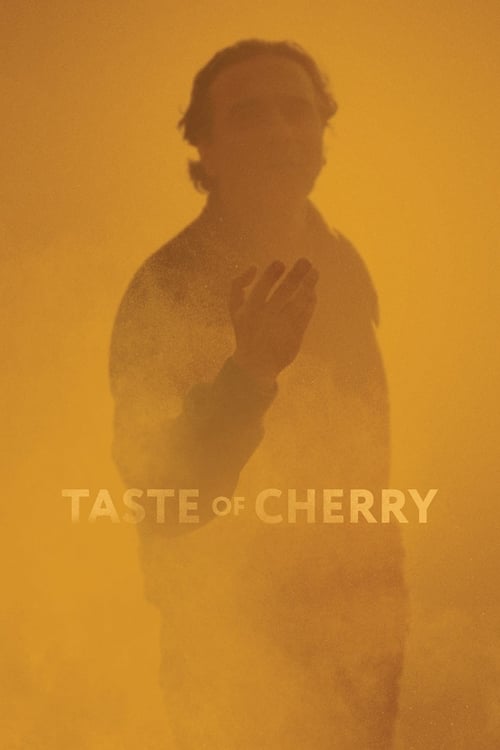
Taste of Cherry
1997 · Abbas Kiarostami
For when you want stillness and a film that takes life-and-death questions seriously without melodrama — something to sit with rather than be entertained by. It's contemplative to its core; come patient, leave changed.
What it's about
A middle-aged man drives a Range Rover in slow circles through the dusty hills outside Tehran, offering strangers money for a strange job: come to a hillside at dawn, call his name, and bury him if he doesn't answer. He has decided to end his life, and the film unfolds as a series of conversations with the men he tries to recruit — a young soldier, a seminary student, a taxidermist — each of whom answers his proposition in a different way.
The experience
Slow, spare, and quietly profound — long drives, long silences, and dialogue that sneaks up on you with its weight. It doesn't dramatize despair so much as sit beside it, and the calm becomes strangely moving.
Performances
Homayoun Ershadi carries the film with almost nothing — a weary face behind a windshield — and makes the man's unexplained sorrow feel completely real.
The craft
Abbas Kiarostami builds the whole film from a car's interior and the ochre landscape outside it, using the drive itself as structure: repetition, dust, winding roads, faces in profile. The minimalism is deceptive — every choice about what you see and what you're denied is deliberate, and the ending takes a formal risk you won't forget.
Why it matters
Winner of the Palme d'Or at Cannes in 1997, it announced Iranian cinema's arrival at the center of world film and remains one of the most argued-about endings in movie history.
Snapshot
A middle-aged man named Mr. Badii (Homayoun Ershadi) drives a Land Rover through the dusty outskirts of Tehran, searching for a stranger willing to perform a simple task: come the following morning to a hillside pit, call his name, and, if he does not answer, cover him with twenty shovelfulls of earth. He has already decided to die. The film is structured around three encounters — a young Kurdish soldier, an Afghan seminary student, and an Azerbaijani taxidermist named Mr. Bagheri — each of whom responds differently to the proposition. The third man agrees, but spends their shared drive attempting to talk Badii out of it by invoking the singular sensory pleasure of eating cherries. The film ends in darkness, narrative resolution withheld, then ruptures into a video-format coda that restores the actors, the crew, and Kiarostami himself to the sunlit hillside. Taste of Cherry won the Palme d'Or at Cannes in 1997, shared with Shohei Imamura's The Eel, and stands as one of the defining works of the Iranian New Wave and of late-twentieth-century world cinema.
Industry & production
Taste of Cherry was produced through Abbas Kiarostami Productions, the director's own company, in a model of artisanal independence that had become Kiarostami's signature. The budget was modest by international standards, though precise figures have not been formally published. The film was shot largely on the rocky hillsides around Golak, a quarrying district on the western fringe of Tehran, with additional driving sequences along the city's peripheral roads. Production took place in conditions of quiet clandestinity: the subject matter — a man seeking to facilitate his own suicide — fell into a zone of ideological and religious sensitivity that complicated formal approval under Iran's post-revolutionary censorship system. The film was submitted to the Cannes selection committee before completing the full domestic approval process, a decision that placed Kiarostami in an awkward position with Iranian cultural authorities. The precise bureaucratic history of its Iranian release and exhibition is not fully documented in the public record; the film's domestic exhibition was restricted, and the situation around its censorship approval was contested. Internationally it was distributed by MK2 in France and Zeitgeist Films in the United States, both established conduits for European and world art cinema.
Kiarostami assembled a small crew, in keeping with his general preference for minimal apparatus. The lead, Homayoun Ershadi, was not a professional actor; he was an architect whom Kiarostami reportedly encountered in Tehran traffic and invited to take the role — a casting method consistent with the director's long practice of seeking faces rather than performers.
Technology
The film was shot on 35mm, the dominant cinematographic standard of the period, but its famous final sequence — the video coda — shifts abruptly to what appears to be consumer-grade video, likely Hi-8 or an equivalent small-format format. This technological rupture is not accidental: it demystifies the illusion of the fiction, revealing the machinery of production and foregrounding the gap between the narrative world and the real world of filmmakers, crew, and actors. The rest of the film makes restrained use of available natural light on the exteriors; interior car scenes depend on carefully controlled artificial supplement to manage exposure within the confined cabin space. Kiarostami's use of relatively long lenses for many of the exterior hillside shots creates a compressed, flattened landscape that isolates the Land Rover against dun-coloured earth — a visual choice with both aesthetic and thematic resonance.
Technique
Cinematography
The cinematographer was Homayoun Payvar, working in close collaboration with a director who had long insisted on treating the visual frame as a philosophical statement rather than a decorative one. The film's palette is deliberately desaturated, the Tehran periphery rendered in tones of ochre, gray, and brown that make the earth feel inescapable — present as both landscape and destiny. Two primary spatial registers dominate: the medium-shot two-hander inside the Land Rover, with the camera positioned on the dashboard or rear seat to catch both driver and passenger in a contained, pressurized space; and the wide exterior shot that dwarfs the vehicle against the scored terrain of quarry roads. Very few shots are decorative in the conventional sense. The decision to place the camera inside the moving car, frequently pointed at the driver's face while the world scrolls past the passenger window, creates a peculiar intimacy — the viewer is structurally positioned as Badii's interlocutor, receiving his proposition.
Editing
Kiarostami is credited as the film's editor — a role he had assumed on several previous projects, reflecting his belief that editing is inseparable from direction and that decisions made in the cutting room are continuous with decisions made in the field. The editing rhythm in Taste of Cherry is sparse and elongated. Scenes in the car run long without intercutting; the physical sensation of the drive — boredom, duration, the slow accumulation of a person's presence — is treated as dramatically essential rather than as material to be compressed. Ellipsis is deployed ruthlessly at moments of potential action: the film cuts away precisely when conventional dramaturgy would hold on consequence. The most drastic editorial gesture is the structural break at the end, where the narrative cuts from a long-hold shot of a darkened hillside to the video coda without transition or warning.
Mise-en-scène / staging
The Land Rover functions as a kind of mobile stage, its interior geometry — two front seats, a rear bench, a windshield that reframes the world outside — dictating the blocking of every encounter. Kiarostami stages conversations so that interlocutors rarely look directly at each other; both driver and passenger look forward, out at the road, which forces the viewer to read emotion through posture, vocal pitch, and the oblique glance rather than through conventional shot-reverse-shot face-reading. This staging choice has a philosophical dimension: it refuses the standard logic of screen dialogue, in which faces are the primary carriers of meaning, and relocates expressivity in the peripheral and the indirect. On the hillside exterior, the staging is equally precise: Badii stands at the lip of the pit, a human figure against an indifferent landscape, in arrangements that recall both documentary portraiture and the spare pictorial tradition of Persian miniature.
Sound
The soundtrack is almost entirely diegetic. There is no underscoring in the conventional sense during the body of the film; the soundscape is populated by wind, the engine of the Land Rover, and the sound of gravel under tires. Dialogue is recorded naturalistically, without the studio cleaning that would be standard in commercial cinema. The absence of non-diegetic music for the film's duration makes the coda's musical intervention — a recorded piece played over the video footage of the company on the hillside — a stark contrast. The specific piece used in the coda is a matter the film does not foreground textually; it underlines a mood of valediction and release rather than grief.
Performance
Ershadi carries the film with an almost entirely internal performance. He was not a trained actor, and Kiarostami appears to have elicited something in that gap between natural behavior and the demands of a scene — a quality of genuine uncertainty, of a man not quite occupying the fictional role assigned to him, that serves the film's ambiguity. The actors who play the three interlocutors are similarly non-professional or semi-professional, and their exchanges with Ershadi have the texture of improvised conversation shaped into narrative necessity. Mr. Bagheri (played by Abdolrahman Bagheri, a taxidermist at Tehran's Natural History Museum who, the production history suggests, was in some respects playing a version of his actual profession) gives the film its emotional climax — a sustained monologue about a morning he himself contemplated suicide and was recalled to life by the taste of a mulberry.
Narrative & dramatic mode
Taste of Cherry operates in a mode that might be called philosophical road narrative, though that label only approximates what it does. Its structure is tripartite: three encounters, three refusals of various degrees, three different registers of argument against death (religious prohibition, moral obligation, sensory appeal to life's sweetness). The dramatic arc is simultaneously a Socratic dialogue — Badii functions as a kind of anti-Socrates, advancing not toward wisdom but toward annihilation — and an almost clinical study in how human beings respond to an impossible request. Causality is suppressed. The film offers no backstory for Badii's desire to die; there is no revelation of trauma, no disclosed reason. This strategic withholding places the film squarely in an art cinema tradition that distrusts psychological explanation, but it also has a formal precision: the absence of cause universalizes the condition and refuses the viewer the consolation of understanding.
Genre & cycle
The film belongs to the loose formation sometimes called philosophical road cinema, alongside works by Wim Wenders, Jim Jarmusch, and others who used vehicular movement as a structuring metaphor for existential inquiry. More specifically, it fits within the post-1979 Iranian New Wave's recurring interest in the car as dramatic arena — a space that Kiarostami had been developing since at least The Traveller (1974) and that would become fully codified in Ten (2002). It can also be read within a broader cycle of 1990s art cinema concerned with duration, ellipsis, and the withdrawal of narrative resolution: roughly contemporary with Hou Hsiao-hsien's Goodbye South, Goodbye (1996) and Tsai Ming-liang's period work.
Authorship & method
Abbas Kiarostami (1940–2016) developed his practice across thirty years of filmmaking, beginning with short films and children's features for the Institute for the Intellectual Development of Children and Young Adults (Kanoon) in the 1970s. By the 1990s, after the success of the Koker trilogy (Where Is the Friend's Home?, 1987; And Life Goes On, 1992; Through the Olive Trees, 1994), he had arrived at a method characterized by: the systematic blurring of documentary and fiction; non-professional casting; the use of landscapes that are themselves expressive agents; and a persistent thematic concern with the instability of the real. Taste of Cherry extends and crystallizes this method. Kiarostami wrote, directed, and edited the film, functioning as the controlling intelligence across every stage of production. His collaboration with Homayoun Payvar on the cinematography was continuous with a broader visual philosophy rather than a delegated technical arrangement.
Movement / national cinema
Taste of Cherry is a summit work of what is variously called the Iranian New Wave, the New Iranian Cinema, or the Second Wave of Iranian film culture. The movement emerged in the years after the 1979 Islamic Revolution from an apparent paradox: the revolutionary government's restrictions on content and the gendered regulation of bodies on screen forced filmmakers to discover an oblique, elliptical aesthetic that international critics found both formally distinctive and philosophically rich. Kiarostami, alongside Mohsen Makhmalbaf, Dariush Mehrjui, and — in a subsequent generation — Jafar Panahi and Samira Makhmalbaf, constituted the movement's international face. Iranian New Wave cinema shared certain formal preoccupations — location shooting, children or marginal figures as protagonists, the interpenetration of fiction and documentary — while diverging widely in political orientation and aesthetic ambition. Kiarostami's position within this movement was both central and somewhat anomalous: his films were celebrated internationally while their reception domestically was complicated by official unease.
Era / period
The film belongs to a specific high-water moment in global art cinema, roughly 1990–2002, when a network of international festivals (Cannes, Venice, Berlin, Toronto), specialist distributors, and a literate urban cinephile public created unusually favourable conditions for formally adventurous world cinema. In this period Iranian cinema achieved unprecedented international visibility; Taiwanese New Wave directors (Hou, Tsai) and Chinese Fifth Generation filmmakers were major presences; and the art film circuit sustained a range of national cinemas that would later find their exhibition infrastructure contracting. Taste of Cherry appeared at the peak of this moment and has been cited repeatedly as among the decade's defining works.
Themes
The film's central inquiry is less about suicide as a social problem than about the phenomenological ground of the will to live. The three interlocutors offer three angles on this question: the young soldier offers silence and refusal; the seminary student invokes religious interdiction; Bagheri offers something more intimate — the memory of cherries, their taste, as something that called him back from an identical despair. The title operates as both literal image and philosophical proposition: against the abstract desire for oblivion, Kiarostami posits the radical particularity of sensory experience. Persian literary and philosophical tradition haunts the film obliquely; the structure of a journey as a search for wisdom, and the interlocutor who redirects the seeker, has precedents in Persian classical poetry (the Sufi journey, the wise counsellor). The film also thinks carefully about class and labor: each of Badii's encounters is shaped by the economic and social position of the person he approaches — a soldier, a student, a museum worker. Only the man who needs money engages. The ethical implication is registered but not resolved. The video coda introduces a further theme: the fragility and constructedness of the filmed world, and the possibility of a kind of resurrection — Badii and his actor coexist in the same hillside, after the story has ended.
Reception, canon & influence
Critical reception. The Palme d'Or at Cannes 1997 (awarded by a jury presided over by Isabelle Adjani, shared with Imamura) gave the film immediate canonical authority in the international festival world. Jean-Luc Godard, who had earlier declared that cinema begins with D. W. Griffith and ends with Kiarostami, was among the film's distinguished advocates — though the precise wording and context of his praise varies across sources, and direct quotation should be treated carefully. Roger Ebert gave the film a strong critical endorsement and engaged seriously with its formal strategies. Some critics and viewers found the film cold, repetitive, or withholding to the point of frustration — an affective resistance that was itself part of the critical conversation about what the film demanded of its audience.
Influences on the film (backward). Italian neorealism's model of location shooting and non-professional casting is a foundational influence, channeled partly through Kiarostami's own earlier practice and partly through the broader legacy of Rossellini, De Sica, and their successors in the developing world. The Socratic dialogue tradition — a philosophical inquiry conducted through conversation between a protagonist and a series of interlocutors — is a structural template that Kiarostami handles secularly and phenomenologically rather than metaphysically. Bresson's minimalism and his theory of the "model" rather than the actor (set out in Notes on Cinematography) is relevant to the performance mode, though direct documented influence is not easy to establish. Within Iranian cinema, the tradition of poetic film practice developed at Kanoon in the 1970s, and the earlier work of Forough Farrokhzad (particularly The House Is Black, 1963, with its documentary lyricism) provide a national lineage.
Legacy and forward influence. The car-as-drama-space that Taste of Cherry consolidates has been among the most generative formal ideas in subsequent Iranian cinema. Jafar Panahi's Ten (2002), which confines its entire narrative to exchanges within a car, is the most direct formal descendant. The broader strategy of structuring a film around a sequence of encounters, each of which modulates a central question without resolving it, has been widely adapted. The video coda's gesture — the rupture into a different image-register that deconstructs the fiction and discloses the machinery of filmmaking — anticipates and may have influenced a range of subsequent films that play with the documentary-fiction boundary, including Panahi's own later work. In the wider sphere of world art cinema, the film contributed to an established vocabulary of ambiguous narrative closure that became increasingly normative across the 2000s. Kiarostami himself cited the film as a turning point in his thinking about what cinema could honestly do with the question of death.
A Deleuzian reading
A man drives.
The full Deleuzian reading of Taste of Cherry →
Reception
It shared the Palme d'Or in 1997 — the first Iranian film to win it — yet split critics immediately: Roger Ebert gave it one star and called it excruciatingly boring, sparking a famous printed feud with Jonathan Rosenbaum, who championed it. Now it's a fixture of the Sight & Sound greatest-films canon and shorthand for Kiarostami's genius.
How Taste of Cherry was received, from release to now →
Influences: the films it descends from and the films it influenced
- Bicycle Thieves (1948) — De Sica's neorealist practice of casting factory workers and children — selecting untrained performers for the lived authenticity of their circumstances rather than theatrical skill — is the direct template for Kiarostami's non-professional casting method, where Mr. Badii's interlocutors are drawn from their own social roles rather than shaped for the camera.
- Au Hasard Balthazar (1966) — Bresson's published 'model' theory — directing non-professionals to suppress interpretive expression in favor of pure physical and vocal economy — provides the conceptual framework for the flat, withheld delivery Kiarostami elicits from his car passengers, where conventional psychological signaling is systematically absent and meaning accrues through accumulation rather than expression.
- The House Is Black (1963) — Farrokhzad's 22-minute documentary-poem fused observational handheld footage of a leper colony with lyrical voice-over structure, establishing an Iranian formal tradition of documentary-fiction blur that Kiarostami inherits as his primary mode and extends in the video coda's rupture into a different image-register.
- Viaggio in Italia (1954) — Rossellini structures the film as a series of location encounters in which each stop modulates the protagonist's existential situation without resolving it — the secular journey-as-philosophical-inquiry template that Kiarostami adapts directly into the tripartite encounter structure of Badii's three successive passengers.
- L'Avventura (1960) — Antonioni's structural device of organizing a narrative around a causally withheld, permanently absent event — the disappeared woman whose fate is never explained — is the template for Kiarostami's refusal to confirm or deny Badii's death, making narrative ellipsis the film's primary dramatic engine rather than a stylistic choice.
- Tokyo Story (1953) — Ozu's editorial practice of cutting past emotional climaxes rather than staging them — ellipsis as the primary narrative gesture — and his static pillow shots that arrest narrative for contemplative landscape duration directly inform Kiarostami's strategic ellipsis and the compressed hillside cinematography that replaces conventional scene-building with durational observation.
- Close-Up (1990) — Kiarostami's reconstruction of a real fraud case using the actual participants collapsed the line between document and fiction in a way that directly prepares the video coda's rupture in Taste of Cherry, where the switch to video discloses the film's own apparatus — Kiarostami visible on the hill directing the cast — retroactively reframing the preceding fiction.
- Through the Olive Trees (1994) — The layered meta-fictional structure — a film-within-a-film shot on the earthquake-scarred Koker hillsides — crystallizes the compressed topographical cinematography and systematic documentary-fiction blur that Taste of Cherry inherits directly, including the visual grammar of a landscape that is simultaneously location and expressive agent.
- Where Is The Friend's House? (1987) — Carries forward the long-lens landscape, winding roads and durational patience, staging a moral question through minimal action and withheld resolution as the friend's-house search did.
- The Fire Within (1963) — Rebuilds the film as a suicide-countdown structured entirely around a man's peripatetic encounters, each visit weighing whether to live, with all melodrama and moralizing withheld.
- Life, and Nothing More… (1992) — Extends the car-as-mobile-stage into a sequence of driver's-seat dialogues shot in shot/reverse-shot from separate passes, capped by an open, medium-breaking ending.
- Ten (2002) — The most direct formal inheritor of the car-as-stage device: Panahi mounts fixed dashboard cameras and confines the entire film to a vehicle's interior, taking Kiarostami's spatial innovation to its logical conclusion — the car becomes the sole dramatic arena, and a succession of women passengers constitute the film's entire social and philosophical world.
- A Separation (2011) — Farhadi inherits Kiarostami's narrative architecture of withheld causality: moral responsibility is distributed across a series of encounters that each modulate a central legal and ethical question without resolution, and the film's ending refuses adjudication — the Iranian art cinema lineage of the irresolvable encounter structure taken into a realist domestic register.
- This Is Not a Film (2011) — Panahi, under house arrest, records himself on a smartphone inside a single apartment, staging scenes from a banned script within a document of his own confinement — a direct inheritance of Taste of Cherry's video coda rupture, where switching image-register discloses the machinery of filmmaking and collapses the boundary between the filmmaker and his fiction.
- Certified Copy (2010) — Kiarostami transposes the car-as-stage and philosophical dialogue structure to Tuscany: two characters whose relationship is held in deliberate ambiguity conduct a sustained Socratic exchange about originals and copies from a moving vehicle, extending the philosophical road cinema of Taste of Cherry into a European register while preserving its ontological irresolution.
- It Was Just an Accident (2025) — The car-bound ethical interrogation shot in available light, where a moral verdict is debated but never adjudicated and no score intrudes, is the template Panahi extends to a captor-captive dialogue.
- Destiny (2006) — Parallel formal development of static framing, naturalistic diegetic sound, and non-expressive performance applied to fatalistic subject matter in a neighboring Islamic cultural context; the Iranian New Wave's formal vocabulary constitutes a likely regional influence on Demirkubuz's synthesis of Bressonian method and Middle Eastern social-realist subject matter.
- Burning (2018) — Kiarostami's principled narrative withholding — the refusal to confirm or deny the central act, encoded as an ethical position about the limits of cinema's knowledge — established the ontological ambiguity that Lee extends to Haemi's disappearance; both directors treat unresolution not as irresolution but as the correct epistemological stance.
- Drive My Car (2021) — The windshield as compositional frame and the digressive philosophical conversation conducted through it — a man driving through arid hills whose passengers become reluctant confessors — is the direct formal ancestor of Misaki's car as a space where disclosure becomes possible only through motion.
- Tropical Malady (2004) — Nonprofessional actors placed in real terrain, durational stretches of movement, and a deliberately open, unresolved ending that refuses narrative closure prefigure Tropical Malady's refusal to reconcile its two panels.
- Once Upon a Time in Anatolia (2011) — Stages mortality as oblique conversation conducted inside a car traversing barren hills in available light, the moral question circled rather than stated — the exact register of the doctor/prosecutor's exchanges.
- House of Sand and Fog (2003) — The Iranian art-cinema idiom of moral gravity, threshold framing, and quiet inevitability that supplies the diasporic-Persian texture the seed grafts onto Hollywood prestige.
- Hit the Road (2021) — The template for carbound cinema — sustained dialogue staged from inside a moving vehicle with the windshield and side windows framing landscape, driver and passenger held in profile two-shots, which Panahi and DP Amin Jafari directly extend.
- The Wind Will Carry Us (1999) — A direct methodological sibling: compressed hillside topography shot with a desaturated palette, a protagonist whose true purpose is withheld from both supporting characters and the audience, and a serial encounter structure that modulates an unstated central question across a rural landscape — the Taste of Cherry method extended one film forward.
- The Apple (1998) — Makhmalbaf cast the actual subjects of a news story she dramatizes — the real imprisoned girls, their father, and the social worker — producing a performance mode neither documentary nor fiction, directly parallel to Kiarostami's non-professional casting practice and the Iranian new wave's systematic blurring of the boundary between document and staged event.
- Gerry (2002) — Van Sant, who has cited Kiarostami as a direct formal influence, applies the compressed landscape cinematography, durational gaze, and diegetic-only sound design to the Mojave Desert; the suppressed performance mode and strategic ellipsis translate the Taste of Cherry method into an American register while preserving its withholding of psychological interiority.
- Elephant (2003) — Van Sant extends the tripartite encounter structure and withheld causality into an American high school: multiple protagonist tracks converge without causal explanation, each modulating a central event whose motivation is permanently refused — Kiarostami's narrative strategy of irresolvable encounter applied to a mass-shooting's ethical opacity.
- Dry Leaf (2026) — Kiarostami stretches a minimal premise across roadside long takes and ends by openly breaking the fiction's frame, fusing the road-movie of digression with essayistic self-disclosure that Koberidze's narrator extends.
- Landscape in the Mist (1988) — Continues the road-movie-as-mythic-quest in long static and tracking takes with off-screen withholding and a famously open ending, the contemplative wandering-vehicle structure shared with Angelopoulos.
- A Moment of Innocence (1997) — Shares the available-light handheld car-and-street realism and closes by revealing the crew and video camera, the same year's twin gesture of exposing the fiction's own construction.
Similar films
- The Wind Will Carry Us (1999) — influence & lineage · same viewing thread
- Close-Up (1990) — influence & lineage · same viewing thread
- Certified Copy (2010) — influence & lineage · same viewing thread
- Tokyo Story (1953) — influence & lineage · often watched together
- It Was Just an Accident (2025) — influence & lineage
- A Separation (2011) — influence & lineage
- Through the Olive Trees (1995) — same viewing thread
- Life, and Nothing More… (1992) — same viewing thread
All the films related to Taste of Cherry →
Watch it with: curated runs of related films
- Where Fiction Meets the Real — Watch these in sequence for the way each lets a staged fiction quietly dissolve into something documentary-real — and the real get restaged as fiction — usually while someone is on a road or a walk.
Film essays and courses that include it
- What the Censor Invented: Forbidden Cinema from Stalin to Tehran
- Pixels and Presence: How Digital Cameras Rewrote Cinema's Grammar
- Duration and Doubt: The Art Film from Dreyer to Kiarostami
- The Art of Duration: Slow Cinema from Dreyer to Tarr
- The Disappearing Self: A Cinema of Estrangement
- God Is Silent, Death Is Certain: Existentialism in World Cinema
- Last Acts: Cinema's Confrontations with Self-Destruction
- Too Much Time
- When Cinema Went Outside
- The Camera That Wasn't Allowed