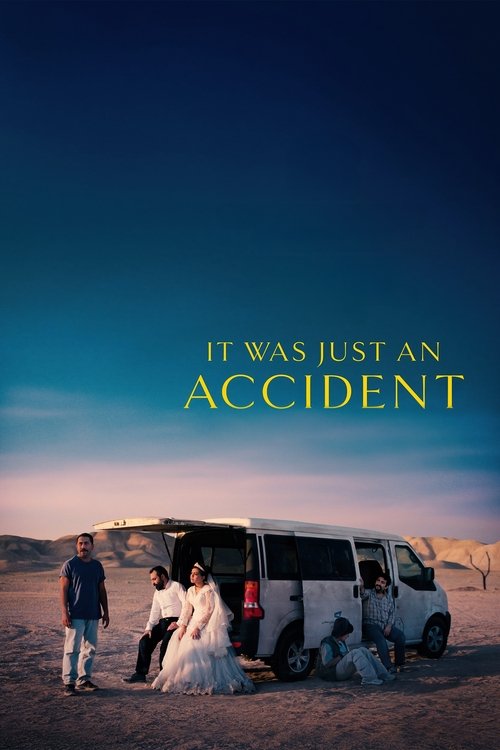
It Was Just an Accident
2025 · Jafar Panahi
Imprisoned by Iran in 2022, released after a hunger strike, then won the 2025 Palme d'Or with It Was Just an Accident — the era's definitive dissident-filmmaker story, complicated by discourse over France (not Iran) submitting his film to the Oscars. Naming him signals cinema-as-resistance.
For when you want a film to chew on for days — tense, urgent, and morally thorny. Choose it when you're up for a challenge that grips like a genre picture.
What it's about
A quiet mechanic in Iran crosses paths with a customer he becomes convinced is the interrogator who tortured him in prison — a man he knew only by sound and nickname. Acting on that conviction pulls him, and a circle of fellow former prisoners, into an impossible question: how sure do you have to be before you take justice into your own hands?
The experience
A moral thriller wound tight as a wire, laced with unexpected dark humor — every conversation raises the stakes, and the uncertainty at its center keeps you leaning forward the whole way. It's the kind of film you finish arguing with yourself.
The craft
Jafar Panahi shot it clandestinely in Iran, without a permit and with a skeleton crew, and the constraint becomes the style: stripped-down, immediate, built almost entirely from faces, voices, and hard choices. The screenplay's escalating dilemma is a masterclass in doing more with less.
Why it matters
Panahi's first film after his own imprisonment in Tehran, it won the Palme d'Or at Cannes in 2025 — a career-crowning act of defiance from a director long banned from filmmaking in his own country.
Snapshot
It Was Just an Accident (Persian: Yek tasadof-e sadeh; French release title Un simple accident) is Jafar Panahi's first feature made after his 2022 imprisonment in Tehran's Evin Prison, and the film with which the long-banned Iranian director won the Palme d'Or at the 78th Cannes Film Festival in May 2025. Working again without a permit and with a skeleton crew, Panahi distils a moral thriller from autobiographical material: a mechanic, Vahid, becomes convinced that a one-legged customer is "Peg-Leg," the interrogator who tortured him in prison, and abducts him. Unsure whether he has seized the right man, Vahid recruits other former detainees to confirm the identity and to decide the captive's fate. The premise—a closed circle of survivors holding a possible torturer, forced to weigh certainty against vengeance—lets Panahi stage a national reckoning in miniature while sustaining genuine suspense. The film extends his late, clandestine mode (Taxi, 3 Faces, No Bears) but pushes it toward something harder and more openly political, and it has been received as a culmination of that arc: near-unanimous critical acclaim, a French-submitted run to the Academy Awards, and a Palme that doubled as an act of solidarity with a filmmaker the Iranian state had repeatedly silenced.
Industry & production
The film is an Iran–France–Luxembourg co-production, produced by Panahi himself with Philippe Martin's Paris-based Les Films Pelléas—the same outfit behind Justine Triet's Palme d'Or winner Anatomy of a Fall—and co-produced by Bidibul Productions (Luxembourg) and Pio & Co (France). That European financing-and-post structure is now standard for major Iranian art cinema made outside the official system: the picture could be shot in Iran only covertly, then finished safely abroad, with post-production completed in France.
Production was, by necessity, guerrilla filmmaking. Panahi shot without a state filming permit, in defiance of the restrictions that have shadowed his career since his 2010 sentencing. Accounts from the production describe a crew pared to the minimum, shooting in quiet areas east of Tehran on weekdays to attract as little notice as possible, using battery-powered, portable equipment that allowed rapid relocation. The cinematographer has said the camera team was effectively three people. The film's existence is inseparable from its maker's circumstances: Panahi was arrested in July 2022 after inquiring about the detention of fellow director Mohammad Rasoulof, held in Evin, undertook a hunger strike, and was released on bail in early 2023; the script grew directly out of stories he heard from fellow prisoners. After its Cannes premiere on 20 May 2025 and Palme win, the film opened in France on 1 October 2025 and in the United States, via Neon, on 15 October 2025, going on to report roughly $10.5 million in box office—substantial for a subtitled, austere political drama.
Technology
The shoot's technology choices were dictated by the need for invisibility. The body of the film was captured on a RED Komodo with Samyang lenses, chosen for a compact footprint that let the crew remain unobtrusive on Tehran streets; the opening sequence alone was shot on an ARRI Alexa Mini with Zeiss Ultra Primes. Lighting was deliberately minimal and self-contained—a single small kit built around Astera Helios wireless LED tubes, run off batteries so the unit could move at a moment's notice. The celebrated interrogation passage inside a car is lit almost entirely by the vehicle's red taillights, supplemented by the Astera tubes, with conventional fill rejected outright. This is a case where the constraints of clandestine production and the aesthetic are one and the same: the digital, near-documentary toolkit is not a stylistic affectation but the precondition of the film getting made at all.
Technique
Cinematography
Amin Jafari, who also shot No Bears, photographs the film with a restrained, observational eye that erupts, at key moments, into long unbroken takes. The set-piece is a roughly ten-minute static take of the captive interrogated inside a car, the camera fixed at the subject's eye level, the frame adjusting only slightly when another character enters. Jafari's stated reasoning is that any cut or lens change would have "broken the emotional flow" for actors and audience alike—the duration is the point, trapping the viewer in the same unresolved scrutiny as the characters. The taillight-red illumination of that scene reads as fear and anger made visible without ever announcing itself as designed light. Elsewhere the handheld, available-light grammar keeps the film in the present tense of its locations.
Editing
Amir Etminan's cutting honors the long-take strategy by getting out of its way: the film alternates between sustained, unbroken duration in its confrontations and a brisker découpage in its road-movie connective tissue, as Vahid drives from one former prisoner to the next. The structure is essentially accretive—each new witness adds testimony, doubt, and a competing moral position—so the editing's job is to manage escalating uncertainty rather than to generate kinetic tension. (Etminan has spoken publicly about completing the edit under extraordinary pressure, including police scrutiny, a circumstance that underscores how the post-production itself was an act of risk.)
Mise-en-scène / staging
Panahi stages the film around confinement and exposure. Much of the action unfolds in cars, a workshop, and roadside spaces—the same constrained, mobile arenas that have defined his post-ban cinema, where a vehicle becomes a confessional and a cell at once. Leila Naghdi's production design keeps the world plain and contemporary; there is no period or genre dressing to soften the realism. The central irony of the staging is moral rather than visual: the survivors, in order to judge their tormentor, must reconstruct the very apparatus of capture and interrogation they suffered, and Panahi blocks these scenes so that the captors keep slipping into the postures of jailers.
Sound
As is characteristic of Panahi's work, there is effectively no non-diegetic score; the soundtrack is built from ambient noise, traffic, voices, and—crucially—the squeak of the suspect's prosthetic leg. That recurring squeak is the film's most important sound motif: it is what triggers Vahid's recognition, the unstable "evidence" on which a man's life hangs, and the sound that returns in the final, ambiguous beat as the prosthetic approaches Vahid's home. Sound here does the work that doubt does in the script—an auditory sign that may or may not mean what the characters need it to mean.
Performance
Panahi draws taut, naturalistic performances from a largely non-star ensemble: Vahid Mobasseri as the mechanic Vahid, Ebrahim Azizi as the captive Eghbal, Mariam Afshari as Shiva, Hadis Pakbaten as the young bride Goli, Mohamad Ali Elyasmehr as Hamid, and Majid Panahi as Ali. The acting register is deliberately undramatic—survivors who carry their trauma quietly until provoked—so that the eruptions of fury, grief, and moral panic land without theatricality. The captive's performance is calibrated to keep his guilt genuinely undecidable, which is the engine of the whole film.
Narrative & dramatic mode
The film's dramatic mode is the moral-dilemma thriller, structured as a road movie and a trial without a court. An inciting accident—the suspect's car striking a dog—brings him to Vahid's garage; recognition, abduction, and a gathering of witnesses follow. Panahi withholds certainty as a matter of design: the audience, like the characters, never receives proof that Eghbal is Peg-Leg, and the suspense derives less from "will they kill him" than from "can they ever know enough to be allowed to." Each former prisoner Vahid enlists embodies a different answer—vengeance, mercy, refusal, pragmatism—turning the narrative into a Socratic argument conducted under duress. The ending is pointedly unresolved, refusing the catharsis of either execution or exoneration and leaving the survivors (and the viewer) inside the unfinished business of justice.
Genre & cycle
Nominally a drama-thriller with crime and mystery elements, the film belongs more precisely to the cycle of clandestine Iranian dissident cinema that has formed around Panahi and Rasoulof over the past fifteen years—films made in defiance of bans, often confined to cars, apartments, and rural margins, that convert state repression into formal constraint. It sits in direct conversation with Rasoulof's torturer-and-conscience dramas (There Is No Evil, The Seed of the Sacred Fig) and shares DNA with the broader Iranian tradition of ethical-dilemma realism descending from Abbas Kiarostami and Asghar Farhadi, where ordinary people are made to adjudicate impossible questions. Within Panahi's own filmography it reads as the most explicitly political turn of his post-2010 cycle.
Authorship & method
Panahi wrote, directed, and produced the film, and as with all his recent work the authorial method is inseparable from his political situation. A protégé of Kiarostami—he assisted on Through the Olive Trees and made his Camera d'Or–winning debut The White Balloon (1995) from a Kiarostami script—Panahi spent the 2010s turning prohibition into a body of work: This Is Not a Film, Closed Curtain, the Berlin-winning Taxi (2015), 3 Faces, and the Venice-honored No Bears (2022). It Was Just an Accident is the first film he has made having actually served time again, and he has framed it as a transmission of what he heard inside. His key collaborators are continuity figures from this clandestine practice: cinematographer Amin Jafari (No Bears), editor Amir Etminan, and production designer Leila Naghdi. There is no credited composer of a conventional score, consistent with Panahi's career-long avoidance of non-diegetic music—an authorial signature in its own right.
Movement / national cinema
The film is a late descendant of the Iranian New Wave and its post-revolutionary inheritors—the lineage of Kiarostami, Mohsen Makhmalbaf, and Farhadi—now mutated into an explicitly oppositional, extra-legal cinema. It exemplifies a national cinema operating in two places at once: shot inside Iran by Iranians at real personal risk, financed and completed in Europe, and addressed simultaneously to a domestic audience that may only see it underground and to the international festival circuit. As such it stands as a leading instance of what might be called Iran's "prohibition cinema," in which the conditions of censorship and surveillance are absorbed into both subject and form.
Era / period
It Was Just an Accident is unmistakably a film of the early-to-mid 2020s in Iran—made in the shadow of the 2022–23 "Woman, Life, Freedom" uprising and its violent suppression, the wave of arrests that swept up filmmakers including Panahi and Rasoulof, and a hardening international stance toward the Iranian state. Its preoccupations with custodial torture, forced confession, and the moral aftermath of imprisonment are the direct cultural sediment of that moment. Technologically and industrially it reflects the present condition of independent Iranian filmmaking: small digital cameras, mobile crews, and European co-production as the only viable route to completion and exhibition.
Themes
The film's central theme is the problem of justice without certainty—whether vengeance can be just when the identity of the wrongdoer cannot be proven, and what it costs survivors to become, even briefly, the jailers and interrogators they once endured. From this flow its subsidiary concerns: the long half-life of state torture in private lives; complicity and recognition (the squeaking leg as a sign that demands interpretation); mercy versus retribution; and the corrosive effect of a regime that makes ordinary citizens into potential executioners of one another. Panahi resists allegorizing these into slogans; the moral weight stays lodged in concrete, individual choices, which is precisely what gives the film its gravity.
Reception, canon & influence
Reception was emphatic. The Palme d'Or at Cannes—where the film also took the ecumenical-style Prix de la Citoyenneté—was widely read as both an artistic award and a gesture of solidarity, and notices were overwhelmingly positive (the film registered near-perfect aggregate scores, around 98% on Rotten Tomatoes and 91 on Metacritic). It then became a notable awards-season presence: submitted by France, it earned Academy Award nominations for Best International Feature and Best Original Screenplay, drew historic Golden Globe recognition, and won at the Asia Pacific Screen Awards, the Gotham Awards, and the National Board of Review, with some end-of-decade lists already placing it among the strongest films of the 2020s.
The influences on the film run backward through Panahi's own clandestine cycle and, beyond it, to Kiarostami's car-bound ethical realism and the confession-and-conscience dramas of Iranian cinema; the autobiographical taproot is Panahi's own 2022–23 imprisonment and the testimony of fellow inmates. Its forward influence is, in 2025–26, too recent to assess with any confidence, and it would be irresponsible to claim a measurable legacy this soon. What can be said is that the film consolidates and validates a working model—covert production inside Iran, European finishing, festival premiere as both art and advocacy—that is likely to remain a template for dissident Iranian filmmakers, and that its Palme has further centered the moral thriller of state violence within world art cinema's idea of what the present demands.
A Deleuzian reading
The sound comes before the man.
The full Deleuzian reading of It Was Just an Accident →
Reception
It arrived already canonized: the 2025 Palme d'Or (from Juliette Binoche's jury) made it the year's consensus masterpiece, and it rode that wave through awards season as France's Oscar pick — landing International Feature and Original Screenplay nominations before losing the former to fellow Cannes darling Sentimental Value.
How It Was Just an Accident was received, from release to now →
How to watch It Was Just an Accident: what to notice on a first viewing
- Listen for the squeak of the prosthetic leg. A mechanical squeak crossing the garage floor is what makes Vahid go still in the film's opening scene. The same sound recurs throughout, always carrying the same unresolved question. The film gives you one unreliable clue and asks you to live inside the same doubt Vahid does.
- Notice there is no music telling you how to feel. Panahi uses no score anywhere in the film. What you hear is traffic, voices, and ambient noise, never a cue steering your emotions toward one reading of a scene. Without music you are left to judge every scene on your own, the same way the characters must.
- Watch for one scene held in a single unbroken shot. Jafari holds the camera fixed at eye level for a long interrogation inside a car, lit almost entirely by the red glow of the taillights, refusing to cut away. The unbroken shot traps you in the same uncertainty the people in the car are stuck in.
- Track how much of the film happens inside cars. Nearly every conversation happens in a car, a workshop, or by the roadside. The same enclosed spaces keep serving as both a place to talk and a place to be trapped. The film's confinement is not symbolic dressing. It is literally where all of this has to happen.
- Watch how calm and undramatic every performance stays. The cast plays fury, grief, and suspicion quietly, without theatrical outburst, so that when someone finally raises their voice it lands as a real rupture rather than a cue. The restraint keeps you guessing, because nobody's face gives you an easy answer about who is telling the truth.
The whole guide to watching It Was Just an Accident, with the keys for a rewatch →
Influences: the films it descends from and the films it influenced
- Through the Olive Trees (1994) — Panahi served as assistant director here, absorbing Kiarostami's method of directing non-professionals to re-enact lived reality and letting a resolution hang unresolved in a long final take.
- Taste of Cherry (1997) — The car-bound ethical interrogation shot in available light, where a moral verdict is debated but never adjudicated and no score intrudes, is the template Panahi extends to a captor-captive dialogue.
- Close-Up (1990) — Establishes the Iranian device of real people playing themselves inside a justice-and-conscience frame, blurring trial and re-enactment so certainty about guilt is structurally withheld.
- The White Balloon (1995) — Panahi's debut from a Kiarostami script builds tension purely from real-time street naturalism, diegetic sound and a non-professional lead—the unscored realist grammar he never abandons.
- The Circle (2000) — Introduces Panahi's interlocking-fates moral architecture and staging of confinement (women hemmed by the state), with handheld available-light realism and no non-diegetic music.
- Crimson Gold (2003) — A Kiarostami-scripted moral thriller anchored by a non-professional lead whose grievance against injustice curdles into violence, prefiguring the revenge-versus-conscience engine here.
- No Bears (2022) — Shares cinematographer Amin Jafari and the same covert practice; its long-take available-light surveillance of a man caught between accusation and proof is the direct stylistic predecessor.
- Death and the Maiden (1994) — The confinement chamber drama of a survivor confronting a man she believes was her torturer, while his guilt remains formally unprovable, is the precise moral-thriller skeleton.
- The Son (2002) — A scoreless, handheld available-light study of a man face-to-face with the person who wronged him, sustaining agonized moral suspense through proximity rather than plot—the ethics-of-revenge craft Panahi inherits.
- This Is Not a Film (2011) — Originates the clandestine-production model—shot covertly under a filmmaking ban with diegetic-only sound—that this film consolidates into a repeatable dissident template.
- Taxi (2015) — Confines the entire drama to a single vehicle with non-professional passengers and no score, the staging-of-confinement technique Panahi carries into the abductors' van.
- 3 Faces (2018) — Extends the car-as-moral-chamber road structure and the deliberate withholding of certainty about an off-screen act, with rural available-light shooting.
- A Separation (2011) — The model moral-dilemma thriller of withheld certainty—an accusation hangs on facts the audience can never fully verify—shot in domestic available light without a score.
- About Elly (2009) — Builds an ensemble guilt-thriller in which the truth of an event is permanently obscured, the 'withheld-certainty' dramaturgy Panahi applies to the question of identity.
- The Salesman (2016) — Turns on a private confrontation with a suspected wrongdoer where vengeance collides with doubt and proof, the same justice-without-certainty climax staged in cramped real spaces.
- There Is No Evil (2020) — Covertly produced inside Iran with European finishing, it dramatizes ordinary people's complicity in state execution as a series of moral-choice scenarios with no score.
- The Seed of the Sacred Fig (2024) — Shares the exact working model—clandestine in-country shooting, European post, festival premiere as advocacy—and the Woman-Life-Freedom-era confrontation with state torture and its aftermath.
Similar films
- No Bears (2022) — influence & lineage
- The Seed of the Sacred Fig (2024) — influence & lineage
- Close-Up (1990) — influence & lineage
- A Separation (2011) — influence & lineage
- Goodbye Julia (2023) — same viewing thread
- Anatomy of a Fall (2023) — often watched together
- Titane (2021) — often watched together
- A Hero (2021) — shared sensibility
All the films related to It Was Just an Accident →
Watch it with: curated runs of related films
- Living With What Was Done — Watch these together for how differently a society answers harm — a room built for restorative justice, a survivor turning the camera on her attacker, a torture victim face-to-face with his interrogator — a run about testimony, guilt, and the slow labor of repair.