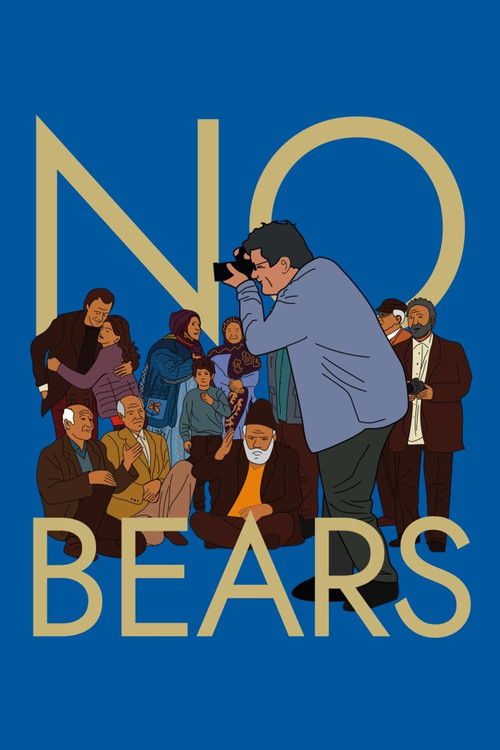
No Bears
2022 · Jafar Panahi
Imprisoned by Iran in 2022, released after a hunger strike, then won the 2025 Palme d'Or with It Was Just an Accident — the era's definitive dissident-filmmaker story, complicated by discourse over France (not Iran) submitting his film to the Oscars. Naming him signals cinema-as-resistance.
When you want a film to chew on for days — one that starts as a low-key character piece and turns into a moral vise. A thoughtful, challenging evening rather than an easy one.
What it's about
Jafar Panahi plays a version of himself: a director banned from leaving Iran, holed up in a tiny village near the Turkish border, remotely directing a film being shot on the other side over a failing internet connection. His film-within-the-film follows a real-life couple trying to obtain forged passports to reach Europe. Meanwhile, in the village, a photograph Panahi may or may not have taken entangles him in a local dispute over a young woman promised to one man and in love with another — and both stories tighten around him at once.
The experience
Quiet and deceptively gentle at first — wry village comedy, glitchy video calls — then steadily more suffocating as both plots close in. It leaves you unsettled and moved, thinking about the cost of an image long after it ends.
Performances
Panahi's own performance as 'himself' is the film's anchor — rumpled, courteous, evasive, and quietly anguished — a director acting out the very predicament he was living.
The craft
Made clandestinely in defiance of a state ban, the film turns its constraints into form: layered stories, cameras within cameras, and borders both literal and invented. The construction is intricate but never showy, and the ending lands with the precision of a trap snapping shut.
Why it matters
The fifth feature Panahi made illegally under his twenty-year filmmaking ban, released as he was imprisoned in Iran — an act of artistic defiance that made the film itself world news and a landmark of dissident cinema.
Snapshot
No Bears (Persian: Khers nist) is Jafar Panahi's fifth feature made under, and in defiance of, the twenty-year ban on filmmaking, travel, and public statements imposed by Iranian authorities in 2010. Running roughly 107 minutes, it braids two stories about the impossibility of crossing a line. In the first, Panahi plays a fictionalized version of himself: a director stuck in a remote village on the Iran–Turkey border, directing a film across the frontier by unreliable internet because he cannot legally leave the country. In the second — the film he is making — a real-life couple, played by exiled actress Mina Kavani and Bakhtiar Panjei, seek forged passports to escape to Europe. When Panahi is accused of having photographed a village woman with a man she was not promised to, the abstract questions of his craft (what an image can prove, whom it can condemn) collapse into a matter of life and death. Both narrative strands end in a death near a border. No Bears premiered in competition at the 79th Venice International Film Festival in September 2022, where it won the Special Jury Prize. Its reception was inseparable from a fact hanging over the screening: two months earlier, in July 2022, Panahi had been arrested and imprisoned in Iran, and he could not attend.
Industry & production
No Bears was produced through Panahi's own outfit, Jafar Panahi Film Productions — the same self-financed, small-crew model he has used since the state closed conventional channels to him. Its very existence is an act of industrial improvisation: a filmmaker legally forbidden to make films continuing to make them, shot quietly and outside the sanctioned system of the Farabi Cinema Foundation and Ministry of Culture and Islamic Guidance permits that govern authorized Iranian production. International sales were handled by Celluloid Dreams, the Paris-based company long associated with Iranian art cinema and with Panahi's work abroad. The film reached festivals and specialty distributors through that route rather than through any domestic Iranian release, which was never a possibility.
The border setting is not incidental to the production's logic; it dramatizes the exact constraint under which the film was made. Panahi's ban forbids leaving Iran, so the fiction of a director tethered to one side of a frontier, "directing" a shoot he can only watch on a laptop, is a literal transcription of his working conditions. The bleeding of production reality into subject is the film's organizing principle. The most sobering piece of industry context is external to the film text: Panahi was detained on 11 July 2022 after going to a courthouse to inquire about the arrests of fellow filmmakers Mohammad Rasoulof and Mostafa Aleahmad, and was made to begin serving the six-year sentence originally handed down in 2010. He remained imprisoned during the Venice premiere and awards, and was released in February 2023 after a hunger strike, following a ruling by Iran's Supreme Court.
Technology
Technologically the film is deliberately austere, and it makes that austerity a subject. The most conspicuous "technology" on screen is the ordinary apparatus of remote work and amateur image capture: laptops, video-call windows, patchy Wi-Fi that a local fixer chases across the village, and the smartphone camera. Panahi's character is repeatedly shown trying to direct actors in another country through a stuttering connection — the tools of contemporary transnational filmmaking rendered as sources of impotence rather than reach. The other pivotal technology is the still camera and the phone photograph: the entire village crisis turns on whether a particular image exists and what it depicts. In this sense the film belongs to Panahi's long-running engagement with lightweight, accessible recording tools — the dashboard-mounted and handheld cameras of Taxi (2015), the phones of 3 Faces (2018) — used not for spectacle but because they are what a banned filmmaker can actually deploy without a permit or a visible crew. The digital, unglamorous image is both his practical means and his thematic material.
Technique
Cinematography
The cinematography is credited to Amin Jafari, who had shot Panahi's 3 Faces (2018). The look is naturalistic and unforced, favoring available light, earth-toned village exteriors, and a documentary plainness that suits the film's docufiction premise. Jafari and Panahi rely heavily on the long take and on compositions that place the camera at a slight remove, watching negotiations and confrontations play out in real duration rather than cutting into them. The two worlds are subtly distinguished: the village material has the dusty, sun-flattened texture of a real place observed, while the Turkey-set film-within-the-film carries a marginally more composed, "cinematic" register appropriate to its status as a production. The recurring motif of the frontier — the invisible line that villagers point to across scrubland — is rendered without dramatic emphasis, a nondescript terrain whose lethal significance is entirely conferred by human belief.
Editing
The film's construction depends on cross-cutting between the two narratives so that thematic rhymes accumulate: an image disputed in the village, an image being manufactured in the film shoot; a couple hoping to cross, a couple forbidden to. The editing favors patience over propulsion, holding shots long enough for social pressure to build and for the viewer to register what is not being said. Detailed, verifiable English-language crediting for the editor of No Bears is thin, and rather than attribute the role speculatively I note that Panahi's ban-era films have frequently kept post-production within his own tight circle; the specific editing credit is not something I can state with confidence from the established record.
Mise-en-scène / staging
Staging is where Panahi's method is most visible. He works with real locations, largely nonprofessional or lightly professional performers, and situations that hover between documentary and script. In the village scenes, the mise-en-scène is dominated by thresholds: doorways, courtyards, the room where Panahi is lodged, the communal spaces where elders convene to demand the photograph and to extract an oath. Bodies are arranged around Panahi to convey encirclement — the affable hospitality of the village slowly revealing itself as a coercive apparatus. The border landscape is staged as deceptively open and empty, its danger purely notional until it is suddenly, fatally real. The title scene crystallizes the approach: a villager guides Panahi at night along a path, warning of bears, and later a character explains there are no bears — the fear is invented to keep people from straying. The staging makes the point physically before the dialogue makes it verbally.
Sound
Sound is handled with the same restraint as image. No Bears, in keeping with Panahi's practice and the broader ascetic tradition of post-revolutionary Iranian art cinema, largely eschews a non-diegetic score; there is no lush musical underlining of emotion. The soundtrack is built from ambient village life, wind and open air, overlapping voices in negotiation, and the degraded audio of video calls. This documentary soundscape reinforces the film's claim to be watching something real, and it lets the silences in confrontations do dramatic work. When sound from the film-within-the-film intrudes, the contrast between "recorded" performance and "live" reality becomes part of the meaning.
Performance
Performance in No Bears is doubled and self-aware by design. Panahi plays "Jafar Panahi," a version of himself whose politeness, curiosity, and evasions the film gently interrogates; he is not a heroic dissident but a compromised observer whose presence disturbs the community and whose good intentions produce harm. His performance is understated to the point of near-passivity, which is precisely the ethical question the film raises. Mina Kavani, an Iranian actress living in exile in France, brings a raw, wounded force to Zara, the woman refusing to leave without her partner; her real condition of exile lends the role documentary weight. Bakhtiar Panjei plays her counterpart, and the surrounding village figures are performed with a lived-in plainness that keeps the audience uncertain where fact ends and staging begins.
Narrative & dramatic mode
The dominant mode is reflexive docufiction — Panahi's signature register, in which the boundary between filming reality and staging fiction is deliberately porous. The film runs two plots in parallel and lets them comment on each other rather than converge mechanically. Dramatically it operates by slow constriction: what begins as anecdote (a photograph that may or may not exist, a shoot with connectivity problems) tightens into tragedy. Panahi withholds spectacle and catharsis; the crucial violent events happen at or near the border and are largely kept off-screen or delivered as aftermath, so the drama lives in negotiation, obligation, and complicity rather than in incident. The film is structured as a moral trap that closes on its protagonist and, by extension, on the audience's assumptions about the innocence of images and the innocence of the artist who makes them.
Genre & cycle
Nominally classified as drama and romance, No Bears sits within a specific cycle: Panahi's clandestine, post-2010 films made in open violation of his ban — This Is Not a Film (2011), Closed Curtain (2013), Taxi (2015), and 3 Faces (2018). Each interrogates the act of filmmaking under prohibition, and No Bears is the fullest and most despairing statement of that series. It also belongs to a broader lineage of self-reflexive, film-about-filmmaking cinema and to the Iranian tradition of docufiction. The "romance" label attaches to the two thwarted couples — the film's actors and the village lovers — but both romances are studies in the impossibility of union under the twin pressures of the state and of custom, making the genre tag almost ironic.
Authorship & method
No Bears is emphatically a single-author work: Panahi wrote, directed, produced, and stars in it, in the mode of total authorship forced on him by circumstance. His method — small crews, real locations, hybrid casting, playing himself, and folding the conditions of production into the story — descends directly from his mentor Abbas Kiarostami, whom Panahi assisted (notably on Through the Olive Trees) and whose Close-Up and Koker films pioneered this blurring of documentary and fiction and this fascination with cinema examining itself. Among key collaborators, cinematographer Amin Jafari provides continuity with 3 Faces. On music, the film follows Panahi's characteristic avoidance of composed score, so there is no significant composer credit to foreground. The screenplay is Panahi's own, and the writing's great sophistication is architectural — the way the two plots are built to rhyme. Where technical credits below the line are concerned, I flag again that English-language documentation is sparse, and I decline to attribute roles I cannot verify.
Movement / national cinema
The film is a late, embattled outgrowth of the Iranian New Wave and its post-revolutionary continuation — the movement associated with Kiarostami, Mohsen Makhmalbaf, Asghar Farhadi, and Panahi himself, internationally celebrated for humanist realism, child protagonists, ethical ambiguity, and formal ingenuity worked around censorship. Panahi belongs to the generation that inherited Kiarostami's aesthetic and radicalized its politics. No Bears also speaks to a parallel condition in contemporary Iranian cinema: the split between filmmakers working inside the permitted system and those, like Panahi and Rasoulof, working outside and against it, often at the cost of their freedom. The film's border setting literalizes the national cinema's central predicament — artists pressed against a frontier they cannot cross, whether physical, legal, or ideological.
Era / period
No Bears is a document of the early 2020s in Iran, and its resonance deepened almost immediately after release. It reached Venice in September 2022, the same month the death in custody of Mahsa Amini ignited the "Woman, Life, Freedom" uprising, and it arrived with its own director behind bars. The film thus reads as a work of and about a specific moment of state repression and civic defiance, even though it was conceived and shot before those events. Its concerns — surveillance, the manufacture of fear, borders as instruments of control, the collision of state power with entrenched tradition — belong squarely to this period, and its imprisoned author became, briefly, an emblem of it.
Themes
The film's governing metaphor is announced by its title. There are no bears — the danger is invented to keep people from crossing the line, from questioning, from leaving. Fear itself is the mechanism of control, whether wielded by the state, by superstition, or by custom. From this spring the film's linked concerns: the border as a lethal fiction; the power and peril of images, since a single disputed photograph can determine whether people live or die, and the artist who makes images is therefore never innocent; the complicity of the observer, as Panahi's benevolent, curious presence brings ruin to a community; exile and the longing to escape, embodied in two couples who both fail; and the clash between individual desire and collective obligation, both the state's and the village's. Underlying all of it is a self-interrogation of cinema — a filmmaker asking what his art costs the people it touches, and whether the eye behind the camera can ever be blameless.
Reception, canon & influence
Critically, No Bears was widely and warmly received on the festival circuit and in the specialty press, praised as one of Panahi's strongest and most self-critical films and frequently read through the tragic frame of his imprisonment; the Venice Special Jury Prize confirmed its standing. Reviewers singled out its formal doubling, its unsparing view of the director's own complicity, and the prophetic force of its themes given the timing of the Iranian uprising. Its influences flow backward from Kiarostami's self-reflexive cinema — the Close-Up strategy of collapsing documentary and fiction — and from Panahi's own ban-era cycle, of which it is the culmination. Looking forward, its legacy is still forming, but it has already entered the canon of films-about-filmmaking-under-repression and stands as a key reference point in debates about artistic resistance, alongside the parallel career of Mohammad Rasoulof. Its most concrete "influence," in a sense outside the frame, was on Panahi's own trajectory: the film's international prominence helped keep global attention on his case, and following his 2023 release he returned to filmmaking — a continuation the film itself seems to have anticipated in its portrait of an artist who will not stop, whatever the line he is told not to cross.
Reception
Acclaimed from the moment it premiered, but its reception was inseparable from real life: Panahi was in Evin prison when it debuted at Venice, and the film has only grown in stature as the capstone of his banned-from-filmmaking era.
How No Bears was received, from release to now →
How to watch No Bears: what to notice on a first viewing
- Watch how often the camera holds still at a slight distance. Jafari and Panahi favor the long take from a slight remove, letting negotiations and confrontations play out in real duration rather than cutting into them. The distance keeps you watching like a witness, never quite inside the room.
- Listen for the video call audio breaking up and stuttering. Panahi's scenes directing the Turkey shoot run through a failing internet connection, so his voice and the actors' keep dropping out mid-sentence. The failing connection makes his exile physical: he can direct the film but never actually reach it.
- Notice who surrounds Panahi when the village elders talk to him. Bodies are arranged around him in the communal spaces, turning a hospitable gathering into something closer to encirclement. Panahi stages welcome and pressure as the same physical shape.
- Watch the empty scrubland the villagers point to as a border. The frontier has no fence and no marker, nothing to distinguish it from any other stretch of ground, yet everyone treats crossing it as lethal. Its danger is entirely a matter of what people believe, not anything the land itself shows you.
- Notice there is no music telling you how to feel. The soundtrack is built from wind, overlapping talk, and ambient village noise, with no score laid over any scene. Without music to cue emotion, the negotiations and silences have to carry the tension on their own.
The whole guide to watching No Bears, with the keys for a rewatch →
Influences: the films it descends from and the films it influenced
- Close-Up (1990) — The foundational move No Bears inherits: staging a real legal/social situation with its actual participants playing themselves, so that documentary re-enactment and fiction become indistinguishable within a single ethical case study.
- Through the Olive Trees (1994) — Panahi assisted on this film, absorbing its meta-structure of a director-figure directing non-actors on a real location, plus the long-take rural framing and the running gag of a filmmaker's authority meeting village reality that No Bears redeploys directly.
- Life, and Nothing More… (1992) — The template of a filmmaker driving into a rural community and probing it with a camera, using the car and the road as a mobile threshold between the director's world and the villagers', which No Bears rewrites at the Turkey–Iran border.
- The Wind Will Carry Us (1999) — Its portrait of an outsider media-maker whose extractive gaze quietly harms a village supplies No Bears' central self-critique of the ethics of the image, along with the withholding of off-screen events the protagonist cannot control.
- The Mirror (1997) — Panahi's own earliest rupture of the frame, where the child actor abruptly quits and the crew keeps filming, establishing the reflexive break between fiction and its making that culminates in No Bears' folding of production conditions into plot.
- This Is Not a Film (2011) — The opening of Panahi's ban-era cycle: total single-authorship under house arrest, self-portrayal as the banned director, and the smartphone/handheld video aesthetic that No Bears extends to full narrative scale.
- Closed Curtain (2013) — Its device of Panahi appearing as himself inside a fiction that dissolves into the reality of his confinement is the direct structural precursor to No Bears' merging of the director-character with his actual situation.
- Taxi (2015) — The ban-era method of shooting himself as protagonist within tight real constraints, using a single low-profile camera and non-professional interlocutors to smuggle a portrait of a whole society, which No Bears expands into two parallel locations.
- The White Balloon (1995) — Establishes Panahi's real-time, real-location, non-professional-cast realism and his architectural plotting of small events into escalating stakes, the storytelling craft later doubled across two rhyming plots in No Bears.
- The Circle (2000) — Introduces Panahi's cross-cutting relay structure, where the narrative baton passes between characters to indict a whole system of control — the structural DNA behind No Bears' interleaving of the village and the film-within-a-film.
- Hit the Road (2021) — The father's later work converges with the son's — border-crossing and exile rendered through structured concealment and the filmmaker's own constrained position — a two-way dialogue Hit the Road helped catalyze.
- The Seed of the Sacred Fig (2024) — Shot clandestinely and smuggled out under repression, it inherits No Bears' fusion of real political footage and fiction and its use of the filmmaker's own persecuted circumstance as the film's engine and stakes.
- It Was Just an Accident (2025) — Panahi's post-release film that carries forward No Bears' minimalist real-location staging, no-score diegetic soundscape, and ethical-thriller interrogation of complicity, confirming the 'artist who will not stop' the earlier film anticipated.
- 3 Faces (2018) — Shares cinematographer Amin Jafari and the exact setup — Panahi as a director driving to a remote village whose customs and superstitions trap him — plus the long-take, available-light rural framing that No Bears reprises almost as a diptych.
- There Is No Evil (2020) — Made under the same Iranian filmmaking ban, it pursues the parallel strategy of anthology-like rhyming stories about complicity and refusal shot clandestinely in real locations, the exact 'artistic resistance' craft No Bears is debated alongside.
- A Moment of Innocence (1996) — An Iranian New Wave landmark of reflexive docufiction in which the director restages a real event with its actual participants, sharing No Bears' method of interrogating authorship and the reliability of the recorded image.
- Holy Motors (2012) — A different tradition arriving at the same reflexive question — the burden of performing the self for the camera — via a director-surrogate moving between staged scenes, a Western counterpart to No Bears' meditation on the ethics of being filmed.
Similar films
- The Mirror (1997) — influence & lineage · same viewing thread
- Life, and Nothing More… (1992) — influence & lineage · same viewing thread
- Close-Up (1990) — influence & lineage · same viewing thread
- It Was Just an Accident (2025) — influence & lineage
- The Seed of the Sacred Fig (2024) — influence & lineage
- The Wind Will Carry Us (1999) — influence & lineage · same viewing thread
- A Moment of Innocence (1997) — same viewing thread
- Through the Olive Trees (1995) — same viewing thread
All the films related to No Bears →
Watch it with: curated runs of related films
- Where Fiction Meets the Real — Watch these in sequence for the way each lets a staged fiction quietly dissolve into something documentary-real — and the real get restaged as fiction — usually while someone is on a road or a walk.