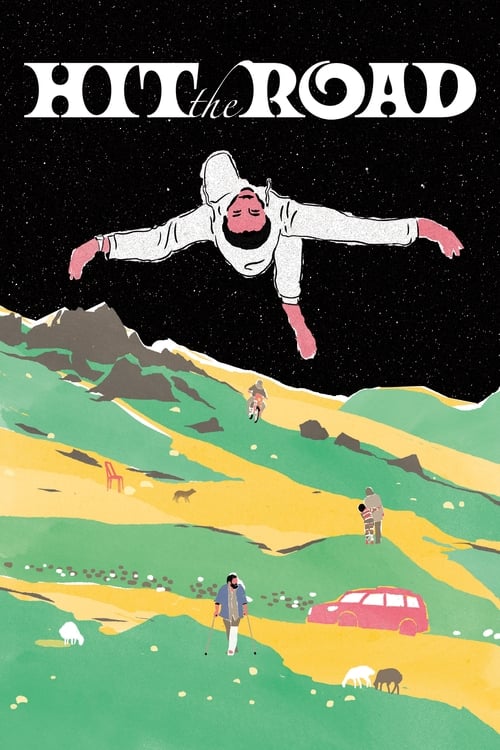
Hit the Road
2021 · Panah Panahi
When you want a film that makes you laugh and then breaks your heart — something warm, human, and worth chewing on for days. Comforting on the surface, quietly wrenching underneath.
What it's about
A family of four — plus a sick dog — crams into a borrowed SUV and drives across Iran's rugged northwest. Dad rides in back with a leg in a cast, Mom laughs to keep from crying, and the youngest son turns the car into a one-boy karaoke stage; only the adult older brother, at the wheel, stays quiet. Where they're going and why is never announced, but the closer they get, the heavier the air in the car becomes.
The experience
Riotously funny and quietly devastating, often in the same minute — the film keeps you giggling at family bickering while a sadness gathers underneath that it never explains and doesn't need to. By the end the laughter and the grief are inseparable.
Performances
The whole family ensemble is remarkable, but the young boy playing the youngest son is a force of nature — motormouthed, unfiltered, and completely unselfconscious — while the parents do heartbreaking work in the pauses between jokes.
The craft
Panah Panahi's debut is astonishingly assured: nearly the whole film unfolds in and around one car, yet it never feels cramped, thanks to patient long takes, precise framing, and a soundtrack of Iranian pop songs the family belts along to. The vast mountain landscapes are used sparingly and to overwhelming effect — one late wide shot is worth the whole trip.
Why it matters
One of the most acclaimed debuts of the 2020s and proof of a startling new voice in Iranian cinema, it premiered at Cannes and instantly marked Panahi — son of director Jafar Panahi — as a filmmaker in his own right.
Snapshot
Hit the Road (Persian: Jaddeh Khaki, literally "Dirt Road") is the debut feature of Panah Panahi, and among the most assured first films to emerge from Iranian cinema in the 2020s. On its surface it is a comedy of confinement: four people and a sick dog crammed into a borrowed SUV, bickering their way across a mountainous northwestern landscape. Beneath that surface it is a muted tragedy about separation, in which a family drives their elder son toward a border he must cross alone, illegally, likely never to return. Panahi never states this plot outright — the destination and its stakes are withheld and only gradually inferred — and that structural reticence is the film's defining artistic gamble. Premiering in the Directors' Fortnight (Quinzaine des Réalisateurs) at the 2021 Cannes Film Festival, it drew immediate attention both for its own achievement and for the surname attached to it: Panah is the son of Jafar Panahi, and the grandson-in-spirit of the Kiarostami road-movie tradition that the film knowingly extends. It is at once a family portrait, a national allegory, and a work of formal inheritance.
Industry & production
The film was produced within Iran's independent art-cinema sector, the same constrained, festival-facing ecosystem that has sustained figures from Abbas Kiarostami to Asghar Farhadi to Jafar Panahi. It is an Iranian–French co-production; French financing and post-production support are a common survival mechanism for Iranian auteur films seeking international distribution, and Hit the Road followed that established route. Jafar Panahi is credited as a producer, alongside collaborators including Mastaneh Mohajer; the elder Panahi's involvement is significant not only financially but as institutional cover and mentorship for a first-time director working in a system where filmmaking permissions are politically fraught. Beyond these production credits, the granular financial record — exact budget, and box-office grosses — is not something I can state with confidence, and I will not invent figures. What can be said reliably is that the film was made on the modest scale typical of the sector: a small cast, a single principal vehicle, largely exterior locations, and a compact crew.
Internationally, the film was picked up for distribution by boutique arthouse distributors — Kino Lorber handled the United States release and Picturehouse the United Kingdom — and it circulated through the festival circuit for roughly a year after Cannes before reaching theatrical and streaming audiences in 2022. Its commercial life was that of a critically championed specialty title rather than a wide release.
Technology
Hit the Road was shot digitally, consistent with the standard practice of contemporary low-budget Iranian production, where digital capture removes the cost and permitting friction of film stock. The technological signature of the film is not in exotic equipment but in disciplined restraint. Much of the drama unfolds inside a moving car, and Panahi and his cinematographer favor locked-off or minimally mobile framings over the elaborate rigs that Hollywood uses to shoot vehicle interiors — a choice that recalls Kiarostami's carbound films (Taste of Cherry, Ten), where the automobile becomes a mobile theater and a fixed camera position turns the windshield and windows into a proscenium. The film also deploys, sparingly, one conspicuous piece of stylization: a near-fantastical sequence in which a character appears to drift among stars, a visual-effects flourish that departs sharply from the surrounding naturalism. I'd flag that the specific technical means of that shot are not something I can document precisely; what matters critically is its deliberate rupture of register. Otherwise the technology serves invisibility: available light where possible, real landscape, real weather.
Technique
Cinematography
The cinematography is by Amin Jafari, and it is the film's most immediately striking craft element. Jafari works in long, patient takes and in wide compositions that hold the whole family in frame, allowing performance and blocking to carry scenes rather than editorial emphasis. The most discussed image in the film is a sustained static long shot of a grassy hillside, held at a great distance, across which the drama of the son's departure plays out in miniature — a refusal of close-up at the very moment a conventional film would cut in for tears. The car interiors are composed with the passengers stacked in depth, faces caught in mirrors and through glass, so that the vehicle's cramped geometry becomes a compositional resource. Landscape is handled with a painter's eye: the arid, folded terrain of the drive is both beautiful and indifferent, a vastness that dwarfs the human cargo.
Editing
Panah Panahi is credited as an editor of the film (working with collaborators; I won't assert the full editorial credit list beyond his own involvement, as I'm not certain of it). The editing philosophy is one of withholding. Cuts are relatively infrequent within scenes; the film trusts duration. This slow rhythm does real narrative work — it forces the audience to sit inside the family's evasions and jokes long enough to feel the dread underneath, and it makes the withheld information (where are they going, and why) accumulate as a felt absence rather than a delivered fact.
Mise-en-scène / staging
The staging is virtuosic given the spatial constraint. Panahi choreographs four actors and a dog within a car so that comic business, tender gestures, and simmering grief occupy the same frame simultaneously — the youngest child careening off the seats, the father's plastered leg wedged awkwardly across the cabin, the mother's composure cracking at the window, the elder son's silence in the driver's seat. The father's broken leg is a superb staging device: it immobilizes the family patriarch, makes him a passenger in every sense, and generates both slapstick and pathos. Outside the car, staging opens into landscape and the human figures shrink accordingly, a deliberate scalar contrast between the intimacy of the interior and the enormity of what the family is driving toward.
Sound
Sound is central to the film's emotional strategy. Music is largely diegetic — the family sings along to Iranian pop songs on the car stereo, and these sing-along sequences are the film's beating heart, expressions of love performed as karaoke because the direct expression of grief is unbearable. The interplay of pop nostalgia and impending loss gives the songs an almost unendurable poignancy. Panahi also uses sound to manage the withheld plot: crucial information is spoken quietly, half-heard, or deliberately drowned, so the audience assembles the truth from fragments. I'll refrain from attributing specific song titles and performers, as I can't verify the exact soundtrack listing, but the reliance on beloved Persian popular music — much of it carrying its own layered associations for Iranian audiences — is well established.
Performance
The performances are extraordinary and tonally exact. Hassan Madjooni, as the father, plays gruff deflection — sarcasm, complaint, mock-grandiosity — as a shield over grief, and the performance's power lies in the moments the shield slips. Pantea Panahiha, as the mother, carries the film's suppressed weeping; the TMDB synopsis's phrase about a mother who "tries to laugh when she's not holding back tears" is precisely her register. The revelation is Rayan Sarlak as the youngest child, whose exhausting, hilarious, uncontainable energy — the car karaoke, the constant chatter — is both authentic child-behavior and a structural device: his obliviousness is the family's protective fiction, the noise that keeps everyone from naming the loss. Amin Simiar's elder brother is defined by his quiet, the still point around whom the others perform.
Narrative & dramatic mode
The dominant mode is tragicomedy built on dramatic irony and structured concealment. The film withholds its premise — that this is a one-way delivery of the elder son to smugglers or an illegal border crossing — and lets the viewer intuit it. This is a narrative of the unsaid: the family's frantic joking is legible as displacement, a communal refusal to speak the thing they are all thinking. The structure is the classic road-movie chain of episodes, but its true engine is emotional rather than incident-based; each stop, each song, each argument brings the departure closer. The tonal management — pivoting from broad comedy to devastation, sometimes within a single shot — is the film's chief dramatic accomplishment.
Genre & cycle
On the genre map, Hit the Road sits at the intersection of the family comedy-drama and the road movie, inflected by the specific tradition of the Iranian carbound film. It belongs to a recognizable cycle of Iranian cinema in which journeys by automobile become vehicles (literally and figuratively) for social observation and philosophical inquiry — a lineage running through Kiarostami's Taste of Cherry (1997) and Ten (2002), and Jafar Panahi's own Taxi (2015). Within that cycle, Panah Panahi's contribution is to turn the form inward, from the essayistic/social toward the intimate and familial, while retaining the political undertow of departure and exile.
Authorship & method
The authorship story is unusually charged. Panah Panahi wrote, directed, and co-edited the film; it is a thoroughgoing auteur debut. He came to it having assisted on his father Jafar Panahi's productions, and the film is legible both as homage to and departure from that patrimony — a first feature about a son leaving his family that was made by a son working in his father's shadow and with his father's support. Among key collaborators, cinematographer Amin Jafari is the most decisive creative partner, responsible for the wide-take aesthetic that defines the film's look. On the music: the film's expressive core is its use of pre-existing Persian popular songs rather than an original orchestral score, so "composer" is not quite the right frame — the sensibility is that of curated, culturally loaded needle-drops. I want to be candid that beyond Panahi and Jafari, I cannot reliably enumerate the full department heads (editor, sound designer) by name, and I won't guess.
Movement / national cinema
The film is a direct heir of Iranian art cinema — the tradition internationally associated with Kiarostami, Mohsen Makhmalaf and his family, Asghar Farhadi, and Jafar Panahi. That movement is characterized by naturalistic performance (often with nonprofessional or lightly professional actors), long takes, an ethics of observation, use of children as narrative and moral lenses, and the practice of encoding political meaning obliquely to survive censorship. Hit the Road carries every one of these markers. The oblique treatment of the border crossing — never named, only felt — is precisely the strategy of indirection that Iranian filmmakers have long used to speak about emigration, dissent, and the pressure to leave, without stating it in terms that would invite official trouble.
Era / period
The film arrives in the early 2020s, a period of acute strain for Iranian cinema: filmmakers under travel bans and prosecution (Jafar Panahi himself was imprisoned in 2022, after this film's release), a wave of talent departing the country, and mounting censorship pressure. Hit the Road's theme — a family delivering a son into exile — reads inescapably against this backdrop of a generation confronting whether to stay or go. It also belongs to the specific festival era in which Iranian debut features are launched abroad first, at Cannes or Berlin, and only circle back to domestic and international audiences later. The film is very much a document of its moment, even as it refuses topical explicitness.
Themes
The governing theme is separation and the impossibility of speaking it — love expressed through its own displacement into jokes, songs, and squabbles. Around this cluster several others: family as a self-protecting fiction, in which each member plays an assigned role to shield the others; the child as both comic relief and unwitting emotional truth-teller; mortality and loss (the dying dog, the father's incapacitation, the "death" of the family unit as it currently exists); and, structurally, exile and departure as the unnamed engine of Iranian life in this period. There is also a persistent theme of confinement versus vastness — the tiny mobile prison of the car set against an immense, indifferent landscape — that gives the film its metaphysical dimension, most explicit in the star-drifting fantasy sequence where grief tips briefly into the cosmic.
Reception, canon & influence
Critically, Hit the Road was received as a major debut and one of the strongest Iranian films of its year, widely praised for its tonal control, its performances (Sarlak's in particular), and Panahi's evident command of the medium. It featured prominently on international critics' year-end lists and consolidated Panah Panahi's reputation as a filmmaker to watch. I'll note honestly that I can't recite specific awards tallies, individual critics' quotations, or precise aggregate scores with confidence, and I won't fabricate them; the securely established fact is that the reception was strongly positive across the major festival and critical press.
Looking backward, the influences on the film are legible and acknowledged: Abbas Kiarostami's carbound cinema and landscape sensibility; the humanist tradition of Iranian family drama; and, most personally, Jafar Panahi's own work and mentorship. One can also detect the broader road-movie genre's DNA and, in the fantastical interlude, a gesture toward a more lyrical, even Kubrickian register that steps outside the naturalist frame.
Looking forward, the film's legacy is still crystallizing given its recency, so claims about what it "shaped" must be modest. Its clearest significance is as the arrival of a distinctive new authorial voice extending a canonical national tradition into a new generation — a passing of the torch made literal by the Panahi lineage. It stands as a reference point for how contemporary Iranian cinema metabolizes the experience of exile obliquely, and as evidence that the country's art-cinema tradition of indirection, long takes, and child's-eye emotional truth remains vital under intensifying constraint.
Reception
No reappraisal needed — it premiered in Cannes' Directors' Fortnight in 2021 to instant raves, won Best Film at the BFI London Film Festival, and just kept climbing as it hit best-of-2022 lists. The only shift since: it went from 'promising debut' to 'one of the great debut features of the decade.'
How Hit the Road was received, from release to now →
How to watch Hit the Road: what to notice on a first viewing
- Notice how long the camera holds on the whole family. Jafari favors long, patient takes and wide compositions that keep all four people in frame together, letting performance and blocking carry the scene instead of cutting. You get to watch the whole family's dynamic at once, not just whoever the film cuts to.
- Watch four people and a dog occupy one crowded frame. Panahi choreographs the whole family inside the car so comic business, tender gestures, and simmering grief happen in the same shot at the same time. Comedy and grief are never separated into different scenes here, they're stacked in the same frame.
- Listen for the family singing along to the car radio. The family bursts into Persian pop songs on the stereo again and again, karaoke standing in for feelings nobody in the car can say out loud. The songs are how this family says what none of them can say directly.
- Notice how the father's cast forces him into the back seat. His broken leg immobilizes him, wedged awkwardly across the cabin, turning the family patriarch into a passenger in his own life, which generates both slapstick and pathos. A cast on one leg does more to explain his place in the family than any line of dialogue.
- Watch the youngest child fill every silence with noise. Rayan Sarlak's constant chatter and car karaoke are exhausting and hilarious at once. His noise changes the mood of every scene he is in.
The whole guide to watching Hit the Road, with the keys for a rewatch →
Influences: the films it descends from and the films it influenced
- Where Is the Friend's House? (1987) — Establishes the child's-eye emotional truth and the Kiarostami device of routing adult moral stakes through a child's persistence, which Panahi inherits in the youngest son as the film's tonal anchor.
- Taste of Cherry (1997) — The template for carbound cinema — sustained dialogue staged from inside a moving vehicle with the windshield and side windows framing landscape, driver and passenger held in profile two-shots, which Panahi and DP Amin Jafari directly extend.
- Ten (2002) — Radicalizes the confined-car interior as a whole formal system — the dashboard-mounted static frame turning the automobile into a fixed proscenium, the staging logic behind Hit the Road's long unbroken interior takes.
- The Wind Will Carry Us (1999) — Models withheld information as structure — key characters and the reason for the journey kept off-screen, forcing meaning from what's concealed, the same 'structured concealment' governing why the family is really driving to the border.
- The White Balloon (1995) — Panah's father's debut supplies the direct patrimony — real-time-feeling long takes built around a child's want, and the humanist neorealist grammar the son both honors and complicates.
- The Mirror (1997) — Its rupture of the naturalist frame — the child-actor breaking the fiction mid-film — prefigures Hit the Road's fantastical star-field interlude that steps outside the documentary-real register.
- Close-Up (1990) — The Iranian New Wave method of withholding and reordering narrative information so the audience reconstructs the emotional situation obliquely, the indirection Panahi applies to the family's unspoken loss.
- 2001: A Space Odyssey (1968) — The lyrical, cosmic register of the film's dying-son fantasy interlude — bodies drifting against a star field — gestures explicitly toward Kubrick's non-naturalist, music-scored sublime.
- Weekend (1967) — The broader art-cinema road movie's device of the automobile journey as social diagnosis and its long-take traffic tableaux, the wide-format DNA underneath the genre Panahi reworks.
- No Bears (2022) — The father's later work converges with the son's — border-crossing and exile rendered through structured concealment and the filmmaker's own constrained position — a two-way dialogue Hit the Road helped catalyze.
- Le Cercle Rouge / A Taste of Honey lineage note — replaced
- Kandahar (2001) — Shares the Iranian road-movie-toward-a-border form where the landscape itself becomes the antagonist and the drive encodes exile, the genre DNA Hit the Road inherits from the national tradition.
- The Salesman (2016) — Contemporary Iranian family drama built on withheld dialogue and the tragicomic register where domestic banter conceals a rupture, the same performance-level concealment Panahi sustains in the car.
- A Separation (2011) — Extends the same theme of separation-and-exile handled through indirection and legal/spatial confinement, with information parceled out to the viewer to produce moral ambiguity rather than exposition.
- The Straight Story (1999) — A road movie that trades incident for duration and static wide compositions of a lone vehicle in vast landscape, matching Hit the Road's confinement-vs-vastness framing and withheld pacing.
- Three Colours: Blue (1993) — Uses pre-existing/loaded musical cues as the emotional payload that carries grief the dialogue withholds, the needle-drop sensibility Panahi deploys with Persian pop songs the family sings.
- Roma (2018) — Contemporary auteur debut-adjacent work built on static wide shots and compositions-in-depth that stage a family in choreographed foreground/background layers, the deep-focus tableau grammar Amin Jafari uses.
- The Apple (1998) — A generational passing-of-the-torch within an Iranian filmmaking family, extending the child-actor-driven naturalism into a new authorial voice — the same lineage logic Panah embodies relative to Jafar.
Similar films
- The Mirror (1997) — influence & lineage
- No Bears (2022) — influence & lineage
- A Separation (2011) — influence & lineage
- The Wind Will Carry Us (1999) — influence & lineage
- Taste of Cherry (1997) — influence & lineage
- Where Is The Friend's House? (1987) — influence & lineage
- Drive My Car (2021) — shared sensibility
- Udaan (2010) — shared sensibility