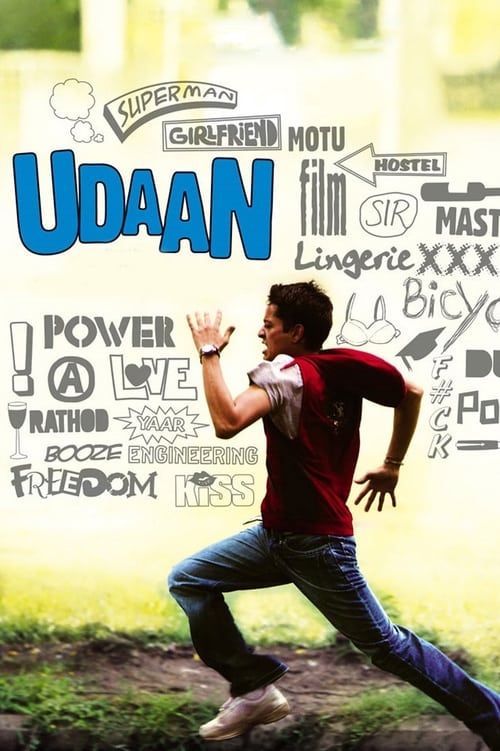
Udaan
2010 · Vikramaditya Motwane
For when you want to feel something real about growing up, breaking away, or surviving a difficult parent — an inspiring watch that goes through genuine pain to get to hope. Have it ready for a night when you need a film to root for.
What it's about
Seventeen-year-old Rohan is expelled from boarding school and shipped back to Jamshedpur, an industrial steel town, to live with a father he barely knows — a rigid, casually cruel man who puts him to work in the family factory and treats discipline as love's only language. Rohan wants to be a writer. The film follows the collision between that secret ambition and a household run like a barracks, with a small half-brother caught in the middle.
The experience
Bruising and tender in equal measure — the domestic scenes knot your stomach, while the stolen moments of friendship, poetry, and late-night rebellion let you breathe. It builds to a catharsis that feels earned rather than engineered.
Performances
Rajat Barmecha makes Rohan's silences as expressive as his outbursts, and Ronit Roy is terrifyingly good as the father — controlled, plausible, never a cartoon villain, which is exactly what makes him frightening.
The craft
Motwane directs with a restraint rare in mainstream Hindi cinema of its moment: no melodramatic underlining, just patient framing of factory smoke, empty roads, and dinner tables where nobody speaks. Amit Trivedi's songs work as interior monologue rather than spectacle, and the running sequences have real kinetic release.
Why it matters
The only Indian film selected for Cannes in 2010, it became a landmark of the country's independent-minded new wave and announced Motwane as a major directorial voice.
Snapshot
Udaan ("flight") is Vikramaditya Motwane's directorial debut, a coming-of-age drama about a seventeen-year-old boy expelled from boarding school and returned to a father who is a stranger, a tyrant, and a wound. Set in the steel town of Jamshedpur, it follows Rohan (Rajat Barmecha) as he is forced into his father's factory and into a nightly routine of discipline, running, and humiliation, while nursing a secret ambition to write. The film is small in canvas and large in feeling — a chamber drama of fathers and sons rendered with unusual formal restraint for its moment in Hindi cinema. Its historical significance is disproportionate to its budget: it was the only Indian film selected for the 2010 Cannes Film Festival, screening in the Un Certain Regard section, and is widely cited as a landmark of the independent-minded "new" Hindi cinema that consolidated around Anurag Kashyap's circle at the turn of the 2010s. It is remembered as a film that proved a modestly scaled, personal, English-inflected Indian drama could travel to the world's most prestigious festival and, over time, accrue a durable domestic canonical status.
Industry & production
Udaan emerged from the confluence of two production impulses in late-2000s Bombay cinema: the studio-backed "indie" arm and the auteur collective. It was produced under UTV Spotboy — the boutique, risk-tolerant label of Ronnie Screwvala's UTV Motion Pictures created to back lower-budget, director-driven work — in association with Anurag Kashyap Films. Kashyap, then the central node of a generation of writer-directors pushing against mainstream Bollywood convention, was co-writer and producer; the project is inseparable from the ecosystem around him that also incubated films by Dibakar Banerjee, Vasan Bala, and others. Motwane had spent years as an assistant and associate director (notably in the orbit of Sanjay Leela Bhansali and Kashyap) before Udaan, and the film had reportedly been developing in one form or another for a long stretch before it found backing — a detail frequently noted in accounts of the film, though precise development chronology in the public record is thin and should be treated cautiously.
The economics were modest by industry standards, and the cast was deliberately unstarry: Rajat Barmecha, an unknown, in the lead, and television actor Ronit Roy — better known to audiences from serialized TV — cast against type as the father. This casting logic, favoring the right face over the bankable name, was itself a statement of the film's independent posture. The decisive industrial event was Cannes: selection for Un Certain Regard in 2010 made Udaan the first Indian film at the festival in several years and generated the festival prestige that a small domestic release could not manufacture on its own. That imprimatur shaped the film's positioning at home, where it opened to strong reviews but a limited theatrical footprint. I won't cite specific box-office figures, as reliable audited numbers are not something I can verify precisely; the durable characterization is that it was a critical success and a modest commercial performer whose reputation grew substantially after release.
Technology
Udaan was made within the conventional professional-cinema toolchain of its period rather than as a technological experiment. It was shot on 35mm film — appropriate to a director and cinematographer working in a naturalist, classically composed register, and consistent with the mainstream Indian production practice of 2009–2010, before digital acquisition became the default. The film's technological interest lies not in novel hardware but in its restraint: available-light-leaning, location-based shooting in and around Jamshedpur, with the industrial infrastructure of the town — the steel plant, the roads, the domestic interiors — used as found architecture rather than built spectacle. The post-production and sound work reflect standard-for-the-era practice. Where the public record is silent on specific camera and stock details, I flag that rather than invent it.
Technique
Cinematography
The cinematography, by Mahendra J. Shetty, is one of the film's quiet achievements. It favors a controlled, unshowy naturalism — steady framing, restrained camera movement, and a palette drained toward the grays, browns, and sodium-lit ambers of a working industrial town. The visual grammar aligns with the psychology of confinement: interiors are often boxed and frontal, the father's household shot with a stillness that reads as constraint, while the film's release of tension into open road and running finds its correlative in wider, more mobile framing. The recurring motif of Rohan running at dawn — beside his father, then eventually away from him — is treated with a lyricism that never tips into music-video gloss. Shetty's work refuses the high-saturation, high-movement default of much contemporaneous Hindi cinema, and that refusal is central to the film's tone.
Editing
Dipika Kalra edited the film, and its cutting is patient. Scenes are allowed to run to their emotional conclusions; the film trusts duration, letting confrontations at the dinner table or in the car breathe until discomfort becomes unbearable. The rhythm is dramatic rather than propulsive — closer to the pacing of art-house drama than to commercial Hindi editing conventions of the time. Montage is used sparingly and pointedly, most memorably in passages that compress the grind of factory work and enforced routine. The restraint of the cutting is what gives the eventual ruptures their force.
Mise-en-scène / staging
The staging is built around a small number of charged spaces: the father's spartan home, the steel factory, the roads of Jamshedpur, the bar where Rohan and his uncle drink. The domestic interiors are organized to express hierarchy — the father at the head of the table, the enforced address of "sir," the geometry of authority. The presence of the young half-brother Arjun (Aayan Boradia) introduces a second axis: Rohan sees in the child a version of the childhood the father is preparing to deform, and the staging repeatedly places the two boys inside the same oppressive frames. Jamshedpur itself functions as mise-en-scène — a company town, a place organized around industry and inheritance, the physical embodiment of the future the father demands his son accept.
Sound
Sound design leans toward realism — the ambient noise of the town and the plant — against which Amit Trivedi's score and songs supply the interior life the taciturn boy cannot voice. The songs are used non-diegetically as extensions of feeling rather than as production numbers, a marked departure from the picturized song sequence. Tracks such as "Aazaadiyan" ("freedoms") and the recurring "Kahani" motif carry the film's yearning for escape, and Trivedi's work here is frequently singled out as some of the most emotionally precise scoring of its year in Hindi cinema.
Performance
The performances anchor everything. Ronit Roy's Bhairav Singh is the film's engine — a portrait of controlling patriarchy that is chilling precisely because it is legible, even coherent from the inside: a man who insists his cruelty is discipline and his discipline is love. Roy plays him without villain's relish, which is what makes him frightening. Rajat Barmecha, in his debut, gives Rohan a watchful, interior quality — resentment and tenderness held under a still surface — and the film asks him to carry long stretches on reaction alone. Ram Kapoor brings warmth as the softer uncle, and young Aayan Boradia is used with care rather than sentimentality. The ensemble's underplayed register is inseparable from the film's naturalist project.
Narrative & dramatic mode
The dramatic mode is the intimate realist bildungsroman — the education, or liberation, of a young man. The structure is classical: return, imprisonment, escalating conflict, and a break for freedom, with the arrival of the vulnerable younger brother functioning as the moral hinge that transforms Rohan's private rebellion into an act of protection. The screenplay resists melodramatic overstatement; its conflicts are domestic and quotidian, accumulating rather than exploding. The father-son duel is the spine, and the film's most striking dramaturgical choice is to grant the father enough interiority that the drama is not a simple contest of good and evil but a study of how authority reproduces itself — and how a child breaks the cycle by refusing to inherit it. The ending is an act of departure that reads as both literal and symbolic flight.
Genre & cycle
Udaan is a coming-of-age drama, and within Indian cinema it belongs to a specific cycle: the late-2000s/early-2010s wave of realist, personal, mid-budget Hindi films that self-consciously departed from the star-and-spectacle template of mainstream Bollywood. This cycle — associated with UTV Spotboy, Anurag Kashyap's collective, and directors like Dibakar Banerjee — sought naturalism, location shooting, non-formulaic narrative, and social specificity. Internationally, the film sits comfortably in the long tradition of the father-son coming-of-age drama and the boarding-school-to-home rite of passage; its restraint and its subject invite comparison with the European art-cinema mode more than with commercial Hindi genre. It is, in the truest sense, a "small" film — genre defined by scale and register as much as by subject.
Authorship & method
Udaan is a debut of unusual assurance, and its authorship is genuinely collaborative in the manner of the Kashyap circle. Vikramaditya Motwane directed and co-wrote; the screenplay is credited to Motwane and Anurag Kashyap, and the film bears the mark of both — Motwane's tonal control and classicism, Kashyap's willingness to sit inside domestic ugliness without flinching. Motwane's method, evident here and across his later career (Lootera, Trapped, Sacred Games), favors restraint, craft precision, and emotional legibility over stylistic flamboyance. His key collaborators define the film's texture: cinematographer Mahendra J. Shetty's drained naturalism, editor Dipika Kalra's patient rhythm, and composer Amit Trivedi's yearning score, which followed his breakthrough on Kashyap's Dev.D and cemented him as one of the signature voices of the new Hindi cinema. The casting of Ronit Roy against his television typecasting is itself an authorial decision, and one that reoriented his screen career. The autobiographical dimension — the film has often been discussed as drawing on Motwane's own feeling about creative vocation and paternal expectation — is part of its reception, though I would treat the precise extent of that as interpretation rather than documented fact.
Movement / national cinema
The film is a defining document of what is loosely called the "new" or "independent" Hindi cinema (sometimes "Hindie") — a movement rather than a formal school, characterized by realism, moderate budgets, urban and small-town specificity, and a rejection of the song-and-dance melodrama that had long defined Bollywood abroad. This tendency was enabled institutionally by studio arms willing to fund director-driven work and by a critical and festival appetite for Indian films that broke from the Bollywood brand. Udaan is frequently placed alongside Dev.D (2009), Love Sex Aur Dhokha (2010), and the slightly later Gangs of Wasseypur (2012) as markers of this shift. Its Cannes selection gave the movement an international validation it had not previously enjoyed at that level, positioning this strand of Indian film within global art cinema rather than within the parallel commercial category of "Bollywood."
Era / period
Udaan is a product of the 2010 turning point in Hindi cinema: the moment when multiplex distribution, studio-backed independents, and a cohort of festival-literate directors converged to make non-mainstream cinema commercially and culturally viable. It arrived just before the digital-acquisition and streaming transformations that would reshape the industry across the decade, and it belongs to the last phase of celluloid-era Indian art film. Historically, it stands at the head of a decade in which many of its makers — Motwane, Kashyap, Trivedi — would become central figures, including in the streaming era (Motwane and Kashyap's Sacred Games being an emblem of that later phase). As a period piece of its own industry, it captures a cinema in transition.
Themes
The film's governing theme is freedom against inheritance — the right of a child to author his own life against a father's demand that he reproduce the father's. From this flow its other concerns: patriarchal authority and its self-justifying cruelty; the vocation of the artist (Rohan's suppressed desire to write) as a form of selfhood the father cannot permit; masculinity as something transmitted, enforced, and potentially refused. The industrial town is thematically loaded — Jamshedpur, a place built on steel and continuity, stands for a world of fixed roles and expected succession. The arrival of the younger brother turns the film's final theme toward solidarity and the breaking of cycles: liberation becomes meaningful only when it is extended to protect another. The title's image of flight gathers all of this: escape, ascent, and the fragile, unfinished attempt to become oneself.
Reception, canon & influence
Critically, Udaan was received on release as a major debut and one of the best Hindi films of its year, praised for Motwane's control, Ronit Roy's performance, Shetty's cinematography, and Trivedi's music; its Cannes selection framed much of that coverage. It was recognized in the domestic awards circuit, including at the Filmfare Awards, where it was among the notable honorees of its year — I'll refrain from itemizing exact statuettes beyond what is securely established, but its strong awards showing is well documented. Its reputation has grown steadily since; it is now routinely included in retrospective lists of the finest Indian films of the 2010s and treated as a modern coming-of-age classic.
Looking backward, the film's influences are legible: the restrained naturalism of European and world art cinema, the father-son and coming-of-age dramatic tradition, and, closer to home, the realist turn that Dev.D had recently modeled within Kashyap's own circle. Looking forward, its legacy is twofold. Institutionally, it helped legitimize the mid-budget, festival-facing Indian independent and demonstrated that such films could reach Cannes, encouraging both studios and directors to pursue that path. In terms of careers, it launched Motwane as a director of the first rank, redirected Ronit Roy toward serious film work, and further established Amit Trivedi's importance to the new Hindi cinema. Its emotional template — the sensitive, formally controlled story of a young person breaking from a suffocating home — echoes through subsequent Indian coming-of-age and family dramas. More than a decade on, Udaan is valued less as a commercial event than as a proof of concept and a lasting work: evidence that Indian cinema of this era could be intimate, rigorous, and world-facing at once.
Reception
Barely made a ripple at the 2010 box office, but critics adored it instantly — and over the decade it climbed from indie darling to fixture on 'best Hindi films of the 2010s' lists, a gateway film for a generation of young Indian cinephiles.
How Udaan was received, from release to now →
How to watch Udaan: what to notice on a first viewing
- Watch who sits at the head of the dinner table. The father's home is staged to express hierarchy, the father at the head of the table, Rohan required to address him as sir. The seating and the forced address are the authority; you feel it before the shouting starts.
- Notice the grays and sodium ambers of the factory town. Shetty drains the palette toward gray, brown, and amber industrial light, avoiding the saturated look common to Hindi cinema of the period. A washed-out town is the film's shorthand for a life with no color left in it.
- Watch how boxed and frontal the interior shots are. Indoors, the camera holds steady, frontal framings that read as confinement, while scenes on the open road use wider, more mobile shots. The camera itself tightens around Rohan at home and loosens the moment he gets outside.
- Watch Rohan's face during long silences at the table. Barmecha carries long stretches on reaction alone, holding resentment and tenderness under a still, watchful surface rather than speaking them aloud. What Rohan cannot say out loud is written on his face for you to read instead.
- Listen for a song rising when Rohan stays quiet. Amit Trivedi's songs enter as extensions of feeling rather than staged musical numbers, carrying the interior life this taciturn boy will not voice aloud. The music says what Rohan won't, which is why it feels like his voice rather than decoration.
The whole guide to watching Udaan, with the keys for a rewatch →
Influences: the films it descends from and the films it influenced
- Pather Panchali (1955) — Establishes the Indian realist bildungsroman Udaan inherits: patient-duration observation of a child's world in unhurried location takes, letting environment and small gestures carry the drama rather than plot.
- The 400 Blows (1959) — The template for reactive-interiority youth: the camera holds on the boy's withholding face instead of dramatizing his rebellion, closing on an ambiguous run toward freedom that Udaan echoes in its final flight from the father's house.
- Bicycle Thieves (1948) — Neorealist father-son dyad shot on real streets, where the son's coming-of-age is measured through witnessing the diminishment or failure of the paternal figure — a moral-education structure Udaan reworks as a duel.
- Fanny and Alexander (1982) — The authoritarian patriarch (the bishop) rendered through geometric domestic framing and rule-bound routine, staging tyranny as mise-en-scène — the 'geometry of authority' and legible-patriarch grammar Ronit Roy's father operates within.
- Ratcatcher (1999) — Drained naturalist palette laid over an industrial working landscape, with a boy's interior life conveyed through held silences and confinement framing rather than dialogue — Shetty's restrained cinematography sits in this lineage.
- This Boy's Life (1993) — The legible domestic tyrant whose escalating, performatively reasonable control drives a boy toward escape; a naturalist study of an abusive stepfather that models Udaan's father-son duel as a war of household rules.
- Dead Poets Society (1989) — The specific engine of a young man's suppressed artistic vocation (writing/poetry) crushed by a rigid patriarch's career decree — the freedom-against-inheritance conflict Udaan localizes through its would-be writer and his factory-owner father.
- Salaam Bombay! (1988) — Location-shot, documentary-inflected Indian realism centered on a boy's survival, proving the naturalist coming-of-age mode viable in Hindi cinema before the new-wave revival Udaan belongs to.
- Lootera (2013) — Motwane's own follow-through on Udaan's method: classical restraint, patient duration and emotional legibility over stylistic flourish, extending the same director-signature into period melodrama.
- Trapped (2016) — Pushes Udaan's confinement-framing to its limit — a single locked location where the frame itself becomes the antagonist, distilling the entrapment grammar Udaan used for the boarding-school and family home.
- Titli (2014) — A Kashyap-produced film that, like Udaan, sits unflinchingly inside domestic ugliness — the violent patriarchal household as a machine of inheritance a son must physically break out of.
- Masaan (2015) — Kashyap-circle small-town realism with a legible patriarch and patient, restrained duration; extends Udaan's proof that intimate, festival-facing (Cannes Un Certain Regard) Indian indies could travel.
- The Lunchbox (2013) — The mid-budget, restrained-naturalist, festival-facing Indian independent whose viability Udaan helped legitimize — quiet observational tempo and drained realism over commercial spectacle.
- Gully Boy (2019) — Reworks the freedom-against-inheritance core as creative vocation (rap) defying a controlling father's decreed future, the same suppressed-artist-versus-patriarch spine Udaan built its arc on.
- Sairat (2016) — Regional realist coming-of-age using naturalist performance and location texture against the weight of patriarchal/authority structures, carrying forward the intimate-yet-rigorous new-wave mode Udaan proved out.
- Dev.D (2009) — The immediate Kashyap-circle precursor sharing Udaan's co-writer and Amit Trivedi, whose breakthrough here established the yearning non-diegetic song-score as emotional counterpoint that Trivedi carries directly into Udaan.
Similar films
- Masaan (2015) — influence & lineage
- Gully Boy (2019) — influence & lineage
- Pather Panchali (1955) — influence & lineage
- Homebound (2025) — shared sensibility
- Asuran (2019) — shared sensibility
- Hit the Road (2021) — shared sensibility
- Rang De Basanti (2006) — shared sensibility
- Lagaan: Once Upon a Time in India (2001) — shared sensibility