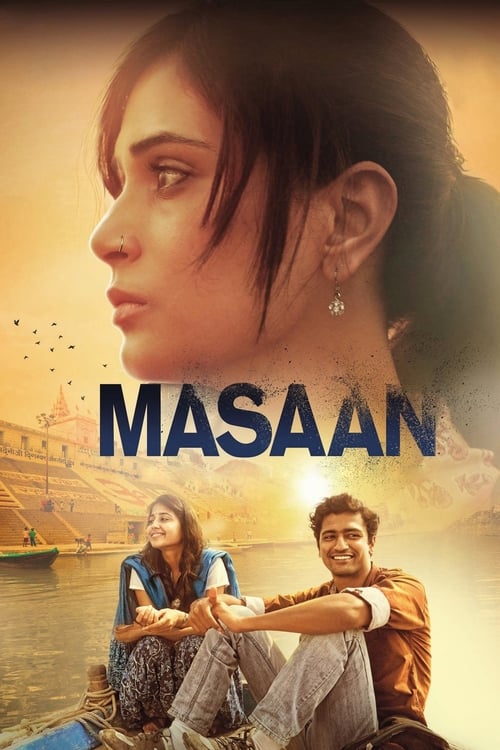
Masaan
2015 · Neeraj Ghaywan
For when you want to feel something real — a slow, humane heartbreaker for a reflective evening, the kind of film you carry around for days afterward.
What it's about
In Varanasi, where the Ganges flows past cremation ghats and railway lines, two stories run side by side. Devi, a young woman, is blackmailed by police after a hotel-room encounter ends in tragedy, and carries the guilt while her father scrapes for the bribe money. Deepak, a boy from the caste that burns the dead for a living, falls in love with a girl from a higher caste — a love the town's old rules say cannot happen.
The experience
Quiet, tender, and quietly devastating — it moves at the pace of a river town, letting small gestures land like blows. Grief and first love sit side by side, and by the end it earns a strange, hard-won lightness.
Performances
Richa Chadha plays Devi's shame and defiance with remarkable restraint, and Vicky Kaushal, in his screen debut, is extraordinary — his grief in the second half is some of the rawest acting in recent Hindi cinema.
The craft
A debut of startling assurance: Varanasi is shot not as postcard exotica but as a working city of fires, trains, and river light, and the two storylines are braided with real editorial grace. The songs are woven in like breath rather than interruption, and the final stretch lands with the precision of a short story.
Why it matters
It premiered at Cannes, won two prizes there, and became a landmark of the independent Hindi cinema wave of the 2010s — launching Vicky Kaushal and proving small, rooted Indian stories could travel worldwide.
Snapshot
Masaan — the word is a vernacular contraction of shmashan, the cremation ground — is Neeraj Ghaywan's debut feature, a quietly devastating chamber drama set among the burning ghats and railway sidings of Varanasi. Across two loosely braided narratives, it follows Devi Pathak (Richa Chadha), a young woman crushed under the social weight of a sexual encounter that ends in a boy's suicide and police extortion, and Deepak Kumar (Vicky Kaushal, in his screen debut), a Dom-caste youth who cremates bodies for a living and falls in love with an upper-caste girl. The film premiered in the Un Certain Regard section at the 2015 Cannes Film Festival, where it won the FIPRESCI Prize and the "Promising Future" prize (Prix de l'Avenir). It stands as one of the signal achievements of the independent Hindi cinema that emerged in the early-to-mid 2010s, marrying social realism about caste and shame to a lyrical, almost devotional attention to place. Its reputation has only grown: it is now widely cited as a modern classic of the parallel-adjacent Indian art film and as the launch point for several major careers.
Industry & production
Masaan is a product of the specific ecosystem that made ambitious low-budget Hindi cinema viable in the years after Gangs of Wasseypur (2012). Ghaywan had served as an assistant director to Anurag Kashyap on that film, and the production reflects the network built around Kashyap's Phantom Films — the company co-founded by Kashyap, Vikramaditya Motwane, Madhu Mantena, and Vikas Bahl. The film was assembled through a coalition of producers rather than a single studio: Drishyam Films (the outfit of industrialist-turned-producer Manish Mundra, who backed a string of independent debuts in this period), Phantom Films, Guneet Monga's Sikhya Entertainment, and French partners including Macassar Productions, Pathé, and Arte France Cinéma. The French co-production structure is significant — it channeled the film toward the European festival circuit and is consistent with the way many Indian art films of the era found financing and distribution abroad before, or instead of, a wide domestic release.
Precise budget and box-office figures for Masaan are not something I can state with confidence; the film was a modestly scaled independent production and was never a commercial blockbuster, and I will not invent specific numbers. What is well established is that its commercial footprint was small relative to mainstream Bollywood, and that its cultural and critical impact vastly exceeded its earnings — a pattern typical of the festival-driven independent sector it belongs to. The Cannes selection functioned as the film's primary launch platform, generating the international attention that carried it to a limited theatrical release in India in July 2015.
Technology
Masaan was shot digitally, in keeping with the near-total transition of Indian independent production to digital acquisition by the mid-2010s. Digital capture was, in practical terms, what made a film like this possible: it allowed a small crew to work handheld and available-light in the dense, unpredictable spaces of a working cremation ghat, crowded railway platforms, and cramped riverside interiors without the logistical burden of celluloid. The film's naturalistic look — its tolerance for low light at the burning grounds, its willingness to shoot in real locations amid real crowds — is bound up with this technological base. There is nothing ostentatiously experimental in its use of tools; the achievement is one of restraint, using contemporary digital cinematography to disappear into place rather than to call attention to itself.
Technique
Cinematography
The photography is by Avinash Arun, himself a director (his Marathi debut Killa appeared the same year). His camera treats Varanasi not as postcard exotica but as lived infrastructure — the ghats as a workplace, the river as both sacred and dirty, the railway as the artery along which aspiration and escape move. Arun favors a controlled naturalism: soft, often overcast or golden riverside light, unhurried framings, and a palette that leans into the ochres, grays, and muted blues of the city. The film repeatedly composes its characters against water and open sky, dwarfing private grief against the vast indifferent geography of the Ganges. Where it moves the camera, it does so with restraint — the handheld work stays intimate rather than agitated, keeping the register melancholic and observational.
Editing
Nitin Baid's editing manages the film's central structural gambit: two narratives that run in parallel for most of the running time and converge only at the very end, when Devi and Deepak meet — strangers — on a boat, having each been carrying a private catastrophe the audience knows and they do not. The cross-cutting withholds the connection, letting each strand accumulate its own emotional weight so that the final convergence lands as grace rather than contrivance. The cutting rhythm is patient throughout, holding on faces and on the labor of daily life, and it trusts silence and duration over montage.
Mise-en-scène / staging
The staging is grounded in the texture of real, specific places: the cremation platforms of Manikarnika, the coin-diving of the boy Jhonta in the river, the internet café and cyber-crime backdrop against which Devi works, the small priestly shop run by her father. Ghaywan stages caste and class as spatial facts — who is permitted where, who touches whom, where a body may or may not be burned. The recurring motif of water (bathing, drowning, immersion of ashes, coins pulled from the riverbed) is built into the physical world of the film rather than imposed as symbol. Interiors are cramped and honest; the film resists any beautification that would soften its social observation.
Sound
The soundscape is dense with the ambient life of Varanasi — temple bells, crackling pyres, the churn of the river, railway announcements — used to root the drama in place. The score and songs are by the band Indian Ocean, whose fusion of folk, rock, and classical idioms gives the film a distinctive sonic signature very different from conventional Bollywood scoring. The song "Tu Kisi Rail Si," with lyrics by Varun Grover that draw on the Hindi poet Dushyant Kumar's famous line "Tu kisi rail si guzarti hai," became one of the film's most celebrated elements, fusing literary Hindi with the railway imagery that threads through the story. Music here is not spectacle or interruption but emotional undertow.
Performance
The acting is uniformly naturalistic and restrained. Richa Chadha, already established from the Gangs of Wasseypur films, plays Devi with a guarded, watchful stillness — a woman refusing the shame the world demands she feel. Vicky Kaushal, in his debut, gives Deepak an open-faced tenderness that makes his grief, when it breaks, almost unbearable; the performance effectively launched his career. Sanjay Mishra, a character actor of long standing, is quietly heartbreaking as Devi's father, a Sanskrit-teaching priest whose morality frays under blackmail. Shweta Tripathi as Shaalu and the child performer as Jhonta round out an ensemble in which no one over-plays. The film's power depends on this collective underacting.
Narrative & dramatic mode
Masaan operates in the mode of quiet social realism inflected with a poetic, almost spiritual lyricism. Its dramatic engine is not plot but the slow pressure of shame, guilt, and caste upon ordinary people trying to live. The braided-parallel structure — two unconnected stories that meet only at the close — is its most distinctive formal choice, and it resolves not through catharsis or resolution of the plots' external problems but through an image of tentative human connection: two wounded strangers, sharing a boat, offered the barest possibility of a future. The ending is deliberately open and gentle, a refusal of both tragic closure and false uplift. The tone throughout is elegiac; the film mourns even as it insists on the possibility of continuing.
Genre & cycle
The film sits in the tradition of Indian social-realist and "parallel"-adjacent art cinema, updated for the multiplex-and-festival era. It belongs to the cycle of independent Hindi films of the early-to-mid 2010s — sometimes loosely tagged "Hindie" — that pushed against mainstream Bollywood convention: naturalistic performance, location shooting in small-town and provincial India, socially engaged subject matter, and a rejection of song-and-dance spectacle in favor of diegetically integrated music. Films from the Phantom Films / Drishyam Films orbit form its immediate cohort. Thematically it also participates in a long lineage of Indian cinema about caste and about the moral geography of the holy city, but its register — intimate, tender, unsentimental — is very much its own.
Authorship & method
Masaan is a debut, and it bears the marks of a first feature made by someone who had apprenticed carefully. Neeraj Ghaywan came up as an assistant director in Anurag Kashyap's orbit, and his method here is one of restraint and grounding — extensive attention to place, casting for authenticity, a refusal of melodrama. Ghaywan has spoken publicly about caste as a lived and personal concern, and the film's treatment of the Dom community is unusually direct for mainstream-adjacent Hindi cinema, which has historically elided caste.
The authorship is genuinely collaborative. The screenplay is by Varun Grover, a writer and lyricist whose script gives the film both its precise social observation and its literary texture (the incorporation of Dushyant Kumar's poetry is characteristic). Cinematographer Avinash Arun brought a director's sensibility to the images. Editor Nitin Baid shaped the parallel structure. The band Indian Ocean supplied a score that is inseparable from the film's identity. This constellation of collaborators — several of whom went on to major careers — is central to what the film is.
Movement / national cinema
The film is a cornerstone document of the new independent Hindi cinema that flourished in the wake of Gangs of Wasseypur, a movement enabled by digital production, festival financing, multiplex distribution, and a cohort of producers (Phantom, Drishyam, Sikhya) willing to back director-driven work. It is distinct from the older "parallel cinema" of the 1970s–80s in its industrial context but continues that tradition's commitment to realism and social conscience. As a French co-production that traveled to Cannes, it also exemplifies the transnational financing and circulation routes by which Indian art cinema of this period reached global audiences.
Era / period
Masaan is set squarely in its contemporary moment — the mid-2010s India of internet cafés, cyber extortion, mobile phones, Facebook, and coaching-class aspiration colliding with ancient social structures. Much of its poignancy comes from this friction: Deepak studies civil engineering and dreams of escaping his caste-bound trade; Devi works with computers and reads about jobs elsewhere. The railway station recurs as the era's emblem of mobility and escape. The film is acutely a portrait of young provincial Indians caught between an inherited moral order and the promises of modernity.
Themes
The governing themes are caste, shame, grief, and the possibility of renewal. Caste is treated with rare directness through Deepak's identity as a Dom, a community whose hereditary labor is the burning of the dead — literally handling death so others need not — and through the impossibility, socially, of his love for an upper-caste girl. Shame, especially the gendered shame policed onto Devi's sexuality, is the film's second great subject; her quiet refusal to be destroyed by it is one of the film's moral centers. Death and cremation are omnipresent — the burning ground as both livelihood and metaphysical fact — and the film draws on Varanasi's status as the city where Hindus come to die and be liberated to frame its meditation on loss and continuance. Running beneath all of it is water: the Ganges as purifier and destroyer, and immersion as both mourning and rebirth. The final image reframes the whole as a film about survival — about the small, unlikely mercy of two damaged people finding each other.
Reception, canon & influence
Critically, Masaan was received with something close to unanimous acclaim. Its Cannes premiere in Un Certain Regard and its twin prizes there — the FIPRESCI Prize and the Prix de l'Avenir — established its international standing immediately, and Indian and Western critics alike praised its restraint, its performances, and its handling of caste. It went on to be recognized at domestic and other awards; I won't enumerate specific trophies I can't verify precisely, but its standing as one of the most lauded Indian films of its year is not in dispute.
Looking backward, the film's influences lie in the tradition of Indian social realism and parallel cinema and in the immediate example of the Kashyap-school independent film that Ghaywan came out of; the incorporation of Dushyant Kumar's poetry situates it within a specifically Hindi literary-cultural lineage as well. Looking forward, its legacy is substantial. It confirmed Ghaywan as a major directorial voice — he went on to acclaimed short-form work, including the "Geeli Pucchi" segment of the anthology Ajeeb Daastaans, again centered on caste and desire, and to a second feature that continued in the festival-cinema tradition. It launched Vicky Kaushal, who became one of Hindi cinema's leading actors, and it consolidated the reputations of Varun Grover, Avinash Arun, and Richa Chadha. More broadly, Masaan helped legitimize a mode of intimate, socially serious, poetically grounded Hindi filmmaking, and it remains a touchstone reference point whenever critics discuss caste on screen, small-town realism, or the achievements of the 2010s Indian independent wave.
Reception
It arrived already garlanded — a five-minute standing ovation and two prizes at Cannes 2015 — but was a modest box-office affair in India; a decade on, Vicky Kaushal's superstardom and Ghaywan's stature as a rare Dalit voice in Bollywood have turned it into a routinely cited 'best Hindi films of the 2010s' pick.
How Masaan was received, from release to now →
How to watch Masaan: what to notice on a first viewing
- Notice how often people are framed against river or open sky. Ghaywan and cinematographer Avinash Arun repeatedly set Devi and Deepak against the Ganges and Varanasi's open horizons, small figures against vast, indifferent geography. The landscape keeps reminding you these are small lives inside something much older and bigger than them.
- Listen for temple bells, crackling pyres, and trains under every scene. The ambient life of Varanasi runs under the drama constantly, and Indian Ocean's score folds folk, rock, and classical idioms into that same soundscape rather than sitting apart from it. Music and city noise blur together, so feeling never announces itself as separate from the place.
- Watch who is allowed to enter a room and who waits outside. Ghaywan stages caste as a spatial fact throughout: who may touch whom, where a body may be burned, who works the ghats and who only visits them. Caste becomes something you can see in where people are allowed to stand, not just something characters say.
- Watch how still the actors hold their faces even in pain. Richa Chadha and Vicky Kaushal underplay throughout, guarding rather than displaying emotion, and Sanjay Mishra does the same as Devi's father. The restraint makes the rare small break in composure land much harder than an outburst would.
- Follow the two separate stories the film keeps cutting between. One strand follows Devi in town, the other follows Deepak among the cremation ghats. The editing moves between them without saying how they relate. You read every scene for what each strand might say about the other.
The whole guide to watching Masaan, with the keys for a rewatch →
Influences: the films it descends from and the films it influenced
- Pather Panchali (1955) — Establishes the parallel-cinema grammar Masaan inherits — available-light location shooting and casting for authenticity to observe the rural poor with patient, incident-light framing that refuses melodrama.
- Subarnarekha (1965) — Ghatak's use of the river and riverbank as the literal stage for loss, displacement and rebirth is the source-water for Masaan's Ganga-as-cleansing/cremation motif and its landscape-dwarfing figures.
- Ankur (1974) — Parallel cinema's direct confrontation of caste hierarchy and gendered sexual shame in a restrained realist register — the socially-serious mode Masaan revives for the Dom community.
- Uski Roti (1969) — Austere formalism — long static holds, faces in dead time, and human figures set small against wide landscape — models Masaan's patient framing and refusal of dramatic incident.
- Water (2005) — Shot on the same Banaras ghats, it fuses widowhood, ritual death and the Ganga into a water-and-rebirth iconography that Masaan restages with less didacticism.
- Amores Perros (2000) — The braided multi-strand structure of separate lives cross-cut and only glancingly intersecting — the parallel-narrative architecture editor Nitin Baid builds Masaan's two storylines on.
- Gangs of Wasseypur (2012) — The Kashyap-school method Ghaywan literally apprenticed on as AD — regional Hindi vernacular, real locations, diegetic music and non-star casting used to guarantee milieu authenticity.
- Ship of Theseus (2012) — A near-contemporary experiment in braided parallel structure — unconnected lives told separately then resolved into thematic unity — the same editorial gambit Masaan deploys.
- The Lunchbox (2013) — Shares the restrained collective underacting and the open, unresolved ending — longing sustained across social distance and left deliberately unclosed rather than paid off.
- Udaan (2010) — Kashyap-circle small-town realism with a legible patriarch and patient, restrained duration; extends Udaan's proof that intimate, festival-facing (Cannes Un Certain Regard) Indian indies could travel.
- Newton (2017) — Carries forward the deadpan, real-location Hindi-indie realism — political seriousness delivered through underplayed performance and available light rather than speechifying.
- Ajeeb Daastaans: Geeli Pucchi (2021) — Ghaywan re-applies his own method — a Dalit protagonist, restrained performance and the intertwining of caste with suppressed desire — condensed into short form.
- All We Imagine as Light (2024) — Continues the Un Certain Regard lineage of intimate, socially-serious Indian cinema — naturalistic available light, a recurring water motif and collective underacting used to hold longing in quiet suspension.
- Homebound (2025) — Ghaywan's own debut sets the method Homebound extends — caste stigma rendered through the proxemics of who may enter or touch which space, with grief held in long observational riverbank takes rather than dramatized by score.
- Gully Boy (2019) — Editor Nitin Baid's practice of ending a scene on a held, unresolved reaction and bridging the cut with sung verse carries straight into Gully Boy, where his cut-to-the-beat montages let a song's downbeat, not a line of dialogue, close the emotional beat.
- Love Sex Aur Dhokha (2010) — Pioneers the digital, available-light, unglamorous small-town Hindi realism — the low-fi texture of everyday north-Indian life — that Masaan adopts as its visual baseline.
- Court (2014) — Real-location shooting, non-professional casting and deadpan observational framing turned into an indictment of caste and class within an institution — the same anti-melodramatic realist ethic.
- Titli (2014) — A Kashyap-produced companion piece using naturalistic grime, cramped real interiors and family cruelty to render lower-class north-Indian life without romanticization.
- Sairat (2016) — Extends the same craft of staging inter-caste desire and its violent policing through regional non-actors and real locations, sharing Masaan's frank on-screen treatment of caste.
- 12th Fail (2023) — Where Vikrant Massey's naturalistic small-town restraint was forged — UP real locations and non-professional support that he carries directly into 12th Fail's physical embodiment.
- Sardar Udham (2021) — Shares cinematographer Avik Mukhopadhyay's naturalist, grief-toned low-light imagery and parallel-cinema restraint, carrying trauma through environment and quiet performance.
- Superboys of Malegaon (2025) — Grover's screenwriting signature — small-town Hindi-belt specificity, class awareness and humane comedy carrying a political undertow — is the same authorial hand shaping Superboys' tonal balance.
Similar films
- Pather Panchali (1955) — influence & lineage
- All We Imagine as Light (2024) — influence & lineage
- Homebound (2025) — shared sensibility
- Main Vaapas Aaunga (2026) — shared sensibility
- Udaan (2010) — shared sensibility
- C/o Kancharapalem (2018) — shared sensibility
- Cactus Pears (2025) — shared sensibility
- Asuran (2019) — shared sensibility