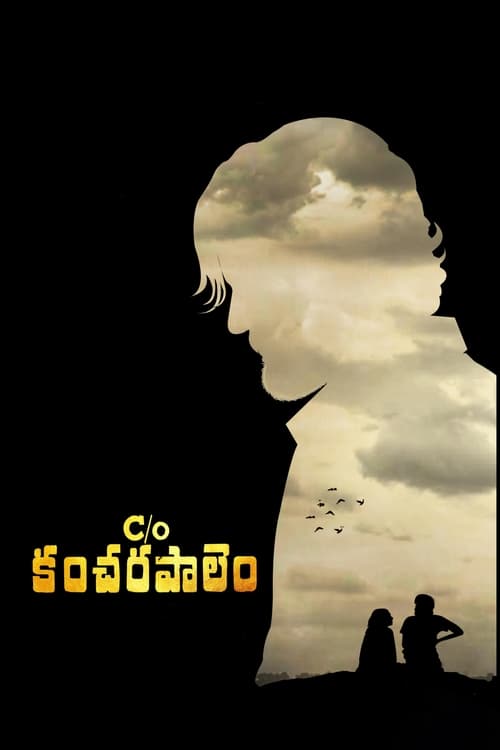
C/o Kancharapalem
2018 · Venkatesh Maha
For when you want something tender and true — a small film about ordinary people in love that leaves you softer than it found you. Cozy on the surface, with real feeling underneath.
What it's about
In a working-class neighborhood of a small Indian coastal town, four love stories unfold side by side: a schoolboy's first crush, a college student testing the lines of religion, a small-time gambler falling hard, and a middle-aged office clerk quietly drawn to a colleague. Each romance runs into the walls of age, caste, faith, or status, and together they add up to a portrait of the whole neighborhood — played largely by the actual residents of the place.
The experience
Gentle, funny, and completely unhurried — it feels less like watching a plot than living on a street for a while. The four stories braid together in a way that rewards attention, and the final stretch lands with a quiet force that recolors everything before it.
Performances
The cast is almost entirely non-professional — locals from the real neighborhood — and their unpolished, lived-in presence is the film's secret weapon; no one seems to be acting, which makes every small gesture land.
The craft
A debut made outside the star system on a modest budget, shot in the real streets and homes of its title neighborhood, with a structure that interlaces its four stories so their echoes accumulate. Its craft is the invisible kind: casting, patience, and an ending that makes you rethink the architecture of what you've watched.
Why it matters
Became a touchstone for independent Telugu cinema — proof that a film without stars, made with a neighborhood instead of a cast, could win over audiences and change the argument about what the industry could be.
Snapshot
C/o Kancharapalem is a Telugu-language independent feature that arrived in 2018 as one of the most quietly disruptive films the industry had produced in years — a debut by writer-director Venkatesh Maha, cast almost entirely with non-professional actors drawn from the actual Visakhapatnam neighborhood that gives the film its name and its "care of" postal address. Structured as four interlaced love stories spanning a schoolboy, a college student, a small-time gambler, and a middle-aged office clerk, it braids age, caste, religion, and class into a single portrait of a place, then delivers a late reversal that recasts the whole. Made outside the star system on a modest budget and elevated to theatrical visibility by actor-producer Rana Daggubati's backing, it became a touchstone for the argument that Telugu cinema could sustain a serious regional-realist alternative to its commercial mainstream.
Industry & production
The film belongs to a specific moment in South Indian cinema when the economics of digital production and the appetite of a younger, subtitle-tolerant audience made small, location-rooted films viable in a market long dominated by high-budget star vehicles. It was produced by Praveena Paruchuri (who also appears in the cast), and — crucially for its commercial life — "presented" by Rana Daggubati, a bankable Telugu and Hindi star whose imprimatur helped a director-driven film with no known faces secure a wider theatrical release than such projects normally command. That patronage model — an established star lending visibility to an outsider's debut — is the film's most legible industrial fact and a large part of why it reached audiences beyond the festival circuit.
Beyond these anchors, the granular production record is genuinely thin in the way that indie regional films often are: precise budget figures, shooting-schedule length, and detailed financing structure are not reliably documented in the public record, and I won't invent them. What is well established is the guiding production choice — that the picture was built around real residents of Kancharapalem rather than professional performers, a decision that shaped everything from casting logistics to the film's texture and was central to its promotion and critical framing.
Technology
C/o Kancharapalem is a product of the digital, location-first mode of low-budget filmmaking that had, by 2018, become the default for independent Indian production. The film's aesthetic — available light, working interiors and streets, a small footprint that let the crew shoot inside a real neighborhood without transforming it into a set — is consistent with lightweight digital cinematography, though I don't have a reliably sourced record of the specific camera and lens package to cite, and won't guess at model names. The salient technological point is not a particular device but a condition: digital capture and compact crews lowered the cost floor enough that a first-time director could shoot a feature on real streets, with real inhabitants, and still finish to a standard that held up on theatrical screens. Post-production and subtitling likewise reflect the era's infrastructure, which made a Telugu-language regional film legible to festival juries and diaspora audiences.
Technique
Cinematography
The visual approach is observational and grounded, favoring the lived texture of Kancharapalem — its lanes, temples and churches, tea stalls, and cramped domestic interiors — over stylized composition. The camera tends to sit with its subjects, letting the neighborhood read as a real, continuous place rather than a backdrop, which is essential to the film's central conceit that geography, not plot, is the connective tissue among its stories. Because the film draws so much of its meaning from place, the cinematography's realism functions almost documentarily, dignifying ordinary faces and spaces with unhurried attention. I don't want to overstate specific technical signatures beyond what the film demonstrably does; the record on individual lighting and camera decisions is limited.
Editing
The film's most consequential formal decision lives in the cutting logic. Four narratives, distinguished by the ages and circumstances of their protagonists, are interwoven so that the town itself becomes the through-line, and the sequencing withholds a structural connection that the ending finally supplies. The editing thus does double duty: it sustains four tonal registers — childhood infatuation, adolescent ardor, a rougher adult transaction, and a tender late-life courtship — while quietly arranging information so that the closing reversal reframes what came before. The pleasure of the design depends on that patience, and on cuts that treat the parallel stories as facets of one place rather than discrete episodes.
Mise-en-scène / staging
Staging is rooted in the specificity of Kancharapalem: religious co-presence (the neighborhood's Hindu and Christian and Muslim life is part of the fabric), the geography of small work and small leisure, and the social boundaries — of caste, faith, and status — that the love stories keep pressing against. The production's decision to shoot in real homes and streets with the people who inhabit them means the staging carries an authenticity that would be difficult to fabricate; the frame is populated by a community rather than by extras. This is the film's defining craft choice, and it converts a modest budget into a strength.
Sound
The soundscape leans on the ambient reality of the location — the film's realism extends to its aural texture — and is bound together by Sweekar Agasthi's score and songs, which give the four strands emotional continuity without homogenizing them. The music is generally credited as one of the film's assets, coloring the romances warmly while staying within the naturalistic register the images establish. Detailed sound-design documentation is limited, so I'll characterize the work at the level the film plainly supports rather than attributing specific techniques I can't verify.
Performance
Performance is where C/o Kancharapalem is most radical. Its ensemble is largely non-professional, cast from the neighborhood, and the film's power derives from faces that carry no star baggage and read as genuine inhabitants of these lives. The absence of practiced technique becomes an asset: hesitations, ordinary rhythms, and un-glamorous physicality lend the romances a credibility that trained polish might have sanded away. This is the tradition of non-professional casting deployed for authenticity, and the film is frequently cited precisely for how convincingly its untrained actors hold the screen.
Narrative & dramatic mode
The film operates in a realist, multi-strand mode — an anthology of romances unified by place and, ultimately, by a structural revelation. Its four love stories are deliberately varied in age and situation so that "love" is examined across a full human lifespan and across the social lines that ordinarily police it: religion, caste, and class. The dramatic engine is not suspense in the conventional sense but accumulation — the sense that we are watching a town's emotional life from several angles at once — capped by a late reframing that ties the strands together and retroactively deepens them. I'll describe the ending's function rather than spell out its mechanics: it is a convergence twist that rewards the film's patient cross-cutting and reframes the anthology as something more unified than it first appeared. Because accounts of the precise reveal vary in emphasis, I won't over-specify it beyond that it recontextualizes the relationships and foregrounds the theme of identity across time and faith.
Genre & cycle
Nominally a drama-romance, the film reads better as regional social realism in a romantic key — closer in spirit to place-based, ensemble humanist cinema than to the songs-and-set-pieces romance of the Telugu mainstream. It sits within a late-2010s cycle of South Indian independent films that used real locations, regional dialect, and non-star casts to tell grounded stories, and it is often grouped with the broader wave of Telugu "new independent" or realist cinema that gained momentum in this period. Its distinctiveness within that cycle is the anthology-plus-reveal architecture, which lets it be a mosaic of a neighborhood and a single unifying story at once.
Authorship & method
The film is a first feature and a clear authorial statement by Venkatesh Maha, who wrote and directed it; its method — building a fiction out of a real place and its people — is the signature of that authorship, and it introduced Maha as a director committed to regional specificity and social texture over commercial convention. Composer Sweekar Agasthi is the most clearly identifiable creative collaborator on the craft side, and his music is consistently singled out as integral to the film's warmth and cohesion. Praveena Paruchuri was central both as producer and as a performer in the ensemble, part of a filmmaking unit that doubled as its own cast. Rana Daggubati's role, while presentational rather than creative, materially shaped the film's public existence by giving it reach.
On the other key craft credits — the cinematographer and editor specifically — I want to be careful: I don't have a reliably sourced attribution to name with confidence, and given the instruction not to invent, I'll flag that the individual technical authorship here is one place where I can't responsibly assign names. What can be said firmly is that the collaborative ethos was closer to a community project than a conventional star production, and that this ethos is inseparable from the film's identity.
Movement / national cinema
C/o Kancharapalem is best understood within the Telugu-language cinema of the Andhra/Telangana region, but as a self-conscious alternative to that cinema's commercial center of gravity. It belongs to the strand of Indian regional realism that privileges place, dialect, and ordinary life — a lineage with deep roots in Indian art cinema's attention to the everyday and the local — updated by digital-era economics. Its specific contribution to the national picture is as evidence that Telugu cinema, so often identified internationally with large-scale spectacle, could also produce intimate, humanist, location-rooted work that traveled on the strength of craft and authenticity rather than stars.
Era / period
The film is a document of the late 2010s: a period when streaming and subtitle culture were widening the audience for regional-language Indian films, when digital production had lowered barriers to entry, and when established stars increasingly lent their names to smaller director-driven projects. It captures a contemporary small-town India in which religious pluralism, caste and class boundaries, and the ordinary economics of clerical work and small enterprise remain fully present — not as period detail but as living conditions. Its temporal texture is unmistakably of its moment, even as its concerns (love against social barriers) are perennial.
Themes
At its core, the film argues that love recurs across every stage of life and refuses to respect the social lines — of religion, caste, age, and status — that societies draw to contain it. Kancharapalem's interwoven Hindu, Christian, and Muslim life is not incidental; the film uses the neighborhood's pluralism to stage romances that cross faith and community, making the question of religious and social identity central rather than ornamental. Place operates as a theme in itself: the "care of" address in the title frames the film as a letter from a specific locality, insisting that identity is bound to geography and community. And the closing reframing pushes a further idea — that a single life, and a single love, can be legible only across the whole arc of time. These are the concerns the film demonstrably foregrounds; I've kept to them rather than extrapolating a thesis the picture doesn't support.
Reception, canon & influence
Critically, C/o Kancharapalem was received as a standout — widely praised for its authenticity, its use of non-professional actors, its music, and the elegance of its interwoven structure, and frequently cited among the strongest Telugu films of 2018 and as a landmark for Telugu independent cinema. Rana Daggubati's association drew attention that a debut of this kind would rarely receive, and the film's reputation as a critical success is well established even where I can't responsibly enumerate every specific award or festival honor; the detailed awards record is one area where I'd rather note the limit than risk misattribution.
Looking backward, the film's influences are the broad tradition of Indian and regional realism — the humanist, place-and-people-centered strain of Indian cinema and the international practice of casting non-professionals for authenticity — rather than any single named precursor the record lets me cite with confidence. Looking forward, its significance is as a proof of concept: it strengthened the case for a Telugu independent cinema built on real locations, regional specificity, and director-driven storytelling, and it helped establish Venkatesh Maha as a filmmaker to watch. Within the atlas of influence this dossier serves, C/o Kancharapalem is best mapped as a node connecting the older lineage of Indian social realism to the digital-era regional independents of the late 2010s — a small film whose method, more than any single stylistic flourish, is what it passed on.
Reception
A tiny crowdfunded indie with no stars, it rode festival buzz and word-of-mouth into a proper theatrical run after Rana Daggubati picked it up — and within a few years it was being talked about as one of the defining Telugu films of its decade.
How C/o Kancharapalem was received, from release to now →
Influences: the films it descends from and the films it influenced
- Bicycle Thieves (1948) — Established the neorealist method C/o Kancharapalem runs on — casting non-professionals off the street and shooting in real working-class locations rather than sets, letting a place's texture carry the drama.
- Pather Panchali (1955) — Founded the Indian regional-humanist strain of building a fiction from a specific village and its ordinary people, using amateur performers and available light so the locale itself becomes a character.
- Ankur (1974) — Indian Parallel Cinema template for staging love and desire across caste/social lines in real rural locations with regionally specific texture, the exact social-realist register C/o adopts.
- Salaam Bombay! (1988) — Cast real street children and shot documentary-textured on location in an actual neighborhood, proving a non-professional ensemble drawn from the milieu itself could anchor a feature.
- Amores Perros (2000) — Supplied the network-narrative architecture — three initially separate strands interwoven and cross-cut until a hidden connection ties them together, the structural engine behind C/o's convergence reveal.
- Short Cuts (1993) — Mosaic-of-a-place ensemble method, cross-cutting many parallel lives bound only by shared geography, an ancestor of C/o's multi-strand portrait of a single neighborhood.
- Cinema Bandi (2021) — A Telugu micro-budget feature built on non-professionals and real village locations, directly extending C/o's proof-of-concept that regional Telugu indie storytelling could work without stars.
- Mallesham (2019) — Telugu regional realist biopic rooted in a specific Telangana weaving community's dialect, labor, and locations, carrying forward C/o's specificity-over-convention authorship.
- Palasa 1978 (2020) — Telugu independent set in a real coastal-Andhra town, dramatizing caste conflict through location shooting and regional texture in the post-C/o Telugu-new-independent wave.
- Uma Maheswara Ugra Roopasya (2020) — Maha's own follow-up, sustaining his signature of location-first shooting and small-town ensemble realism over commercial staging, the throughline of his authorship established here.
- Balagam (2023) — Telugu village-set realism drawing on largely local performers and ritual-specific regional detail, continuing the place-as-identity, community-cast lineage C/o helped legitimize.
- Fandry (2013) — Contemporary regional realism casting non-professionals to dramatize a love thwarted by caste in a real Maharashtrian village — the same location-first, socially-charged romance craft.
- Sairat (2016) — Extends the inter-caste romance shot with regional specificity and near-documentary location work, the love-across-social-lines craft C/o also builds its stories on.
- Court (2014) — Parallel new-independent Indian film using non-professional actors and observational, static long-take realism to indict social structures rather than dramatize them through star performance.
- Thithi (2015) — Cast entirely from real villagers playing lightly fictionalized versions of themselves on their own location, the community-as-cast ethos central to C/o's making.
- Kaaka Muttai (2014) — Non-professional child leads and a Chennai slum shot as a lived-in neighborhood, treating place-as-identity through observational realism the same way C/o treats Kancharapalem.
- Maheshinte Prathikaram (2015) — Malayalam small-town realism that lets an entire named locality and its everyday rhythms drive an understated ensemble comedy-drama, a parallel place-portrait method.
- Meiyazhagan (2024) — Hyperlocal small-town naturalism built from near-documentary texture and non-professional faces, dignifying ordinary lives — the same anti-melodramatic tenderness toward provincial community.
- Jersey (2019) — Telugu content-cinema contemporary that similarly uses withheld structural information as a revelation device and naturalistic restraint over glossy production.
- 96 (2018) — Contemporary Telugu content-cinema using available-light naturalism, non-professional underplayed performance, and a braided multi-timeline romance — 96's exact-year twin in method.
Similar films
- Pather Panchali (1955) — influence & lineage
- 96 (2018) — same viewing thread
- All We Imagine as Light (2024) — same viewing thread
- Vada Chennai (2018) — shared sensibility
- Kumbalangi Nights (2019) — shared sensibility
- Bangalore Days (2014) — shared sensibility
- Meiyazhagan (2024) — shared sensibility
- Premam (2015) — shared sensibility
All the films related to C/o Kancharapalem →
Watch it with: curated runs of related films
- The Ache of Almost — Watch these together for the way each circles a love that time, distance, or duty keeps just out of reach — long looks, feelings left unsent, and the life that gets lived instead.