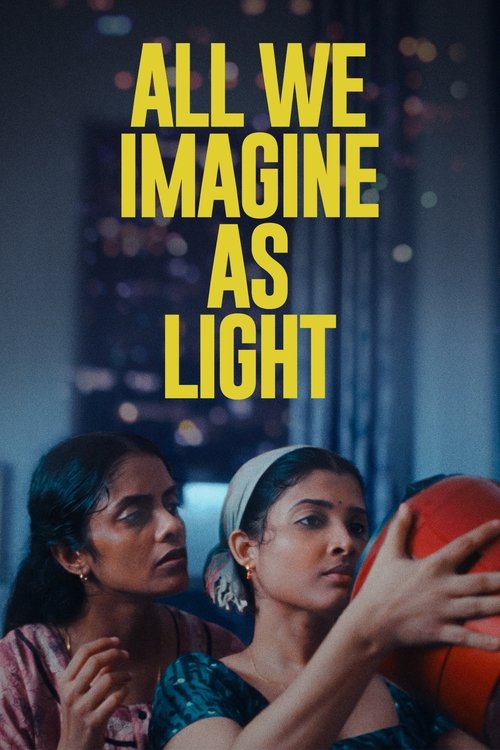
All We Imagine as Light
2024 · Payal Kapadia
All We Imagine as Light won the Cannes Grand Prix — a historic first for India — and then India declined to submit it to the Oscars, igniting a national argument about what "Indian cinema" means. The center of parallel-cinema-versus-industry discourse.
For a quiet, reflective evening when you want a film to hold you rather than grab you — gentle in tone, but it gives you plenty to chew on about loneliness, desire, and making a life far from home.
What it's about
Two migrant nurses share a cramped Mumbai apartment: Prabha, whose absent husband — an arranged match working in Germany — exists mostly as silence until an unexpected gift arrives, and Anu, younger and secretly in love, hunting the crowded city for any private place to meet her boyfriend. Alongside an older coworker being pushed out of her home by developers, a trip to a coastal town finally gives their longings room to breathe.
The experience
Meditative and tender, moving at the unhurried pace of night shifts and monsoon rain. It's the kind of film that feels like eavesdropping on real lives, and it leaves a soft glow that lasts for days.
Performances
Kani Kusruti gives Prabha a stillness that carries whole histories of restraint, and Divya Prabha and Chhaya Kadam round out a trio of beautifully unshowy, lived-in performances.
The craft
Kapadia shoots nocturnal, monsoon-soaked Mumbai like a city dreaming — trains, night markets, hospital corridors — then shifts to sun and sea for the film's second movement, and the change of light is the emotional turn. The three-language texture and near-documentary attention to working life give it uncommon intimacy.
Why it matters
Won the Grand Prix at Cannes in 2024 — a landmark for Indian cinema, which hadn't had a film in the main competition in three decades — and announced Kapadia as a major new voice.
Snapshot
All We Imagine as Light is Payal Kapadia's first narrative feature, a luminous three-language drama about two migrant nurses and an older cook-cleaner living and working in Mumbai. It braids the interior lives of Prabha (Kani Kusruti), whose absent husband — an arranged match now working in Germany — surfaces only as silence and, one day, an unexpected gift; her younger roommate Anu (Divya Prabha), conducting a clandestine interfaith romance with no private place to conduct it; and Parvaty (Chhaya Kadam), a widow being evicted by developers. The film moves in two movements: a nocturnal, monsoon-soaked Mumbai of labor and constraint, and a coastal escape to the Konkan seaboard where desire finally finds room to breathe. At Cannes 2024 it won the Grand Prix — the first Indian film in the main competition in three decades and the first Indian feature to take that prize — vaulting Kapadia to the front rank of world cinema.
Industry & production
The film is a genuinely transnational art-cinema object, financed as a European–Indian co-production spanning France, India, the Netherlands, Luxembourg, and Italy. On the French side the lead producers were Thomas Hakim and Julien Graff for Petit Chaos; the Indian production came through Chalk & Cheese Films, the outfit associated with Kapadia's core collaborators. This financing architecture matters: it is the now-standard European festival-circuit model — soft money, co-production treaties, and public film funds assembled around a first-time narrative director with festival pedigree — rather than any Indian studio or streaming-platform backing. That independence is legible in the film's freedom of subject and pace.
Kapadia arrived with unusual leverage for a debut narrative director. Her documentary A Night of Knowing Nothing (2021) had won the Golden Eye (L'Œil d'or), Cannes's documentary prize, establishing her with the festival's selectors and with the same European producing partners who then backed this feature. The production shot in Mumbai and on the Maharashtra coast around Ratnagiri; the two-location structure is the film's spine as much as its logistics. Distribution abroad ran through prestige art-house channels — in North America via the Janus Films/Sideshow orbit — which positioned it for a long, awards-season theatrical life rather than a quick platform dump.
One industrial footnote became a story in itself: despite the Cannes triumph, the film was not chosen as India's official submission to the Academy Awards' international category (that slot went to Laapataa Ladies), a decision widely debated in the Indian press as emblematic of the gap between the country's festival auteurs and its official cultural gatekeeping.
Technology
The film was made with the tools of contemporary independent digital production, and its technical program is one of restraint rather than spectacle. It is a digitally-originated film whose ambitions lie in available and low-level light — Mumbai at night, under sodium lamps, neon shopfronts, hospital fluorescents, rain-slicked streets, the flare of passing trains and traffic — captured with a naturalism that reads as documentary even when the staging is composed. This is not a film of heavy visual-effects pipelines or large-format capture; its "technology" is the modern low-light sensor's ability to hold detail and color in near-darkness, which the cinematography exploits continuously.
Sound technology is deployed with comparable subtlety: the dense, layered field recording of the metropolis — traffic, trains, monsoon, overheard languages — functions almost as a second score. Where the record is thin on precise camera, lens, or post specifics, it is fair to say only that the film's aesthetic points toward lightweight, mobile, available-light digital capture consistent with its co-production budget and its director's documentary formation, rather than any headline technical innovation.
Technique
Cinematography
The cinematography, by Ranabir Das — Kapadia's longtime collaborator, who also shot A Night of Knowing Nothing — is the film's signal achievement and the source of its title's promise. The Mumbai passages are built from blues, greens, and amber: figures glimpsed through bus and train windows, reflections doubling the city over its inhabitants, faces held in pools of artificial light against enveloping dark. The camera favors patient framing and a slightly observational distance, letting bodies move through crowds and corridors; it often watches its women from just behind or beside, complicit but unintrusive. When the film relocates to the coast, the palette opens into daylight, foliage, and sea — a deliberate chromatic and spatial release that stages the narrative's emotional loosening in purely visual terms. The recurring motif of light through glass, water, and rain gives the title its literal grammar.
Editing
The cutting is unhurried, keyed to duration and mood rather than plot mechanics, in the register of contemporary slow cinema. Scenes are allowed to breathe; transitions frequently work by association — a sound, a color, a body's gesture — rather than by conventional cause-and-effect. The film's most striking structural move is its bifurcation: the tightly wound, interior-heavy Mumbai act gives way to the more expansive coastal act, and the editing manages that tonal shift so the second half feels like an exhalation. The film opens, too, with a documentary-inflected prologue — voices of unseen migrants over images of the nighttime city — and the editing's willingness to hold that essayistic mode before settling into fiction reflects Kapadia's non-fiction background.
Mise-en-scène / staging
Kapadia stages the city as a machine of proximity without privacy: shared rooms, packed trains, hospital wards, rooftops, and stairwells where intimacy must be improvised and hidden. Anu's central predicament — nowhere to be alone with her boyfriend — is a staging problem before it is a plot, and the film's blocking constantly registers the pressure of other bodies and watchful eyes. Small objects carry disproportionate weight: the gift that arrives from Prabha's estranged husband (a rice cooker) becomes a charged domestic totem she cannot quite reconcile. On the coast, the staging inverts: open thresholds, a cave, the shoreline, interiors that admit sea air — space itself becomes available to desire.
Sound
Sound design is arguably co-equal with the image. The Mumbai soundscape is a thick, near-continuous weave of the city that keeps the characters embedded in labor and multitude; silence, when it comes, is expressive. The film's multilingual texture — Malayalam, Hindi, and Marathi — is itself a sound-design fact, mapping migration and class onto who speaks what to whom. A restrained musical score (composed by Dhritiman Das, who records as Topshe) supplements rather than steers the emotion, leaving much of the affective work to ambient sound and to the human voice.
Performance
The acting is calibrated to the film's understated realism. Kani Kusruti gives Prabha a contained, watchful gravity — a woman disciplined by duty and disappointment, her longing legible mostly in stillness. Divya Prabha's Anu is her counterweight: quicker, more open, more willing to risk. Chhaya Kadam grounds the film's class and displacement themes as Parvaty, lending the ensemble its weathered moral center. The performances avoid melodramatic peaks; feeling accumulates through gesture, glance, and the rhythms of shared domestic life, which is why the film's few overtly lyrical or dreamlike beats land with such force.
Narrative & dramatic mode
The film operates in a mode of lyrical realism shading into the oneiric. It is a mosaic character study rather than a plotted drama: three women's parallel situations — marital abandonment, forbidden romance, forced eviction — rhyme without being mechanically interlocked. Its dramatic engine is longing and its obstruction, and it withholds conventional resolution in favor of atmospheric and emotional shifts. The two-part structure functions almost as thesis and release: constraint in the city, possibility by the sea. Late in the film Kapadia risks an ambiguous, near-surreal sequence on the coast — an encounter that hovers between rescue, reverie, and the return of the absent husband — that pointedly refuses to clarify whether we are watching event or wish. That embrace of ambiguity, and the essayistic documentary prologue that frames the whole, mark the film as the work of a filmmaker trained outside conventional narrative fiction.
Genre & cycle
Nominally a drama and romance, the film belongs more precisely to the international art-cinema lineage of the female-friendship city film and the "portrait of women's inner lives under urban modernity." It sits within a recognizable contemporary cycle of slow, atmospheric, festival-circuit features about migration, precarity, and desire in the Global South megacity. Within Indian cinema it aligns with the post-parallel-cinema independent tradition rather than with mainstream Bollywood or regional commercial modes — a small, personal, formally adventurous register that Indian festival auteurs have sustained at the margins of a vast commercial industry. Its interfaith-romance strand and its housing-displacement strand each connect it to broader socially engaged cycles in South Asian filmmaking, but the film metabolizes those topics as texture rather than as message-driven plot.
Authorship & method
Payal Kapadia is a graduate of the Film and Television Institute of India (FTII) in Pune, and her formation there — including her prominence in the 2015–16 FTII student strike — informs both her politics and her hybrid documentary-fiction method. A Night of Knowing Nothing, her Golden Eye–winning essay film, established the approach she extends here: porous boundaries between the observed and the staged, voiceover and archive, the personal and the collective. Her method is collaborative and consistent: Ranabir Das, her cinematographer, is a continuous creative partner across her films (also serving in producing/editorial capacities in her practice), and their shared visual sensibility — available light, reflective surfaces, the city as dreamscape — is the authorial signature as much as anything in the script, which Kapadia wrote. The score by Dhritiman Das (Topshe) and the ensemble performances of Kusruti, Divya Prabha, and Kadam complete a tightly held authorial unit. Where public documentation of specific below-the-line credits (for instance, the precise editing and post-production personnel) is thinner, the safe claim is that the film is unmistakably the product of a small, repeat collaboration organized around Kapadia and Das.
Movement / national cinema
The film reads at the confluence of two currents. Nationally, it extends India's independent, art-cinema tradition — the inheritance of the Indian New Wave / parallel cinema (Ray, Ghatak, Sen, and later Adoor Gopalakrishnan and Shaji N. Karun) — updated for a transnationally financed, festival-facing present. Its multilingualism and its Malayali protagonists in Mumbai also tie it to the vitality of contemporary Malayalam cinema's performers even as its production culture is pan-Indian and European. Internationally, it belongs to the transnational co-production art film — a European-funded, world-cinema formation in which national origin and financing diverge. The symbolic weight of its Cannes selection (India's first competition title since Shaji N. Karun's Swaham in 1994) made it a marker of Indian art cinema's re-entry into the front rank of the global festival system.
Era / period
All We Imagine as Light is very much a film of the mid-2020s: made in the current landscape of European soft-money co-production and low-light digital craft, and thematically attuned to now-pressing concerns — internal migration, gig-and-service-economy precarity, urban gentrification and displacement, women's autonomy, and interfaith relationships in a polarized public sphere. It arrives at a moment when Indian commercial cinema is dominated by big-budget spectacle and streaming content, which sharpens the contrast the film draws simply by being small, quiet, and locally observed. Its Cannes success also caught a period-specific appetite in the festival world for women directors from the Global South working in a humane, formally refined register.
Themes
The governing theme is desire under constraint — romantic, sexual, and existential longing pressed against the limits of space, money, marriage, religion, and class. Mumbai is figured as both promise and prison: a city that draws migrants with the fantasy of a new life while denying them the room to live it. Light and water recur as the film's central metaphors — light as the imagined, the hoped-for, the barely-glimpsed; water and the sea as release and dissolution. Female friendship and solidarity across generations (Prabha, Anu, Parvaty) supply the film's moral and emotional architecture, a network of care standing against institutional indifference. Displacement operates on every register: the migrant far from home, the wife abandoned within a marriage, the widow evicted from her home. And throughout runs a meditation on invisibility — the unseen labor of women who keep a metropolis running — which the film answers by making their inner lives its entire subject.
Reception, canon & influence
Critically, the film was among the most acclaimed titles of 2024. The Cannes Grand Prix — awarded second only to the Palme d'Or (which went to Anora) — anchored a near-unanimous international reception, and the film subsequently featured prominently on year-end critics' lists and in the awards-season conversation abroad, including recognition in the international/foreign-language categories of major bodies. (Given how recent the film is, its long-term canonical standing is still being written, and specific award tallies are best confirmed against the record rather than asserted here.) The domestic subplot — its omission as India's official Oscar candidate — became part of its reception history, read by many commentators as a telling institutional snub.
Looking backward, the film's lineage is legible: the durational, women-centered observation of Chantal Akerman; the nocturnal, dream-porous tropical cinema of Apichatpong Weerasethakul; the sensuous materialism of Claire Denis; the neon urban longing associated with Wong Kar-wai; and, on the Indian side, the humanist inheritance of Ray and especially the lyrical melancholy of Ritwik Ghatak and the Malayalam art tradition of Adoor Gopalakrishnan and Shaji N. Karun. Kapadia's own documentary practice is the most direct antecedent of all. Looking forward, the film's most concrete legacy is already visible in what it authorized: the arrival of a major new Indian auteur on the world stage and a proof-of-concept that small, formally daring, transnationally financed Indian art cinema can win at the sport's highest level. Its full influence on the next cohort of Indian filmmakers — and on the festival world's attention to South Asian women directors — remains, appropriately for so recent a film, still unfolding.
Reception
No reappraisal needed — it arrived canonized: Grand Prix at Cannes 2024 (the first Indian film ever to win it, and the first in competition in three decades), then topped Sight & Sound's best-of-2024 poll. The twist is at home, where it got only a modest Indian theatrical run after all that global noise.
How All We Imagine as Light was received, from release to now →
Influences: the films it descends from and the films it influenced
- Jeanne Dielman, 23 quai du Commerce, 1080 Bruxelles (1975) — The durational, fixed-observation attention to women's unglamorous labor and dead time — letting the runtime accrue meaning rather than plot — is the slow-cinema grammar Kapadia adapts to the nurses' hospital shifts and shared flat.
- News from Home (1977) — Akerman's technique of laying an intimate, unsynced voiceover of personal letters over impassive documentary footage of a city is the essayistic device Kapadia uses for Mumbai's off-screen confessional narration.
- Syndromes and a Century (2006) — The formal split into two mirrored halves — one clinical and interior, one open and expansive — models the bifurcated city/coast structure that reorganizes the film's final third.
- Tropical Malady (2004) — Its nocturnal, dream-porous slide from the observed everyday into a hushed, spectral register licenses Kapadia's coastal night sequence where a comatose man seems to speak and reality loosens.
- 35 Shots of Rum (2008) — Denis's sensuous, near-wordless attention to working-class domestic intimacy — bodies in cramped apartments, gesture over exposition — is the tactile ensemble grammar behind the nurses' shared quarters.
- In the Mood for Love (2000) — The neon-saturated longing rendered through reflective surfaces, glass, and chromatic pools of color — desire choreographed as restraint and proximity-without-contact — is the palette Ranabir Das echoes in Mumbai's wet night streets.
- Chungking Express (1994) — Its diptych of two loosely linked urban solitudes, using the metropolis itself as the connective tissue between separate emotional lives, prefigures the mosaic-ensemble handling of the two nurses and the cook.
- The Cloud-Capped Star (1960) — Ghatak's lyrical melancholy centered on a self-sacrificing woman, and his expressionist use of layered sound to carry interior anguish, is the Bengali-humanist strain in Kapadia's understated female suffering.
- Charulata (1964) — Ray's patient rendering of a woman's constrained desire through glances, thresholds, and small domestic framings supplies the humanist observational restraint behind 'desire under constraint.'
- Elippathayam (1981) — The Malayalam art-cinema tradition of available-light interiors and slow, socially-observed stasis — that Kerala-rooted formal patience — surfaces directly once the film relocates to the coastal Konkan village.
- A Night of Knowing Nothing (2021) — Kapadia's own hybrid essay film established the exact method she extends here: porous boundaries between staged and observed, archival texture, and a voiced letter as the emotional spine — with Ranabir Das again shaping the reflective, grainy nocturnal image.
- Masaan (2015) — Continues the Un Certain Regard lineage of intimate, socially-serious Indian cinema — naturalistic available light, a recurring water motif and collective underacting used to hold longing in quiet suspension.
- Atlantics (2019) — Diop shares the transnationally-financed, women-centered nocturnal-city film in which working-class labor, unfulfilled desire, and a drift toward the spectral coexist within available-light realism.
- Happy Hour (2015) — The durational, mosaic-ensemble study of adult women's friendship — built from long, undramatic scenes of talk and gesture rather than incident — is the same female-collective realism at a different scale.
- Certain Women (2016) — Reichardt's quietly interlocking portraits of women, using understated performance and a landscape-and-weather sensitivity to render loneliness without melodrama, parallels the multi-strand female-observation structure.
- Memoria (2021) — As a transnational-coproduction art film built on ambient urban-and-rural soundscape and a woman moving through unexplained sensory events, it extends the same porous-realism, sound-forward mode into the mid-2020s festival cohort.
- Girls Will Be Girls (2024) — A contemporary India-set, transnationally financed film of female desire under social constraint, rendered in intimate available-light realism and understated performance — the adjacent proof that small formally-controlled Indian women's cinema now travels.
Similar films
- Charulata (1964) — influence & lineage
- Memoria (2021) — influence & lineage
- C/o Kancharapalem (2018) — same viewing thread
- Lost in Starlight (2025) — same viewing thread
- In the Mood for Love (2000) — influence & lineage · often watched together
- Falling in Love Like in Movies (2023) — often watched together
- Lost Ladies (2024) — shared sensibility
- Beanpole (2019) — shared sensibility
All the films related to All We Imagine as Light →
Watch it with: curated runs of related films
- The Ache of Almost — Watch these together for the way each circles a love that time, distance, or duty keeps just out of reach — long looks, feelings left unsent, and the life that gets lived instead.