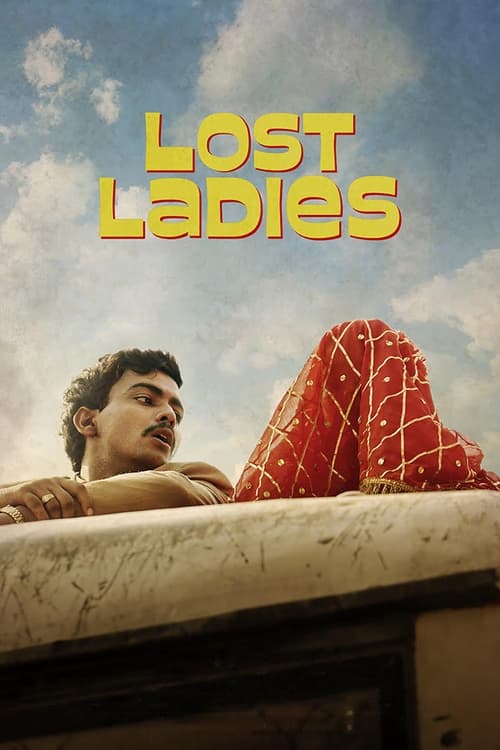
Lost Ladies
2024 · Kiran Rao
Laapataa Ladies became India's Oscar entry over All We Imagine as Light, detonating a national argument about feminist crowd-pleasers versus festival art and who decides what represents India.
For a feel-good night when you want to laugh and be moved without cynicism — comfort viewing with a real brain, great to watch with family or someone you love.
What it's about
Rural India, 2001: two young brides, faces hidden under identical long red veils, board a night train — and get off with the wrong husbands. One lands in a household of strangers who slowly become allies; the other is stranded at a railway-station tea stall, where nobody knows her and, for the first time, nobody is watching her. A farce of mistaken identity opens out into two women quietly discovering what they actually want.
The experience
Warm, funny and gently sly — it plays like a classic comedy of errors but keeps landing small, true observations about how women get overlooked. You come out smiling with a lump in your throat.
Performances
Ravi Kishan is wonderful as a corrupt small-town cop who may or may not have a conscience — he steals scenes while keeping you guessing which way he'll break.
The craft
Kiran Rao, directing again after a thirteen-year gap, works in the register of classic Hindi social comedy rather than Bollywood spectacle: the veil that causes the mix-up is also the film's whole argument, a culture of female invisibility made literal and then lovingly dismantled. The plotting is farce-tight, but the tone stays tender.
Why it matters
A word-of-mouth favorite that became one of Indian cinema's most talked-about crossover hits of its moment, and reaffirmed the tradition of the gentle social comedy that smuggles in a feminist argument.
Two young brides, faces identically hidden beneath long red veils, board a night train in rural India in 2001 — and get off with the wrong husbands. From that farce premise, Kiran Rao builds something slyer than its gentle surface suggests: the ghunghat that causes the mix-up is also the film's argument, a culture of female invisibility made literal, then lovingly dismantled. One bride lands in a household of strangers who slowly become allies; the other, stranded at a railway station tea stall, discovers what a woman might want when nobody is watching her. Rao, returning to directing thirteen years after her Mumbai mosaic Dhobi Ghat, works in the register of classic Hindi social comedy — closer to Hrishikesh Mukherjee than to Bollywood spectacle — with Ravi Kishan wonderful as a corrupt cop who may or may not have a conscience. Produced by Aamir Khan, it became a sleeper phenomenon in India, chosen as the country's official Oscar submission for 2024, and found a second enormous life on streaming. Its feminism arrives without a single raised voice, smuggled in on laughter.
Reception
A quiet theatrical release in March 2024 that grossed modestly, then exploded on Netflix into one of the year's biggest word-of-mouth Indian hits — capped by a sweep at the 2025 Filmfare Awards, including Best Film and Best Director for Kiran Rao, her first feature in the 13 years since Dhobi Ghat.
How Lost Ladies was received, from release to now →
Influences: the films it descends from and the films it influenced
- Chupke Chupke (1975) — The named template: a sustained impersonation/mistaken-identity comedy whose engine is benign deception among decent people, so laughs never require a villain — Lost Ladies inherits this gentle-farce mechanic wholesale.
- Gol Maal (1979) — A single false identity escalating through polite social embarrassment rather than danger; the humanist middle-cinema comedy of manners whose warmth-not-cruelty tone Rao explicitly cites.
- Bawarchi (1972) — An unassuming outsider quietly reorders a household's moral economy through warm ensemble staging and unforced uplift — the same 'small person quietly rights a world' arc as Lost Ladies' swapped bride.
- Angoor (1982) — Mistaken-identity farce built on dramatic irony — the audience always knowing what the characters don't — the exact suspense-through-superior-knowledge construction that drives the swapped-brides plot.
- Charulata (1964) — Female desire and interior life rendered through gesture, framing and the woman 'unseen' inside her own home — the visual grammar of female-invisibility Rao adapts to the veil.
- Mahanagar (1963) — A sheltered wife's step-by-step awakening into public agency and selfhood; the female-emergence arc that Phool's journey from lost bride to self-possession retraces.
- Teen Kanya (Samapti) (1961) — The reluctant, veiled rural child-bride as a study in withheld interiority — foregrounding the ghunghat as both literal covering and metaphor for an unread woman's mind.
- Monsoon Wedding (2001) — A wedding used as a pressure-chamber that exposes women's hidden desires and secrets across an ensemble — the same ceremony-as-x-ray staging, set in the same 2001 milieu.
- Dhobi Ghat (2010) — Rao's own authorship signature: braided parallel narratives of characters who barely intersect, and an observational compassion aimed squarely at the socially invisible.
- Peepli Live (2010) — The Aamir Khan Productions rural-satire mode — deadpan comedy that indicts systemic neglect through ordinary villagers while keeping them dignified rather than mocked.
- English Vinglish (2012) — The overlooked housewife rendered literally invisible to her family, then granted voice and worth through a warm comic arc — the female-invisibility theme played tender, not tragic.
- Parched (2015) — Rural women's sexual and economic awakening foregrounded in a village setting, giving female desire explicit narrative weight in the same milieu Lost Ladies handles by implication.
- Dum Laga Ke Haisha (2015) — Small-town arranged-marriage comedy whose craft lies in period-precise North-Indian texture and a woman's fight for self-worth inside a mismatched match.
- Lipstick Under My Burkha (2016) — Interlocking parallel plotlines of women reclaiming forbidden desire — the multi-woman ensemble structure that gives the female-desire theme a braided narrative form.
- Newton (2017) — Gentle deadpan satire set in a rural bureaucratic backwater; comedy that skewers a system while never demeaning its earnest small people — the tonal cousin to Lost Ladies' police-station scenes.
- Bareilly Ki Barfi (2017) — Small-town comedy of assumed and mistaken identities, quirky ensemble and gentle tone, proving the Hrishikesh-Mukherjee mode alive in contemporary heartland-set romance-farce.
Similar films
- Monsoon Wedding (2001) — influence & lineage
- English Vinglish (2012) — influence & lineage
- Charulata (1964) — influence & lineage
- Meiyazhagan (2024) — same viewing thread
- Main Vaapas Aaunga (2026) — same viewing thread
- Kadaisi Vivasayi (2022) — same viewing thread
- Kishkindha Kaandam (2024) — same viewing thread
- All We Imagine as Light (2024) — shared sensibility
All the films related to Lost Ladies →
Watch it with: curated runs of related films
- Small Towns, Long Memory — Watch these together for how patiently they sit with a place and its people — a last farmer, a slipping memory, a homecoming after twenty-two years — each measuring belonging in soil, kin, and time.