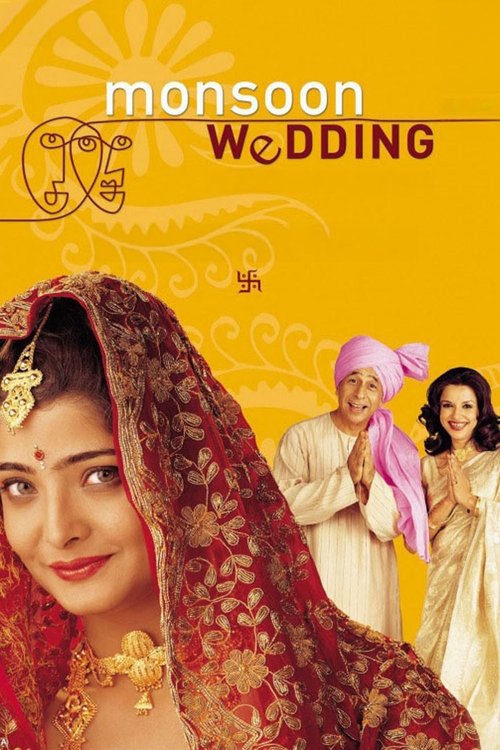
Monsoon Wedding
2001 · Mira Nair
For when you want to be swept into a big, chaotic, loving family — a feel-good film that earns its joy by being honest about what families hide. Great for a night in when you want to end up smiling through tears.
What it's about
In New Delhi, an upper-middle-class Punjabi family reunites from around the world for the four-day whirlwind before an arranged marriage — a stressed father bleeding money, a bride with divided feelings, a harried event planner falling unexpectedly in love, and relatives whose old secrets start pressing against the festivities. Overhead, the monsoon is coming.
The experience
Warm, noisy, and alive — it swirls between comedy, romance, and sudden seriousness the way a real family gathering does. By the end it's genuinely moving, with music and rain doing half the emotional work.
Performances
Naseeruddin Shah anchors the whole carnival as the father, letting worry, love, and moral backbone play across a performance of enormous warmth.
The craft
Mira Nair shot it fast and cheap on handheld Super 16mm, and the looseness is the point: cameras weave through marigolds, kitchens, and dance rehearsals like another wedding guest. The soundtrack's blend of Punjabi wedding songs, Bollywood pop, and film score makes it irresistible with good speakers.
Why it matters
It won the Golden Lion at Venice in 2001 and became one of the most widely seen Indian films in the international market, proving an intimate, local family story could travel everywhere.
Snapshot
Monsoon Wedding is Mira Nair's ensemble comedy-drama about the four-day run-up to an arranged marriage in an upper-middle-class Punjabi family in New Delhi, staged against the arrival of the seasonal monsoon. Structured around the wedding of Aditi Verma (Vasundhara Das) to the Houston-based engineer Hemant Rai (Parvin Dabas), the film braids together at least four love stories, a scattered diaspora reunited from Australia, the Gulf, and the United States, and a buried family secret of child sexual abuse that surfaces during the celebrations. Made quickly and cheaply on Super 16mm, it won the Golden Lion at the 2001 Venice Film Festival and became one of the most widely seen Indian-directed films of its era in the international art-house market. It is at once a warm family comedy and a serious reckoning with patriarchy, class, and the deracination of the globalized Indian family — Nair's synthesis of Bollywood exuberance and observational realism.
Industry & production
The film was produced through Nair's own company, Mirabai Films, with backing from IFC Productions and international partners, and made on a modest budget widely reported in the low seven figures — a sum small enough that Nair has described the production as a deliberate exercise in speed and constraint. It was shot on location in Delhi over roughly a month, using the city's real houses, markets, and monsoon rather than sets, a working method closer to guerrilla independent filmmaking than to the studio-scaled Bollywood industry it partly depicts.
The project came at a pivotal point in Nair's career. After the international breakthrough of Salaam Bombay! (1988) and the more troubled, censorship-dogged Kama Sutra: A Tale of Love (1996), Monsoon Wedding was conceived as a return to intimate, energized, personal filmmaking — a "small" film made among family and friends in the city Nair knew. The screenplay was written by Sabrina Dhawan, developed from a story rooted in the texture of Punjabi Delhi wedding culture. The cast fused respected art-cinema and theater actors — Naseeruddin Shah, Lillete Dubey, Shefali Shah (then Shetty), Rajat Kapoor — with relative newcomers, notably Vijay Raaz and Tillotama Shome, in their career-making roles.
Commercially, the film vastly outperformed its budget, crossing over from festival prestige into sustained theatrical release across Europe, North America, and Asia, and it remains one of the defining examples of a crossover Indian film that reached Western audiences without being an English-language production. Precise global grosses reported for the film vary between sources, so a single authoritative figure is best treated with caution; what is not in dispute is that its worldwide box office was a large multiple of its cost.
Technology
Monsoon Wedding was shot on Super 16mm and blown up to 35mm for release — a choice central to both its economics and its aesthetic. The smaller-gauge format kept the camera light, cheap to run, and mobile enough to work handheld in cramped domestic interiors and crowded streets, while the grain and slightly rougher texture of the blow-up reinforced the film's documentary immediacy. This was a film made at the tail end of the celluloid era's dominance and before digital acquisition became standard for independent features; its look belongs firmly to photochemical 16mm practice — saturated color negative pushed toward the marigold yellows, henna oranges, and monsoon grays that define its palette. The production's reliance on available locations and natural light, supplemented rather than replaced by rigging, was likewise enabled by the format's flexibility.
Technique
Cinematography
Declan Quinn, Nair's frequent collaborator, shot the film largely handheld, favoring a restless, close, roving camera that moves through rooms with the guests rather than observing from a fixed proscenium. The style deliberately courts the energy of home-movie and reportage footage — jostling, reframing, catching performances mid-gesture — which lends the domestic scenes their sense of a real household in motion. Against this looseness Quinn deploys an intensely saturated color scheme: the marigold garlands that recur as a visual motif, the reds and golds of wedding textiles, and finally the desaturated silver of rain. The monsoon itself becomes a photographic subject in the climax, the downpour that the whole title has promised arriving as both meteorological and emotional release.
Editing
Allyson C. Johnson's editing manages an unusually crowded ensemble — a large family plus staff, plus multiple parallel plotlines — by cross-cutting fluidly between registers, so that the broad comedy of wedding logistics, the tender working-class romance of the event planner and the maid, and the grave abuse subplot coexist without tonal collapse. The cutting sustains a propulsive rhythm through the preparation sequences and then slows to hold on faces during the film's confrontations, particularly Lalit's decision to expel his brother-in-law. The film's tonal control is largely an achievement of this editing logic, which knows when to let comedy run and when to cut it dead.
Mise-en-scène / staging
Production designer Stephanie Carroll and Nair build the film's world from the accumulated clutter of a real, lived-in home: the shamiana tents, the marigold strings, the plastic chairs and improvised electrics of a middle-class wedding under construction. The marigold is the governing decorative and symbolic element — festive, cheap, ubiquitous, and, in the recurring image of Dubey eating the flowers, quietly transformed into a token of longing. Staging emphasizes thresholds and crowded thresholds especially: doorways, courtyards, and rooftops where the family gathers and where private crises intrude on public ceremony.
Sound
The soundtrack is one of the film's most distinctive achievements, layering Mychael Danna's original score with popular Hindi film songs, Punjabi wedding music, and bhangra, so that the film's sonic world moves between diegetic celebration and scored emotion. Music is not decorative but structural — the wedding's songs mark its stages, and set pieces built around numbers such as the flirtatious performance of "Chunari Chunari" function as the film's Bollywood-inflected release valves. The layered languages of the dialogue — Hindi, Punjabi, and English, often within a single sentence — are themselves part of the sound design, registering class, generation, and diasporic dislocation through code-switching.
Performance
The film is an actors' ensemble, and its performances range across registers. Naseeruddin Shah anchors it as Lalit Verma, the anxious, loving, financially strained patriarch whose final moral choice gives the film its spine. Lillete Dubey plays his wife Pimmi with warmth and buried tension; Shefali Shah, as the niece Ria, carries the film's darkest material with restraint. Vijay Raaz's P.K. Dubey — the harried, marigold-chewing event planner who falls for the household's Christian maid Alice — became the film's breakout comic-romantic figure, and Tillotama Shome's near-silent, watchful Alice its quiet emotional counterweight. Rajat Kapoor, as the outwardly genial uncle Tej, plays the abuser with a chilling ordinariness that refuses caricature.
Narrative & dramatic mode
The film operates in an Altman-esque multi-strand ensemble mode, distributing its drama across a network of characters rather than a single protagonist, and unifying them through the pressure and deadline of the wedding. The dominant register is festive comedy — mismatched relatives, budget panic, a bride with a lingering affair, a servants' romance — but the structure is built to deliver a hairpin turn into tragedy and moral crisis when Ria reveals that Tej abused her as a child and continues to threaten another young girl. The dramatic engine is the collision between ceremony and truth: the wedding demands that the family present a seamless, respectable face precisely as its most shameful secret demands acknowledgment. The resolution — Lalit siding with his niece over money, reputation, and blood — reframes the entire comedy as a story about what a family owes its most vulnerable members.
Genre & cycle
Monsoon Wedding sits at the intersection of the wedding film, the family melodrama, and the diaspora film. It participates in the turn-of-the-millennium global vogue for wedding-centered ensemble comedies while pointedly complicating the form: where the popular Bollywood wedding films of the period tended toward glossy affirmation, Nair's film keeps the celebration but plants a knife in it. It also belongs to the emerging cycle of transnational Indian and South Asian diaspora cinema — films concerned with families dispersed across continents and the frictions of return — that gained international visibility around 2000–2002. Its blend of realist texture and musical set piece marks it as a deliberate hybrid rather than a work fully inside either the Bollywood or the art-house tradition.
Authorship & method
The dossier's core creative authorship belongs to Nair as director in close partnership with a recurring team. Screenwriter Sabrina Dhawan supplied the script's specific cultural texture and its interwoven structure. Cinematographer Declan Quinn provided the handheld, saturated 16mm look. Composer Mychael Danna, another long-term Nair collaborator, built the genre-crossing score that fuses Western scoring with Indian popular and folk idioms. Editor Allyson C. Johnson shaped the tonal balance, and production designer Stephanie Carroll the marigold-strewn material world. Nair's method here is defined by speed, locality, and intimacy — shooting fast in her home city, drawing on a mixed cast of veterans and newcomers, and privileging lived texture over polish — a mode she has repeatedly described as the film's animating principle and one that distinguishes it sharply from her larger-budgeted studio work.
Movement / national cinema
The film is best understood as part of the crossover or "middle cinema" strand of Indian filmmaking — work positioned between the mainstream Hindi commercial industry and the parallel art cinema associated with figures like Shyam Bengal and the actors (Shah, in particular) who came out of that tradition. It also stands as a landmark of globalized Indian cinema, made with international financing for a world audience yet grounded in specifically Delhi Punjabi social reality. Its Golden Lion win positioned it, alongside Nair's earlier work, as a signal that Indian-directed cinema could command the top of the European festival circuit on its own cultural terms rather than through Western mediation.
Era / period
Released in 2001, the film is a document of a particular moment in liberalized, post-1990s India: a professional, mobile upper-middle class whose children live and work in Houston, Melbourne, and the Gulf, and whose weddings must reconcile inherited ritual with globalized lives and modern intimacies. The film registers the era's tensions — arranged marriage alongside premarital affairs and open questions of consent, tradition alongside cell phones and NRI money — without resolving them into simple nostalgia or simple critique. It captures a society negotiating rapid change through its most conservative institution.
Themes
Its central themes are family and its obligations; the tension between public respectability and private truth; patriarchy and its abuses, both in the marriage plot and in the abuse subplot; class, dramatized through the parallel romance of the event planner and the maid that runs beneath the family's own; and diaspora and belonging. The monsoon itself is the governing metaphor — long anticipated, cleansing, overwhelming — mapped onto the emotional and moral downpour that the wedding precipitates. Above all the film asks what love and duty require when they conflict, and answers, in Lalit's final stand, that protecting the vulnerable must outrank family honor.
Reception, canon & influence
Critically, Monsoon Wedding was widely and warmly received, praised for its vitality, its ensemble performances, and its rare ability to hold comedy and grave subject matter in the same frame; its Golden Lion at Venice was its most prestigious endorsement and remains central to its standing. It became a durable art-house and repertory title and one of the most recognizable Indian-directed crossover films of its generation.
Looking backward, the film draws on the ensemble tradition associated with Robert Altman, on the handheld immediacy fashionable in turn-of-the-millennium independent cinema, and on the Bollywood musical's song idiom, which Nair quotes and repurposes rather than simply adopts; it also extends the socially engaged realism of Nair's own Salaam Bombay! and the parallel-cinema lineage of its lead actors.
Looking forward, its legacy is substantial. It helped consolidate a market and template for transnational South Asian wedding and family films, and it launched or elevated the careers of Vijay Raaz and Tillotama Shome. Nair herself returned to and expanded the material decades later, developing Monsoon Wedding into a stage musical that premiered at Berkeley Repertory Theatre and was subsequently staged in New York — a rare instance of a director adapting her own film for the theater. Within Nair's body of work it stands as the fullest realization of her signature mode: fast, warm, musical, socially serious cinema rooted in a specific place and family. The precise scale of its commercial and cultural reach is sometimes overstated in circulation, and exact figures should be treated carefully, but its status as a canonical work of globalized Indian cinema is secure.
A Deleuzian reading
A man is holding a string of marigolds, and he eats one.
The full Deleuzian reading of Monsoon Wedding →
Reception
It arrived a winner — the Golden Lion at Venice in 2001 and a rare arthouse crossover smash — and time has only warmed it: what once read as a bright festival hit is now cherished as a comfort classic that smuggled real family darkness in under the marigolds.
How Monsoon Wedding was received, from release to now →
Influences: the films it descends from and the films it influenced
- Salaam Bombay! (1988) — Nair's own docu-realist method — casting nonprofessionals alongside veterans and shooting in live, unpolished city locations for lived texture — is the working practice she carries directly into Monsoon Wedding.
- Nashville (1975) — The Altman template of many parallel character strands with overlapping, code-switching dialogue, all converging on a single public event, is the structural blueprint for the film's multi-strand ensemble.
- A Wedding (1978) — Altman's earlier experiment in staging a sprawling family wedding as the frame for cross-cutting among dozens of guests and their buried secrets prefigures the film's exact scenario and cutting logic.
- The Godfather (1972) — Coppola's opening set-piece — using a wedding celebration to introduce a whole family ensemble while cross-cutting the festivity against the darker private business it masks — models the comedy-to-tragedy braid.
- Hum Aapke Hain Koun..! (1994) — This is the big-joint-family Bollywood wedding-and-song idiom — the ritual musical numbers and festivity-as-narrative — that Nair quotes and repurposes rather than simply adopts.
- Ankur (1974) — Benegal's parallel-cinema naturalism trained the understated, non-melodramatic performance grammar of Nair's veteran cast (Naseeruddin Shah's milieu), which grounds the film against Bollywood pitch.
- Festen (1998) — The Dogme-handheld immediacy staging a family gathering where celebration cracks open a concealed child-sexual-abuse secret is the precise formal-and-thematic move behind the film's abuse subplot and public-respectability-vs-private-truth turn.
- Mississippi Masala (1991) — Scales up Mississippi Masala's communal-ensemble set-pieces — the eating, dancing, and multilingual cross-talk of a family gathering shot in saturated color — into a full polyphonic wedding, extending Nair's signature staging of diasporic celebration.
- The Namesake (2006) — Nair extends her own signature with the same team — Mychael Danna's East-West hybrid score and English/Bengali code-switching — to trace diasporic family tension across generations.
- Bend It Like Beckham (2002) — Chadha builds on the newly consolidated transnational South Asian family-comedy template — generational patriarchy versus a daughter's private desire, resolved through warmth rather than tragedy.
- Bride & Prejudice (2004) — Extends Nair's crossover strategy of quoting the Bollywood song-and-dance idiom for a global art-house audience, staging a marriage plot as a bilingual musical.
- Rachel Getting Married (2008) — Demme adopts the roaming handheld, documentary-immediate camera at a multicultural wedding where celebration keeps surfacing family trauma — Quinn's on-the-shoulder ensemble coverage in a new register.
- Band Baaja Baaraat (2010) — Builds a whole film around the wedding-planner's-eye view — the harried event-contractor figure Vijay Raaz embodies as P.K. Dubey — turning the logistical underside of the big Indian wedding into narrative.
- Kapoor & Sons (2016) — Carries forward the multi-strand family-reunion structure whose comedy curdles into tragedy as long-buried secrets and patriarchal fault-lines are exposed at a domestic gathering.
- The Big Sick (2017) — Extends the code-switching, respectability-versus-private-love conflict of a South Asian family — arranged expectation against chosen partner — mined for tonal balance between comedy and grave illness.
- The Lunchbox (2013) — Continues the middle-cinema mode of lived-in Mumbai locations and restrained, naturalistic ensemble performance privileging everyday texture over Bollywood polish.
- Joyland (2022) — Builds a teeming multigenerational urban South Asian household as ensemble portrait, layering class, repression and secrets under saturated festival color.
- Chithha (2023) — Exposes intra-family child sexual abuse inside a warm domestic setting, staging the guardian's protective reckoning intimately rather than as courtroom melodrama.
- English Vinglish (2012) — Multilingual code-switching (English/Hindi) staged as lived social texture and status-marking within one family, the same register in which Shashi's imperfect English becomes a marker of standing at home.
- Gosford Park (2001) — A same-year Altman ensemble that cross-cuts a large house-party across class strata, sharing the technique of layering upstairs and downstairs (family and servants) as simultaneous parallel narratives.
- My Big Fat Greek Wedding (2002) — Runs the same market template of the ethnic-wedding-family comedy — an immigrant clan's rituals, patriarchy, and respectability played for warmth around a marriage — that Monsoon Wedding helped make bankable.
- Slumdog Millionaire (2008) — Shares the saturated-color, handheld, fast-cut treatment of dense Indian urban texture married to an East-West hybrid score aimed at crossover audiences.
- Lost Ladies (2024) — A wedding used as a pressure-chamber that exposes women's hidden desires and secrets across an ensemble — the same ceremony-as-x-ray staging, set in the same 2001 milieu.
Similar films
- The Big Sick (2017) — influence & lineage
- Salaam Bombay! (1988) — influence & lineage
- Dilwale Dulhania Le Jayenge (1995) — shared sensibility
- Kabhi Khushi Kabhie Gham (2001) — shared sensibility
- Lost Ladies (2024) — shared sensibility
- Bangalore Days (2014) — shared sensibility
- All We Imagine as Light (2024) — shared sensibility
- Pather Panchali (1955) — shared sensibility