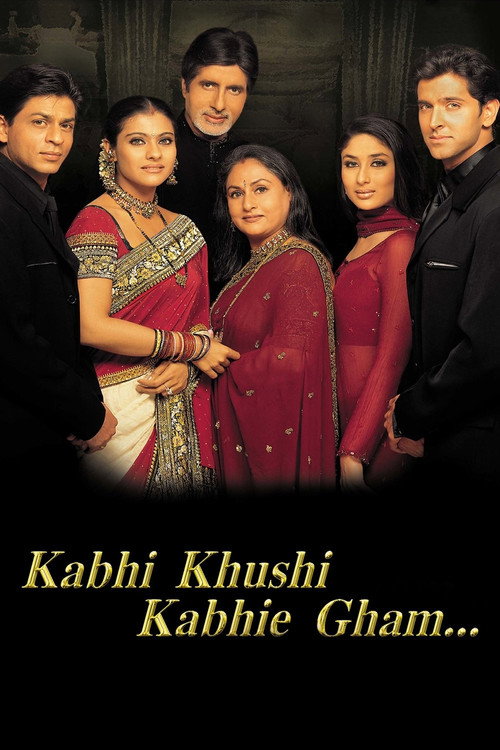
Kabhi Khushi Kabhie Gham
2001 · Karan Johar
For when you want to surrender to a big, tearful, gorgeous family saga — a rainy-weekend epic to watch with people you love, or a homesickness cure if you've ever lived far from family. Pure comfort viewing, as long as you're willing to give it the whole evening.
What it's about
A wealthy Delhi patriarch disowns his adopted son for marrying a spirited woman from the old city instead of the bride chosen for him, splitting a family across continents. Years later the younger son, now grown, sets out for London on a secret mission to find his estranged brother and stitch the family back together. Four generations, two countries, and one stubborn father's pride stand between them and a reunion.
The experience
This is maximalist melodrama, fully committed: enormous emotions, enormous houses, enormous musical numbers, with broad comedy folded between the tears. At three and a half hours it's a full evening, and it works on you shamelessly — you'll laugh at its excess and still find yourself crying when it wants you to.
Performances
A once-in-a-generation cast working at full wattage: Amitabh Bachchan as the immovable patriarch, Shah Rukh Khan and Kajol rekindling their signature chemistry — her turn as a loud-mouthed Chandni Chowk girl is the film's comic heart — with Jaya Bachchan wringing tears from a single look, and Hrithik Roshan and Kareena Kapoor as the younger, flashier generation.
The craft
Karan Johar directs like a pageant master: every frame is dressed to the nines, from candlelit mansion sets to song sequences staged across Delhi and London, with costumes and production design doing as much storytelling as the script. The soundtrack became inescapable, and the sheer scale of the musical set pieces rewards the biggest screen and best speakers you have.
Why it matters
One of the defining Bollywood blockbusters of the 2000s, it became a massive hit with Indian audiences overseas and set the template for the glossy diaspora family epic, cementing Dharma Productions' house style for a generation.
Snapshot
Karan Johar's second feature is the Hindi family melodrama inflated to its maximum viable scale: three and a half hours, four generations of star capital, two continents, and a moral argument so nakedly stated that the film's own tagline supplied the thesis — "It's all about loving your parents." Made under his father Yash Johar's Dharma Productions, Kabhi Khushi Kabhie Gham (widely shortened to K3G) takes the oldest engine in the Bombay repertoire — the lost-and-found family, the patriarch who casts out a son over an unequal marriage, the eventual tearful restoration — and stages it as a post-liberalisation pageant of wealth, diaspora belonging, and designer Indianness.
The plot is a two-act structure hinged on a hard interval. Yashvardhan "Yash" Raichand (Amitabh Bachchan), an industrialist of quasi-royal bearing, disowns his adopted elder son Rahul (Shah Rukh Khan) for marrying Anjali (Kajol), a Chandni Chowk shopkeeper's daughter. Ten years on, the younger son Rohan (Hrithik Roshan) travels to London to retrieve the exiled family and force a reconciliation, assisted by Anjali's sister Pooja — "Poo" (Kareena Kapoor). Jaya Bachchan plays the mother whose grief supplies the film's emotional weather, and whose casting opposite her real husband, decades after their 1970s collaborations, was itself part of the film's address to the audience.
The film was among the highest-grossing Hindi releases of 2001 and performed at then-unprecedented levels in overseas markets, particularly the United Kingdom and North America. It has since become one of the most durably circulated Hindi films of its generation — canonized, parodied, memed, and repeatedly reassessed as both a summit of the family-entertainer form and the point at which the form's ideology became too visible to ignore.
Industry & production
K3G arrives at a precise industrial moment. The Government of India had granted filmmaking formal industry status in 1998, opening the sector — slowly, and unevenly — to institutional bank finance and away from the opaque, often criminalised private capital that had funded Bombay cinema for decades. Simultaneously, the diaspora had been recognized as a distinct and enormously profitable market segment: Dilwale Dulhania Le Jayenge (1995) and Pardes (1997) had proven that overseas theatrical revenue could be a headline number rather than a rounding error, and satellite television, music rights, and home video were maturing into revenue streams that could be pre-sold.
Dharma Productions, founded by Yash Johar in 1976, had not previously operated at this scale. K3G was widely reported at the time as one of the most expensive Hindi films yet mounted, and its budget is legible on screen — international locations, a vast constructed bazaar, a helicopter, and costume and jewelry that function as production value in their own right. Yash Johar produced; Karan Johar, then in his late twenties and one film into his career after Kuch Kuch Hota Hai (1998), directed and wrote. The film consolidated Dharma as a house brand with a recognizable idiom, a position it has occupied ever since.
Casting was itself the business model. Bachchan was mid-resurrection: the collapse of his ABCL venture, followed by Mohabbatein (2000) and the television juggernaut Kaun Banega Crorepati, had rebuilt him as national patriarch rather than angry young man, and K3G is the film that fixed that second career in place. Shah Rukh Khan and Kajol were re-teamed after Kuch Kuch Hota Hai, their pairing already load-bearing. Hrithik Roshan had detonated into stardom with Kaho Naa... Pyaar Hai (2000). Kareena Kapoor was barely a year into her career. Rani Mukerji appears in a smaller role. Assembling six such names in one ensemble was a statement about what a Dharma production could command.
Production spanned Indian studio work, extensive location shooting in and around London, and a song sequence filmed in Egypt at the Giza pyramid complex. The Raichand estate combined studio interiors with grand exteriors shot in England — Waddesdon Manor in Buckinghamshire is the property most commonly identified in accounts of the shoot. The Chandni Chowk of the first half is largely a designed environment rather than documentary Delhi, a distinction worth holding onto: the film's "authentic India" is as constructed as its palace.
The title's spelling — Kabhi against Kabhie, the doubled vowels — reflects the numerological title superstitions then endemic in the Hindi industry, a small but telling index of how the business actually made decisions.
Technology
K3G is a photochemical film made at the last moment when that was simply the default. Shot on 35mm color negative and finished on film, it predates the digital intermediate's arrival in Indian post-production by several years; color, opticals, and titles were achieved by conventional laboratory means. There is no significant visual-effects program — the spectacle is physical, which is precisely why it has aged as well as it has. Crowds are crowds, fabric is fabric, and the mansion is a real building.
Sound is where the period's technological change is most audible. Hindi cinema had adopted digital multichannel formats through the later 1990s, and K3G is engineered for a big-room, high-level presentation: songs mixed for surround impact, dialogue foregrounded, score cushioning nearly every scene. In keeping with prevailing Bombay practice, dialogue was post-dubbed rather than recorded live — a notable contrast with Lagaan, released the same year, whose use of synchronous sound was treated as an event in itself. The two 2001 films thus sit on opposite sides of a technical threshold the industry was then crossing.
Distribution technology mattered as much as production technology. The film was released on a large international print count and moved quickly into VCD and DVD, formats that carried Hindi cinema into diaspora households at a volume theatrical exhibition never could — and, simultaneously, into a piracy economy the industry spent the decade failing to contain. Its soundtrack, released on physical cassette and CD in the last years before that market's collapse, was among the year's biggest sellers.
Technique
Cinematography
Kiran Deohans — who had shot 1942: A Love Story (1994) and would later photograph Jodhaa Akbar (2008) — lights K3G as two distinct films. The Raichand world is polished, cool, and architectural: wide compositions that subordinate figures to marble and chandeliers, backlight used to separate bodies from expensive rooms, camera moves that glide rather than jostle. Chandni Chowk is warmer, denser, more saturated, shot closer and with more handheld inflection, its color skewed toward reds and golds. The grammar is not subtle, and is not meant to be: wealth is photographed as space, community as texture.
The song picturisations expand the vocabulary considerably — crane descents, circling 360-degree moves around embracing couples, telephoto compression across the Giza plateau in "Suraj Hua Maddham," and the shallow-focus close-up as an emotional exclamation mark. Deohans is a fluent classicist here rather than an innovator; the achievement is consistency across an enormous logistical range.
Editing
Sanjay Sankla cuts to the two-part architecture that governs almost all commercial Hindi cinema of the era: a first half that builds toward the interval's catastrophe, a second that engineers its reversal. The film runs roughly three and a half hours and is unembarrassed about it. Scenes are permitted to extend past their informational function so that emotion can accumulate; reaction shots are held; a single revelation may be replayed across three faces.
The most characteristic editorial device is the flashback insert — a line in the present triggering a fragment of the past, often a few seconds of a scene the audience has already witnessed, returned as an emotional stamp. Song sequences, by contrast, are cut fast and rhythmically, sometimes at a rate several times that of the surrounding drama. That deliberate metabolic difference between narrative and number is central to how the film breathes.
Mise-en-scène / staging
Sharmishta Roy's production design is arguably the film's dominant authorial voice. The Raichand mansion is a total environment — staircases built for entrances, a helipad that turns arrival into liturgy, interiors scaled so that family members must cross distance to reach each other, a spatial metaphor the film exploits repeatedly. Against it, the Delhi bazaar is stacked, cluttered, and communal: no privacy, therefore no alienation.
Manish Malhotra's costume work is not decoration but characterization and, in Poo's case, near-authorship. Kareena Kapoor's wardrobe — the crop tops, the sunglasses, the sheer contempt for restraint — created a figure who outlived the film's plot entirely. Festival and ritual staging (Diwali, karva chauth, the ceremonial marking of family time) does heavy ideological work, defining "Indianness" through a specific, largely upper-caste North Indian Hindu vocabulary that the film presents as simply universal.
Farah Khan's choreography organizes bodies in ensemble formations that read instantly at scale — "Bole Chudiyan" and "Say Shava Shava" are staged as family events, integrating the older generation into the dance floor rather than sidelining it.
Sound
The score by Jatin–Lalit, with contributions from Sandesh Shandilya and Aadesh Shrivastava, and lyrics chiefly by Sameer, produced one of the decade's defining soundtracks. The title song, in Lata Mangeshkar's rendition, functions as a leitmotif of loss threaded through the entire picture — its return is the film's most reliable emotional trigger. "Suraj Hua Maddham" (Sonu Nigam, Alka Yagnik) is the romantic set piece; "Bole Chudiyan" the communal one; "You Are My Soniya" the youth-market entry; "Say Shava Shava" the patriarch's release into play.
Beyond the songs, the film's sound design leans hard on background score — very little of K3G plays dry. The most discussed sound gesture is diegetic and patriotic: the Indian national anthem sung by a child at a London school assembly, a scene that crystallizes the film's argument that national belonging is portable, inherited, and performable abroad.
Performance
Registers vary by generation, deliberately. Amitabh Bachchan plays Yash in a mode of vocal gravity and physical stillness, withholding rather than emoting; the performance's power comes from the audience's memory of what that voice once did. Jaya Bachchan's Nandini is the film's affective center, a study in suppressed grief that erupts perhaps three times in three and a half hours. Shah Rukh Khan operates in his signature idiom of trembling sincerity, and Kajol supplies most of the film's comic energy and nearly all of its class friction. Hrithik Roshan carries the second half on physical presence and earnestness. Kareena Kapoor, playing broad and knowing, gives the most stylized performance in the film and the one that has proven most culturally resilient.
Narrative & dramatic mode
The film is melodrama in the technical sense: a mode organized around moral legibility, the externalization of interior states, and the deferral of recognition. Nobody in K3G is ambiguous. The conflict is not between competing goods but between a rigid patriarchal principle and the obvious claims of love, and the film's suspense derives entirely from delay — how long can restoration be withheld?
Its structural inheritance is the khoya-paya (lost-and-found) family narrative that Bombay cinema has run since at least the 1950s, refitted so that separation is voluntary rather than accidental: the father chooses exile for his son, which makes reconciliation a matter of repentance rather than coincidence. The adoption premise sharpens this — Yash's rejection can be read as blood asserting itself against chosen kinship, and the film's resolution insists, somewhat strenuously, that it never was about blood.
Songs are not interruptions but a parallel narrative channel, carrying interiority the dialogue cannot. The interval functions as a genuine formal break, splitting the film into a tragedy and its answering comedy.
Genre & cycle
K3G belongs to the 1990s–2000s cycle of the big family entertainer, whose founding text is Sooraj Barjatya's Hum Aapke Hain Koun..! (1994) — the film that proved a plotless celebration of ritual and kinship could outgross anything. Yash Raj's Dilwale Dulhania Le Jayenge (1995) added the diaspora and the proposition that tradition and modernity could be reconciled by a sufficiently well-behaved hero. Johar's own Kuch Kuch Hota Hai (1998) added youth-market gloss and a designer visual language.
K3G is the cycle's maximalist statement: it takes the wedding-film's ritual density, the diaspora romance's transnational geography, and the classical melodrama's patriarchal conflict, and runs all three at once. It also marks a limit. After K3G, the form's scale had nowhere obvious to go, and the mid-2000s saw both its continuation as house style and its fracture into multiplex-oriented smaller cinema.
Authorship & method
Karan Johar wrote and directed, and the film is best understood as an authored object in the producer-auteur tradition — the director as curator of stars, songs, spaces, and sentiment. His method is emotional maximization: identify the moment of greatest feeling in each scene and stage everything else to arrive there. He also inherits a specific lineage. Johar worked as an assistant on DDLJ and appeared in it, and his cinema is a direct continuation of Yash Chopra's romantic melodrama by way of Aditya Chopra's diaspora rewrite — the title itself echoes Yash Chopra's Kabhi Kabhie (1976).
His key collaborators constitute a recognizable repertory, most carried over from Kuch Kuch Hota Hai: Sharmishta Roy on design, Manish Malhotra on costume, Farah Khan on choreography, Sanjay Sankla cutting, Jatin–Lalit heading the music. Kiran Deohans on camera is the notable outside hire, bringing a heavier, more classical photographic weight than Johar's debut had. The consistency of this team across Dharma and Yash Raj productions of the period is a large part of why "Bollywood" of the late 1990s and 2000s has such a unified look — a house style produced by shared crew rather than shared direction.
Movement / national cinema
K3G is a central document of post-liberalisation Hindi cinema — the body of films made after India's 1991 economic reforms, in which consumption ceased to be morally suspect and wealth became aspirational rather than corrupting. In an earlier Bombay cinema, the Raichand fortune would have marked Yash as a villain; here it marks him as a custodian.
It is equally a central document of diaspora cinema. Half the film takes place in London, where Indianness is maintained as ritual practice under mild siege — the child who sings the Indian anthem, the sister who threatens to become too Western, the mother's shop that reproduces home. Scholarship on Hindi cinema and the diaspora (Vijay Mishra, Rachel Dwyer, Jigna Desai, Priya Joshi, among others) has treated films of this cycle as machinery for producing a portable, consumable national identity for the non-resident Indian audience whose foreign-currency ticket revenue had become strategically important. K3G makes that machinery unusually easy to see.
Era / period
The film sits at the exact hinge of the Indian 2000s. 2001 produced Lagaan, which took the top critical honors of its year and pointed toward realist ambition and international festival address, and Gadar: Ek Prem Katha, which channeled mass sentiment through nationalist spectacle; K3G took the third path, of transnational family melodrama and diaspora address. All three were enormous. Within a few years the multiplex would fragment that unified audience, and the single film capable of satisfying everyone from a small-town single screen to a cinema in Southall would become a rarer object.
It is also a film of a specific media moment: pre-broadband, pre-streaming, pre-social, when a soundtrack's dominance was measured in cassette sales and a film's afterlife in television reruns.
Reception, canon & influence
Contemporary reception was split along a fault line that has only widened. The film was a major commercial success, widely reported as among the year's top domestic grossers and as setting new benchmarks in overseas territories, and it took multiple honors in the technical and supporting categories at the following year's Filmfare ceremony, where Lagaan claimed the principal prizes. Audiences responded overwhelmingly to the music, the star ensemble, and the emotional architecture.
Critically, the reaction ranged from admiration for the craft to sharp objection to the politics. Reviewers noted the length, the redundancy of the second half, and above all the film's explicit endorsement of parental authority — a tagline instructing the audience to love their parents sat uneasily with a plot in which a father's cruelty is ultimately absorbed rather than confronted. Later academic and critical writing has extended this, examining the film's conflation of Indianness with a narrow upper-caste Hindu ritual vocabulary, its class condescension toward the Chandni Chowk family it claims to celebrate, and the feudal aesthetics of the Raichand household. Johar himself has spoken publicly, in the years since, about the film's excesses.
Influences on the film (backward). The disowned son and the socially unequal love match reach back through Mughal-e-Azam-style dynastic conflict to the whole tradition of the Hindi patriarchal melodrama. The mother-son bond and the ethics of return descend from Mother India and Yash Chopra's Deewaar. The family-ritual template and the interminable pleasure of extended kin are Hum Aapke Hain Koun..!'s legacy. The diaspora structure, the London geography, and the reconciliation of tradition with global mobility come from DDLJ. The star-pairing, the designer surface, and the youth register come from Johar's own Kuch Kuch Hota Hai.
Legacy (forward). K3G established the Dharma house style — glossy, emotionally direct, fashion-forward, family-centred — that governed a decade of the studio's output and shaped competitors' as well. It confirmed the overseas market as a primary rather than supplementary revenue base, altering how Hindi films were budgeted, cast, and marketed. It fixed Amitabh Bachchan's late-career persona as patriarch, a role he has played in variations ever since. It made Kareena Kapoor's Poo into a free-floating cultural figure who long outlasted her narrative function, and the film as a whole into one of the most heavily quoted, GIF-ed, and parodied texts in Indian internet culture — an afterlife in which its sincerity is both mocked and, unmistakably, loved. Johar's later Kabhi Alvida Naa Kehna (2006) can be read as a deliberate inversion of K3G's faith in the family, which suggests how thoroughly this film had defined the position he was arguing against.
Twenty-five years on, its standing is genuinely double: a technical and emotional high-water mark for a form Bombay cinema may never mount at this scale again, and the clearest available specimen of that form's assumptions about class, nation, and obedience.
A Deleuzian reading
The house has a helipad.
The full Deleuzian reading of Kabhi Khushi Kabhie Gham →
Reception
A monster hit in 2001 that critics side-eyed as overstuffed melodrama, K3G has aged into a beloved comfort classic — its maximalism now read as the whole point, peak Bollywood opulence delivered without apology.
How Kabhi Khushi Kabhie Gham was received, from release to now →
How to watch Kabhi Khushi Kabhie Gham: what to notice on a first viewing
- Notice how far family members must walk to reach each other. Roy designs the Raichand mansion with staircases built for entrances and rooms scaled so wide that closing an emotional gap always means physically crossing real distance. The house turns every family moment into a small journey, before a single word of dialogue does the same work.
- Track the mansion and the bazaar being lit completely differently. The Raichand world is shot cool, polished, and wide, while Chandni Chowk is warmer, denser, and closer, skewed toward reds and golds. Wealth is photographed as cold space here, and community is photographed as warm texture, before either is ever discussed.
- Listen for the title song returning across the film. Lata Mangeshkar's rendition of the title song keeps resurfacing at different points, functioning as a running thread of loss that ties distant scenes together. The melody is doing memory's work, reminding you of an absence even in scenes that never mention it.
- Watch the older generation join the group dance numbers. The big ensemble songs stage grandparents and parents dancing right alongside the young cast, rather than watching from the side the way many family films would. The choreography itself argues that the whole family belongs together, before the plot gets there.
- Follow how much faster the songs cut than the dialogue. Whenever a song begins, the editing rhythm speeds up several times over compared to the held, patient pace of the surrounding drama. The film breathes on two different clocks, one for talking and one for feeling.
The whole guide to watching Kabhi Khushi Kabhie Gham, with the keys for a rewatch →
Influences: the films it descends from and the films it influenced
- Awaara (1951) — Establishes the patriarch-as-magistrate blocking K3G reuses — the father seated, elevated and frontal, delivering a verdict on a son whose legitimacy of 'blood' is the case at hand, with the socially unequal beloved as the disqualifying evidence.
- Mother India (1957) — Supplies the sanctified low-angle close-up of the enduring mother as the film's moral tribunal, and the ethic that a son's return is a debt owed to her rather than to the father — the structural engine of K3G's entire second half.
- Mughal-e-Azam (1960) — The monumental frontal staging of dynastic refusal: father and son held in wide, symmetrical compositions inside a palace hall whose architecture dwarfs the rebel, a scheme Sharmishta Roy's Raichand atrium reproduces in marble and chandelier.
- Deewaar (1975) — The two-son melodrama in which the mother is the contested object and the moral split is stated aloud as a single line of dialogue; K3G inverts the polarity — the exiled elder son is the righteous one, and the younger is dispatched to retrieve him.
- Kabhi Kabhie (1976) — Model for the title song as recursive leitmotif — sung, hummed and reprised across years by different characters so the melody carries memory rather than plot; K3G borrows the device wholesale along with the title's cadence.
- Jo Jeeta Wohi Sikandar (1992) — Kiran Deohans's class-coded lighting grammar: the wealthy institution in cool, hard, high-key polish against the working household in warm, practical-sourced softness — the exact scheme he scales up for the Raichand mansion versus Chandni Chowk.
- Hum Aapke Hain Koun..! (1994) — Invents the ritual-festival set piece as narrative substitute — sangeet and games staged as full production numbers with extended kin arrayed across a single opulent house — which K3G restages as 'Bole Chudiyan' and the Diwali block.
- Dilwale Dulhania Le Jayenge (1995) — The diaspora template Johar assisted on directly: London establishing geography, the NRI household that polices Indianness from abroad, and a climax that resolves not by elopement but by the father's granted permission.
- Kuch Kuch Hota Hai (1998) — Assembles the repertory carried intact into K3G — Sharmishta Roy's design, Manish Malhotra's costume-as-characterisation, Farah Khan's choreography, Sanjay Sankla's cutting — plus the two-movement structure hinged on a time jump at the interval.
- Kal Ho Naa Ho (2003) — Johar-scripted transplant of the K3G apparatus to New York: Malhotra styling, the same diaspora-household geography, and the title-song leitmotif deployed on the Kabhi Kabhie model but resolved as elegy rather than reunion.
- Baghban (2003) — Runs the late-career Bachchan patriarch persona K3G fixed as the entire premise — the father's wounded authority as the film's moral engine, staged in the same dignified-suffering close-ups and reproachful silences.
- Main Hoon Na (2004) — Farah Khan's move from K3G's choreography floor to direction carries over her massed-formation courtyard number and the circling 360-degree crane, now applied to a lost-half-brother reunion plot.
- Kabhi Alvida Naa Kehna (2006) — Johar turning his own grammar against itself: identical repertory, glossy NRI interiors and leitmotif scoring, but the emotional-maximisation beats now land on escaping the family rather than returning to it.
- Student of the Year (2012) — Codifies the Dharma house style K3G established — Malhotra costume as characterization, high-gloss institutional lighting, and the slow-tilt glamour entrance that Poo's introduction invented, stripped of the melodrama it originally served.
- Rocky Aur Rani Kii Prem Kahaani (2023) — Knowingly re-stages K3G's Delhi-elite versus Chandni Chowk class collision — Bachchan-style patriarch, ritual set piece, family-permission climax — while reversing the verdict the earlier film's blocking had rendered.
- My Name Is Khan (2010) — Johar's own melodramatic grammar transplanted wholesale — the maternal blessing staged as ritual, slow-motion recognition entrances, songs deployed as emotional punctuation rather than plot, and the Khan–Kajol register of comic sparring collapsing into weeping reconciliation.
- Hum Saath-Saath Hain (1999) — Contemporaneous joint-family ensemble built on the same block structure: a son exiled by a parent's decree, the household reconciled through festival staging rather than confrontation, with kin choreographed in tiered courtyard formations.
- Mohabbatein (2000) — Fixes Bachchan's authoritarian patriarch a year earlier through reverent low-angle entrances and echoing institutional interiors — authority rendered as architecture, the register K3G's Raichand hall extends into domestic space.
- Devdas (2002) — The rival statement of the same maximalist turn: purpose-built palatial sets, heavily saturated color-coded lighting, and a festival number ('Dola Re') placed as emotional climax where plot would normally sit.
Similar films
- Kuch Kuch Hota Hai (1998) — influence & lineage
- Dilwale Dulhania Le Jayenge (1995) — influence & lineage
- Kal Ho Naa Ho (2003) — influence & lineage
- Awaara (1951) — influence & lineage
- My Name Is Khan (2010) — shared sensibility
- Monsoon Wedding (2001) — shared sensibility
- Jab We Met (2007) — shared sensibility
- Bajrangi Bhaijaan (2015) — shared sensibility