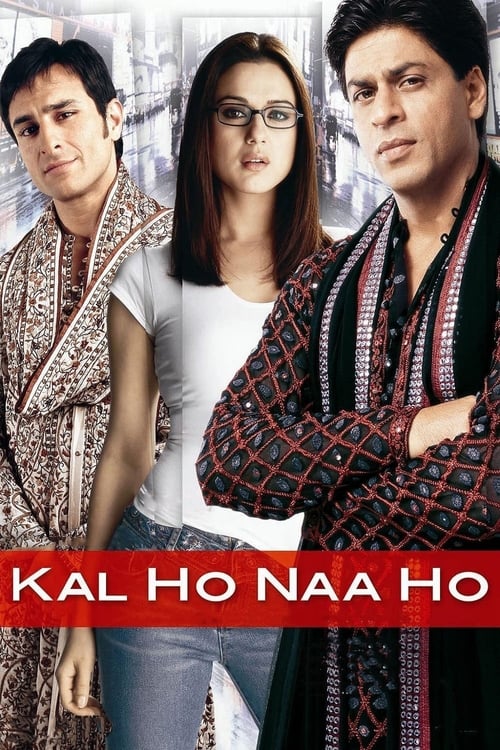
Kal Ho Naa Ho
2003 · Nikkhil Advani
When you want a lavish romantic weepie — to laugh, swoon, and then cry hard. Reach for it on a night when you're willing to be emotionally wrecked by design; keep tissues within arm's length.
What it's about
In Manhattan, Naina — an uptight MBA student holding together her fractured Indian-Christian household in Queens — finds her guarded world upended by Aman, an irrepressibly charming new neighbor who sets about fixing her family's troubles and teaching her to live a little. She falls for him; but Aman is carrying a secret, and instead of returning her love he begins engineering a match between her and her devoted friend Rohit.
The experience
It swings between big glossy comedy, soaring musical numbers, and full-throated melodrama — the first half sparkles, the second half goes straight for the tear ducts. This is a film that wants you sobbing by the end, and it usually gets its way.
Performances
Shah Rukh Khan gives one of his defining performances, all effervescent charm with grief flickering underneath; Preity Zinta grounds the film as Naina, and Saif Ali Khan nearly steals it with loose, funny, generous work as Rohit.
The craft
Nikkhil Advani's debut, shaped by producer-writer Karan Johar, gives the diaspora romance a glossy New York canvas and one of Hindi cinema's most beloved soundtracks — the title song alone became a generational anthem. The staging of the musical numbers is lavish, and the script's tonal gear-shifts from farce to deathbed melodrama are executed with real craft.
Why it matters
A landmark of the 2000s diaspora romance that pushed the Bollywood family musical into darker emotional territory, its songs and its love-triangle template echoing through Hindi romances for years after. It cemented the Shah Rukh Khan–Dharma Productions partnership as the era's defining brand of romance.
Snapshot
Kal Ho Naa Ho is the point at which the Hindi diaspora romance turns and looks at death. A Manhattan-set melodrama produced by Dharma Productions, written and shepherded by Karan Johar and directed by his former assistant Nikkhil Advani, it takes the family-and-courtship architecture that Johar and Aditya Chopra had standardized through the late 1990s and runs it through a terminal-illness plot borrowed, unmistakably, from Hrishikesh Mukherjee's Anand (1971). Naina Catherine Kapur (Preity Zinta), an MBA student holding together a bruised, half-broken household in Queens, is loosened out of her defensiveness by Aman Mathur (Shah Rukh Khan), a new neighbor whose extravagant life-force turns out to be borrowed time; knowing he is dying of a heart condition, Aman engineers her marriage to his friend Rohit (Saif Ali Khan) and denies his own feeling to the end.
The film runs past three hours, splits cleanly at the interval from screwball comedy into sustained weepie, and closes on a six-year epilogue. It was one of the largest Hindi hits of 2003 and, more durably, produced a title song — Sonu Nigam's rendition of the Shankar–Ehsaan–Loy/Javed Akhtar theme — that has passed into general Indian usage as a farewell and memorial anthem, detached from the film that produced it. Two decades on it is read simultaneously as the high-water mark of Dharma's glossy diaspora mode and as one of the most-criticised texts in the discussion of Bollywood's handling of queerness.
Industry & production
The film belongs to the corporatised phase of the Bombay industry that followed the granting of official industry status in 1998, when bank and institutional finance began to displace the opaque private capital of earlier decades, and when overseas theatrical revenue — the UK, the US, the Gulf — had become a line item that could justify a production budget on its own. Dharma Productions, founded by Yash Johar, had reached its commercial peak with Kuch Kuch Hota Hai (1998) and Kabhi Khushi Kabhie Gham (2001); Kal Ho Naa Ho is its consolidation, and Yash Johar's last major production before his death in June 2004. Karan Johar has spoken since about how his father's illness during this period fed the film's preoccupation with mortality; the biographical reading is his own, offered retrospectively, and should be held loosely.
Advani, directing his first feature, had assisted Johar on both Kuch Kuch Hota Hai and Kabhi Khushi Kabhie Gham. The authorship is therefore genuinely split: Johar supplied the story and co-wrote the screenplay with Niranjan Iyengar, who also wrote the dialogue, and the film carries the Dharma house signature so completely in casting, costume, music and emotional grammar that it is often discussed as a Johar film with another name on the director's card. Advani's own subsequent career — Salaam-e-Ishq (2007), D-Day (2013), Batla House (2019), the streaming series Mumbai Diaries — moved decisively away from this register, which retrospectively sharpens the sense that the house style, not the debutant, is what governs here.
The shoot was based extensively in New York City in 2002–03, at a moment when Manhattan location work by an Indian production was still notable and when the city's post-9/11 image economy was actively courting film-makers. The Hindi film had long used the foreign location as an emotional free zone — Switzerland for Yash Chopra, Scotland and London for Johar — but Kal Ho Naa Ho is unusual in treating New York as an inhabited home rather than a holiday backdrop: the characters work there, run a failing café there, and are buried there.
Technology
Technologically the film sits in the last stretch of the photochemical mainstream. It was shot on 35mm color negative and finished for conventional release printing; the digital intermediate, which would become standard in Indian post-production over the following few years, had not yet been normalized, and the detailed record of this particular film's finishing pipeline is thin enough that specific claims about it should not be made. What is visible on screen is a print-based color aesthetic: dense, saturated primaries achieved in camera and in the lab through lighting, costume and set color rather than through a grading suite.
Sound was released in digital multichannel formats then standard for A-list Hindi releases. The larger technological transition running under the film is the industry's slow move from post-synchronised dialogue — the century-old default, in which actors dubbed their lines in studio after the fact — toward location sync sound, a shift usually dated to Lagaan and Dil Chahta Hai in 2001. Big-canvas star vehicles shooting in noisy foreign cities were among the last to convert, and the dialogue in Kal Ho Naa Ho has the clean, forward, slightly disembodied presence characteristic of studio-built tracks.
Technique
Cinematography
Anil Mehta — who had shot Hum Dil De Chuke Sanam (1999) and Lagaan (2001) — photographs the film in a high-key, warm-shadowed register with very little contrast latitude given up to realism. New York is rendered as bright glass, water and bridge cable; interiors are lit to a flattering, near-shadowless fill that keeps faces continuously legible, which is a melodramatic requirement rather than a naturalistic failure. The vocabulary is long-lens singles for emotional beats, wide-angle crane and dolly moves for the musical numbers, and skyline establishing material used as punctuation between scenes. Mehta's most efficient device is the reverse: a great deal of the film's meaning is carried by cuts to Aman watching Naina from just outside the frame she thinks she occupies alone, so that the audience is repeatedly placed in the position of knowing more than the heroine does.
Editing
Sanjay Sankla, a Dharma regular, cuts to the interval-based two-act structure that governs commercial Hindi features. The first half is fast, gag-driven and elliptical, cutting on comic reaction; the second slows markedly, holds shots longer, and lets scenes play out to their full emotional length. The song sequences are cut on their own logic, as self-contained set-pieces with their own continuity, rhythm and geography — a convention that a viewer trained on Hollywood continuity reads as rupture and which the form treats as a parallel expressive channel. The film's principal structural gamble is the retrospective frame: Naina's voice-over opens the film and returns to close it, which converts everything between into recollection and pre-loads the comedy with elegy.
Mise-en-scène / staging
Sharmishta Roy's production design gives the Kapur household a specific, worked-in Queens texture — the struggling café, the crowded kitchen, the visible seams of a family whose father's suicide and illegitimate daughter have never been metabolized — and sets it against the aspirational cleanliness of the Manhattan sequences. Manish Malhotra's costume work is doing sustained narrative labor: Naina's transformation is staged almost entirely through wardrobe, from severe dark spectacles-and-shirt drabness to color, and the film's most-quoted images are costume images. Farah Khan's choreography, particularly for the sangeet number "Maahi Ve," organizes the extended family into a single legible social body — the entire ensemble arranged, in sequence, as a portrait of the community the film wants to repair. The staging of the household around the grandmother's cruelty and the mother's endurance is old melodramatic blocking, worked with confidence.
Sound
Shankar–Ehsaan–Loy's score and songs, with lyrics by Javed Akhtar, are the film's spine. The title theme functions as a genuine leitmotif, recurring in instrumental and vocal variants and in a slowed reprise that does most of the work of the final act; Sonu Nigam's lead vocal is the film's single most consequential artifact. The soundtrack is deliberately eclectic — the club number "It's the Time to Disco," the wedding-Punjabi of "Maahi Ve," a "Pretty Woman" number built on the licensed hook of Roy Orbison's 1964 song — and the eclecticism is itself a diaspora argument: this is music that moves between registers as fluently as the characters move between languages. Playback singing remains, as always in this cinema, a second layer of performance running in parallel with the actors' bodies.
Performance
Shah Rukh Khan is playing, with unusual self-awareness, a compilation of his own persona: the hyperactive charm of the mid-1990s romantic lead fused to the death-marked figure he had been returning to since Baazigar (1993) and Kabhi Haan Kabhi Naa (1994), and had most recently inhabited in Devdas (2002). The performance is deliberately overscaled in the first half so that its collapse in the second registers as cost. Preity Zinta plays Naina against the era's ingénue default — brittle, closed, unglamorous by design in the opening reels — and her arc is legible as a loosening rather than a transformation. Saif Ali Khan's Rohit belongs to the reinvention that ran from Dil Chahta Hai (2001) through Hum Tum (2004), in which a comic second lead was rebuilt as a leading man; his work here is the film's most modulated. Jaya Bachchan supplies the maternal gravity, and Sushma Seth the grandmother's sourness. The film also runs a persistent gag in which the housekeeper Kantaben misreads Aman and Rohit's closeness as a sexual relationship — material now central to critical writing on the film, discussed further below.
Narrative & dramatic mode
The mode is melodrama in its precise sense: a dramaturgy of legibility, in which moral positions are externalized, coincidence is structural rather than accidental, and music carries what dialogue cannot. The plot is a triangle resolved by renunciation, the oldest device in the Hindi repertoire, with one significant inversion — the sacrificing party is the man, and his sacrifice takes the form of actively constructing his rival's happiness. Aman does not step aside; he stage-manages. This makes him a variant of the Cyrano figure grafted onto the Anand archetype of the dying man whose function is to teach the living how to live.
The retrospective narration does something specific to the comedy: because the audience is told from the first minutes that this is a story being remembered, every joke in the first half is legible in two registers at once. The second half then withholds almost nothing, which is not a failure of suspense but a deliberate melodramatic choice — the tension is not whether Aman will die but how long the characters can keep not saying what they know.
Genre & cycle
The film is a late, self-conscious entry in the NRI romance cycle that runs from Dilwale Dulhania Le Jayenge (1995) and Pardes (1997) through Kuch Kuch Hota Hai (1998) and Kabhi Khushi Kabhie Gham (2001), and onward to Salaam Namaste (2005) and Kabhi Alvida Naa Kehna (2006). The cycle's governing question — whether Indianness survives relocation — is by 2003 no longer in doubt, and Kal Ho Naa Ho accordingly spends almost no energy on it. Its diaspora is settled, multi-generational and unanxious about assimilation; the crisis is internal to the family, not between the family and America. It is simultaneously a terminal-illness weepie, a genre with its own transnational lineage, and a family melodrama of restored legitimacy.
Authorship & method
The controlling authorial signature is Karan Johar's, executed by Advani. The method is producer-led and collaborator-stable: Mehta's photography, Sankla's cutting, Roy's sets, Malhotra's costumes, Farah Khan's choreography and Shankar–Ehsaan–Loy's music form a repertory unit whose members recur across Dharma and Yash Raj productions of the period. Iyengar's dialogue, in a mixed Hindi-Urdu-English idiom, is written for quotability and does much of the work of establishing the characters' bilingual class position. The result is closer to studio authorship than to auteur authorship — a house achieving a house effect — which is why the film reads as continuous with Johar's directed work despite the different credit.
Movement / national cinema
Kal Ho Naa Ho is a central document of what Ashish Rajadhyaksha influentially called the "Bollywoodisation" of Indian cinema: the emergence, around the turn of the millennium, of a globally-circulating culture industry in which the film is one node among music, television, fashion and diaspora event culture. Scholarship on this period — Vijay Mishra's Bollywood Cinema: Temples of Desire (2002), Jigna Desai's Beyond Bollywood (2004), Rachel Dwyer's work on the Chopra and Johar houses — provides the frame in which the film is usually placed. Within it, Kal Ho Naa Ho is notable for its casual religious pluralism: Naina Catherine Kapur's household is Hindu-Christian, the film moves without comment between a church and a Punjabi wedding, and this ecumenism is presented as ordinary rather than as a theme.
Era / period
The film's New York is a post-9/11 city photographed without reference to the attack, and the omission is itself period-specific: a warm, welcoming, unwounded Manhattan offered to an audience for whom the city had recently become an image of catastrophe. Domestically it arrives in an unusually strong Hindi year alongside Koi... Mil Gaya, Munna Bhai M.B.B.S. and Baghban, at a moment when multiplex construction was beginning to segment the Indian audience and when the overseas market had become large enough to shape scripts.
Themes
Mortality is the explicit subject, and the title — roughly, there may be no tomorrow — is stated as an imperative rather than a lament. Around it the film organises: the reparability of a damaged family, worked through the mother's eventual acceptance of her late husband's illegitimate daughter and the grandmother's belated softening; the ethics of the beneficial lie, since almost every act of love in the film is also an act of concealment; and the gendering of sacrifice, which the film inverts without fully examining. Its most contested material is the running Kantaben gag, which extracts comedy from the misreading of male intimacy as homosexuality. Later criticism has treated this as straightforwardly homophobic; a parallel body of queer reading has treated the Aman–Rohit relationship as the film's genuine emotional center, with the gag functioning as the disavowal that permits it. Both readings are now standard, and the film's canonical status is inseparable from the argument.
Reception, canon & influence
Contemporary Indian reception was strongly positive and commercially enormous: the film was among 2003's biggest domestic earners and performed exceptionally in the overseas circuit, though specific figures vary between sources and are not reproduced here. At the following year's Filmfare Awards it took a broad sweep of craft and supporting honors — Zinta for Best Actress, Jaya Bachchan and Saif Ali Khan in the supporting categories, Shankar–Ehsaan–Loy for music, Javed Akhtar for lyrics, Sonu Nigam for playback and Farah Khan for choreography — while the top prizes that year went to Koi... Mil Gaya. Criticism at the time and since has centered on the length, the tonal break at the interval, and the calculated efficiency of the emotional machinery.
Backward, the debts are clear and largely acknowledged: Anand (1971) and, more distantly, Mili (1975) for the dying protagonist who reorganizes other people's lives; the Hollywood terminal romance from Love Story (1970) onward for the disease-melodrama grammar; and, most immediately, the Chopra–Johar diaspora romance for everything structural. Forward, its legacy is uneven but real. It made New York a default Hindi-film location and set the template that Johar himself would darken three years later in Kabhi Alvida Naa Kehna. It confirmed Saif Ali Khan's second career and launched Farah Khan toward direction (Main Hoon Na, 2004). It gave Shah Rukh Khan the definitive statement of his romantic-fatalist persona, a role his later career repeatedly cites. And the title song has had the longest life of anything in it, functioning across South Asia and its diaspora as a graduation and funeral standard — a piece of cultural furniture whose users frequently do not connect it to the film at all. The film remains a fixture of streaming catalogs and of anniversary re-release programming, sustained by an audience that treats it less as a 2003 release than as a permanent reference point.
Reception
A blockbuster on release — 2003's biggest Bollywood hit overseas and a Filmfare magnet — it's since settled into millennial comfort-cry canon: the definitive Dharma NRI-era weepie people rewatch knowing exactly what it will do to them, even as its comedy gets side-eyed today.
How Kal Ho Naa Ho was received, from release to now →
How to watch Kal Ho Naa Ho: what to notice on a first viewing
- Notice how often the camera catches Aman watching Naina. Mehta repeatedly cuts to Aman observing her from just outside the frame she thinks she occupies alone, placing you ahead of what she knows. You are given more information than the heroine has, which changes how every scene between them plays.
- Watch Naina's clothes shift from severe dark to color. Her spectacles-and-shirt drabness gradually gives way to brighter costume as the film goes on, staging her whole change almost entirely through wardrobe. Costume alone tells you how much she has loosened, before a single line of dialogue does.
- Listen for the title song returning in different arrangements. The theme recurs across the film in instrumental and vocal variants, growing slower and more sustained each time it comes back. The music is keeping score of the story's mood before you have caught up to it yourself.
- Notice the voice-over framing the film as something already past. Naina narrates from outside the story's timeline right from the opening minutes, which tells you this is being told after the fact, not lived in the present. Every joke in the first half is already colored by the fact that someone is looking back on it.
The whole guide to watching Kal Ho Naa Ho, with the keys for a rewatch →
Influences: the films it descends from and the films it influenced
- Anand (1971) — Supplies the exact narrative machine KHNH rebuilds — a terminal patient who stage-manages the emotional lives of everyone around him, recounted after the fact by a surviving intimate whose voiceover frames the film as memoir, so the audience knows the ending before the first scene.
- Mili (1975) — Establishes the withholding protocol KHNH inherits: the diagnosis is known to the doctor and the audience but concealed from the beloved, and illness is staged through collapse-and-recovery beats in domestic space rather than hospital exposition.
- Love Story (1970) — Codifies the terminal-romance grammar of a courtship montage scored to a single theme that is then reprised in stripped arrangement over the death — the same leitmotif-as-mortality-clock logic Shankar–Ehsaan–Loy apply to the title song across KHNH's two halves.
- Sangam (1964) — The template for the renunciation triangle in which the third party's self-removal, not the heroine's choice, resolves the couple — and for the long-form structure that uses the interval as a genre pivot rather than a pause.
- Chhoti Si Baat (1976) — The Hindi-cinema Cyrano device played as comic tutorial: an older mentor scripts a timid suitor's lines, gestures and wardrobe from offstage, which is precisely the Aman-coaching-Rohit apparatus down to the rehearsed dialogue and prompted phone calls.
- Cyrano de Bergerac (1990) — The source structure for a lover who ventriloquises a rival's courtship while suppressing his own claim, and for the reveal-by-document ending in which the beloved recognizes the true author of the words only at the deathbed.
- Kabhi Kabhie (1976) — Model for the title song as recurring leitmotif re-voiced in different arrangements to mark elapsed time and shifting ownership of the romance, paired with a renouncing poet-lover whose withdrawal is the film's moral center.
- Dilwale Dulhania Le Jayenge (1995) — Builds the diaspora chassis KHNH runs on — an unbroken Hindi-film emotional order relocated to a Western city, plus the Shah Rukh Khan persona of the teasing intruder who ultimately defers to the family's authority; Johar apprenticed on it as assistant and costumer.
- Kuch Kuch Hota Hai (1998) — The house grammar KHNH executes under a different credit: interval as two-act hinge between comedy and grief, costume-as-character-arc (tomboy-to-sari), Farah Khan's ensemble choreography as narrative set piece, and Malhotra styling used to signal class position.
- Hum Dil De Chuke Sanam (1999) — Anil Mehta's earlier laboratory for the high-key, shadowless fill and wide-lens emotional geography he brings to KHNH — faces lit from all sides with no modeling so grief reads as luminous rather than somber — attached to the same rival-abnegation triangle.
- Dil Chahta Hai (2001) — Legitimizes the mixed Hindi-Urdu-English dialogue register that Niranjan Iyengar writes to, and recalibrates Saif Ali Khan into the self-deprecating urban comic lead that the Rohit role is written directly on top of.
- Kabhi Khushi Kabhie Gham (2001) — Johar-scripted transplant of the K3G apparatus to New York: Malhotra styling, the same diaspora-household geography, and the title-song leitmotif deployed on the Kabhi Kabhie model but resolved as elegy rather than reunion.
- Main Hoon Na (2004) — Farah Khan's move from choreographing KHNH's sangeet ensembles to directing, carrying over the same staging logic — song numbers built as autonomous ensemble spectacles with their own tonal register, detachable from the scene that precedes them.
- Kabhi Alvida Naa Kehna (2006) — Johar's deliberate inversion of his own KHNH: identical New York apparatus, identical Anil Mehta lighting scheme and Malhotra wardrobe economy, but the renunciation triangle is reworked so adultery replaces death as the obstacle.
- Om Shanti Om (2007) — Pushes the performance-as-compilation device to explicit citation — the Shah Rukh Khan star text is quoted rather than merely performed — and extends Farah Khan's KHNH practice of the mass-ensemble number staged as an industry event.
- Dostana (2008) — Dharma's diaspora romance rebuilt on the same deception architecture — two men, a shared apartment abroad, and a sustained pretense about desire — with the interval again splitting broad comedy from confessional melodrama.
- Rab Ne Bana Di Jodi (2008) — Internalizes the Cyrano figure by having Shah Rukh Khan coach and court as a second self, retaining KHNH's structure of a man engineering his beloved's happiness through a proxy identity he must eventually surrender.
- Ae Dil Hai Mushkil (2016) — Johar's late return to the KHNH engine — unrequited love resolved by terminal illness, a friend permanently zoned out of romance, and the diagnosis withheld until it can convert rejection into elegy — with the same house scoring of a title theme reprised at the death.
- My Name Is Khan (2010) — The Johar-scripted New York diaspora film with a Shankar–Ehsaan–Loy score that established the Manhattan location grammar — bridge, brownstone stoop, neighborhood-as-chorus — which Khan repurposes for a Muslim family whose neighborhood turns hostile.
- Veer-Zaara (2004) — Same cinematographer working the same shadowless key on a parallel structure — a retrospective frame narrated by a third party, a renouncing lover, and a recurring song motif carrying the passage of years.
Similar films
- Dilwale Dulhania Le Jayenge (1995) — influence & lineage
- Om Shanti Om (2007) — influence & lineage
- Kuch Kuch Hota Hai (1998) — influence & lineage
- Kabhi Khushi Kabhie Gham (2001) — shared sensibility
- My Name Is Khan (2010) — shared sensibility
- Rang De Basanti (2006) — shared sensibility
- Main Vaapas Aaunga (2026) — shared sensibility
- 3 Idiots (2009) — shared sensibility