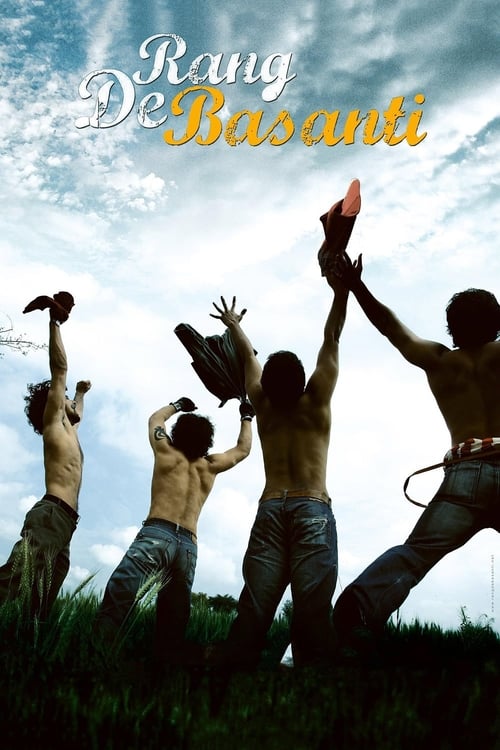
Rang De Basanti
2006 · Rakeysh Omprakash Mehra
For when you want a film that fires you up — about friendship, conscience, and refusing to look away. Come for the college banter and the songs; know that it will not stay light.
What it's about
A young British filmmaker arrives in Delhi with her grandfather's colonial-era diaries, hoping to make a film about India's revolutionary martyrs — and casts a gang of aimless, wisecracking university graduates to play them. The friends treat it as a lark until a death caused by official corruption cracks their apathy open, and the roles they've been rehearsing start bleeding into their real lives.
The experience
It starts as a warm, freewheeling hangout comedy and gradually turns urgent, angry, and devastating — the tonal swerve is the point, and it hits hard. Few films move an audience from laughter to a lump in the throat to genuine political fire this effectively.
Performances
Aamir Khan anchors the group as DJ, the joker who can't bring himself to leave campus, and Atul Kulkarni is quietly remarkable as a hardline activist whose certainties get tested.
The craft
A. R. Rahman's soundtrack is one of the most beloved in modern Hindi cinema, and the film's signature move — intercutting the friends' present with sepia-toned scenes of the 1920s revolutionaries they're playing — lets two eras answer each other. It's mainstream craft put fully in service of an idea.
Why it matters
Released on Republic Day 2006, it became the most politically consequential mainstream Indian film of its decade — its candlelight-vigil imagery was adopted by real protest movements demanding justice in high-profile cases.
Snapshot
Released on Republic Day, 26 January 2006, Rang De Basanti is the film that fused the Hindi campus comedy with the anti-colonial martyr biopic and, in doing so, produced the most politically consequential mainstream Indian film of its decade. Its premise is a rehearsal that becomes real: a young British documentarian, Sue McKinley (Alice Patten), arrives in Delhi with the diaries of her grandfather, a jailer in colonial Punjab who recorded his reluctant awe at the revolutionaries he was helping to hang. She casts a group of drifting Delhi University graduates — DJ (Aamir Khan), Karan (Siddharth), Aslam (Kunal Kapoor), Sukhi (Sharman Joshi) and, eventually, the Hindu-nationalist activist Laxman Pandey (Atul Kulkarni) — as Chandrashekhar Azad, Bhagat Singh, Ashfaqulla Khan, Rajguru and Ram Prasad Bismil. The performance metabolizes into conviction. When their friend Ajay Rathod (R. Madhavan), an Air Force pilot, dies in a MiG-21 crash and the state blames the dead man rather than the corrupt procurement that killed him, the group crosses from re-enactment into assassination, seizes a radio station to confess, and is killed by commandos — an ending the film cuts against the 1931 gallows so that the two eras die in the same frames.
The film's afterlife exceeded its text. Within weeks of release, the candlelight vigil at India Gate had become the default grammar of urban Indian protest, and Indian journalism acquired the shorthand "the RDB effect."
Industry & production
Rang De Basanti is a product of Bollywood's corporatisation. It was produced by UTV Motion Pictures — Ronnie Screwvala's company, then aggressively building a studio model of financing, distribution and ancillary-rights exploitation — in partnership with Mehra's own banner. This mattered structurally: a film with an unproven tonal gamble (two hours of hangout comedy detonating into political violence), a large ensemble of relative unknowns, a period strand requiring separate design and a running time well over two and a half hours is not the sort of package an older, distributor-financed, star-led system underwrites easily. The corporate studio, the multiplex boom, and a soundtrack by A. R. Rahman that could be monetized independently made the risk survivable.
Aamir Khan's participation was the pivot. Coming directly off The Rising: Ballad of Mangal Pandey (2005) — a costly nationalist historical that underperformed — he took a role written for a man fifteen years younger, a perpetual student squatting in his own graduated past. The casting is both star-economics and thematic argument: the arrested adolescence of the liberalization generation, played by the era's most deliberate star.
Production ran across Delhi and Punjab, using the capital's monuments as lived space rather than postcard — Purana Qila, India Gate, the North Campus, Jama Masjid — and the Golden Temple at Amritsar for the film's most quietly reverent sequence. The Air Force strand triggered an unusual clearance process: because the film implicates the defense establishment in fatal procurement corruption, the Central Board of Film Certification referred it to the Ministry of Defense, and it was passed after special screenings for officials. This is a documented episode, though accounts of exactly what was requested and conceded vary; the film reached theaters substantially intact.
The MiG-21 plot was not invention. India's aging MiG-21 fleet had by the early 2000s accumulated a crash record grim enough to earn the aircraft the press nickname "flying coffin," and the campaigning of bereaved service families — most prominently Kavita Gadgil, whose son Flight Lieutenant Abhijit Gadgil died in a 2001 crash — was live public controversy when the film was written. Audiences recognized the reference immediately.
Technology
The film was shot and released on 35mm in the last years before digital acquisition became normal in Bombay. Its most conspicuous technological choice is chromatic: the contemporary Delhi material and the colonial-era material are graded into two irreconcilable worlds — the present hot, saturated, sunstruck; the past drained toward monochrome amber and bleached bone. That degree of separation, and the ability to slide between the two inside a single continuous movement, points to the digital intermediate pipeline then entering Indian mainstream production, though the specific finishing arrangements for this title are not well documented in accessible sources and I won't assert particulars.
Equally consequential and less glamorous: sync sound. The migration of Hindi cinema away from post-dubbing, accelerated by Lagaan (2001) and Dil Chahta Hai (2001), is what allows Rang De Basanti's overlapping, code-switching, half-swallowed Hinglish to sound like actual speech rather than recited dialogue. The film's realism is substantially an audio-technology realism.
Technique
Cinematography
Binod Pradhan — whose credits run from Parinda (1989) and 1942: A Love Story (1994) through Mission Kashmir (2000) and Devdas (2002) — builds the picture on a contrast of camera behaviors, not just palettes. The present tense is handheld, wide, close, jostling; the camera is inside the group, at motorcycle height, catching faces at the edge of frame. The past is composed, frontal, statuary, slower — closer to the pictorial monumentality Pradhan brought to Devdas, drained of its color. Because the same actors occupy both registers, the shift in shooting style does the identification work: we recognize the person and register the change in the world around them.
The film's signature figure is the era-crossing transition — a match on gesture, a pan that begins in 2005 and lands in 1929, a face that turns from one century into the other. Used dozens of times, it converts what could have been a clumsy dual-timeline structure into a single continuous argument about inheritance.
Editing
P. S. Bharathi's cutting is the film's most underrated craft achievement, and its structural risk is total. The first movement is loose, digressive, comic, almost plotless — the deliberate shapelessness of people with nothing to do. The second is a hard clamp. Ajay's death is the hinge, and everything after it tightens: shorter takes, harder cuts, less air. The climax runs three actions in parallel — the radio confession, the police assault, the 1931 executions — and resolves them into a montage in which the two generations' deaths are intercut until they read as one event. Whether that equation is earned is the film's central critical question; that it is executed with precision is not in dispute.
Mise-en-scène / staging
The production design (art direction credited to Samir Chanda) treats Delhi as a palimpsest: Mughal ruins as picnic ground, colonial avenues as motorcycle track, the university as a place people cannot leave. Costume work by Arjun Bhasin — a key figure in the visual modernization of Hindi film clothing — keeps the contemporary group in unstyled, specific, class-legible clothes, which makes the khadi and kurta of the rehearsal sequences read as costume in the literal sense, then stop reading as costume.
Space is used to stage the film's thesis. The boys are repeatedly framed against monuments and memorials they treat as furniture; by the end they are inside a monument's logic, dying at a broadcast microphone as their counterparts died at a scaffold.
Sound
Rahman's score is not accompaniment but structure. The soundtrack's range is programmatic: bhangra in the title track ("Rang De Basanti," Daler Mehndi with Chitra), campus rock in "Paathshaala," Sufi ecstatic mode in "Khalbali," and an anthem of self-recognition in "Roobaroo" (Naresh Iyer with Rahman) that became the film's emotional signature. "Khoon Chala," sung by Mohit Chauhan in one of his defining early Hindi playback performances, carries the march toward violence. "Luka Chuppi," a mother's lament for a son who will not come home, is a late-career Lata Mangeshkar recording in duet with Rahman and remains one of the most affecting things in either artist's 2000s work. "Ik Onkar," Harshdeep Kaur's rendition of the Sikh Mool Mantar, is set against flight and sky, and is the one passage where the film's patriotism is devotional rather than agitated.
Prasoon Joshi's lyrics — plain-spoken, contemporary, free of the ornamental Urdu register — were widely credited with making the songs usable as speech by young listeners, which is precisely how they were subsequently used at protests.
Diegetically, the climax turns on broadcast: the radio station, the callers, the voice going out to a city. The film's final political act is an act of sound.
Performance
The ensemble is calibrated so that no one carries the film alone. Aamir Khan plays DJ with a deliberately unglamorous slackness, the charisma turned down to something local and slightly sad. Siddharth, in his Hindi-language breakthrough after Boys (2003), gives Karan the film's coldest and most disturbing arc — the son who kills his father. Atul Kulkarni, from the Marathi and Kannada parallel-cinema tradition, has the hardest assignment: making Laxman Pandey's transit from communal street politics to solidarity with Aslam credible rather than schematic, which he does largely through physical stiffness gradually released. Kunal Kapoor and Sharman Joshi supply, respectively, the film's reticence and its comedy. Alice Patten's Sue is functional — an outsider's camera, an audience surrogate — and the role is thinly written; the film's interest lies elsewhere. Among the older generation, Waheeda Rehman's grieving mother, Om Puri, Anupam Kher and Kirron Kher anchor the parental world the young men are indicting.
Narrative & dramatic mode
The architecture is a rehearsal narrative: characters perform historical roles until the performance rewrites them. This is an old theatrical device — the play-within-the-play as moral solvent — deployed here at mainstream scale and with unusual literalism, since the same bodies occupy both texts.
Tonally the film is a deliberate bait-and-switch. It recruits its audience through the pleasures of the youth comedy — banter, bikes, drinking, a light romance — and then charges that affection as an emotional debt when the deaths begin. The mode shifts from picaresque to tragedy without an intervening register, which is what makes the second half feel like an ambush rather than a development. Critics split precisely here: the same construction is read as the film's daring or its manipulation.
The dramaturgy is also, unmistakably, tragic in the classical sense — the protagonists choose an action that is politically futile and personally fatal, and the film knows it. The radio confession exists so that the deaths can be narrated as meaning rather than crime, which is both the characters' strategy and the film's.
Genre & cycle
Rang De Basanti sits at the junction of three cycles. First, the Bhagat Singh film, a recurring Hindi form from Manoj Kumar's Shaheed (1965) through the extraordinary 2002 cluster of three competing Bhagat Singh pictures — Rajkumar Santoshi's The Legend of Bhagat Singh, Guddu Dhanoa's 23rd March 1931: Shaheed, and Shaheed-E-Azam. Second, the post-1997 patriotic cycle: Border (1997), Sarfarosh (1999), Lagaan and Gadar (2001), LOC Kargil (2003), Swades (2004), Mangal Pandey (2005). Third, the multiplex-era urban youth film inaugurated by Dil Chahta Hai (2001) — the male friendship triad, the sync-sound idiom, the untranslated English.
Its innovation is the collision: it is Dil Chahta Hai rebuilt as a martyr film, and it argues that the two audiences — the apolitical multiplex young and the mass patriotic viewership — are the same people. Mani Ratnam's Yuva (2004) had already put students into political violence with an interlocking-fates structure; Rang De Basanti is the version that connected.
Authorship & method
Rakeysh Omprakash Mehra came out of Delhi and out of advertising, and both show. His debut feature, Aks (2001) with Amitabh Bachchan, was a commercial failure and a stylistic manifesto — dense, over-designed, metaphysically ambitious. Rang De Basanti keeps the visual appetite and attaches it to a script with a public argument.
The screenplay is credited to Mehra with Rensil D'Silva (who would go on to direct Kurbaan, 2009), with dialogue work by Kamlesh Pandey; sources differ on the precise apportionment of story, screenplay and dialogue credits, and I'd not press the distinctions harder than the credits support. Prasoon Joshi's lyrics function as a fourth writing voice.
The core collaborative unit — Pradhan's camera, Bharathi's cutting (she also edited Aks and would edit Delhi-6), Rahman's score, Joshi's words — is a genuine authorial ensemble rather than a director plus technicians. Mehra reassembled much of it for Delhi-6 (2009) and Bhaag Milkha Bhaag (2013), the latter a return to Pradhan's photography and to the nation-through-a-body subject.
Movement / national cinema
The film belongs to the post-liberalisation reformation of Hindi cinema: corporate finance, multiplex exhibition, sync sound, a diaspora market treated as core rather than ancillary, and a new confidence about depicting English-speaking urban India without apology. It is also a document of that class's self-image. The revolutionaries the boys play were, historically, participants in an organized, ideologically literate socialist-revolutionary movement — Bhagat Singh's own writings are explicit about that — while the boys themselves are individualists who arrive at violence with no politics beyond outrage. Scholarship on Bollywood and nationalism has read the film's substitution of moral fury for political organization as characteristic of the new middle class it addresses. That reading is a critique of the film's ideology, not of its craft, and both can be true at once.
Era / period
Two periods are in play. The historical strand covers the late 1920s and early 1930s — the lathi charge that killed Lala Lajpat Rai, the Saunders assassination, the 1929 Central Legislative Assembly bombing, the Kakori conspiracy of Bismil and Ashfaqulla Khan, the 1931 executions. The contemporary strand is mid-2000s India: economic optimism, endemic procurement corruption, a discredited political class, and a media environment — 24-hour news, mobile telephony, talk radio — that the plot depends on absolutely.
The title itself reaches back: "Mera Rang De Basanti Chola," the song of the saffron shroud associated with Bhagat Singh, carried into popular memory partly by the 1965 Shaheed. The film inherits a slogan before it writes a line.
Themes
Inheritance and debt. The governing question is what the dead are owed and whether the debt can be paid in kind. The film's answer — that it can — is its most contested move.
Communal reconciliation. The Bismil–Ashfaqulla friendship is deployed as the historical solvent for the Laxman–Aslam antagonism: a Hindu-nationalist and a Muslim are made to inhabit a comradeship the archive actually records. This is the film's most generous gesture and, given what followed in Indian public life, its most poignant.
The state as adversary. Corruption here is not a bad official but a system that kills its own pilots and then defames them. The film refuses institutional remedy entirely — no court, no inquiry, no election appears as a live option — which is the source of both its charge and its danger.
Performance as conversion. Pretending to be someone braver until you become them; the film is optimistic about theater in a way it is not about politics.
Youth and futility. For all the anthemic surface, the film ends with five dead boys, no reform, and a broadcast. Its patriotism is elegiac, not triumphant.
Reception, canon & influence
Reception was strong and swift. The film was a major commercial success in a crowded 2006 and traveled unusually well in overseas markets. Critically it was praised for its ensemble, Rahman's score, Pradhan's photography and its tonal ambition; the recurring reservation, then and since, was moral — that it aestheticizes assassination, that it equates armed resistance to a colonial occupier with murder in a functioning democracy, and that its heroes' politics are all affect and no program. Both positions are still argued.
Institutionally it was well decorated, including the National Film Award for Best Popular Film Providing Wholesome Entertainment and Filmfare's Best Film; it was India's official submission for the Academy Award for Best Foreign Language Film and received a BAFTA nomination for Best Film Not in the English Language. (I've kept this list to the awards I can state with confidence rather than enumerating a full sweep.)
Backward. Its influences are legible: the Bhagat Singh cycle and the martyrological literature around it; Manoj Kumar's patriotic mode, ironised; Dil Chahta Hai for the register of urban male friendship; Yuva for youth-into-politics; Mehra's advertising-honed visual compression; and the documentary record of MiG-21 crashes and bereaved-family activism.
Forward. The most significant legacy is extra-cinematic. Weeks after release, the acquittal of the accused in the Jessica Lal murder case brought candlelight crowds to India Gate, and the resemblance to the film's own imagery was noted everywhere; commentators subsequently used "the RDB effect" as shorthand for a style of televised, middle-class, image-conscious protest that recurred through the 2006 anti-reservation agitation and into the 2011 India Against Corruption movement. Few mainstream films have so visibly supplied a template for public conduct.
Within cinema, it licensed a run of angry, urban, system-versus-citizen pictures — A Wednesday (2008), Anurag Kashyap's Gulaal (2009), Dibakar Banerjee's Shanghai (2012) among them — and confirmed that political anger was commercially viable at scale, a lesson later cycles of Hindi nationalist cinema would take in directions the film's own politics do not obviously endorse. For Rahman it was a peak of pre-Slumdog Millionaire domestic reach, and its songs have had the rare fate of leaving the film entirely: "Roobaroo" and the title track are now heard at gatherings by people who are not thinking about a movie at all.
Reception
A blockbuster event from the moment it opened on Republic Day 2006, it was instantly hailed as the film that woke up Bollywood's youth-politics conscience — and two decades on it's settled in as a defining 2000s Hindi film, though its politics get re-litigated with every rewatch.
How Rang De Basanti was received, from release to now →
How to watch Rang De Basanti: what to notice on a first viewing
- Watch a shot slide from 2005 straight into 1929. Pradhan uses a match on gesture or a single pan to carry the same actor's face from the present day directly into the colonial past, dozens of times. The transitions argue that these two eras are one continuous inheritance, not separate stories.
- Compare the color of the present-day scenes to the historical ones. The contemporary Delhi material runs hot and saturated while the 1929 strand is drained toward monochrome amber, composed and frontal. You can feel which century you're in from the color alone, before any costume confirms it.
- Listen for how differently each song matches its own mood. Rahman shifts registers song to song, bhangra, campus rock, Sufi ecstatic mode, so the soundtrack works as structure rather than mere accompaniment. Each song is doing narrative work, not just filling space between scenes.
- Watch how ordinary the friends' clothes look before the rehearsal starts. Bhasin keeps the contemporary group in unstyled, class-legible clothing, so the khadi and kurta of the historical rehearsal first read as pure costume. Watch when the costume stops feeling like a costume, because that shift is the whole film's argument.
- Watch how deliberately unglamorous DJ's energy stays. Aamir Khan plays DJ with slackness turned down to something local and slightly sad, a perpetual student squatting in his own graduated past. His low-key charisma is the film's entry point before anything political begins to happen.
The whole guide to watching Rang De Basanti, with the keys for a rewatch →
Influences: the films it descends from and the films it influenced
- Shaheed (1965) — Supplies the Bhagat Singh martyr-film's fixed liturgy — Ram Prasad Bismil's 'Sarfaroshi Ki Tamanna' and 'Mera Rang De Basanti Chola' staged as diegetic group song in cell and gallows — which Mehra takes for his title and then re-scores as Rahman rock rather than devotional chorus.
- The Legend of Bhagat Singh (2002) — The straight, unironised version of the same hagiography, scored by the same composer four years earlier; RDB inherits its period iconography wholesale but refuses its continuous chronology, quarantining the 1920s inside a film-within-a-film so the martyrdom arrives as re-enactment rather than history.
- Jaane Bhi Do Yaaro (1983) — Establishes the tonal bait-and-switch RDB runs at feature scale — buddy farce curdling into procurement-corruption despair — and the rehearsal-becomes-real device, its staged Mahabharata tableau invaded by the actual conspirators exactly as RDB's costumed rehearsals bleed into the boys' own conspiracy.
- Maachis (1996) — Provides the procedural template for the friend-group radicalization arc: a close civilian ensemble tracked step by step from grief through weapons training to an assassination they cannot survive, with the political songs functioning as internal argument rather than interlude.
- Dil Se.. (1998) — Rahman's first full fusion of qawwali form with a nationalist-terror plot, and the direct precedent for RDB's climax: a protagonist embedded in All India Radio whose crisis plays out through the machinery of state broadcast on a ceremonial national occasion.
- Dil Chahta Hai (2001) — Invents the register RDB's first hour lives in — sync-sound, code-switched Hindi-English overlapping dialogue among three affluent city men, shot in wide clean daylight with no comic sidekick — so that the film's later politics land on characters the multiplex audience already recognizes as itself.
- Yuva (2004) — The immediate precedent for converting apolitical urban students into political actors via a single violent event, structured as intercut strands that converge on one bridge; RDB compresses Ratnam's three-strand hyperlink into one friend-group and moves the convergence to a broadcast studio.
- 1942: A Love Story (1994) — Binod Pradhan's freedom-struggle grammar in embryo — smoke-raked amber interiors, hard side-key on conspirators, colonial exteriors bleached toward sepia — which becomes RDB's period register, the visual key that lets the 1920s strand be legible as a separate stock from the contemporary one.
- Aks (2001) — Mehra's own proving ground for the ad-derived compression he reuses here — graphic-match cutting across bodies and time under P.S. Bharathi's editing — and the film that assembles the Mehra-Bharathi unit whose signature is the era-crossing transition on a held gesture.
- Man of Marble (1977) — The structural ancestor of RDB's framing device: a young documentarian excavating a suppressed martyr's biography, with the reconstructed past rendered in a visibly different film register from the present, and the filmmaker's investigation itself becoming the political act the state moves against.
- Lagaan: Once Upon a Time in India (2001) — Extends the Aamir Khan producer-star run of high-concept, message-driven films that Lagaan inaugurated, again binding an ensemble to a socio-political awakening.
- A Wednesday! (2008) — Takes RDB's insight that the media apparatus is the real weapon and builds a whole film from it — an ordinary citizen commandeering broadcast and police communication channels in real time — retaining the civic-vigilante logic while stripping out the songs and the period strand.
- Gulaal (2009) — Rewrites RDB's campus-to-violence pipeline as rot rather than awakening, and answers Prasoon Joshi's anthemic lyrics with Piyush Mishra's ironic on-screen balladeer, a diegetic chorus that comments on the students' politics instead of amplifying them.
- Delhi-6 (2009) — Reconvenes the identical authorial unit — Pradhan's camera, Bharathi's cutting, Rahman's score, Joshi's lyrics — and extends the Delhi-as-palimpsest staging into a single mohalla, again building to a mob climax where a crowd turns on its own and the hero's death is meant to shame it.
- Shanghai (2012) — Inherits the murdered-activist-forces-a-bystander-into-action premise but replaces RDB's affective montage with cold procedural surveillance — depositions, video evidence, bureaucratic rooms — arguing that the same story is better served by inquiry than by the gun.
- Kai Po Che! (2013) — Reruns the RDB structure almost beat for beat — sunlit ensemble comedy among three young men for an hour, then a mass political event that kills one and radicalizes another — using the friendship's earned lightness as the load-bearing setup for the tonal collapse.
- Bhaag Milkha Bhaag (2013) — Mehra and Pradhan reprise the dual-register timeline as biography: Partition-era passages graded and lit distinctly from the athletic present, joined by Bharathi's match-cut transitions on running bodies, the same era-crossing device now carrying a nation through a single physique.
- Sardar Udham (2021) — The martyr cycle's revisionist reply — Avik Mukhopadhyay's near-real-time, unmontaged Jallianwala Bagh sequence deliberately withholds the ecstatic cutting and anthem that RDB uses to make revolutionary death exhilarating, prosecuting the same history through duration instead.
- 3 Idiots (2009) — An Aamir Khan-led college ensemble organized by a frame/awakening structure, converting campus camaraderie into generational conscience — the ensemble-plus-social-argument blueprint.
- Hazaaron Khwaishein Aisi (2005) — Released months earlier on the same terrain — Delhi University friends drawn from privilege into armed politics — but choosing handheld, desaturated documentary observation and a downbeat ending where RDB chooses Pradhan's gloss and martyrdom, making the pair the two available craft answers to the same question.
Similar films
- Bhaag Milkha Bhaag (2013) — influence & lineage
- 3 Idiots (2009) — shared sensibility
- Om Shanti Om (2007) — shared sensibility
- RRR (2022) — shared sensibility
- Kuch Kuch Hota Hai (1998) — shared sensibility
- Lagaan: Once Upon a Time in India (2001) — shared sensibility
- Dilwale Dulhania Le Jayenge (1995) — shared sensibility
- Kal Ho Naa Ho (2003) — shared sensibility