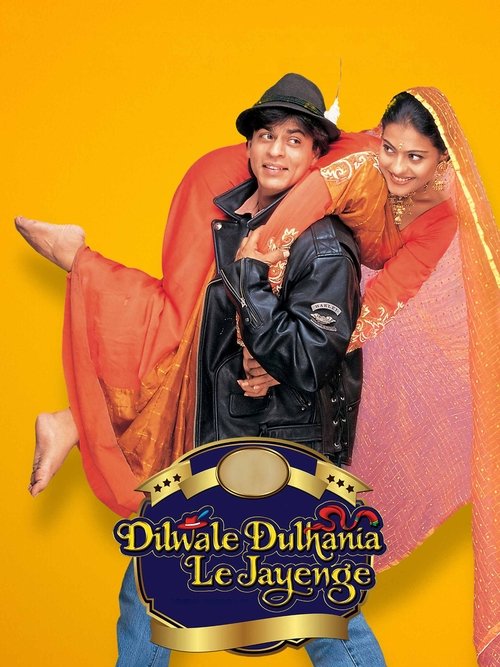
Dilwale Dulhania Le Jayenge
1995 · Aditya Chopra
For a cozy night in when you want to fall head over heels — comfort viewing at grand scale, perfect with family, snacks, and zero cynicism.
What it's about
Raj, a carefree London-raised rich kid, and Simran, the dutiful daughter of a sternly traditional father, fall in love on a backpacking trip through Europe — just before she's taken to Punjab to marry the fiancé chosen for her in childhood. Instead of asking her to run away, Raj follows her to India and embeds himself in the wedding household, determined to win not just Simran but her entire family, especially her unbending father.
The experience
Pure pleasure with a big beating heart — funny, swooning, song-filled, and increasingly emotional as the stakes turn from flirtation to family. It's a long, generous sit that earns its tears the old-fashioned way.
Performances
Shah Rukh Khan and Kajol have one of the most beloved romantic pairings in Indian cinema — his mischief playing off her guardedness until both melt — while Amrish Puri makes the father a genuinely formidable wall for love to climb.
The craft
Written and directed by Aditya Chopra at just twenty-three, it moves from postcard European vistas to the mustard fields and bustling wedding rituals of Punjab with total confidence, powered by a soundtrack whose songs became permanent fixtures of Indian weddings. It's built for a big screen and a full room.
Why it matters
The template for the modern Hindi romance and a genuine phenomenon — it ran continuously in a Mumbai cinema for decades, defined the diaspora love story, and cemented Shah Rukh Khan as the era's romantic icon.
Snapshot
Dilwale Dulhania Le Jayenge — universally abbreviated to DDLJ — is the film against which the modern Hindi romance measures itself. Directed by Aditya Chopra at twenty-three, from his own script, and produced by his father Yash Chopra's Yash Raj Films, it fused the studio's established idiom of European-landscape romanticism with a new subject: the second-generation non-resident Indian (NRI) and the question of what "Indianness" means at a distance from India. Shah Rukh Khan's Raj and Kajol's Simran meet on a rail journey through Europe, fall in love, and then spend the film's second half in Punjab, where Raj refuses to elope with the already-betrothed Simran and instead sets out to win the blessing of her forbidding father. That single narrative choice — courtship conducted inside the family rather than in flight from it — is the film's ideological signature. Released in October 1995, it became the defining commercial event of post-liberalization Hindi cinema and, through its famous marathon theatrical run at Mumbai's Maratha Mandir, a piece of living infrastructure rather than a mere hit.
Industry & production
DDLJ was a Yash Raj Films production, and it marked a generational handover within one of Bombay cinema's most prestigious houses. Yash Chopra, whose reputation rested on lush romances (Silsila, Chandni, Lamhe), produced; his elder son Aditya Chopra directed for the first time, having apprenticed as an assistant on his father's films. The picture arrived at a specific industrial moment. India's 1991 economic liberalization had opened the country to global capital and expanded, materially and symbolically, the standing of the overseas Indian; Hindi cinema was simultaneously courting the diaspora as an audience with disposable income and hard currency. DDLJ addressed that audience directly by making NRIs its protagonists and by shooting a substantial portion abroad — the London of shopkeepers and second-generation youth, and the Alpine and continental European locations that were by then a Yash Raj trademark. The casting paired Shah Rukh Khan, then still associated in part with anti-hero and villainous roles from the early 1990s, with Kajol; the film helped consolidate Khan's transformation into the reigning romantic lead of his generation. The supporting cast — Amrish Puri as the patriarch Baldev Singh, Farida Jalal as Simran's mother, Anupam Kher as Raj's indulgent father — drew on seasoned character actors whose presence lent the family drama weight. Precise production budget and gross figures should be treated cautiously here; what is securely documented is the film's extraordinary longevity in exhibition, which is discussed below.
Technology
DDLJ was not a film of technological novelty, and the honest scholarly note is that the record offers little to claim on this front. It was shot and finished on 35mm using the conventional apparatus of mid-1990s mainstream Bombay production, and its innovations are those of craft, casting, and narrative design rather than of camera, lab, or sound technology. Its "technology," if the term applies, is really the industrialized Yash Raj production method: dependable location logistics for European and Punjabi shoots, playback song recording, and the polished married-print presentation that defined the studio's house style. Any account that credits DDLJ with technical breakthroughs would be overstating a record that does not support it.
Technique
Cinematography
The photography is credited to Manmohan Singh, Yash Chopra's longtime cinematographer, and the film bears the visual grammar he helped establish for the studio. European exteriors are rendered as saturated, postcard-clean romantic space — open skies, green fields, the choreographed use of trains and stations as sites of chance and reunion. The Punjab of the second half is coded differently: golden mustard fields, courtyards, and the warm interiors of a joint family home, photographed to signify rootedness and belonging rather than reverie. Singh's lighting favors softness and glow on the leads, and the film's most iconic images — Simran running along a station platform, the outstretched hand — are composed as instantly legible romantic icons, built for memory and reproduction.
Editing
The cutting, credited to Keshav Naidu, serves a long film (its runtime is generous even by the standards of the period) that is structurally bisected: a European courtship followed by a Punjabi campaign to win the family. The editing sustains a deliberately unhurried tempo, allowing scenes of comedy, familial ritual, and slow-building tension to breathe. Song sequences are integrated as set-pieces that advance emotion rather than plot, and the film's pacing tolerates digression because its pleasures are cumulative — the audience is meant to live inside the family's routines long enough to feel the stakes of Raj's patience.
Mise-en-scène / staging
Staging is where the film's ideology is most visible. The first half stages romance in transit and in open landscape — the mobility of the diaspora. The second half relocates almost entirely into domestic and communal space: the preparation for Simran's arranged wedding, the songs of mehndi and celebration, the crowded family table. Raj is inserted into this world in disguise, as a welcomed guest rather than an abductor, so that the mise-en-scène itself dramatizes his strategy of infiltration-by-charm. The recurring staging of thresholds, doorways, courtyards, and finally a railway platform gives spatial form to the film's central problem: who is permitted to cross into the family, and on whose terms.
Sound
The score and songs are by the duo Jatin–Lalit, with lyrics by the veteran Anand Bakshi, and the soundtrack is inseparable from the film's success and afterlife. Numbers such as "Tujhe Dekha To," "Mehndi Laga Ke Rakhna," "Ruk Ja O Dil Deewane," and "Zara Sa Jhoom Loon Main" function as both romantic expression and communal ritual, sung in playback by leading voices of the era. The songs are structured to do narrative work — establishing intimacy, marking festivity, signaling longing — and several became standards performed at real weddings, folding the film back into the social occasions it depicts.
Performance
Performance carries the film. Shah Rukh Khan's Raj calibrates brashness and tenderness: the flirtatious NRI joker of the first half who reveals, at the pivotal moment, an insistence on doing things honorably. His refusal to elope — his statement that he will take Simran only with her father's consent — reframes the romantic hero as an agent of familial reconciliation rather than rebellion, and Khan plays the turn without losing charm. Kajol's Simran gives the film its emotional interior, moving between girlish spirit and the grief of impending arranged marriage. Amrish Puri, an actor long typecast as a screen villain, is used against and with that history as Baldev Singh — his rigidity is the film's true antagonist, and his final gesture of release is the emotional payoff the entire structure has been engineering. Farida Jalal and Anupam Kher supply the warmth and comedy that make the family worth reconciling with.
Narrative & dramatic mode
The dramatic mode is romantic comedy braided with family melodrama, and its architecture is unusually schematic in the best sense. The obstacle to the couple is not a rival or an external villain but the legitimate authority of the patriarch and the moral weight of a given word — Baldev Singh has promised Simran to a friend's son. The film's originality lies in refusing the elopement plot that its own premise invites. Instead of romance-as-transgression, DDLJ offers romance-as-earned-consent: the hero's task is to be accepted, to convert the father rather than defeat him. This produces a two-act structure — desire established abroad, legitimacy sought at home — and a climax staged not as escape but as blessing, the moment the father, in effect, lets the bride go. The dramatic tension is therefore ethical rather than merely plotted: can love be reconciled with duty without either being falsified?
Genre & cycle
DDLJ belongs to the Hindi family romance, but it is more accurately understood as the film that founded a cycle. It crystallized what would be called the NRI romance or the "family entertainer": large-canvas, song-driven, tradition-affirming love stories built around joint families, festivals, and the diaspora. Its DNA runs directly through Yash Raj Films' and Dharma Productions' late-1990s and early-2000s output and through the star persona of Shah Rukh Khan as the diaspora's romantic emblem. The genre it consolidated is defined by a particular resolution — modern love validated by traditional structures — and DDLJ is its purest statement.
Authorship & method
The governing authorship is Aditya Chopra's, remarkable as a debut for its confidence of design; he wrote the story and screenplay and directed, with dialogues credited to him with the veteran writer Javed Siddiqui. The film is also, unmistakably, a Yash Raj house production shaped by Yash Chopra's aesthetic inheritance — the European romanticism, the primacy of the song, the belief in emotional maximalism. The key collaborators form a coherent authorial unit: cinematographer Manmohan Singh, extending the studio's visual signature; composers Jatin–Lalit with lyricist Anand Bakshi, whose songs became the film's second life; and editor Keshav Naidu, sustaining its expansive rhythm. The method is classical Bombay filmmaking at a high level of polish — star vehicle, integrated musical, location romance — deployed by a young director who understood exactly which conventions to honor and which single convention (the elopement) to overturn.
Movement / national cinema
The film is a landmark of mainstream Hindi cinema (Bollywood) at the threshold of liberalization, and it is best read as a national-cinema document about the reimagining of Indian identity for a globalizing era. Where earlier decades had often coded the West and the Westernized Indian with suspicion, DDLJ proposes that Indianness is portable — that one can be a jeans-wearing, English-speaking NRI raised in London and remain a custodian of sanskaar (values). It thereby helped author a new self-image for a middle class newly connected to the global economy, one that could embrace consumer modernity without conceding the authority of family and tradition. That reconciliation is the film's national-cultural project.
Era / period
DDLJ is a quintessential product of mid-1990s India: post-1991 liberalization, an expanding urban middle class, satellite television, and a film industry beginning to formalize and to prize the overseas market. It both reflected and helped construct the aspirational sensibility of that moment. Its period specificity — the particular texture of London Indian shopkeeper life, the arranged-marriage plot, the mustard-field Punjab — is also what has allowed it to function as a time capsule, a fixed image of how liberalizing India wished to picture its own values.
Themes
The central theme is the reconciliation of tradition and modernity — love pursued through, rather than against, the family. Adjacent to it runs the theme of consent and patriarchal authority: the drama turns on the father's permission, and its emotional climax is his act of release, a moment that both affirms and gently reforms patriarchal power (love wins, but only once the patriarch chooses to grant it). Diaspora and belonging form a third axis: the film insists that the migrant retains an essential Indianness and can "return" morally even while living abroad. Honor and the given word — Baldev Singh's promise — supply the ethical friction. And underlying all of it is a theme of romantic love as a legitimate but disciplined force, one that must prove its worthiness by respecting the social order it seeks to enter. The film's own gender politics have been the subject of extended debate — celebrated by some as sincere and criticized by others as conservative — and that debate is itself part of the film's significance.
Reception, canon & influence
DDLJ was an immense popular success on release in 1995 and swept the major Hindi-film awards of its year; it is frequently cited as one of the most-decorated films at the Filmfare Awards, though exact tallies should be verified against the record rather than asserted from memory. Its most extraordinary reception fact is documented and undisputed: the film began a continuous theatrical run at the Maratha Mandir cinema in Mumbai that lasted for well over a thousand weeks, making it by common account the longest-running film in Indian cinema history and turning a daily screening into a civic ritual and tourist attraction.
Its influences backward are those of the Yash Raj tradition itself — the romantic-melodrama lineage of Yash Chopra, the integrated song-picture form of classical Hindi cinema, and the arranged-marriage-versus-love-marriage plot that the industry had worked for decades. What DDLJ did was refine that inheritance to an ideal type.
Its influence forward is difficult to overstate. It set the template for the NRI family romance that dominated Hindi cinema's next fifteen years, shaped the ongoing star personas of Shah Rukh Khan and Kajol (who would be repeatedly paired as a screen couple), and made "winning the family" rather than defying it the default resolution of the mainstream love story. Its songs entered the repertoire of real-life weddings; its iconic images — the train, the outstretched hand, the mustard fields — became shorthand quoted and parodied across later cinema. More than a hit, DDLJ became a reference point: the film through which subsequent romances defined themselves, whether by imitation or reaction, and a durable object of academic study on diaspora, gender, and the cultural politics of liberalization-era India.
A Deleuzian reading
Watch the last minutes again.
The full Deleuzian reading of Dilwale Dulhania Le Jayenge →
Reception
A colossal blockbuster from day one in 1995, it hardened into the definitive Bollywood romance — but decades on it gets steady revisionist pushback for its 'I'll only marry you with your father's blessing' patriarchy, making it both institution and target.
How Dilwale Dulhania Le Jayenge was received, from release to now →
How to watch Dilwale Dulhania Le Jayenge: what to notice on a first viewing
- Compare the color of Europe with the color of Punjab. Manmohan Singh shoots Europe as saturated postcard space, open skies and green fields. Punjab arrives in golden mustard, courtyards, and warm interiors photographed to feel rooted. One palette means travel and freedom. The other means belonging. The film argues about home in color before anyone states the case.
- Count how many scenes happen in a doorway or courtyard. Chopra keeps staging at thresholds: doorways, the edge of the family table, courtyards full of relatives, station platforms. Raj is repeatedly placed at the boundary of the household. The film's question is who gets to cross into a family and on whose say so. The staging asks it in physical terms.
- Watch the camera hold on Kajol's face during the songs. Manmohan Singh lights the leads with a soft glow, and the film stops for the reaction rather than the action. One expression, wonder, held long enough to become an image people keep. These held faces are the film's currency. Songs here do not advance the plot. They park you inside a feeling.
- Watch the wedding preparations going on around the couple. Mehndi, cooking, fittings, songs, relatives arriving. Chopra spends real screen time on ritual, so the household becomes a weight you can feel in every scene. The family is not the backdrop. It is what stands between these two people, and the film makes you like it anyway.
- Notice how Raj plays the clown in his first scenes. Khan plays the early Raj as a flirtatious clown, all charm and banter, with a steadiness underneath that the jokes never quite hide. The easy charm is the film's whole proposition about its hero.
The whole guide to watching Dilwale Dulhania Le Jayenge, with the keys for a rewatch →
Influences: the films it descends from and the films it influenced
- Kuch Kuch Hota Hai (1998) — Directly inherits and reuses the Shah Rukh Khan–Kajol screen pairing DDLJ established as the default romantic couple of the era.
- Kabhi Khushi Kabhie Gham (2001) — Scales the NRI-family romance template to epic size — SRK-Kajol coupling, the imposing father, and reconciliation across London and Delhi — the DDLJ resolution writ large.
- Jab We Met (2007) — Reworks DDLJ's train-and-journey courtship — strangers thrown together on a rail trip whose route becomes the romance — while retaining the 'return to win the family' arc.
- English Vinglish (2012) — The canonical NRI/diaspora template of 1990s Hindi cinema that English Vinglish consciously revises — shifting the diasporic gaze from the patriarch and the romantic hero to the overlooked housewife.
- Kal Ho Naa Ho (2003) — Builds the diaspora chassis KHNH runs on — an unbroken Hindi-film emotional order relocated to a Western city, plus the Shah Rukh Khan persona of the teasing intruder who ultimately defers to the family's authority; Johar apprenticed on it as assistant and costumer.
- Sangam (1964) — Established the Hindi-cinema convention DDLJ inherits of routing a love story through a European travelogue, treating Swiss and continental locations as a romantic register rather than mere backdrop.
- Purab Aur Paschim (1970) — Originated the diaspora template DDLJ refines — the Indian abroad who preserves 'Indianness' against Western permissiveness — staging the moral contest between tradition and modernity on London soil.
- Kabhi Kabhie (1976) — Codified the Yash Raj romantic-melodrama grammar DDLJ runs on: emotion carried by lyric and song (Sahir's poetry as narration) and love negotiated within, not against, the family's arranged-marriage machinery.
- Silsila (1981) — Fixed the iconography DDLJ quotes directly — sweeping fields of flowers as the arena for the picturized love song ('Dekha Ek Khwab' in the tulips prefiguring the mustard fields and 'Tujhe Dekha').
- Chandni (1989) — Consolidated the studio's high-key, saturated visual signature under cinematographer Manmohan Singh, the exact glossy location-romance look Singh carries into DDLJ.
- Maine Pyar Kiya (1989) — Modeled the 'young love must earn parental approval rather than defy it' resolution, replacing the elopement/defiance climax with the suitor proving worthiness to the father.
- Lamhe (1991) — Advanced the NRI-diaspora setting and the tradition-versus-modernity axis within a UK-based Indian family, again shot by Manmohan Singh in the studio's romantic idiom.
- Hum Aapke Hain Koun..! (1994) — Immediately preceded DDLJ in reorienting the hit romance around the joint family and wedding ritual, making the song-and-ceremony ensemble — not the couple alone — the emotional engine.
- Pardes (1997) — Extends DDLJ's NRI thesis explicitly — the diaspora bride choosing the 'authentically Indian' suitor over the Westernized one — reworking the tradition-vs-modernity contest DDLJ crystallized.
- Dil To Pagal Hai (1997) — Carries forward the DDLJ integrated-musical star vehicle with Shah Rukh Khan, building romance out of a suite of picturized songs as narrative spine.
- Mohabbatein (2000) — Chopra's own directorial follow-up recasts Amrish Puri as the rigid patriarchal-authority figure, extending DDLJ's engineering of tradition as an obstacle to be won over from within.
- Veer-Zaara (2004) — Continues the Yash Raj cross-border romance in Shah Rukh Khan's persona, love validated through family and sacrifice rather than elopement, in the studio's mustard-field pastoral register.
Similar films
- Kabhi Khushi Kabhie Gham (2001) — influence & lineage
- Kuch Kuch Hota Hai (1998) — influence & lineage
- Jab We Met (2007) — influence & lineage
- Kal Ho Naa Ho (2003) — shared sensibility
- Main Vaapas Aaunga (2026) — shared sensibility
- Bajrangi Bhaijaan (2015) — shared sensibility
- My Name Is Khan (2010) — shared sensibility
- Monsoon Wedding (2001) — shared sensibility