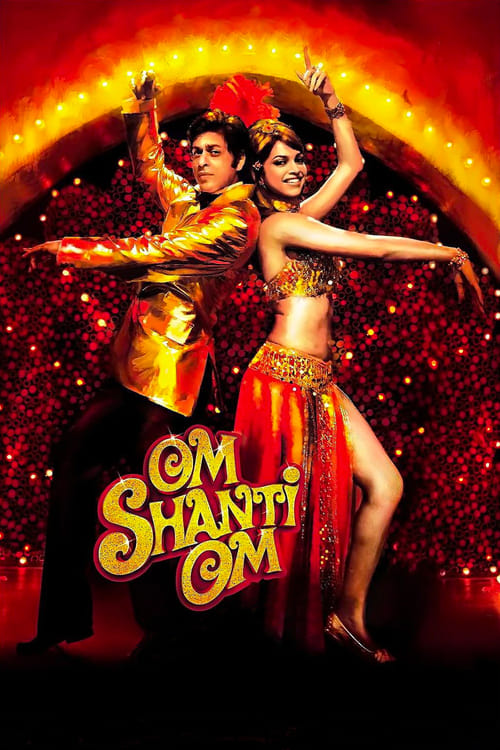
Om Shanti Om
2007 · Farah Khan
For when you want pure spectacle: a crowd-pleaser for a group night, a pick-me-up, three hours that fly. Comfort viewing at the largest possible scale.
What it's about
A junior artist scraping by in the Bombay film industry of the 1970s dies in a suspicious studio fire — and is reincarnated thirty years later as a superstar with a score to settle. Shah Rukh Khan plays both the struggler and the star, in a reincarnation melodrama that is also Bollywood's grand love letter to itself, mocking and adoring celebrity in the same breath.
The experience
Maximalist and joyous — big songs, big jokes, big melodrama, all played with a wink and total sincerity at once. It moves like a party that occasionally remembers it's also a revenge thriller.
Performances
Shah Rukh Khan's double role — wide-eyed 70s struggler and preening modern superstar — lets him spoof and embody his own stardom simultaneously. Deepika Padukone, in her Hindi film debut, arrives in a slow-motion swirl that minted her as a star on the spot.
The craft
Farah Khan, choreographer turned director, recreates the filmi seventies with fanatical, affectionate accuracy, and her set pieces remain reference points — 'Deewangi Deewangi' packs some thirty real stars into a single number. It's built for the biggest screen and loudest speakers you can find.
Why it matters
One of the defining Bollywood blockbusters of the 2000s: it launched Deepika Padukone, cemented Farah Khan as a director, and became the industry's definitive act of self-portraiture.
Farah Khan, Bollywood's premier choreographer turned director, made the industry's definitive love letter to itself: a reincarnation melodrama in which a junior artist of the 1970s, killed in a suspicious studio fire, returns thirty years later as a superstar with a score to settle. The genius is in the doubling — Shah Rukh Khan plays both the struggler and the star, the film mocking and adoring celebrity in the same breath — and in the period work, which recreates the filmi seventies of Karz and Rishi Kapoor with fanatical, affectionate accuracy, down to the title song it borrows and reignites. Deepika Padukone, in her Hindi debut, is introduced in a slow-motion swirl that instantly minted her stardom. Khan's set pieces remain reference points: 'Deewangi Deewangi' packs some thirty real stars into one number, a Hollywood-party joke Bollywood alone could pull off. Beneath the sequins runs a genuine argument about the industry's cruelty to its bit players and its women. It out-grossed everything in 2007, and its dialogue — picture abhi baaki hai — passed straight into the language.
Reception
A Diwali 2007 monster hit that flattened Sanjay Leela Bhansali's Saawariya in one of Bollywood's most famous box-office clashes, it was initially filed under 'glossy masala fun' — and has since climbed to beloved-modern-classic status as THE Bollywood film about Bollywood, a gateway drug for international viewers discovering Hindi cinema.
How Om Shanti Om was received, from release to now →
Influences: the films it descends from and the films it influenced
- Karz (1980) — OSO lifts wholesale its central engine — a man murdered and reborn who returns to unmask his killer — and literally reuses Ghai's 'Om Shanti Om' title song, making it the most direct structural and musical debt.
- Madhumati (1958) — Established the Bollywood reincarnation-melodrama grammar OSO inherits: the reborn man who must solve his own past-life murder, paired with an actress playing the doubled beloved across two lifetimes.
- Mahal (1949) — Fixed the genre's foundational device of the beckoning past-life song and the ghostly returning-lover staging that OSO's rebirth-haunting sequences deliberately echo.
- The Reincarnation of Peter Proud (1975) — The Western reincarnation-thriller mechanics — a man haunted by fragments of a former life piecing together his own killing — that Karz adapted and OSO thus inherits at one remove.
- Guddi (1971) — Pioneered the self-reflexive Bollywood-about-Bollywood mode with real stars playing themselves in cameo, the insider-industry gaze OSO turns satirical.
- Singin' in the Rain (1952) — The template of the backstage musical that turns the film industry's own machinery — sets, playback, star-making cruelty — into song-and-dance spectacle, OSO's core genre move.
- Sunset Boulevard (1950) — Bequeaths the murder-inside-the-dream-factory frame and the faded-glamour cruelty toward the discarded, which OSO recasts as the bit-player's revenge against a star system.
- Amar Akbar Anthony (1977) — The masala-musical form — coincidence-driven plotting, lost-and-found reunions, item-song excess — that OSO's 1970s first half lovingly pastiches beat for beat.
- Sholay (1975) — Supplies the filmi-seventies iconography and the slow-motion hero-entry grammar that OSO recreates as period texture in its recreated golden-age studio world.
- Kal Ho Naa Ho (2003) — Pushes the performance-as-compilation device to explicit citation — the Shah Rukh Khan star text is quoted rather than merely performed — and extends Farah Khan's KHNH practice of the mass-ensemble number staged as an industry event.
- The Dirty Picture (2011) — Extends OSO's industry-cruelty theme, chronicling a star built up and discarded by the same filmi machine, wrapped in nostalgic period-cinema self-reflexivity.
- Happy New Year (2014) — Scales up OSO's star-studded set-piece logic — the 'Deewangi Deewangi' wall-of-celebrities device — into a full ensemble grammar of the mega-cameo spectacle.
- The Artist (2011) — A self-reflexive love letter to a vanished movie era told through a star's rise-and-fall, sharing OSO's project of resurrecting a film industry's golden age as pastiche.
- Once Upon a Time in Hollywood (2019) — Makes the meticulous pastiche recreation of a film industry's bygone era — down to backlots, bit-players and stunt doubles — the true subject, the same nostalgic-reconstruction craft OSO pioneered for Bollywood.
- Rangeela (1995) — Shares the behind-the-camera view of a struggling junior artist's rise and the bit-player-looking-in gaze, staged through choreography-forward song spectacle.
- Main Hoon Na (2004) — Farah Khan's own choreographer-turned-director debut established her self-aware masala grammar — meta-casting SRK, wink-to-camera nostalgia — that OSO perfects.
- Karan Arjun (1995) — Deploys the same rebirth-to-avenge-murder melodrama at maximum pitch, the reincarnation-revenge register OSO shares and amplifies for spectacle.
- Luck by Chance (2009) — A realist counter-take on the same subject — the industry's casual cruelty to strugglers and outsiders — released two years later, treating as tragedy what OSO plays as satirical revenge.
- Nuvvostanante Nenoddantana (2005) — A choreographer-director's spectacle-maximalist entertainer built on lavish song picturization and star iconography, the same showman-attuned formal priorities that govern the seed.
Similar films
- Sholay (1975) — influence & lineage
- Rang De Basanti (2006) — shared sensibility
- Kal Ho Naa Ho (2003) — shared sensibility
- Bajrangi Bhaijaan (2015) — shared sensibility
- PK (2014) — shared sensibility
- Dilwale Dulhania Le Jayenge (1995) — shared sensibility
- Kabhi Khushi Kabhie Gham (2001) — shared sensibility
- Ghajini (2008) — shared sensibility