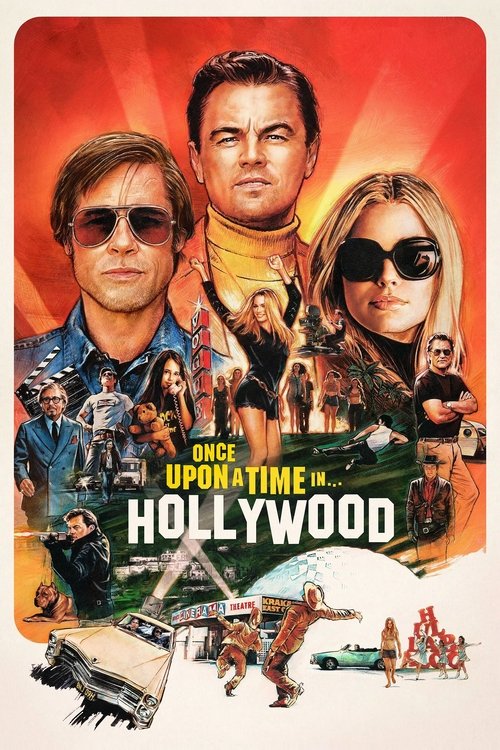
Once Upon a Time... in Hollywood
2019 · Quentin Tarantino
Generates discourse without releasing anything: the abandoned Movie Critic "final film," podcast hot takes (dunking on Marvel actors as "not movie stars," snubbing Toy Story 3), and the eternal "what will the tenth film be" watch. The industry's loudest opinion-haver.
For a long, luxurious evening when you want to live inside a movie rather than race through one — part comfort, part slow-building dread, best with no clock-watching.
What it's about
Los Angeles, 1969. Rick Dalton, a TV Western star watching his fame curdle into has-been status, and Cliff Booth, his stunt double, driver, and only real friend, drift through a Hollywood that's changing under their feet. Next door on Cielo Drive lives Sharon Tate, young and luminous, at the start of everything — while out at a derelict movie ranch, something much darker is gathering.
The experience
Sun-drunk and unhurried — a hangout movie that lets you cruise 1969 LA with the radio on, laugh-out-loud funny about actorly vanity, then increasingly tense as history's shadow creeps in. It saves its wildest energy for the end, and takes its sweet time getting there.
Performances
Leonardo DiCaprio is hilarious and touching as a fading star unraveling between takes, Brad Pitt won an Oscar for Cliff's effortless, coiled cool, and Margot Robbie makes Sharon Tate radiant with almost no dialogue — a performance built out of pure presence.
The craft
Tarantino rebuilds 1969 Los Angeles down to the marquees, billboards, and radio jingles, shooting on film with a wall-to-wall period soundtrack that does half the storytelling. The craft is immersive rather than flashy: long drives, golden light, and dead-on recreations of the era's TV and movies. A treat on a big screen with the sound up.
Why it matters
Tarantino's ninth film became a cultural event — winning Pitt his acting Oscar — and reignited the argument about how movies should handle real tragedy, cementing his late-career turn toward rewriting history with cinema.
Snapshot
A revisionist elegy for late-golden-age Hollywood, set across a single transformative week in February 1969 and culminating on the night of August 8–9, when history's most notorious celebrity murder was waiting to happen. Quentin Tarantino's ninth feature follows Rick Dalton (Leonardo DiCaprio), a television Western actor watching his relevance evaporate as the industry pivots from genre TV toward the countercultural cinema of the New Hollywood, and his stuntman-cum-best-friend Cliff Booth (Brad Pitt), a morally ambiguous drifter who lives in a trailer behind the Van Nuys Drive-In. Sharon Tate (Margot Robbie) drifts through the story as Rick's neighbor on Cielo Drive, a luminous figure whose real-world fate the film hovers around without consummating. The film's climactic alternate history—in which Charles Manson's acolytes stumble into Rick's house instead of Sharon Tate's—reframes Hollywood mythology as a fairy tale that can, retroactively, be told differently. At 161 minutes in its theatrical cut, it is the longest and most deliberately paced of Tarantino's theatrical features.
Industry & production
Columbia Pictures and Sony Pictures Entertainment financed and distributed the film, with Tarantino producing alongside David Heyman, Shannon McIntosh, and Georgia Kacandes. The production budget has been reported in the vicinity of $90 million—modest by franchise standards but substantial for an original period film without an IP anchor. The decision to shoot on practical Los Angeles locations, augmented by exhaustive period dressing, drove significant logistical cost: hundreds of vintage automobiles, restored storefronts along the Sunset Strip and Hollywood Boulevard, and the recreation of Cielo Drive's upper reaches. The Spahn Movie Ranch—the actual Manson Family compound—was recreated on location in Chatsworth, not far from where the original ranch stood before it burned down in 1970.
The film premiered in competition at the Cannes Film Festival in May 2019, two months before its wide North American release on July 26—timed to fall within days of the 50th anniversary of the Tate–LaBianca murders. This scheduling choice was universally noted as deliberate. At the 92nd Academy Awards the film received ten nominations and won two: Best Supporting Actor (Brad Pitt) and Best Production Design (Barbara Ling and Nancy Haigh).
The casting consolidated Tarantino's long-cultivated Hollywood relationships. DiCaprio had worked with him on Django Unchained; Pitt had not, and the pairing generated considerable pre-release interest. A large ensemble—Al Pacino as a Hollywood operator who recruits Rick for Italian Westerns, Kurt Russell as a veteran stunt coordinator, Damian Lewis as Steve McQueen, Emile Hirsch as Jay Sebring, Timothy Olyphant, Bruce Dern, Dakota Fanning, Margaret Qualley—populated the world with period-accurate figures. Mike Moh played Bruce Lee in a brief but controversy-attracting scene; Damon Herriman appeared as Charles Manson in a cameo, having also played him in the television series Mindhunter. Tarantino subsequently adapted the screenplay into a novel, published in 2021—an extension of his creative process he has pursued selectively.
Technology
Tarantino has been a consistent and vocal advocate for photochemical filmmaking in an era of digital production. Once Upon a Time... in Hollywood was shot on 35mm, with sequences depicting Rick's television appearances rendered in different formats to simulate the authentic visual texture of late-1960s broadcast television. The choice of 35mm reinforces the film's thematic investment in celluloid as a medium of memory and loss: the grain, warmth, and particular tonal latitude of the film stock become formal equivalents of the nostalgia the narrative describes.
Production designer Barbara Ling orchestrated one of the more exhaustive practical period recreations in recent American cinema. Rather than relying primarily on digital set extensions, the production redressed actual Los Angeles streets over months of preparation. The Musso & Frank Grill appeared without significant modification; other Sunset Strip and Hollywood Boulevard locations required sustained physical transformation. This commitment to practical location distinguishes the film from contemporaneous period productions that lean on volume stages or heavy post-production compositing.
Technique
Cinematography
Robert Richardson, Tarantino's director of photography since Kill Bill: Volume 1 (2003) and a three-time Academy Award winner (JFK, The Aviator, Hugo), shot the film in a style that departs meaningfully from their prior collaborations. Where The Hateful Eight was hard, cold, and hermetically closed—appropriate to its 70mm Panavision format and snowbound setting—Once Upon a Time... in Hollywood is warm, open, and observational. Richardson exploits the golden-hour quality of Southern California light, shooting the Los Angeles streets in ways that evoke late-1960s location photography without feeling like mere pastiche. Long observational takes of Cliff driving through Hollywood, or Rick sitting in his trailer between set-ups, slow the film into something closer to a reverie than a plot-driven progression. Anamorphic widescreen supports the film's investment in the Western and action aesthetic of the period depicted while also permitting the intimate two-shot compositions that anchor the central friendship.
Editing
Fred Raskin, who has cut Tarantino's films since Django Unchained, edited a film whose pace is by Tarantino's standards extraordinarily measured. The film's celebrated hangout quality—long stretches on the Lancer television set, Cliff's digressive drive to the Spahn Ranch, Sharon Tate watching herself in a Westwood cinema—requires an editorial sensibility comfortable with deferral. Raskin's work is less ostentatiously virtuosic than in earlier Tarantino features; the cuts are largely functional, allowing scenes to expand at their own pace. The final twenty minutes shift without ceremony into compressed, brutal efficiency that throws the film's prior languor into sharp formal relief.
Mise-en-scène / staging
Tarantino's staging in this film reflects a director at ease with stillness. Many of its most memorable moments are not scenes of confrontation but scenes of coexistence: Rick and Cliff driving together at night, Rick weeping in his trailer between takes after a difficult scene with a child actress (Julia Butters), Tate dancing barefoot in the cinema aisles. The film's investment in spectacle is largely horizontal and peripatetic—cruising, wandering, watching—rather than confrontational or architecturally concentrated. The Spahn Ranch sequence is staged as a slow accumulation of dread, with Cliff moving through a compound populated by Manson Family members in a manner that relies on the viewer's historical knowledge to generate unease Cliff himself declines to register.
Sound
The sound design is inseparable from the music supervision. Tarantino has never employed a conventional composed score, and here the period radio programming—drawn from playlists historically accurate to KHJ and other Los Angeles stations of 1969—functions as a continuous atmospheric layer. Songs by Paul Revere & the Raiders, Deep Purple, Simon & Garfunkel, José Feliciano, and dozens of others appear diegetically, on car radios and at parties. The strategy immerses the viewer in period consciousness while reinforcing the film's central argument that pop culture is a form of time capsule—that to hear these songs is to re-inhabit, however briefly, a world that no longer exists. Scenes of domestic tenderness or suburban dread are allowed to develop in near-silence, and the contrast between the film's lush sonic surface and these quiet interludes is one of its more sophisticated formal choices.
Performance
DiCaprio's Rick Dalton is a performance of deliberate overacting within the fiction: Rick is a television actor whose craft runs to broad genre registers, and DiCaprio plays a man performing a character who is himself always performing—with just enough fissure between the two registers to reveal Rick's actual anxiety and grief. His tears when he nails a difficult scene with Butters's child actress are among the most emotionally dense moments in the film, and theoretically intricate: they are the tears of a performer who has stopped trusting himself, moved by the discovery that he still can do the work.
Pitt's performance is the controlled counterpoint. Cliff Booth barely raises his voice; Pitt plays him with a quality of absolute ease that reads simultaneously as contentment, latent menace, and a species of terminal cool. The ambiguity surrounding whether Cliff murdered his wife—shown in a flashback whose resolution the film deliberately withholds—casts a moral shadow that Pitt refuses to dramatize.
Robbie's Sharon Tate is the film's most contested performance. Tarantino gives her relatively little dialogue, instead following her through a series of luminous, unhurried sequences—browsing a bookstore, laughing with friends, watching herself in a cinema—that frame her less as a psychological subject than as an emblem of a world about to end. Whether this constitutes a feminist reclamation of a woman reduced by historical record to her victimhood, or a missed opportunity to grant her genuine interiority, generated sustained critical debate that remains unresolved.
Narrative & dramatic mode
The film operates in what might be called a counter-factual pastoral: it proceeds in the register of near-documentary naturalism, accumulating a scrupulous texture of late-1960s Hollywood life, only to pivot in its final act into revisionist mythology. The structural strategy echoes Inglourious Basterds (2009), where Tarantino similarly built historically grounded tension to release it through an alternate-historical catharsis. Here the effect is less triumphalist: the violence that redirects history is accidental, chaotic, and grotesque rather than operatically staged. The underlying logic is nonetheless the same—cinema can revise what history cannot.
The film conspicuously avoids conventional mechanisms of dramatic economy. Scenes run longer than their information content requires; subplots resolve at oblique angles to the central narrative. Tarantino's stated admiration for the digressive rhythms of early-1970s Hollywood films—Carnal Knowledge, The Long Goodbye, The Last Picture Show—is legible throughout. The film is less interested in what will happen than in the texture of existing in a particular historical moment that is about to be shattered.
Genre & cycle
The buddy film is the functional skeleton: Rick and Cliff's relationship has the asymmetrical dependency and genuine affection of the classic odd-couple pairing. The Western intrudes constantly—through Rick's television career and through the moral archetype of the loyal retainer who handles violence so the principal doesn't have to. The title's direct invocation of Sergio Leone (Once Upon a Time in the West, 1968; Once Upon a Time in America, 1984) is not incidental: Leone's late Westerns were themselves elegies for genre mythology, and Tarantino consciously positions his film in that lineage of the myth-maker mourning the myth.
The revisionist history cycle, to which Inglourious Basterds also belongs, has its own coherence; the film participates in a mode that engages traumatic historical events through fantasy resolution, with roots in the alternate-history novel tradition. It can also be read alongside the Hollywood-about-Hollywood cycle—Sunset Boulevard, The Player, Mulholland Drive—that uses the industry as a lens for examining American mythology and the cost of dreams.
Authorship & method
Tarantino wrote the screenplay, as he writes all his features. His compositional process is famously longhand—drafting in notebooks before transcribing—and he has spoken of Once Upon a Time... in Hollywood as his most personal film: a love letter to the Los Angeles of his formation, to the pop culture that shaped him, and to a Hollywood he knew primarily through its images before he was old enough to enter it. The film is saturated with the particular melancholy of someone mourning a world they experienced mostly as memory before they ever lived in it.
Robert Richardson's long collaborative relationship with Tarantino constitutes a shared aesthetic project across enough films to track its own evolution. Fred Raskin's editorial patience was essential to a film whose entire argument depends on the value of slowness—and whose climax depends on the shock of suddenly withdrawing it. Barbara Ling's production design is arguably the film's single most visible technical achievement. Mary Ramos's music supervision, often underweighted in auteurist accounts, is a structuring force rather than a supporting one: the needle-drop method—using historically situated pre-existing recordings in place of composed scores—achieves particular thematic density in a film where the songs are not counterpointing the action but are rather the medium through which these characters experience their world as meaningful.
Movement / national cinema
The film belongs definitively to American cinema while produced in conscious dialogue with European, and specifically Italian, genre traditions. The Leone title echo, the Italian production subplot in which Rick is recruited for spaghetti Westerns—mirroring the historical migration of American television actors to Cinecittà during the late 1960s—and Tarantino's lifelong immersion in Italian giallo, poliziottesco, and the Western all situate it in a transatlantic generic conversation. Within American cinema, the film represents a strand of the post-Sundance independent tradition absorbed into studio production: auteur-driven, genre-inflected, star-powered films that maintain an art-cinema pace while operating within commercial distribution frameworks.
Era / period
The setting—Los Angeles, 1969—carries enormous symbolic weight in American cultural mythology. The Manson murders have been interpreted since their occurrence as marking the end of the 1960s utopian moment; Joan Didion's essays in The White Album make the killings into an epistemological rupture, the moment when a certain California innocence became permanently inaccessible. Tarantino is in explicit dialogue with this mythological construction, though the film's emotional center is less Didion's account of idealism's collapse than a more intimate account of professional and personal obsolescence. Rick Dalton's crisis is not primarily historical; it is the ordinary crisis of the middle-aged performer watching the world move past him.
The year 1969 also sits precisely at the hinge between Old Hollywood and New Hollywood—between the studio system's final gasps and the emergence of a director-driven American cinema associated with Coppola, Bogdanovich, Friedkin, and Altman. Tarantino, constitutively formed by New Hollywood and further trained on the B-film tradition, occupies an ambiguous position relative to both: nostalgic for a pre-New Hollywood aesthetic he never actually experienced, and shaped by directors who were themselves nostalgia merchants.
Themes
Obsolescence and loyalty are the film's central thematic concerns. Rick Dalton stands at the end of a particular kind of Hollywood career—the televisual Western hero whose genre has exhausted itself—and the film is interested in what it means to age out of the culture that made you. The friendship between Rick and Cliff is the emotional center precisely because it is a relationship outside utility: Cliff remains loyal to Rick past the point where loyalty serves his professional interests, and the film treats this as a form of grace in a world otherwise governed by calculation.
The film is equally a meditation on violence and its mythologies. Cliff is, by implication, a killer—of his wife, possibly of others—and the film's treatment of his capacity for violence is morally unsettled rather than condemned: the same quality that makes him potentially a murderer also makes him an effective protector. The final act's eruption of gore is framed as cathartic wish-fulfillment, but the film is too self-aware to present this cleanly; the violence is excessive, faintly absurd, and committed by forces the film has taken care not to glamorize.
Nostalgia as a mode of historical consciousness runs throughout. The film is frank about the seductiveness of looking backward and about the ways movie culture produces a particularly intense and delusional form of it—an emotional attachment not just to a time but to the images of a time, which are not the same thing.
Reception, canon & influence
Influences on the film (backward): Sergio Leone's mythological Westerns are the primary formal ancestor—the title is a direct homage, and the film inherits Leone's conviction that the Western is primarily a genre about mythology rather than history. Robert Altman's Los Angeles films, The Long Goodbye (1973) in particular, provide a template for the city as a state of mind, for the observational drift and deliberate non-resolution that characterizes Altman at his most peripatetic. Sam Peckinpah's elegiac late Westerns—Ride the High Country, The Wild Bunch—inform the treatment of male obsolescence and the moral ambivalence toward violence. The film is in clear dialogue with Paul Thomas Anderson's Inherent Vice (2014) as a vision of Los Angeles on the cusp of the Summer of Love's aftermath, and Tarantino's own acknowledged debts to Italian genre cinema (Leone, Sergio Corbucci, Dario Argento, Enzo G. Castellari) are present throughout in texture and reference.
Critical reception: Among the most widely reviewed films of 2019, it received largely enthusiastic notices, with particular praise for DiCaprio and Pitt's performances and for the quality of the period reconstruction. Dissent clustered around three areas: the limited interiority afforded to Robbie's Sharon Tate; the Bruce Lee scene, criticized by Lee's daughter Shannon Lee and others as a caricature that misrepresented his personality and established skill; and, from some quarters, the film's deliberate avoidance of conventional dramatic momentum. The decision to displace the Manson Family's violence onto their own ranks rather than onto Sharon Tate was widely read as a moral intervention—a filmmaker's explicit refusal to repeat, even in fiction, an act of real-world atrocity—and this reading was broadly accepted even by critics otherwise unconvinced by the film.
Legacy and influence (forward): The film reinforced a market and critical appetite for large-scale, unhurried, star-driven Hollywood history that privileges atmosphere over narrative mechanics, consolidating a prestige-period-film mode that has continued to attract significant production investment. Its revisionist-history structure has become an identifiable option for films engaging historical trauma—a demonstrated proof that the alternate-ending catharsis can be made to carry genuine emotional weight rather than functioning merely as provocation. Tarantino's stated intention to retire after a tenth film makes Once Upon a Time... in Hollywood function, in retrospect, as a kind of penultimate statement: a meditation not only on Hollywood's past but on the finite arc of a filmmaking career, and on what it means to be a director whose whole art is the transformation of cinematic memory into something that feels, impossibly, like the present tense.
A Deleuzian reading
Sharon Tate buys a ticket to her own movie.
The full Deleuzian reading of Once Upon a Time... in Hollywood →
Reception
It premiered at Cannes 2019 to a rapturous standing ovation, made real money for a near-three-hour hangout movie, and won Brad Pitt his acting Oscar — but the discourse at the time was dominated by the Bruce Lee scene and Margot Robbie's line count. Since then it's settled comfortably into 'late-period Tarantino peak' status, with the hangout looseness now cited as the whole point rather than the flaw.
How Once Upon a Time... in Hollywood was received, from release to now →
Influences: the films it descends from and the films it influenced
- Once Upon a Time in the West (1968) — The title is a direct homage, and Tarantino inherits Leone's anamorphic extreme-close/extreme-wide grammar and his conviction that the Western is a genre of mythology rather than documented history.
- The Long Goodbye (1973) — Altman's peripatetic, observational camera following Marlowe through early-1970s LA without conventional dramatic urgency is the direct formal precedent for Cliff Booth's unhurried, purposeless wandering through 1969 Hollywood.
- The Wild Bunch (1969) — Peckinpah's structural gambit of extended elegiac hangout pace erupting into sudden stylized ultraviolence—and his elegiac treatment of men whose world has outpaced them—are both explicitly extended by Tarantino's climactic tonal rupture.
- Once Upon a Time in America (1984) — Leone establishes the counter-factual dream-ending that rewrites historical trauma as consolatory pastoral, and the needle-drop-as-structural-argument in which Morricone themes carry nostalgia and loss rather than scoring scenes—both inherited by Tarantino's music supervision method.
- McCabe & Mrs. Miller (1971) — Altman's use of diegetic Leonard Cohen records as a structuring force rather than composed score is the direct prototype for the needle-drop-no-score method in which period pop music supervision carries the film's emotional argument rather than underscoring it.
- American Graffiti (1973) — Lucas invented the diegetic period-radio-as-temporal-anchor device—Wolfman Jack broadcasting continuously over the action—that OUaTiH literalizes through Cliff's truck radio, using AM radio as the primary period-immersion mechanism rather than a period detail.
- Day for Night (1973) — Truffaut's film-within-a-film structure, in which actors exist simultaneously as themselves and as their characters across overlapping performance layers, is the structural precedent for DiCaprio's Rick Dalton, whose identity is inseparable from his own performances within performances.
- Boogie Nights (1997) — PTA's argument that era-specific nostalgia can be transmitted entirely through period-accurate production design and needle-drop structure—with ensemble hangout pacing making social immersion itself the narrative subject—is the template Tarantino extends into the 1969 Hollywood setting.
- Dazed and Confused (1993) — Linklater's anti-dramatic hangout-pace structure—in which ensemble peripatetic observation substitutes for conventional dramatic arc and the refusal of resolution is itself the formal argument—is the American independent precedent for Tarantino's deliberate narrative economy.
- Inherent Vice (2014) — Shot on 35mm anamorphic in a Manson-era LA of observational drift, it shares OUaTiH's specific historical threshold, photochemical surface, and the formal argument that period atmosphere transmitted through production design and unhurried pacing is itself the subject rather than a vehicle for plot.
- Inglourious Basterds (2009) — Tarantino's own prior deployment of the revisionist-history counter-factual proves the alternate-ending structure can carry genuine moral weight—the Holocaust rewritten as cinema incinerating its own predators—establishing the formal permission OUaTiH claims in replacing the Manson murders with domestic comeuppance.
- The Hateful Eight (2015) — Carries forward the chapter-based screenplay architecture, retrospective omniscient narration, and ensemble character dynamics of The Hateful Eight, extending the formal template into a longer-form chamber nostalgia structure where Tarantino's theatrical blocking and monologue-driven performance are sustained across a wider geography.
- Licorice Pizza (2021) — Shot on 35mm in golden-hour San Fernando Valley, PTA deepens the anti-dramatic-economy argument that peripatetic wandering through a specific historical moment is itself the subject, making this the closest formal descendant in the post-OUaTiH period-LA observational hangout mode.
- Babylon (2022) — Chazelle takes cinematic-nostalgia-and-loss as explicit subject—Hollywood's transition era as mythological elegy—deploying meta-performance modes in which actors portray studio-era archetypes in a film that shares OUaTiH's core argument that Hollywood history is mythology to be mourned rather than documented.
- The Nice Guys (2016) — Black practices the same period-LA buddy-film hangout mode—anti-dramatic economy punctuated by climactic violence, two male leads whose dynamic trades on latent-menace-cool against genre obsolescence—working parallel to Tarantino in the same craft register and historical geography.
- Nouvelle Vague (2025) — Meticulous reconstruction of a specific film-industry moment with actors impersonating real figures, prizing atmospheric period accuracy and cinephile in-jokes over conventional plot.
- X (2022) — Parallel project in meticulous period-industry emulation: an affectionate portrait of show-business dreamers in a precisely reconstructed era, ruptured by a sudden burst of brutality.
- Django Unchained (2012) — Closes the informal counterfactual-revenge trilogy, again staging history's victims taking cathartic violent revenge in a fictional rewrite, scored by compiled needle-drops.
- The Fall Guy (2024) — Parallel elevation of the stunt double to romantic-heroic protagonist, foregrounding stunt labor and the doubling-and-authenticity theme within an affectionate industry portrait.
- Jigarthanda DoubleX (2023) — Shares the film-within-a-film device deployed toward the same fantasy of cinema undoing real violence — the movies literally rewriting a bloody outcome, DoubleX's cinema-as-nonviolence in another key.
Similar films
- Babylon (2022) — influence & lineage
- Inglourious Basterds (2009) — influence & lineage
- American Graffiti (1973) — influence & lineage
- Once Upon a Time in America (1984) — influence & lineage
- Boogie Nights (1997) — influence & lineage
- Once Upon a Time in the West (1968) — influence & lineage
- The Wild Bunch (1969) — influence & lineage · same viewing thread
- McCabe & Mrs. Miller (1971) — influence & lineage · same viewing thread
All the films related to Once Upon a Time... in Hollywood →
Watch it with: curated runs of related films
- Print the Legend — A run of frontier myths and their unmaking — town-taming marshals, aging gunfighters, and the stories the newspapers chose to print instead of the truth.