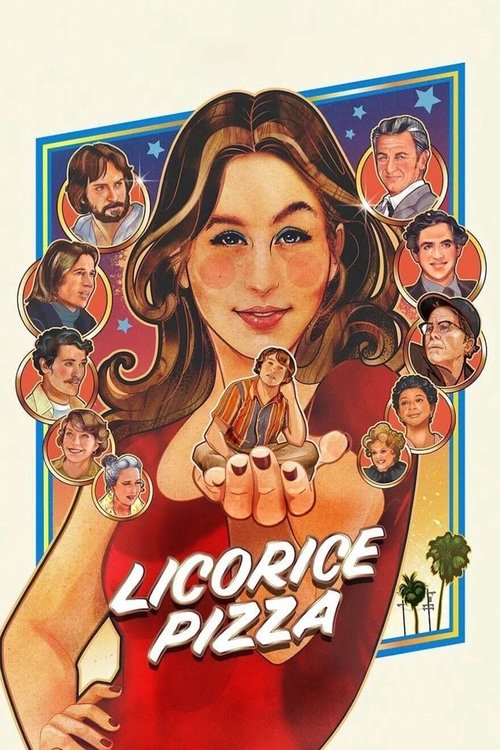
Licorice Pizza
2021 · Paul Thomas Anderson
The critics' consensus "greatest living American director" finally made a commercial-scale film with One Battle After Another, instantly triggering debates about its politics, its reported $130M+ budget, and whether the best-reviewed film of 2025 could actually win Best Picture. PTA fandom is a Letterboxd personality type.
For when you want to feel young and reckless for two hours — a hangout movie to sink into, ideally with someone you like. Pure comfort with a nostalgic glow, though its odd, prickly central relationship gives you something to argue about after.
What it's about
San Fernando Valley, 1973. Gary Valentine is fifteen, a former child actor with a hustler's confidence, and Alana Kane is twenty-five, adrift and prickly, when he asks her out at his high school picture day. What follows is not quite a romance and not quite not one: the two orbit each other through waterbed businesses, pinball parlors, a mayoral campaign, and encounters with the Valley's showbiz fringe, while the oil crisis rumbles in the background.
The experience
Sun-drunk and loose-limbed — it ambles from one comic misadventure to the next, powered by needle-drops and the crackle between its two leads. It's funny, warm, and a little melancholy underneath, the feeling of a summer you know is ending even while you're in it.
Performances
Alana Haim and Cooper Hoffman, both in their first film roles, are astonishingly natural — Haim especially, all restless intelligence and wounded pride, gives one of the great screen debuts. Bradley Cooper's brief, unhinged turn as a volatile Hollywood producer nearly runs off with the movie.
The craft
Paul Thomas Anderson shoots the Valley like a memory — grainy, golden 35mm, long takes of kids running through the dark, a period soundtrack woven in like weather. The film's structure is deliberately shaggy, a chain of episodes rather than a plot, and that looseness is the point: it trusts charm and texture over engineering. Gorgeous on a big screen, where the film grain and California light do their work.
Why it matters
Anderson's warmest, most purely pleasurable film, it earned Oscar nominations including Best Picture and announced Alana Haim as a major screen actress arriving from the music world.
Snapshot
Paul Thomas Anderson's eighth feature is a sun-drunk, picaresque love story set in the San Fernando Valley during the autumn and winter of 1973. Alana Kane (Alana Haim), twenty-five and adrift, and Gary Valentine (Cooper Hoffman), fifteen and relentlessly ambitious, orbit each other through a series of comic misadventures: a child acting agency, a pinball machine business, a waterbed company, a run-in with a volatile producer, a brushfire at a gas station during the oil embargo. The film resists conventional romantic structure—its climax is a sprint across a darkened parking lot, not a declaration—and trusts in the electricity of its two débuting leads. Named after a chain of Southern California record stores, the title never appears in the film itself; it functions instead as an evocation of a particular cultural atmosphere, a smell and a sound more than a plot.
Industry & production
Licorice Pizza was produced by Anderson's production company, Ghoulardi Film Company (named for the late-night Cleveland horror host Ernie Anderson, father of Wes Anderson's frequent collaborator), with MGM and United Artists Releasing handling North American distribution. The budget has been reported in the range of forty million dollars, though Anderson and his producers have not confirmed precise figures publicly.
The screenplay drew substantially on stories shared with Anderson by Gary Goetzman, the producer best known for his long collaboration with Jonathan Demme on Philadelphia (1993) and The Silence of the Lambs (1991). Goetzman grew up in the San Fernando Valley as a child actor turned juvenile entrepreneur—precisely the trajectory the fictional Gary Valentine follows—and his anecdotes provided the episodic spine of the script. Anderson has acknowledged the debt while stressing that the film is not biography; the characters are composites and inventions laid over a geography and an era that Anderson himself inhabited as a boy, having grown up in Studio City.
Casting proceeded unconventionally on both lead roles. Alana Haim, a member of the pop-rock trio HAIM, had appeared in Anderson's music videos for the band and was offered the role directly; she had no prior feature film experience. Cooper Hoffman, son of Philip Seymour Hoffman, was seventeen at the time of production and likewise making his feature début. Both were cast against the grain of professional polish—a conscious decision that echoes Anderson's interest, across his career, in non-actors or actors deployed against type. The supporting ensemble includes Sean Penn, Tom Waits, and Bradley Cooper, whose cameo as the volatile film producer Jon Peters generated particular attention and some controversy; John Michael Higgins plays a restaurateur whose scenes drew criticism for their use of exaggerated mock-Japanese accents as a comedic device.
Principal photography took place almost entirely in the San Fernando Valley, with production making extensive use of practical locations—storefronts, residential streets, bowling alleys, and hillside roads that retain their 1970s character. The film shot in 2020 and 2021 under modified COVID-era protocols, a circumstance that, unusually, left little visible mark on the final cut.
Technology
Anderson shot Licorice Pizza on 35mm film, an unbroken commitment since Boogie Nights (1997). The choice is aesthetic rather than nostalgic on principle: the grain structure, contrast response, and color latitude of photochemical film suit Anderson's interest in the quality of light specific to the Valley—smoggy, warm, saturating late-afternoon sun. The film was shot in the 1.85:1 aspect ratio, which allowed for compositions that breathe without the formal weight of anamorphic scope; this distinguishes the film's texture from Boogie Nights or Inherent Vice, both shot in anamorphic widescreen. Post-production involved a photochemical intermediate before digital color grading, preserving the grain structure through the pipeline.
Technique
Cinematography
The director of photography was Michael Bauman, who had worked with Anderson in camera department capacities on previous productions before ascending to the lead DP role here. The visual approach favors handheld or loosely stabilized long-lens work: the camera follows characters at a slight remove, catching them in motion rather than pinning them in static compositions. The effect is documentary-adjacent—the film often feels observed rather than arranged. Daylight interiors are lit with practical sources augmented to mimic afternoon sun flooding through windows. Night exteriors, including the film's several pivotal running sequences, lean into available light and the warm sodium-vapor glow of 1970s street lighting, producing images that feel simultaneously vivid and slightly degraded in the manner of period Super 8 or 16mm home footage.
Editing
Anderson's longtime editor Andy Jurgensen, who has cut the director's work since Inherent Vice (2014), assembled a film of roughly two hours and thirteen minutes from what was reportedly a great deal of footage. The editing grammar is largely classical—cuts within scenes are motivated by dialogue and eyeline—but the between-scene transitions are often abrupt, even jarring, as if catching the characters mid-stride. The episodic structure encourages a segmented rhythm: discrete adventures follow one another with minimal connective tissue, and the film trusts the audience to project continuity across temporal ellipses.
Mise-en-scène / staging
Anderson stages Licorice Pizza with a freedom that recalls the improvisational warmth of Hal Ashby and Jonathan Demme rather than the rigorous geometric formalism of his own earlier work. Scenes frequently run long, allowing actors to find their moments without the pressure of a tightly planned camera program. The famous closing run—Gary and Alana sprinting toward each other through the dark across a parking lot, shot with a telephoto lens that compresses space and makes their approach feel endless—is among the most discussed sequences in recent American cinema, and illustrates Anderson's ability to extract emotional magnitude from a simple, unadorned physical action.
The production design (by Florencia Martin) integrates period-accurate objects—wallpaper patterns, vehicle models, furniture, appliances—without the hermetic perfection that often makes period films feel embalmed. Spaces look lived in; the Valley's working-class and lower-middle-class homes and businesses are rendered without either condescension or nostalgia's falsifying gloss.
Sound
The sound design operates in close collaboration with the music supervision, creating a world where diegetic and non-diegetic music are often porous. A David Bowie song erupts without warning; a period pop record bleeds from a car radio into the scene's ambient space. Jonny Greenwood, who has scored every Anderson film since There Will Be Blood (2007), provided original music here, though the film leans more heavily than any of their previous collaborations on a curated selection of early-1970s source recordings. Greenwood's orchestral contributions are woven into rather than set against the period music, and the overall sonic texture privileges the warm, slightly distorted sound of vinyl—another formal rhyme with the record-store world the title invokes.
Performance
The film's central gamble is its leads, and both Haim and Hoffman meet it. Haim plays Alana with a specific combination of exasperation, vulnerability, and unfocused longing that feels genuinely found rather than performed; she moves as a non-actor does, slightly off the theatrical beat, which gives her reactions an authenticity that professional polish might have smoothed away. Hoffman carries a remarkable physical confidence—his walk, his posture, his easy command of a room—that makes Gary's entrepreneurial audacity credible even at fifteen. Neither performance depends on technical virtuosity; both depend on presence. Anderson's work with actors throughout his career has shown consistent preference for performers who inhabit rather than construct, and Licorice Pizza is perhaps the purest expression of that method.
Narrative & dramatic mode
The film's structure is episodic and picaresque rather than goal-driven. There is no single objective that organizes the plot; Gary and Alana are not trying to do one thing but are instead caught up in a series of doing many things, each of which briefly preoccupies the film before giving way to the next. This is consistent with the phenomenology of adolescence and young adulthood—life experienced as a sequence of vivid incidents rather than a teleological arc. The central romantic tension is similarly diffuse: Gary is explicitly smitten; Alana resists, deflects, pursues other men, circles back. Their relationship is never consummated on screen, and the film ends at the moment of mutual recognition rather than at any conventional resolution. The mode is essentially comic, in the deep sense—a comedy of embarrassment, desire, and the social grotesque—with sporadic passages of genuine danger (the film's gas-station fire sequence) that remind the audience the world of 1973 was not entirely soft.
Genre & cycle
Licorice Pizza belongs most immediately to the coming-of-age comedy, a genre with deep roots in American cinema. It participates in a specific sub-cycle of nostalgia films that reconstruct particular American decades through the lens of adolescent or young adult experience: the tradition runs from Lucas's American Graffiti (1973, also set in the early 1970s) through Dazed and Confused (1993), Almost Famous (2000), and beyond. The film is also legible as a romantic comedy, though it deliberately frustrates the genre's conventions of consummation and declaration. Its period setting places it within the broader cycle of 1970s-revival films, though Anderson is unusual in that his investment in the decade is autobiographical and local rather than generically motivated.
Authorship & method
Anderson wrote and directed without co-writers, continuing his practice of solo screenplay authorship. His method involves long preparation—extensive location scouting, period research, accumulation of anecdote and detail—before production, after which he allows significant latitude on set. He operates camera himself on occasion, and his proximity to the image-making process shapes the visual intimacy of his films. His collaboration with Jonny Greenwood, now spanning six features, has become one of the most significant director-composer partnerships in contemporary American cinema; Greenwood's ability to modulate between dissonance and lyricism maps onto Anderson's tonal range.
Michael Bauman's contribution as DP represents a generational handoff from Anderson's long partnership with Robert Elswit (who shot Boogie Nights through There Will Be Blood) and the single-film experiment of Phantom Thread, on which Anderson served as his own cinematographer. Bauman's approach on Licorice Pizza prioritizes mobility and light sensitivity over compositional control, a shift that suits the film's improvisational register.
Movement / national cinema
Anderson occupies a specific position in American cinema: a filmmaker who emerged from the 1990s independent wave but has consistently worked at the intersection of studio resources and auteur prerogative. Licorice Pizza is an American studio film in the traditional sense—made with significant capital, distributed by a major—but is controlled entirely by Anderson's creative vision in a manner more characteristic of European art cinema. The film belongs to no formal school or movement; its closest kinship is with the generation of American humanist filmmakers working in the 1970s and early 1980s—Ashby, Demme, Cassavetes—whose work Anderson has repeatedly cited as foundational.
Era / period
The film is set in the autumn and winter of 1973, during the OPEC oil embargo. The embargo is woven into the plot: the gas shortage and the resulting scenes of violence and chaos at filling stations function both as period texture and as a reminder that the era's apparent freedom was shadowed by resource anxiety and political turbulence. Anderson locates the film's events against this background without making it didactic; the embargo is experienced as circumstance, not symbol.
Themes
The film's central concern is the peculiar asymmetry of desire and readiness: Gary wants Alana completely and immediately; Alana wants something she cannot yet name. Their ten-year age gap is treated as a source of comedy and pathos simultaneously—he is precocious, she is underachieving, and neither is quite where they should be given their age. The Valley itself is thematic: a peripheral geography where ambitions form and circulate at a slight remove from the cultural centers of Los Angeles, a place where a fifteen-year-old can plausibly run a pinball machine business and a twenty-five-year-old can feel genuinely outpaced. California dreaming here is not debunked but refracted—the dreams are achievable, slightly absurd, and specific to a moment that is already passing.
Reception, canon & influence
Critical reception. Licorice Pizza received strongly positive reviews on its limited release in late November 2021 and wide release in December. Critics praised the performances of Haim and Hoffman, the period detail, and Anderson's tonal command. Some dissenting voices noted the film's loose narrative as a structural weakness, and the scenes involving Higgins's character drew pointed criticism as racially insensitive caricature—a charge that generated sustained discussion about the film's ethical blind spots. The film received three nominations at the 94th Academy Awards (2022): Best Picture, Best Director, and Best Original Screenplay; it did not win in any category.
Influences on the film. The most direct antecedent is American Graffiti (George Lucas, 1973), with which Licorice Pizza shares its episodic structure, period setting, and investment in the social world of California youth. Hal Ashby's cinema—Harold and Maude (1971) for its unconventional romance across an age gap; Shampoo (1975) for its Valley milieu and restless sexual energy; The Last Detail (1973) for its picaresque momentum—is an evident touchstone. Jonathan Demme's warmth and his use of non-actors and musicians as screen presences (notably in Something Wild, 1986) inform Anderson's approach to his leads. Robert Altman's overlapping naturalism and his willingness to let scenes expand beyond their functional necessity are felt throughout. Anderson's own Boogie Nights (1997), set in the same geography a few years later, forms an implicit prequel in mood and milieu.
Legacy and forward influence. The film's legacy is still forming, given its recency, but several lines are already visible. Haim's performance ignited renewed critical discussion about the casting of musicians in dramatic roles—a practice as old as cinema but given fresh impetus by the conviction of her work here. The film has been frequently cited in subsequent debates about nostalgia in American cinema: as an example of how period recreation can serve emotional interiority rather than mere spectacle. Anderson's refusal of resolution—his willingness to end on potential rather than arrival—has been noted as a model for romantic narrative that honors ambiguity. Cooper Hoffman's début, carrying with it the weight of his father's legacy, was received with particular critical generosity, and his subsequent career will be tracked closely as a result.
A Deleuzian reading
Two kids run toward each other across a dark parking lot, and the shot won't let them arrive.
The full Deleuzian reading of Licorice Pizza →
Reception
Landed in 2021 as a critics' darling — three Oscar nominations including Best Picture — but the online discourse was instantly stormy; a few years on it has settled into place as the beloved, rewatchable 'hangout movie' of late-period PTA.
How Licorice Pizza was received, from release to now →
Influences: the films it descends from and the films it influenced
- American Graffiti (1973) — The episodic multi-strand structure—where California teenage social life accumulates through loosely connected encounters across a single night without resolving into a conventional arc—is the direct structural template LP inherits for its Valley picaresque.
- Harold and Maude (1971) — Ashby sustains a romantic attraction across a radical age and status asymmetry without pathologizing the desire or forcing resolution, establishing the precise model LP follows in leaving the Alana-Gary attachment in productive irresolution.
- Shampoo (1975) — Set in the Valley milieu on the eve of the 1968 election, Ashby uses his protagonist's lateral drift through overlapping social situations to capture a California moment of restless sexual and political energy—the spatial and milieu logic LP inherits wholesale.
- The Last Detail (1973) — Ashby's picaresque propels characters through loosely connected episodes via accumulation rather than cause-and-effect plotting, with abrupt scene-to-scene transitions that foreground present sensation over narrative destination—LP's structural rhythm descends directly from this.
- Nashville (1975) — Altman casts actual musicians (Ronee Blakley, Keith Carradine) as dramatic leads in an episodic ensemble where live performance bleeds into the ambient soundscape without editorial demarcation—the precise porous sound strategy and musician-as-performer casting LP applies to Haim.
- A Woman Under the Influence (1974) — Cassavetes holds takes through social discomfort past conventional editorial comfort, training the camera to wait on performance rather than cut to convenience—LP's improvisational long takes inherit this durational patience with actors in behaviorally uncertain states.
- Badlands (1973) — Malick deploys telephoto lenses to observe romantic protagonists at critical psychological distance against American landscape with deliberate narrative underresolution—LP's telephoto grammar of desire and refusal of arrival descend directly from this formal stance.
- Something Wild (1986) — Demme's method of directing musicians and non-professionals with warmth that elicits unguarded screen presence—casting by instinct for charisma over trained technique—provides the philosophy Anderson applies to Haim and Cooper Hoffman.
- Dazed and Confused (1993) — Linklater assembles a non-professional-adjacent ensemble through a single afternoon of episodic coming-of-age encounters, using the social world itself as dramatic engine without resolving into individual character arcs—LP's collective-milieu approach inherits this structure.
- Boogie Nights (1997) — Anderson's earlier 35mm San Fernando Valley film establishes the photochemical grammar and period-specific California milieu LP inherits, including Altman-derived ensemble staging of aspiration-adjacent characters whose world sits just outside Hollywood proper—LP is its implicit prequel in mood.
- Punch-Drunk Love (2002) — Anderson develops his sustained telephoto compression of romantic leads against shallow-focused Valley commercial backgrounds—the long-lens grammar of desire held at proximate distance—which LP's DP Michael Bauman inherits and extends into the film's signature closing runs.
- Once Upon a Time in Hollywood (2019) — Tarantino shoots period 1969 Los Angeles on 35mm photochemical stock with an episodic picaresque structure and industry-adjacent characters moving through the same Valley geography, making photochemical grain the material carrier of California nostalgia rather than mere period decoration.
- Aftersun (2022) — Wells uses Super 8 and Hi8 consumer-video texture as the material carrier of period nostalgia, extending LP's argument—established through 35mm grain—that photochemical or analog degradation should excavate emotional interiority rather than supply period spectacle.
- Armageddon Time (2022) — Gray shoots his period 1980 Queens coming-of-age on 35mm with visible grain as emotional register, inheriting LP's insistence that the photochemical image is the appropriate material for rendering childhood memory rather than the retrospective clarity of digital reconstruction.
- Tony (2026) — Michael Bauman's lens-led period method carries over intact — vintage wide-angle glass pushed close to young faces so the room bends at the edges, golden-hour available light rather than gelled interiors, and period signalled through the optics' rendering instead of set-dressing inventory.
- Lady Bird (2017) — Gerwig's elliptical chapter-transition structure—cutting abruptly between disconnected coming-of-age episodes without transitional tissue—mirrors LP's abrupt editing, and her casting of Ronan against her star glamour in favor of geographic specificity parallels Anderson's anti-stardom decision to cast Haim.
- The Worst Person in the World (2021) — Trier's chapter-divided romantic narrative refuses conventional resolution by ending on the protagonist's emergence rather than romantic arrival, deploying the same deferral strategy LP uses: ending on potential and ambiguity rather than consummation, honoring irresolution as the honest form of adult desire.
- One Battle After Another (2025) — 35mm long-lens photography of the San Fernando Valley as period Californian geography, episodic picaresque structure where set-pieces accrue emotional weight independently of narrative arc, and improvisational performance latitude within tightly structured dramatic frameworks — the closest direct sibling in Anderson's own California strand.
- 20th Century Women (2016) — A period California coming-of-age driven by dense era-specific needle-drops and loose ensemble staging, reconstructing a remembered 1970s Southern California with the same nostalgic-yet-precise source-music design.
Similar films
- Boogie Nights (1997) — influence & lineage
- Punch-Drunk Love (2002) — influence & lineage
- Lady Bird (2017) — influence & lineage
- American Graffiti (1973) — influence & lineage
- Once Upon a Time... in Hollywood (2019) — influence & lineage
- One Battle After Another (2025) — shared sensibility
- Palm Springs (2020) — shared sensibility
- Fast Times at Ridgemont High (1982) — shared sensibility
All the films related to Licorice Pizza →