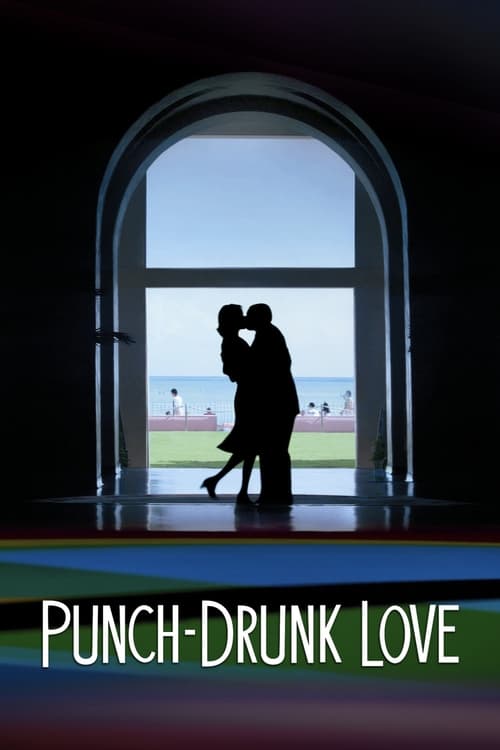
Punch-Drunk Love
2002 · Paul Thomas Anderson
The critics' consensus "greatest living American director" finally made a commercial-scale film with One Battle After Another, instantly triggering debates about its politics, its reported $130M+ budget, and whether the best-reviewed film of 2025 could actually win Best Picture. PTA fandom is a Letterboxd personality type.
For when you want to fall in love but can't stomach a normal rom-com — a film for anyone who's ever felt too strange for the standard love story. A cozy night in, with an edge.
What it's about
Barry Egan sells novelty plungers out of a warehouse in the San Fernando Valley, endures seven overbearing sisters, and hides a temper that erupts out of nowhere. Then two things happen almost at once: a phone-sex line starts extorting him, and a woman named Lena walks into his life and, inexplicably, likes him. It's a love story about a man who has never been allowed to be loved, told at the pitch of a panic attack.
The experience
Jittery and tender at the same time — the anxiety is so vivid it's almost physical, and then the romance breaks through it like sunlight. Ninety-five minutes that feel like holding your breath and then letting it go.
Performances
Adam Sandler, cast against everything he was known for, is a revelation — all the rage and sweetness of his comedies turned inward until they hurt. Emily Watson matches him with a warmth that never explains itself.
The craft
Paul Thomas Anderson shoots the Valley in lens flares and lonely wide frames, splices in washes of pure abstract color, and lets Jon Brion's percussive, seasick score play Barry's nervous system out loud. It's a romantic comedy built like a thriller, and the sound design does half the emotional work. Watch it with the volume up.
Why it matters
It won Anderson the directing prize at Cannes and permanently changed the conversation about what Adam Sandler could do — every serious Sandler role since traces back here. It's become a touchstone for filmmakers bending comedy stars into drama.
Snapshot
Paul Thomas Anderson's fourth feature is a 95-minute anomaly in his filmography and in American cinema at large: a romantic comedy stripped of genre comfort, a melodrama operating almost entirely through texture and sensation, a showcase for Adam Sandler that the industry did not know how to process at the time and has spent two decades trying to understand. Barry Egan, a novelty-plunger wholesaler with seven domineering sisters and a hair-trigger capacity for violence, falls catastrophically, sincerely in love with a woman named Lena Leonard — and that premise, rendered with the formal compression of a tone poem and the nervous energy of a thriller, produces one of the defining American films of the 2000s.
Industry & production
Punch-Drunk Love was developed at New Line Cinema before moving to Revolution Studios, which distributed through Columbia Pictures. After the sprawling, three-hour Magnolia (1999), Anderson reportedly wanted to make something small and fast, a deliberate act of formal self-discipline. The film was produced on a relatively modest budget for a studio-adjacent project of its pedigree — commonly cited around $25 million — and performed modestly at the box office during its theatrical run. It was not a commercial event. Anderson had earned enough capital from Boogie Nights (1997) and Magnolia to secure unusual creative latitude, and the studio appears to have given him substantial freedom, in part because the film was cheap enough not to require much oversight.
The casting of Adam Sandler was the film's most conspicuous industry gambit. Sandler in 2002 was one of the most reliable box-office draws in American comedy — broadly derided by critics, beloved by multiplexes — and Anderson cast him not despite that reputation but in direct conversation with it, leveraging the audience's accumulated familiarity with Sandler's barely-suppressed rage and man-child affect while redirecting those qualities into something genuinely unsettling and tender. The project was produced with close input from Anderson's regular collaborators, and Emily Watson, cast as Lena, brought a European art-cinema credibility that helped anchor the film's tonal ambitions.
Technology
The film was shot on 35mm using anamorphic lenses, the format standard to Anderson's cinematographic practice through this period. Anamorphic widescreen (approximately 2.39:1) contributes meaningfully to the film's visual grammar: the extreme horizontal field emphasizes Barry's isolation within his cavernous warehouse, lets figures be dwarfed by empty space on either side, and makes intimate close-ups feel at once monumental and claustrophobic. Robert Elswit, Anderson's cinematographer since Hard Eight (1996), used available and practical sources extensively alongside controlled studio work, lending the Los Angeles locations a bleached, slightly overexposed quality that reads as both mundane and hallucinatory.
Perhaps the most distinctive technological element is the animated color "curtains" — abstract fields of saturated pigment that punctuate the film at emotional inflection points, suggesting overwhelming sensation without literal representation. These sequences were created by the visual artist Jeremy Blake, working in digital paint and animation, and their integration into a photochemical feature film was unusual for mainstream releases of the period. Blake's contribution gives the film a formal dialogue with Pop Art and abstract expressionism that operates below the level of narrative.
Technique
Cinematography
Elswit shoots Punch-Drunk Love with a kinetic, hand-held urgency that keeps Barry's interior life from ever fully settling. The camera often finds Sandler from odd angles or catches him mid-gesture, off-balance. Primary colors — deep blues, sharp reds, whites — are used with precision rather than naturalism: Barry's blue suit becomes a kind of armor and a vulnerability simultaneously, persisting through the film against the gray and beige of his industrial environment. Rack focuses and shallow depth-of-field emphasize perceptual instability. The Los Angeles locations — Alhambra, the airport, a Hawaiian resort — are photographed without romanticism but with a peculiar luminous intensity, ordinary spaces made slightly alien.
Editing
The editing, credited to Leslie Jones, is the film's most formally radical element. Anderson structures sequences through associative cuts and ellipses that bypass conventional scene logic: conversations end before they resolve, transitions collapse time without notice, and the film repeatedly cuts away from violence at the moment of impact, then returns to aftermath. This rhythm communicates Barry's dissociated consciousness more efficiently than any expository scene could. At the same time, the film withholds the dense cross-cutting and coincidence-plotting of Magnolia; scenes are held long enough to become uncomfortable, and the editing refuses to rescue the viewer through pace.
Mise-en-scène / staging
Anderson stages the film with a heightened awareness of threshold and confinement. Barry's warehouse office is a glass-walled box inside a larger box, the architecture of a man who simultaneously broadcasts and contains. The Hawaii sequence — shot with unusual warmth and directness — represents the only space in the film where Barry is not framed by architecture that implies enclosure. Staging frequently positions characters at the edges of the anamorphic frame, the center given over to objects: the harmonium, a stack of pudding cups, a telephone. The physical choreography of Sandler and Watson in their earliest scenes together is painfully precise, two people who want proximity and cannot coordinate it.
Sound
Jon Brion's score is the film's emotional spine and its most formally adventurous element. Brion, who also scored Magnolia and was a close collaborator with Anderson during this period, builds the Punch-Drunk Love soundtrack through interlocking percussion loops, prepared piano, and orchestral swells that function more like sound design than conventional underscoring. The harmonium — the strange keyboard instrument Barry encounters at the film's opening — threads through the score, its timbre suggesting both music-box innocence and malfunction. Brion integrates diegetic sound into the score so gradually that the boundary between the two dissolves; phone static, warehouse ambiance, and the rhythm of the pudding-cup stacking become musical events. The effect is total submersion in Barry's sensory experience.
Performance
Sandler's performance is the film's most discussed element and remains one of the more remarkable instances of casting against type in contemporary American cinema. He does not abandon his familiar mannerisms — the voice that cracks into childlike register, the barely-governed physicality — but Anderson deploys them as genuine character data rather than comedic shorthand. Barry is not a parody of a Sandler character; he is an account of what that character's pathology would look like if you took it seriously. The supporting cast is deployed with deliberate economy: Philip Seymour Hoffman appears in only a handful of scenes as Dean Trumbell, the mattress-man operator of a phone-sex scam ring, and his overbearing confidence creates a precise foil for Barry's contracted self.
Narrative & dramatic mode
The film operates less through event than through accumulation of emotional pressure. Its nominal plot — Barry exploits a loophole in a Healthy Choice promotion to amass frequent-flyer miles, becomes the target of a phone-sex extortion ring, and falls in love with his sister's friend — is thin enough to hold only a short film. Anderson stretches it to feature length by dwelling inside sensation: Barry's anxiety before a phone call, the silence in a room after an outburst, the specific quality of embarrassment in front of another person. The dramatic mode is closer to the chamber works of Cassavetes or the emotional abstraction of Jacques Tati than to the Hollywood romantic comedy the marketing briefly tried to suggest.
The film is structured around escalation and release in a way that mimics physiological arousal — anxiety building to violence or to tenderness, then subsiding, then building again. Narrative information is distributed unevenly: the pudding scheme, for instance, is never fully explained within the story, and the film trusts the audience to not need it explained. The climactic confrontation in Provo, Utah, which resolves the extortion subplot, is played as farce edging into the surreal, the film refusing to take its own thriller mechanics seriously while still delivering catharsis.
Genre & cycle
Punch-Drunk Love is most usefully understood as a critique of and transformation of the romantic comedy, a genre that by 2002 had calcified into a reliable formula centered on charming misunderstanding and predictable reconciliation. Anderson strips the genre of its social lubrication — there is nothing easygoing about Barry's courtship of Lena, nothing cute about his impulses — and replaces it with an inquiry into what romantic attachment actually feels like: intrusive, overwhelming, physically destabilizing, capable of reorganizing a person's entire behavioral repertoire.
The film belongs to a loosely defined cycle of early-2000s American films that raided genre forms for emotional sincerity while refusing genre payoffs — a category that includes work by Michel Gondry and Charlie Kaufman, directors with whom Anderson shares certain influences and temperament, even if they are not directly connected. It also sits within the auteurist branch of 1990s and early 2000s American independent cinema: ambitious, formally self-conscious work produced on the margins of the studio system with significant directorial control.
Authorship & method
Anderson wrote and directed the film in what he described as a period of deliberate compression after the expansiveness of Magnolia. The script is characteristically self-authored — Anderson does not adapt other material — and the premise was reportedly inspired in part by a real incident in which a man named David Phillips, an engineer from California, discovered and exploited a Healthy Choice frequent-flyer promotion in 1999, purchasing thousands of cups of pudding to accumulate miles far in excess of what the company intended. Anderson has acknowledged this case as a seed, though the film's treatment of it is oblique.
Robert Elswit, who would later win the Academy Award for Best Cinematography for There Will Be Blood (2007), has been Anderson's primary cinematographic collaborator across nearly his entire career; his contribution to the film's visual logic is inseparable from Anderson's own instincts. Jon Brion's score represents arguably his finest work and a high-water mark of director-composer collaboration in the period; Brion's approach to blurring source music with underscoring shaped the film's sensory argument as much as any visual decision. Editor Leslie Jones maintained a close working relationship with Anderson through this period, and the editing's willingness to sit inside discomfort reflects a shared aesthetic judgment.
Movement / national cinema
Punch-Drunk Love belongs to American cinema but is in direct, acknowledged conversation with European modernism, particularly the French and Italian traditions. Anderson's debt to Jacques Tati — specifically Tati's use of architectural space, his alienated protagonists, his treatment of sound as a comic and existential element — is evident in the warehouse settings and in the film's handling of Barry's sisters, whose collective presence operates like Tati's crowds: oppressive, undifferentiated, generative of physical comedy through sheer mass. The influence of Jean-Luc Godard's use of primary color in films like Une femme est une femme (1961) is also frequently cited in relation to the film's visual palette, though Anderson has been guarded about direct influences in interviews.
The film has no strong relationship to a national cinema movement as such — it is an American independent production made through studio infrastructure — but it participates in a loose international art-film sensibility defined more by shared formal concerns than by national or institutional affiliation.
Era / period
The film arrives at a particular moment in the consolidation of the American independent cinema that had expanded dramatically in the 1990s. By 2002, the novelty of that expansion was wearing off, and filmmakers who had emerged within it were being pressed either toward full studio integration or toward smaller-scale, more difficult work. Punch-Drunk Love represents Anderson choosing difficulty. The decade would also see, across American and European cinema, an increasing engagement with formal minimalism and sensory intensity as alternatives to the narrative density that had characterized much prestige cinema of the 1990s — a current in which the film participates.
Themes
The film's central preoccupation is the relationship between violence and tenderness, specifically the question of whether they are separable or whether, in certain persons, they are two expressions of the same overwhelming affective capacity. Barry is capable of genuine, overwhelming violence — he smashes plate glass windows, destroys a bathroom in Hawaii, punches out three men who threaten Lena — and of an equally overwhelming tenderness toward Lena that the film treats as directly continuous with that rage. The film proposes, without arguing it discursively, that what looks like pathology in isolation might be metabolized differently in the presence of someone willing to receive it.
The film also concerns the phenomenology of shame — particularly the specifically gendered dynamics of a man raised by women who communicate through ridicule, and the way that shame distorts social interaction at the most granular level. Barry's relationship with his sisters is not developed as backstory in any conventional sense but as ongoing texture, present and determining even when they are offscreen. Against this, the film sets the redemptive proposition of reciprocal vulnerability: Lena's acknowledgment that she wanted to meet Barry, that she finds him interesting, reorganizes his entire relationship to social space.
Reception, canon & influence
Critical reception. Punch-Drunk Love won the Best Director prize at the Cannes Film Festival in 2002, a recognition that established Anderson within the international auteurist canon at a relatively early career stage. Critical response in the United States was strongly positive among serious critics — the film appeared on numerous year-end lists — but the general audience was disoriented by its rejection of Sandler's established formula, and the film was not a commercial success. Its reputation has grown substantially in the years since its release and it is now widely regarded as one of the significant American films of the 2000s.
Influences on the film. The most visible antecedents are Tati — Mon Oncle (1958) and Playtime (1967) in particular — and the formal investigations of the French New Wave, especially Godard's use of color and sound discontinuity. Cassavetes' relationship to performance and emotional rawness is a persistent touchstone in Anderson's work and is felt here. The film's engagement with popular genre while working against its conventions also connects to the work of late-period studio-era directors who similarly worked in and against formula. The pudding scheme's real-world origin connects the film to a tradition of American folk-heroic eccentricity that has its own narrative genealogy.
Legacy and influence. The film's most direct influence has been on how serious filmmakers and critics think about Adam Sandler: it established a template — since extended by the Safdie brothers' Uncut Gems (2019), which cites it as a clear precursor — for using Sandler's particular emotional register as a vehicle for genuinely serious dramatic work rather than as material for condescension. More broadly, the film contributed to a legitimation of genre hybridization and formal intensity in American cinema, demonstrating that the language of European art film was available to American studio-adjacent productions without becoming pastiche. Jon Brion's score has been widely influential on subsequent film music that seeks to dissolve the boundary between underscoring and sound design. Jeremy Blake's color animations, while not widely replicated, represent a mode of integrating fine-art practice into narrative cinema that remains distinctive.
A Deleuzian reading
Dawn at the mouth of a warehouse in Alhambra.
The full Deleuzian reading of Punch-Drunk Love →
Reception
Greeted in 2002 as PTA's baffling left turn — a 95-minute Adam Sandler romance after the sprawl of Magnolia — it split audiences and stiffed at the box office even as PTA took Best Director at Cannes. Now it's a consensus gem: the film people point to as proof Sandler was always a real actor.
How Punch-Drunk Love was received, from release to now →
Influences: the films it descends from and the films it influenced
- Playtime (1967) — Anderson's glass-walled warehouse office — a box inside a box that simultaneously exposes and traps Barry — is a formal quotation of Tati's Orly airport architecture, where modernist glass enclosures frame alienated figures while denying them privacy or escape.
- Pierrot le Fou (1965) — The flat fields of primary red, blue, and yellow deployed as emotional annotation in Barry's blue suit and his industrial environment descend directly from Godard's chromatic system here, where color functions as mood notation rather than naturalistic information.
- Breathless (1960) — Anderson's editing strategy — conversations ending before resolution, transitions collapsing time without notice — descends from Godard's jump-cut practice here, which established ellipsis as a representation of consciousness rather than a continuity error to be corrected.
- The Umbrellas of Cherbourg (1964) — Demy's score dissolves the boundary between diegetic and non-diegetic sound so completely that romantic feeling is delivered through musical texture rather than narrative event — the structural model for Jon Brion's technique of letting the harmonium motif absorb and replace ambient sound.
- Written on the Wind (1956) — Anderson inherits Sirk's technique of loading saturated color and heightened mise-en-scène with melodramatic emotional weight that the narrative refuses to carry — genre deployed as a container for formal excess rather than a mechanism of audience comfort.
- A Woman Under the Influence (1974) — Peter Falk's performance of domestic violence and tenderness as the same undifferentiated behavioral impulse, shot with handheld intimacy that denies psychological distance, is the direct template for Anderson's direction of Sandler's hair-trigger affect as simultaneously menacing and desperately tender.
- The King of Comedy (1982) — Scorsese's against-type casting of Jerry Lewis uses audience familiarity with Lewis's comedic persona of desperate need for approval to generate menace and pathos simultaneously — the precise technique Anderson applies to Sandler's accumulated multiplex reputation.
- Magnolia (1999) — PTA's next film inverts Magnolia's maximalism but keeps the song-driven scoring and Jon Brion soundscape, and the close-anamorphic study of a sincerely overwhelmed man, against-type casting (Sandler) in place of Cruise.
- Buffalo '66 (1998) — Extends the abrasive wounded male whose rage and tenderness coexist, healed by a love interest, inside saturated formal stylization and tonal whiplash.
- Uncut Gems (2019) — The Safdies' against-type casting of Adam Sandler — using his accumulated comedic persona as the carrier of unbearable intensity in a formally compressed genre film — is the most direct filmic response to Anderson's PDL experiment; the Safdies cited Punch-Drunk Love explicitly when developing the project with Sandler.
- Good Time (2017) — The Safdies' use of Oneohtrix Point Never's score — beginning as ambient environmental texture and gradually becoming indistinguishable from subjective dread — descends from Jon Brion's PDL technique of dissolving the boundary between diegetic sound and scored interiority until the two are inextricable.
- Moonlight (2016) — Jenkins applies PDL's primary-color annotation system — each act coded by a distinct chromatic palette functioning as emotional register rather than naturalistic lighting — alongside an associative ellipsis structure that withholds narrative event to force sustained sensation in its place.
- You Were Never Really Here (2017) — Ramsay's systematic technique of withholding violence at the moment of physical impact and cutting immediately to aftermath — the film almost never shows the act itself — is a direct amplification of Anderson's withheld-violence editing principle from PDL, extended here into a complete formal grammar.
- Aftersun (2022) — Wells extends PDL's radical formal withholding into a pure cinema of sensation: DV footage interpolated into 35mm, time collapsed through associative ellipsis without explanatory transitions, narrative absent until retroactively constructed by the viewer from texture and implication alone.
- Her (2013) — Shallow-focus, close-up-dominant cinematography rendering a socially maladapted man's romantic interiority through reactive stillness — Adam Sandler's performance mode of registering emotion as physical hesitation and attentive listening is the direct formal ancestor of Joaquin Phoenix's in Her.
- Licorice Pizza (2021) — Anderson develops his sustained telephoto compression of romantic leads against shallow-focused Valley commercial backgrounds—the long-lens grammar of desire held at proximate distance—which LP's DP Michael Bauman inherits and extends into the film's signature closing runs.
- Rye Lane (2023) — Demonstrates bold color-block production design and heightened, near-surreal saturation deployed to make an anxious romance feel emotionally amplified beyond realism.
- (500) Days of Summer (2009) — Uses a color-coded emotional palette and abrupt tonal swerves to render an indie romance as formally heightened, near-musical grammar rather than naturalism.
- The Drama (2026) — Anxiety-inflected romance where dissonant, ironic scoring and heightened sound design destabilize the love story from within.
- Jay Kelly (2025) — The founding move of photographing Sandler's comic mask as a pathology: holding the camera on him in silence past the point where the joke would land, so the register drops out of comedy without the performer changing anything.
- Gary (2026) — The original recalibration of the Sandler persona and the source of the subjective mix collapse: score and treated sound swell over and bury the room tone at the moment of panic, so the mix reports the character's interior instead of the space.
- In the Mood for Love (2000) — Both films use rack-focus to isolate figures against saturated practical-light color fields and treat romantic narrative as a problem of withheld exposition rather than accumulated event, forcing color and sonic texture to carry emotional weight the plot refuses to deliver.
- Eternal Sunshine of the Spotless Mind (2004) — Both films integrate hand-crafted non-photographic sequences — Anderson's Jeremy Blake digital paint-fields, Gondry's analog memory distortions — into photochemical live-action to externalize interiority, refusing naturalistic subjectivity as a means of rendering romantic experience.
- Lost in Translation (2003) — Both films locate romantic feeling in sustained atmospheric texture rather than narrative event, using diegetic sound (karaoke, ambient city noise) that gradually dissolves into score as a structural analog for altered perception rather than conventional falling-in-love plotting.
- The Smashing Machine (2025) — Template for recasting a broad comic star (Sandler) into an interiorized, vulnerable dramatic key — the persona-dismantling craft that Johnson's against-type turn extends.
- The Royal Tenenbaums (2001) — Jon Brion's score functions as the emotional nervous system for an affect-blocked protagonist who cannot name his own feelings, directly paralleling Wes Anderson's use of curated needle-drops to carry the emotional register that his deadpan performers deliberately suppress — both films locate music as the film's only honest register.
- On the Count of Three (2022) — Recasts a comedian in a dramatic key, letting live-wire rage and fragility surface through a deadpan-absurd tone — the register shift that lets a comic actor carry mental-illness material.
- Dinner in America (2020) — The nearest sibling in tonal engineering — an abrasive, rage-prone protagonist redeemed by an improbable love, executing a warming migration from harsh dissonance to tenderness carried by an expressive, integral score.
- Radical (2023) — Executes the same against-type gambit Radical makes with Derbez — recasting a beloved comedian (Adam Sandler) in a restrained dramatic register that trades on the audience's comic expectation.
Similar films
- In the Mood for Love (2000) — influence & lineage · often watched together
- Uncut Gems (2019) — influence & lineage
- Aftersun (2022) — influence & lineage · same viewing thread
- Rushmore (1998) — often watched together
- Melancholia (2011) — often watched together
- Possession (1981) — often watched together
- The Master (2012) — often watched together
- Happy Together (1997) — often watched together
All the films related to Punch-Drunk Love →
Watch it with: curated runs of related films
- Desire on Uneven Ground — A run of tender, lopsided intimacies — an outsider fixed on someone just out of reach — that keep slipping from realism into dream, myth, or memory.