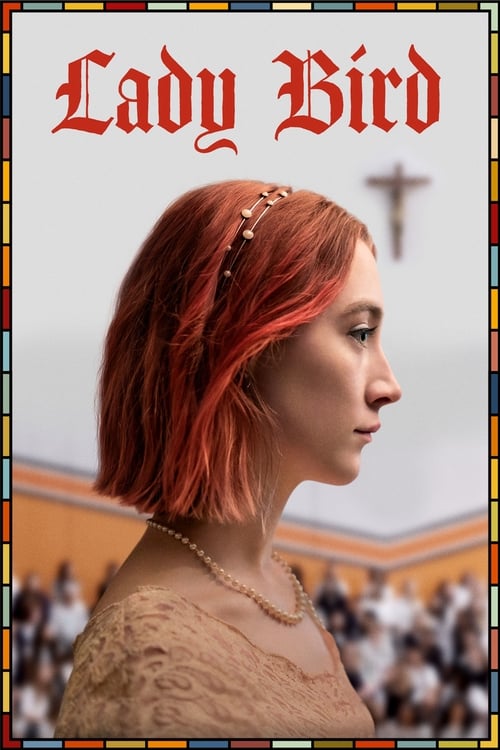
Lady Bird
2017 · Greta Gerwig
Went from mumblecore darling to billion-dollar Barbie director, triggering endless discourse about whether Barbie was feminist subversion or corporate co-optation, then her Best Director snub became an Oscars flashpoint. Her Narnia-for-Netflix deal keeps the "indie voice swallowed by IP" conversation running.
For when you want to laugh and cry in the same sitting, miss your mom, or feel eighteen again — comfort viewing with real teeth. A perfect pick when you can't agree on anything else.
What it's about
Sacramento, 2002. A self-christened seventeen-year-old — 'Lady Bird,' she insists — spends her senior year at Catholic school scheming to escape to a college back East, falling in and out of first love, and waging a running battle with the mother who loves her ferociously and criticizes her in the same breath. It's a coming-of-age story where the real romance is between a girl and the hometown she can't wait to leave.
The experience
Fast, funny, and then suddenly it has you by the throat — scenes cut on the laugh or the wound, and the mother-daughter fights land because both sides are right. It's ninety-three minutes that feel like flipping through someone's best and worst year.
Performances
Saoirse Ronan makes self-invention both hilarious and touching, and Laurie Metcalf, as her mother, gives one of the decade's great performances — every criticism doubling as a declaration of love.
The craft
Greta Gerwig structured her solo directing debut like memory itself: a whole year folded into short, sharp scenes that end a beat early. Sam Levy shot it to look slightly faded, like a photograph handled too often, and the film's big idea arrives sideways — a nun's gentle suggestion that love and attention might be the same thing.
Why it matters
An instant classic that launched Gerwig as a major American director and reset expectations for what a coming-of-age comedy could carry emotionally.
Greta Gerwig's solo directing debut returns to Sacramento, 2002, where a self-christened seventeen-year-old (Saoirse Ronan) wages a year-long campaign to escape the town, the Catholic school, and above all the mother — Laurie Metcalf, in one of the decade's great performances — who loves her ferociously and criticizes her in the same breath. Gerwig emerged from micro-budget mumblecore and the Frances Ha collaborations with Noah Baumbach, and she structured this film like memory itself: scenes cut short on the laugh or the wound, a whole year folded into ninety-three minutes. Sam Levy's cinematography was designed to feel slightly faded, like a photograph handled too often. The film's thesis arrives sideways, when a nun gently suggests that love and attention might be the same thing — an idea the movie extends to place as much as to people. Five Oscar nominations followed, and a wave of coming-of-age films in its image, but few of them learned its real lesson: Gerwig films Sacramento's overpasses and ranch homes the way other directors film Paris.
A Deleuzian reading
The picture looks slightly used.
The full Deleuzian reading of Lady Bird →
Reception
Arrived at Toronto 2017 as an instant darling and briefly became the best-reviewed film in Rotten Tomatoes history, then went 0-for-5 on Oscar night — and has since settled comfortably into the modern coming-of-age canon as the film that announced Gerwig the director.
How Lady Bird was received, from release to now →
Influences: the films it descends from and the films it influenced
- The 400 Blows (1959) — Establishes the template Gerwig follows: autobiographical adolescence rendered as loosely episodic vignettes with the child protagonist as an unmistakable director-surrogate, ending on a departure rather than a resolution.
- Amarcord (1973) — Recalls a provincial hometown through warm comic memory-vignettes in which the town itself, not the plot, is the real subject — Sacramento as Gerwig's Rimini.
- American Graffiti (1973) — Turns one town's streets and local geography into emotional cartography on the eve of leaving, the 'place-as-love' mapping Lady Bird inherits.
- Rushmore (1998) — Stages the precocious, overreaching adolescent's social-climbing ambition and unrequited longing with deadpan affection, a comic register Gerwig softens but keeps.
- Ghost World (2001) — Builds a sardonic, class-conscious teenage-girl coming-of-age almost entirely from dialogue and taste-signaling at the threshold of leaving home.
- The Squid and the Whale (2005) — Baumbach's semi-autobiographical family drama pioneers the overlapping, wounding parent-child dialogue and finely calibrated cruelty that is Gerwig's collaborator's core method.
- Frances Ha (2012) — Gerwig co-wrote and starred; its chaptered, elliptical structure and warm naturalism about a young woman inventing herself is the direct workshop for Lady Bird's form.
- Election (1999) — Carries forward the regionally specific, empathetic-merciless portrait of a female overachiever, balancing satire and tenderness on the tonal tightrope Payne defined.
- The Perks of Being a Wallflower (2012) — Adopts the single-school-year structure and period specificity to dramatize self-worth, championing sincerity over irony in the same coming-of-age key Perks helped revive.
- Mean Girls (2004) — Extends the ambition of taking teen-girl social sociology seriously as observed anthropology — the genre-as-thesis stance Mean Girls legitimized.
- Fast Times at Ridgemont High (1982) — The school-year chronicle rendered in short elliptical scenes with a girl's first sex staged as flat anticlimax — no score swell, no punishment, the disappointment simply allowed to sit — the exact tonal choice Heckerling made against her screenplay's genre defaults.
- Eighth Grade (2018) — Extends Lady Bird's tender-awkward register into cringe-precise, empathetically observed adolescence held in unbroken naturalistic close-up.
- Little Women (2019) — Gerwig's own follow-up reunites Ronan and Metcalf and builds its entire architecture on interwoven memory-time, cross-cutting past and present where Lady Bird used ellipsis.
- Booksmart (2019) — Foregrounds girls' inner lives in a last-days-of-high-school comedy driven by rapid-fire wit and a central female friendship as the emotional spine.
- Aftersun (2022) — Renders memory as faded, elliptical fragments — the deliberately degraded 'remembered photograph' image Sam Levy's Lady Bird cinematography made a coming-of-age grammar.
- Mid90s (2018) — Autobiographical adolescence steeped in period-specific place texture and loose vignette editing, prioritizing atmosphere and observed behavior over plot.
- Dìdi (弟弟) (2024) — Autobiographical California mother-child drama structured as episodic drift across a school year, where the parent conflict is the true emotional spine — the shape and register Dìdi mirrors with a mother instead of daughter.
- Mistress America (2015) — Another Gerwig-co-written script whose rapid, screwball-inflected verbal rhythm and generational aspiration feed Lady Bird's dialogue cadence.
- 20th Century Women (2016) — Anchors a specific California place-and-era memory in a fiercely drawn mother, using voiceover and time-collapsing ellipses that rhyme with Gerwig's editing.
- Juno (2007) — Fronts genuine adolescent vulnerability with a wisecracking teenage-girl voice, the quip-over-tenderness balance Lady Bird recalibrates toward realism.
- An Education (2009) — Dramatizes a bright girl's yearning to escape a stifling schooling milieu through class aspiration, sharing the Catholic-school-and-scholarship texture.
- The Edge of Seventeen (2016) — Runs an acidic teenage-girl coming-of-age on a fraught-but-loving family engine, the comic-abrasive mother/child friction Lady Bird also mines.
- The Diary of a Teenage Girl (2015) — Renders female adolescence with tactile period texture and unsentimental first-person interiority, refusing to moralize the girl's desires.
- Licorice Pizza (2021) — Gerwig's elliptical chapter-transition structure—cutting abruptly between disconnected coming-of-age episodes without transitional tissue—mirrors LP's abrupt editing, and her casting of Ronan against her star glamour in favor of geographic specificity parallels Anderson's anti-stardom decision to cast Haim.
- Sorry, Baby (2025) — A writer-director's tonal control over the comedy/pain seam in a deadpan coming-of-age register, advancing the female multi-hyphenate authorial model.
- House of Hummingbird (2019) — Semi-autobiographical coming-of-age anchored in a prickly mother-daughter relationship and a precisely dated milieu, told through small accreting scenes.
- The Forty-Year-Old Version (2020) — A Sundance-era female auteur's semi-autobiographical coming-of-age whose Best-Director recognition and personal comic specificity mark the same multi-hyphenate authorship moment Blank arrives in.
- The Worst Person in the World (2021) — Gerwig's coming-into-self study glides between comedy and hurt within single scenes and treats its heroine's mistakes with the same tenderness-without-judgment.
- Barbie (2023) — Gerwig's own recurring craft — a young woman negotiating identity and expectation, staged with warm specificity — scaled from realist coming-of-age to mythic-comic canvas.
Similar films
- Little Women (2019) — influence & lineage
- Juno (2007) — influence & lineage
- 20th Century Women (2016) — influence & lineage
- Sorry, Baby (2025) — same viewing thread
- Blue Heron (2026) — same viewing thread
- The Worst Person in the World (2021) — same viewing thread
- mid90s (2018) — influence & lineage · often watched together
- Girls Like Girls (2026) — shared sensibility
All the films related to Lady Bird →
Watch it with: curated runs of related films
- Funny Because It Aches — A run of tender, deadpan dramedies where love, grief, and the panic of becoming yourself all get metabolized through jokes — watch these when you want to laugh and cry in the same scene.