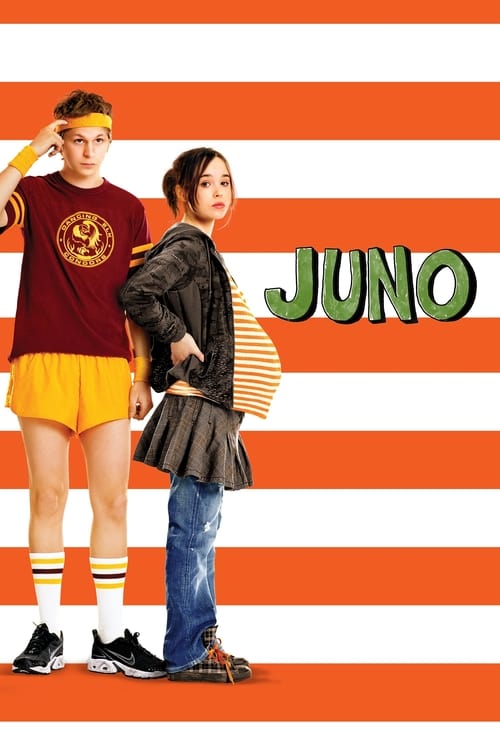
Juno
2007 · Jason Reitman
For when you want comfort with wit — a hopeful, hug-shaped movie for a low-key night, especially if you like your sentiment cut with sass.
What it's about
Juno MacGuff, sixteen and sharper-tongued than everyone around her, gets pregnant by her best friend Paulie Bleeker and decides to have the baby and place it with a couple she finds through a want ad. What follows is a school year of growing up fast: navigating the polished suburban couple who want her child, her bewildered but solid parents, and her own feelings about Bleeker.
The experience
Fast, funny, and endlessly quotable, with a warmth that sneaks in under the sarcasm — it treats a heavy subject with a light hand and still lands the tender moments. You come out smiling.
Performances
Elliot Page's Juno is one of the defining performances of 2000s indie film — armored in one-liners, achingly young underneath — with pitch-perfect support from Michael Cera, J.K. Simmons, Allison Janney, and Jennifer Garner.
The craft
Diablo Cody's debut screenplay, all invented slang and rapid-fire wit, won the Oscar and became instantly recognizable — imitated for years after. Jason Reitman keeps the tone balanced on a knife's edge between quirk and sincerity, helped by a homespun acoustic soundtrack that became a phenomenon in its own right.
Why it matters
The defining indie crossover of the late 2000s: a tiny film that became a box-office hit, a Best Picture nominee, and the template for a wave of voice-driven quirky comedies. It made stars of Cody and Page overnight.
Snapshot
Juno is a small-budget American comedy-drama that became one of the defining independent crossover hits of the late 2000s. Directed by Jason Reitman from a debut screenplay by Diablo Cody, it follows Juno MacGuff, a sixteen-year-old Minnesota high-schooler who, after becoming pregnant by her friend Paulie Bleeker, decides to carry the baby to term and place it with an affluent suburban couple through a private adoption. The film's reputation rests on two intertwined qualities: the hyper-verbal, slang-thick voice of Cody's script, and a tonal balance that keeps a potentially maudlin subject buoyant without trivializing it. Released by Fox Searchlight, it moved from festival premiere to wide commercial success and awards contention with unusual speed, and it made stars of its writer and its lead, Ellen Page (now Elliot Page). Its cultural footprint — the twee soundtrack, the wisecracking pregnant teenager, the hamburger phone — was large enough that "Juno" quickly became shorthand for a whole strain of quirk-inflected American indie filmmaking.
Industry & production
Juno was produced by Mandate Pictures with Mason Novick — the manager who had discovered Cody's writing — among its producing figures, and distributed by Fox Searchlight Pictures, the specialty arm that had built a house style around exactly this kind of literate, mid-budget prestige comedy. The production budget was modest, widely reported in the single-digit millions, and the film was shot largely in and around Vancouver, British Columbia, standing in for suburban Minnesota — a common cost-driven arrangement for North American productions of the period.
The project's origin story is central to its industry mythology. Cody, a former blogger and columnist writing under a pen name (her memoir Candy Girl recounts a stint working in the Minnesota adult industry), was signed by Novick largely on the strength of her prose voice and encouraged to try a screenplay. Juno was that first script. It attached Reitman — then coming off his own debut feature, Thank You for Smoking (2005) — and moved into production relatively quickly.
Fox Searchlight's release strategy exemplified the platform model: a fall festival launch (the film played the autumn 2007 circuit, including Toronto), a limited December opening timed to the awards calendar, and a steady expansion into wide release across the winter. The picture became a genuine commercial sleeper, grossing far in excess of its cost — a scale of return that is well documented as one of the more profitable specialty releases of its year, though I'll avoid citing a precise figure here. That success reinforced Searchlight's model and made Juno a frequent reference point in later discussions of how a small film could be positioned for both box office and Oscars.
Technology
Juno was made with conventional late-2000s tools and does not represent a technological watershed; its innovations are stylistic rather than mechanical. It was photographed on 35mm film, in keeping with the era's prevailing practice for narrative features of this budget and pedigree, before the wholesale industry shift to digital capture. The most technologically distinctive element is its animated title sequence and interstitial imagery: the opening transforms live-action photography of Juno walking through her town into a hand-crafted, rotoscope-adjacent illustrated style, produced by an outside animation/design house. This blend of photographic and drawn imagery — echoed in the film's illustrated poster and marketing — became a signature of its visual identity. Beyond that sequence, the film's craft is grounded in traditional cinematography, editing, and sound practice rather than novel technology.
Technique
Cinematography
Eric Steelberg shot the film, beginning a long working partnership with Reitman that would continue across the director's subsequent features. The visual approach is unshowy and warm: naturalistic suburban interiors, a palette that leans into autumnal and wintry tones consistent with the film's seasonal structure, and a preference for framing that keeps performances legible rather than calling attention to camera virtuosity. Steelberg's work here serves the dialogue and the actors, using relatively steady, character-centered compositions. The most stylized visual gestures are reserved for the animated bookends and for small motifs — the running track where Bleeker trains, the MacGuff home's lived-in clutter — rather than for bravura camera movement.
Editing
Dana E. Glauberman edited the film, another recurring Reitman collaborator. The cutting is brisk and comedy-forward, timed to land Cody's dialogue rhythms — quick exchanges, punchlines, and reaction beats — while still allowing the more dramatic scenes (Juno's encounters with the prospective adoptive parents, the confrontation about the adoption falling through) to breathe. The film's overt organizing device is its division into seasons — autumn, winter, spring, summer — which structures the pregnancy across roughly a year and gives the editing a clear temporal architecture, marking gestational and emotional progress through onscreen chapter breaks.
Mise-en-scène / staging
The production design is a study in specific, class-inflected texture. The MacGuff household — dad a heating-and-cooling technician, stepmother obsessed with dogs and home décor — is cluttered and affectionate; the Loring house, home to prospective adopters Mark and Vanessa, is by contrast a manicured, catalog-perfect suburban space whose sterility quietly signals the tensions inside the marriage. Props do heavy characterizing work: the hamburger telephone became the film's most iconic object, alongside Juno's flannel, oversized sweaters, and the tic-tacs Bleeker consumes. Costuming distinguishes Juno's deliberately unfeminine, secondhand-styled wardrobe from Vanessa's polished conformity, staging class and identity through surface detail.
Sound
The soundtrack is arguably as famous as the film. It draws heavily on anti-folk and lo-fi indie music, most prominently Kimya Dawson (solo and via her band The Moldy Peaches, whose "Anyone Else But You" recurs and closes the film in a duet performed by Page and Cera). Mateo Messina composed the score. The music's homemade, unpolished quality is a deliberate aesthetic choice that mirrors Juno's own self-styling, and the soundtrack album became a substantial commercial success in its own right, topping album charts — a rare feat for an indie-leaning film compilation. Beyond the songs, the sound design is naturalistic, foregrounding dialogue clarity above all, appropriate to a script this word-driven.
Performance
Performance is where the film's tonal tightrope is walked. Ellen Page anchors it with a delivery that fires Cody's slang at high velocity while keeping Juno's vulnerability visible underneath the armor of irony; the role earned Page an Academy Award nomination and defined the early phase of the actor's career. Michael Cera's Paulie Bleeker refines the diffident, gentle-awkward register he was becoming known for. Jennifer Garner gives Vanessa Loring a carefully modulated performance that turns a character who could read as an antagonist into the film's quiet emotional center, particularly in the scene where she speaks to Juno's belly at the mall. Jason Bateman plays Mark Loring's arrested-development charm with an undertow of menace, while Allison Janney and J.K. Simmons, as Juno's stepmother and father, supply grounded, funny warmth that keeps the family believable. Olivia Thirlby and Rainn Wilson round out the ensemble.
Narrative & dramatic mode
The film operates in the register of the coming-of-age dramedy, structured around a single-year pregnancy divided into seasonal chapters. Its dramatic mode is character-driven and dialogue-forward rather than plot-mechanical: the external events (the decision to keep the baby, the search for adopters, the unraveling of the Lorings' marriage) matter chiefly as pressures that reveal and mature Juno. The screenplay's most distinctive feature is its voice — a dense, stylized teen argot ("honest to blog," "home skillet") that critics debated as either brilliantly specific or artificially arch. Tonally the film mixes comic deflection with genuine feeling, deferring emotional payoff until late; the arc bends from Juno's protective sarcasm toward earned tenderness, culminating in the reconciliation with Bleeker and the relinquishment of the child. It is notable for treating a fraught social subject through comedy while, in the end, foregrounding emotional sincerity.
Genre & cycle
Juno sits squarely within the mid-to-late-2000s cycle of American independent comedy that Fox Searchlight and similar labels cultivated — films marked by ensemble warmth, offbeat characters, curated indie soundtracks, and a "quirky" sensibility. It is frequently paired with Little Miss Sunshine (2006) as the twin commercial-and-awards success that crystallized this cycle, and it shares DNA with the melancholy-comic teen films of the era. It also belongs to the longer lineage of teen-pregnancy narratives, but distinguishes itself by refusing melodrama or moralizing tragedy. The film became so emblematic that its name attached to a critical backlash against "quirk" itself; "twee" and "Sundance quirk" discourse in subsequent years often cited Juno as a defining, and for some over-exposed, example.
Authorship & method
The film is best understood as a collaboration between two authorial sensibilities. Diablo Cody, the screenwriter, supplies the voice — the verbal density and pop-cultural specificity that make the film unmistakable, and which she carried into later work (the Reitman-directed Young Adult, the horror-comedy Jennifer's Body). Jason Reitman, the director, supplies the tonal control: coming from Thank You for Smoking, he was skilled at making satirically sharp material feel humane, and he tempers the script's archness with grounded performances and warm domestic texture. Reitman is the son of comedy director Ivan Reitman, a lineage often noted in accounts of his career.
The film established Reitman's core craft team, several of whom recur across his filmography: cinematographer Eric Steelberg, editor Dana E. Glauberman, and composer Mateo Messina. The music supervision, foregrounding Kimya Dawson's catalog, was itself a defining authorial choice — Page reportedly advocated for Dawson's music, and the soundtrack's homemade texture functions as an extension of the film's characterization. The result is a work whose "authorship" is genuinely shared between a first-time writer with a singular voice and a director skilled at housing that voice inside a broadly appealing, emotionally legible film.
Movement / national cinema
Juno is a product of the American independent-adjacent studio-specialty ecosystem rather than any formal movement. It emerged from the institutional world of Sundance-oriented, festival-launched, specialty-distributed cinema — a "movement" more of financing and taste than of manifesto. Its Canadian shooting location notwithstanding, it is thoroughly American in setting and idiom, portraying a specific Midwestern suburban milieu. If it belongs to anything larger, it is the loosely defined "indie" or "quirk" tendency of 2000s American film culture, itself a commercial descendant of the 1990s independent boom, now channeled through studio subsidiaries positioned to shepherd such films to both audiences and awards.
Era / period
The film is very much of its moment: the late-2000s peak of the specialty-label prestige-comedy, just before the 2008 financial crisis and the subsequent contraction and reorganization of the indie-distribution landscape. Culturally, it arrived amid a broader mainstreaming of "geek chic" and lo-fi indie music, and its release coincided with — and was sometimes read against — contemporaneous studio comedies about accidental pregnancy such as Knocked Up (2007), making 2007 a notable year for the subject in American film. Its aesthetic markers — flip phones, blogging, the particular indie-folk soundtrack — root it firmly in its year.
Themes
The film's central concerns cluster around adolescence and the negotiation of adult consequence. It examines an unplanned teen pregnancy not as catastrophe but as a passage into self-knowledge, foregrounding choice, autonomy, and responsibility — Juno considers termination, rejects it, and elects adoption on her own terms. Family is a recurring subject, contrasting the imperfect but loving MacGuff household with the outwardly ideal but failing Loring marriage, and asking what actually constitutes readiness for parenthood. Class runs quietly throughout, staged in the gap between blue-collar and affluent-suburban worlds. Authenticity versus performance underlies both Juno's ironic self-presentation and the film's interest in who is genuinely prepared to love and care versus who merely looks the part. And beneath the comedy is a sincere treatment of first love and vulnerability, withheld until the film allows Juno to drop her defenses. The film has also been discussed in the context of American debates over abortion and adoption, though it is generally read as more interested in character than in polemic.
Reception, canon & influence
Critical reception was strongly positive on release, with particular praise for Page's performance, Cody's dialogue, and Reitman's tonal control; a vocal minority pushed back against the script's stylized slang as too clever by half, a critique that hardened over time into a broader reaction against "quirk." Awards recognition was substantial: the film received Academy Award nominations for Best Picture, Best Director, and Best Actress, and won Best Original Screenplay for Diablo Cody — a striking result for a debut screenwriter and a signature triumph of Searchlight's campaign.
Backward influences on the film include the lineage of American teen and coming-of-age comedy, the 1990s independent tradition of dialogue-driven character films, and the immediate template of Little Miss Sunshine as commercial-indie proof of concept. Cody's voice draws on the confessional, pop-saturated register of blogging and alt-weekly columns as much as on prior screenwriting.
Forward influence is considerable. Juno helped cement a marketable model of the quirky indie dramedy with a curated soundtrack, and its commercial success encouraged studios and specialty labels to pursue similar projects; its soundtrack's chart performance demonstrated the cross-promotional power of indie-music curation in film. It launched Cody as a prominent screenwriter and producer and consolidated Reitman's career. It became a touchstone in ongoing critical conversations about "twee," about the representation of teen pregnancy on screen, and — following Elliot Page's later public life — about the film's place in his body of work. Its imagery and phrasings entered pop-cultural shorthand to a degree few films of its size achieve. If its reputation has been complicated by the backlash its very success helped provoke, that ubiquity is itself the clearest measure of its influence.
Reception
A Sundance-to-Oscars Cinderella story in 2007 — a $7.5M indie that grossed over $230M and won Diablo Cody the screenplay Oscar — followed by a swift backlash against its hyper-quirky dialogue; today it's been largely re-embraced as a warm, sharply written comfort classic of the late-2000s indie boom.
How Juno was received, from release to now →
How to watch Juno: what to notice on a first viewing
- Watch for the season titles that break the film into chapters. Autumn, winter, spring, summer arrive on screen and divide the pregnancy across a year. Each chapter opens with the weather changed and Juno's body further along. The film measures time in seasons rather than in plot events, so you track her growing up by the calendar instead of by incident.
- Count how fast Page fires Cody's slang. The lines come out at speed, fully formed, with no hesitation. Page keeps the tempo up in every room, including the ones where nobody is laughing with her. The wit is armor worn in public. Watch for the moments the speed drops, because that is where the character actually is.
- Look at Juno's clothes and the objects in her room. Flannel, oversized sweaters, secondhand layers, the hamburger phone. Nothing she owns is new or coordinated, and none of it is styled to make her look like a girl in a teen movie. Her self-presentation is assembled from cast-offs on purpose, which tells you how she wants to be seen before she says a word about it.
- Compare the clutter of the MacGuff house with the Loring house. One home has dog figurines, laundry, and worn furniture in every shot. The other is catalog-clean, with matched surfaces and space around every object. Class and character are staged in furniture, and the film lets you notice the difference yourself.
- Listen for the unpolished singing and thin guitar. Kimya Dawson and the Moldy Peaches supply most of the songs, recorded plainly with audible imperfections, and the mix always keeps dialogue on top of them. The music is put together the way Juno puts herself together, homemade and a little off-key, so the soundtrack characterizes rather than decorates.
The whole guide to watching Juno, with the keys for a rewatch →
Influences: the films it descends from and the films it influenced
- Ghost World (2001) — Templates the sardonic female outsider-teen whose identity is built from ironic pop-culture curation and withering deadpan asides, the same defensive-argot characterization Page performs.
- Little Miss Sunshine (2006) — Immediate commercial-indie proof of concept: Searchlight's warm-dysfunction family dramedy with quirky needle-drops, the release-and-tone blueprint Juno's campaign replicated a year later.
- High Fidelity (2000) — Deploys an obscure-music-taste-as-identity register where record/song knowledge signals selfhood and romantic compatibility, the 'taste-as-identity' vocabulary High Fidelity fixed in cinema.
- Mean Girls (2004) — Carries forward the writer-as-auteur teen comedy in which densely coined, instantly quotable dialect is the film's authorial signature, as Fey's lines were hers.
- Love, Rosie (2014) — Provides the tonal-hybridity license for the teen-pregnancy first act: unplanned pregnancy played in a wry comic register with the emotional weight carried by curated indie-pop needle-drops rather than by score, and by a best-friend relationship the film refuses to name as romance.
- Rushmore (1998) — Establishes the hyper-articulate, unrealistically eloquent teen protagonist whose adult-grade verbal wit is played straight — the deadpan-precocious register Cody's Juno inherits wholesale.
- Election (1999) — Model for housing satirically sharp, arch dialogue inside grounded suburban realism so mockery reads as affection — the exact humane-yet-caustic tonal calibration Reitman applies.
- Welcome to the Dollhouse (1995) — Indie template for an unglamorized adolescent girl navigating sexual/social humiliation without the camera prettifying her, the anti-teen-movie framing Juno softens but descends from.
- Harold and Maude (1971) — Pioneers scoring a whole morbid-whimsy comedy with one singer-songwriter's homemade catalog (Cat Stevens) as character extension — the exact needle-drop strategy Juno runs with Kimya Dawson.
- Say Anything... (1989) — Establishes dialogue-forward teen romance where a curated soundtrack functions as emotional subtext, the music-supervision-as-authorship approach Juno's mix foregrounds.
- Napoleon Dynamite (2004) — Proves the deadpan lo-fi indie can build comedy from precise dorky props and homemade texture — the object-driven quirk aesthetic behind Juno's hamburger phone and tchotchke staging.
- Thank You for Smoking (2005) — Reitman's own prior film where he learned to make relentlessly clever, verbally dense material feel humane via grounded performance — the craft muscle he brings to Cody's script.
- The Royal Tenenbaums (2001) — Popularizes the illustrated storybook chapter-title device and meticulous curated production design that Juno's rotoscoped animated titles and seasonal-chapter structure echo.
- Superbad (2007) — Sibling teen comedy sharing Michael Cera's stammering deadpan naturalism and a frank, articulate treatment of teen sexuality released the same summer.
- Young Adult (2011) — Direct descendant reuniting the Cody-Reitman authorship and Steelberg camera to push Cody's caustic verbal voice into darker, arrested-adolescent territory.
- Jennifer's Body (2009) — Carries Cody's signature slang-dense, pop-saturated teen dialogue into horror-comedy, testing whether her voice survives outside Reitman's humanizing direction.
- (500) Days of Summer (2009) — Extends Juno's non-linear titled-chapter structure and indie-music-curation-as-narration into quirky romance, riding the same specialty-label soundtrack cross-promotion model.
Similar films
- Lady Bird (2017) — influence & lineage
- Little Miss Sunshine (2006) — influence & lineage
- Superbad (2007) — influence & lineage
- Me and You and Everyone We Know (2005) — shared sensibility
- Bridget Jones's Diary (2001) — shared sensibility
- Promising Young Woman (2020) — shared sensibility
- Mean Girls (2004) — shared sensibility
- The Big Sick (2017) — shared sensibility