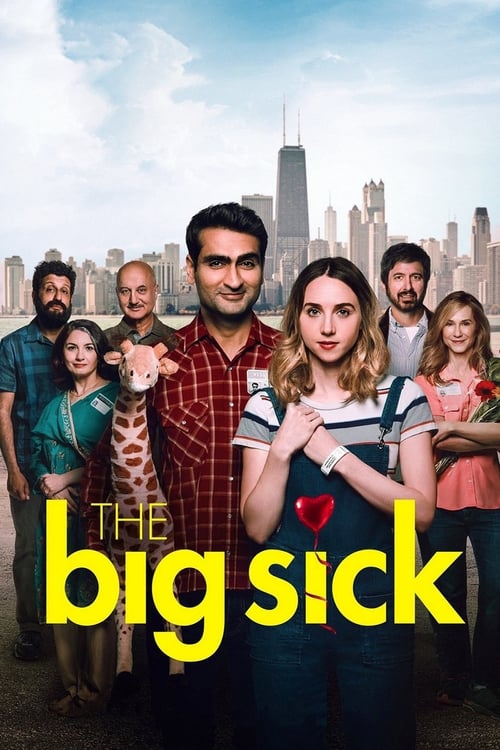
The Big Sick
2017 · Michael Showalter
For when you want a rom-com with real stakes — to laugh and get misty in the same sitting. Comfort viewing that respects your intelligence.
What it's about
Kumail, a Pakistani-born stand-up in Chicago, falls for Emily while hiding her from a family arranging his marriage — and hiding them from her. After they break up, she's hospitalized with a mysterious illness and placed in a coma, leaving Kumail in a waiting room with her parents, two strangers who have every reason to hate him. It's drawn from Nanjiani and Emily V. Gordon's real courtship.
The experience
Warm, funny, and quietly devastating in turns — it earns its laughs in hospital corridors without ever feeling glib. The awkwardness is exquisite and the sincerity sneaks up on you.
Performances
Holly Hunter and Ray Romano are the film's secret engine, playing a long-married couple with lived-in prickliness and grace; Kumail Nanjiani, playing a version of himself, and Zoe Kazan give the romance its charm.
The craft
The Oscar-nominated screenplay, written by the real couple about their own story, gives every character — including the ones a lesser film would flatten into obstacles — their full argument. Its structural gamble, sidelining one romantic lead for the whole middle act, pays off beautifully.
Why it matters
A Sundance sensation that became one of the decade's defining romantic comedies, proving the genre could carry immigrant family life, culture clash, and genuine medical dread — and launching Nanjiani to leading-man status.
Snapshot
The Big Sick is an autobiographical romantic comedy in which the romance is interrupted, roughly at its midpoint, by a medically induced coma. Kumail Nanjiani plays a version of himself: a Pakistani-born stand-up in Chicago driving for Uber, hiding a white girlfriend from a family that expects an arranged marriage, and hiding the family from the girlfriend. When Emily (Zoe Kazan) is hospitalized with an undiagnosed autoimmune condition and put under, Kumail — by then her ex — signs the consent form and stays. The film's second act is a two-hander he never wanted: a bereft, furious pair of Midwestern parents, Beth (Holly Hunter) and Terry (Ray Romano), and the man who broke their unconscious daughter's heart, waiting together in a corridor.
Written by Nanjiani and Emily V. Gordon about their own courtship and her 2007 illness, produced under Judd Apatow's banner, and acquired by Amazon Studios out of Sundance in one of the festival's largest deals to that point, it became the rare 2010s romantic comedy to work commercially in theaters — grossing north of $40 million domestically on a modest budget — and earned an Academy Award nomination for Original Screenplay. Its lasting formal interest is structural: it removes its female lead from the middle of a love story and asks whether the genre can survive her absence.
Industry & production
The film sits at the junction of three distinct production cultures. The first is Apatow's. Judd Apatow and Barry Mendel produced, and the project carries the house method: a comedian-authored script drawn from lived material, developed over years of drafts, cast largely from the stand-up and sketch world, and shot with the expectation that scenes will be run repeatedly for alternate jokes. Apatow's own Knocked Up (2007) and Funny People (2009) had already established the template of the comedy that lets illness, mortality, or parenthood puncture the joke economy; The Big Sick is that template applied to someone else's autobiography.
The second is FilmNation Entertainment, which financed and handled international sales — part of a mid-2010s independent financing ecology in which mid-budget adult comedies had largely vanished from studio slates and migrated to independent equity plus festival sale.
The third is Amazon Studios. The film premiered at the 2017 Sundance Film Festival in the Premieres section, and Amazon acquired worldwide rights in a deal widely reported at roughly $12 million. Crucially, Amazon then partnered with Lionsgate for a genuine theatrical release — a platform opening in late June 2017 expanding through July — rather than routing it straight to streaming. That sequencing mattered: 2017 was the year streamers were testing whether they could buy prestige at festivals and still convert it in cinemas, and The Big Sick's theatrical performance became one of the more cited data points in that argument. It was also, in retrospect, near the end of that window; Amazon's appetite for theatrical specialty releases contracted in the years following.
Production was compressed in the way independent features are, and the technical record for the shoot is thinner than for a studio picture. The story is set in Chicago; the production worked substantially on the East Coast, using New York interiors and locations with Chicago material for geographic anchoring. This is ordinary indie practice and the film does not strain to disguise it — Chicago functions less as a documented city than as a generic condition of Midwestern winter, apartment radiators, and comedy-club basements.
Technology
The Big Sick is a low-technology film that is nonetheless organized around technologies. It was shot digitally, in the unobtrusive naturalistic register standard for contemporary American comedy — an aesthetic choice that is also an economic one. Digital capture is what makes the Apatow method affordable: if you intend to run a scene a dozen times so your performers can find the joke, you need a medium with no per-take stock cost. The film's improvisational looseness and its comparatively long two-hour runtime are downstream of that.
More interesting is the diegetic technology. The relationship is conducted through screens before it is conducted in person: the phone as flirtation instrument, the Uber app as both Kumail's labor and his mobility, the one-man show he is building on a laptop. When Emily discovers the cigar box of headshots — photographs of prospective brides delivered by his mother at dinner after dinner — the betrayal is mediated by a physical archive of images, an analog matchmaking database sitting inside a film otherwise conducted by text message.
Then there is medical technology, which the film treats with unusual restraint. The coma is not a visual set piece. Ventilators, monitors, and the vocabulary of intubation are present but unglamorized; the drama is in the waiting room, not the ICU. Kumail's compulsive phone-searching of symptoms — the layman's encounter with medical information he cannot metabolize — is the film's most accurate depiction of twenty-first-century illness, and it is played for anxiety rather than for the reassurance a procedural would offer.
Technique
Cinematography
Brian Burgoyne's photography is deliberately self-effacing: handheld-adjacent but not shaky, available-light-flavored, shallow but not showy in its focus. The palette divides cleanly. Kumail's world — the club, the apartment, the car at night — runs warm, amber, cluttered, lit by practicals. The hospital runs cold and evenly lit, with the flat fluorescence that is the visual grammar of institutional time. His family's dinners are warm too, but composed more formally, more frontally, the camera slightly more static, as if the household imposes its own framing discipline.
The comedy-stage material is shot with a specific intelligence. Stand-up on film is usually covered either as spectacle (wide, audience visible) or as psychology (tight, audience erased). Burgoyne moves between them depending on whether a set is going well, so that Kumail's competence and his humiliation are photographed differently.
Editing
Robert Nassau's cutting is where the Apatow production model meets the constraints of a story with a genuine dramatic spine. Improvisational coverage produces enormous assemblies; the achievement here is that the comic riffing rarely stalls the narrative. Scenes tend to be cut on the beat after the laugh — the moment when the joke lands and no one knows what to say next. That extra beat is the film's signature rhythm and the reason the tonal shifts don't whiplash.
The structural edit is the bolder move: Emily exits the film, functionally, for a long stretch, and the picture does not compensate with flashbacks or dream sequences. It simply proceeds without her, which places an unusual burden on the parents and forces the audience to sit inside Kumail's dread rather than escaping into memory.
Mise-en-scène / staging
The film's spaces are arranged as competing claims on one man. The Nanjiani family dining table is staged as an ambush: Kumail seated, the doorbell ringing, another young woman ushered in "coincidentally," the mise-en-scène of arranged marriage played as recurring comic structure until its repetition becomes suffocating. The hospital corridor is staged as neutral ground where no one has home advantage. The apartment Kumail shares with fellow comic Chris is a squalid, joke-strewn adolescence he is being evicted from by events.
Small staging choices carry the theme. Kumail performs a mock prayer ritual in a basement, retreating from the family faith with a video game rather than confronting it — a scene that says more about diaspora ambivalence than any speech in the film.
Sound
Michael Andrews's score is characteristically warm, small-scale, and analog-leaning — the sensibility he brought to Donnie Darko (2001) and Me and Earl and the Dying Girl (2015), applied here with restraint. He resists the two obvious temptations: no swelling strings over the coma, no comic underscoring of the family scenes. The score mostly withdraws during the hospital stretch, leaving room tone, machinery, and the specific silence of people who have run out of things to say.
The sound design's key contrast is between the club — laughter, glasses, heckling, the horrible dead air after a bad joke — and the hospital's hum. The film's ugliest moment is acoustic: a heckler shouting a racist line about ISIS during Kumail's set, the laughter curdling, the room turning.
Performance
Nanjiani plays himself with an odd, productive flatness. He is a stand-up whose comic persona is built on deadpan understatement, and the performance largely refuses to open up emotionally, which is either a limitation or the point — a man whose evasiveness is his defining flaw cannot credibly become expressive on cue.
Zoe Kazan — herself a playwright and screenwriter — does the harder job, establishing a person vivid enough that her absence has weight, then playing the disorienting reentry of someone who has lost weeks and returns to find her relationships rearranged without her.
Hunter and Romano are the film's engine. Hunter, an Academy Award winner for The Piano (1993), plays Beth as fierce, unreasonable, and unembarrassed — she is the one who attacks the heckler. Romano, cast well against the affable sitcom register of Everybody Loves Raymond, plays a man whose jokes are a symptom of failure rather than charm, and his confession scene in a hotel room is the film's most exposed piece of acting.
Anupam Kher, a genuine giant of Hindi cinema with a filmography numbering in the hundreds, brings an authority to the father that the writing alone would not command; Zenobia Shroff's mother is granted her own dignity in the final act rather than dismissed as an obstacle. Bo Burnham, Aidy Bryant, and Kurt Braunohler populate the comedy scene with recognizable professional texture.
Narrative & dramatic mode
The film runs a romantic comedy and a family melodrama through each other, using illness as the coupling device. Its structure is genuinely irregular: a first act of conventional courtship, a breakup, and then a long middle in which the romantic object is unconscious and the antagonists — the parents — become the protagonists' de facto scene partners and eventual allies. The love story is therefore displaced onto its in-laws. Kumail earns Emily by earning Beth and Terry, and the film's real reconciliation scenes are with them.
This is also a film about disclosure. Nearly every dramatic beat turns on something withheld: Kumail hides Emily from his parents, hides his parents from Emily, hides the box of photographs, hides his lapsed faith. The illness functions as a forcing mechanism that makes concealment logistically impossible. The dramatic mode is confessional in the specific American stand-up sense — the belief that material becomes true only once it has been performed publicly — and the film's climax is, fittingly, a set.
The autobiography raises its own questions, which the film does not fully resolve: the account is authored by both parties but centers only one of them, and Emily's interiority during the crisis is structurally unavailable.
Genre & cycle
The Big Sick arrived at a low point for the theatrical romantic comedy. The studio romcom of the Ephron–Meyers era had largely collapsed by the early 2010s, its audience absorbed by television and streaming. The genre's survival in this period ran through the specialty market and through comedians' autobiographies: Obvious Child (2014), Trainwreck (2015), Sleeping with Other People (2015). The Big Sick is the most commercially successful of that group, and it was widely read at the time as evidence that the form was recoverable if it was allowed to be specific, adult, and roughly two hours long.
It also belongs to a parallel cycle: the diaspora romance in which cultural expectation is the antagonist. My Big Fat Greek Wedding (2002) is the commercial precedent, Bend It Like Beckham (2002) and Mira Nair's Mississippi Masala (1991) the more searching ones. And it sits inside the mid-2010s wave of South Asian American authorship on screen — Master of None (2015 onward) most immediately, with Ramy (2019), Never Have I Ever (2020), and Ms. Marvel (2022) following.
A third lineage is the comedy of terminal or near-terminal illness: Terms of Endearment (1983) for the hospital melodrama's tonal license, 50/50 (2011) for the specific bargain of letting a comedian's voice narrate a medical crisis.
Authorship & method
Michael Showalter's authorship is unusual because it is largely one of accommodation. He came out of MTV's The State and the absurdist tradition of Wet Hot American Summer (2001), which he co-wrote with David Wain — a sensibility of deadpan surrealism almost entirely absent here. His directorial work, from The Baxter (2005) through Hello, My Name Is Doris (2015), shows a growing interest in awkwardness played straight, and The Big Sick extends that: his contribution is tonal calibration, a refusal to let either the comedy or the pathos win. He subsequently moved toward biographical prestige work with The Eyes of Tammy Faye (2021) and Spoiler Alert (2022), and to studio romance with The Idea of You (2024) — a trajectory The Big Sick clearly enabled.
The primary authorship is Nanjiani and Gordon's. Gordon, a former therapist, and Nanjiani had collaborated before — on the podcast The Indoor Kids and Nanjiani's The Meltdown — and the screenplay's precision about the mechanics of a comedy scene and the etiquette of a hospital vigil reflects two people writing what they separately knew. The script was developed over years with Apatow's involvement, and its Oscar nomination for Original Screenplay (it lost to Get Out) recognized a structure that is far stranger than its genre packaging suggests.
Among collaborators, Burgoyne's photography and Nassau's editing are covered above; Michael Andrews's score is the most identifiable authorial signature in the technical package, its small warm instrumentation doing the work of assuring the audience the film will not become cruel.
Movement / national cinema
The film is not affiliated with a movement in the historical sense. It belongs to American independent cinema in its late, festival-market phase — Sundance as an acquisition floor rather than an aesthetic program.
Its more meaningful national-cinema position is transnational. It is a US film about the Pakistani diaspora, and its relationship to South Asian cinema is present chiefly through casting (Kher) and through the household's cultural furniture rather than through form: there is no engagement with Hindi or Pakistani filmmaking's stylistic conventions, no musical sequences, no formal citation. That absence is itself characteristic of second-generation diaspora filmmaking, which tends to inherit American genre grammar and treat the ancestral culture as content rather than as style.
Era / period
The film's present tense is 2017; its source events are from roughly a decade earlier, and the transposition matters. Kumail drives for Uber — a job that did not exist in 2007 — which converts the story's economic precarity into a specifically gig-economy precarity. The heckler's ISIS taunt likewise updates the racism from a post-9/11 register to a mid-2010s one.
The film was released into an American political moment defined by the first months of the Trump administration and the executive orders restricting travel from several Muslim-majority countries, and much of its 2017 reception explicitly read a warm mainstream comedy about a Pakistani Muslim family as a political object whether or not it intended to be one. It is also a document of American healthcare anxiety: the cost of the crisis is never the film's subject, but the terror of an undiagnosed illness in an American hospital is.
Themes
The governing theme is the cost of not choosing. Kumail's failure is not that he loves a white woman or that he has lost his faith; it is that he will not say so to anyone, preferring a life of managed compartments. The illness forecloses that option.
Around it: filial debt and its price — his parents' immigration is the sacrifice that funds his American options, and the film is honest that his freedom requires wounding them, and that his mother's grief is not a joke. Comedy as evasion and as truth-telling — every stand-up scene doubles as a diagnosis of how much Kumail is willing to admit. Care without entitlement — Kumail has no standing at Emily's bedside; he is an ex, legally and emotionally unauthorized, and the film's tenderest idea is that he stays anyway. And the parents as the real love story: Beth and Terry's damaged marriage is the film's most adult material, a portrait of a couple who have hurt each other and are still, awkwardly, present.
Reception, canon & influence
Critical reception was strongly positive from Sundance onward, with the consensus praising the screenplay's specificity, Hunter and Romano's performances, and the film's willingness to be genuinely uncomfortable. It became one of 2017's signature specialty successes and, alongside its Original Screenplay nomination, collected substantial critics'-group and guild recognition through that awards season.
The dissent is worth recording accurately, because it shaped the film's afterlife. A significant body of criticism — much of it from South Asian and Muslim writers — argued that the film's brown women are written as punchlines and obstacles while the white love interest is granted full personhood, and that the parade of prospective brides reproduces a trope in which the immigrant son's liberation is figured as a white woman. The film has real answers to parts of this (Khadija is given a scene of genuine anger; the mother is granted late dignity), and the material is autobiographical, which complicates the charge. But the debate is a substantive one and became a reference point in wider mid-2010s arguments about representation in South Asian American comedy.
Influences on the film (backward): Annie Hall (1977) for the comedian's retrospective romance and the encounter with the beloved's family as ethnographic comedy; the Apatow line from Knocked Up through Funny People for the comedy that admits mortality; Terms of Endearment for the license to place a hospital at a comedy's center; My Big Fat Greek Wedding for the commercial shape of the immigrant-family romance; Guess Who's Coming to Dinner (1967) as the ancestor of every meet-the-parents interracial-romance scene, here doubled so that both sets of parents are the problem; and the confessional American stand-up tradition — Richard Pryor's transmutation of catastrophe into material as its distant founding gesture.
Legacy (forward): commercially, it is a standing citation in the argument that adult, specific, mid-budget comedy can still work theatrically, and one of the strongest results of the streamer-acquisition experiment at Sundance. Culturally, it moved a South Asian Muslim American man into a mainstream romantic lead — a position Nanjiani would extend into Eternals (2021) and Welcome to Chippendales (2022) — and it contributed to the conditions for the run of diaspora-authored comedy that followed, from Ramy to Never Have I Ever to Always Be My Maybe (2019), even as its critics used it to sharpen the terms of that conversation. Formally, its most imitable move is the one least often imitated: taking the love interest out of the middle of a love story, and trusting that what remains — two frightened parents and a man with no right to be there — is enough.
Reception
A Sundance 2017 sensation that became the year's feel-good indie hit and an Oscar screenplay nominee; it's since settled from 'instant classic' to a warmer, slightly more contested spot as the flagship of the late-2010s rom-com revival.
How The Big Sick was received, from release to now →
How to watch The Big Sick: what to notice on a first viewing
- Compare the light in the comedy club with the hospital light. Burgoyne gives Kumail's world amber practicals, clutter, and shallow warmth. Institutional interiors come flat and evenly fluorescent. The family dinners are warm too, but framed more formally and frontally. Each world has its own light and its own camera manners. You can feel which set of rules Kumail is under in any scene.
- Notice whether you can see the audience during a set. Burgoyne shoots a good set wide, with the room visible. A bad one goes tight and the audience disappears. Kumail's competence and his humiliation are photographed differently. The camera grades every set for you. How a scene is covered tells you how the night is going before the jokes do.
- Watch the doorbell during the family dinners. Kumail is seated, the bell rings, and another prospective bride is shown in as though by coincidence. The scene repeats until the comedy of it turns airless. The staging is an ambush played as a running joke. Repetition is how the film makes a loving family feel like a trap.
- Notice how long a scene runs after the joke lands. Nassau tends to cut one beat late, on the moment when nobody knows what to say next. The Apatow method produces enormous improvised assemblies, and this rhythm is what shapes them. That extra beat is why the film can swing between funny and painful without giving you whiplash.
- Watch how little Kumail's face changes when he is caught. Nanjiani plays himself deadpan and closed. The performance refuses to open on cue, because a man whose defining flaw is evasion cannot suddenly become expressive. His flatness is the character's problem made visible. Everything he will not say is sitting inside that non-reaction.
The whole guide to watching The Big Sick, with the keys for a rewatch →
Influences: the films it descends from and the films it influenced
- Annie Hall (1977) — Establishes the comedian's romance as a retrospective assembled around stand-up address and discrete set pieces, and invents the ethnographic dinner-with-her-family scene (the Hall lunch) that The Big Sick doubles so both households, not one, become the obstacle.
- Guess Who's Coming to Dinner (1967) — Fixes the blocking grammar of the interracial-romance parental ambush — couple seated on one side, parents interrogating across a laid table, the meal itself functioning as the trap — which The Big Sick restages twice, at Kumail's family dinners and at Beth and Terry's.
- Psycho (1960) — The canonical precedent for mid-film protagonist removal: the ostensible lead is taken out at the midpoint and the film must reconstitute itself around the secondary figures left behind, exactly the gamble of putting Emily in a coma and handing the second act to her parents.
- Richard Pryor: Live in Concert (1979) — Founds the confessional American stand-up method of metabolizing one's own catastrophe into material on stage, in unbroken takes that let the room's silence sit — the technique underwriting Kumail's club sets and the film's willingness to let a bomb play out uncut.
- Terms of Endearment (1983) — Licenses a comedy to relocate its third act to hospital corridors and to mine the boredom and bad coffee of the vigil for laughs, with comic-register actors playing bedside — the tonal permission Showalter's calibration depends on.
- Knocked Up (2007) — Supplies the Apatow production grammar the film inherits: loose multi-camera coverage of improv-tolerant long takes, cut to hold the beat after the laugh rather than clipping out on the punchline, with medical settings played for deadpan procedural comedy.
- Funny People (2009) — Shoots the comic's professional ecosystem — green rooms, open-mic pecking order, roommates who are also rivals — as workplace realism while a terminal diagnosis sits at the center, the exact structural pairing of club scenes and illness that The Big Sick cross-cuts.
- My Big Fat Greek Wedding (2002) — Provides the commercial template of the performer writing their own immigrant family as autobiographical screenplay and playing the lead, with the family staged as a comic chorus that surrounds and appraises the outsider partner.
- Wet Hot American Summer (2001) — Showalter's own school of deadpan under-reaction — lines delivered flat, with no vocal underlining or reaction-shot signposting — a performance register he strips of absurdism and hands to Nanjiani as sincere affect.
- Hello, My Name Is Doris (2015) — Showalter's immediate precedent for holding a socially excruciating scene past the point of comfort without rescuing the character with a punchline, shot in unglamorous practically lit interiors that refuse to prettify the awkwardness.
- Sleepwalk with Me (2012) — Model for the autobiographical comedian-lead indie in which stand-up sets are the load-bearing narrative spine and the girlfriend is written from life, with the club stage lit warm against cold domestic and clinical spaces.
- 50/50 (2011) — Written by Will Reiser from his own diagnosis, it establishes the technique of letting clinical vocabulary and procedure be spoken deadpan and turned into bits by the friends around the patient, rather than scored as melodrama.
- Always Be My Maybe (2019) — Extends the model of the comedian co-writing and starring in their own Asian American romance, with the family kitchen table as the site of cultural negotiation and the standup-adjacent performer's deadpan flatness carried into the romantic lead.
- Spoiler Alert (2022) — Showalter re-runs his own device: a terminal-illness vigil in which the partner must share the hospital room with the patient's parents, comedy admitted at the bedside and score held back so the corridor scenes play in room tone.
- 7 Days (2021) — Takes The Big Sick's parent-brokered marriage-mart premise — the parade of arranged introductions played as comic set pieces — and compresses it into a two-hander between two South Asian American children of that system, again with illness forcing the confinement.
- A Nice Indian Boy (2024) — Doubles the meet-the-parents dinner in the way The Big Sick did, making the South Asian family's table the primary battleground and staging the disclosure scene as an ambush the protagonist has rehearsed and still fumbles.
- Obvious Child (2014) — Structures a romance so the protagonist's stand-up sets directly metabolize the film's own plot, and contrasts the club's red-lit intimacy with flat clinical daylight — the same club-versus-medical ambience split The Big Sick uses on its soundtrack.
- The Farewell (2019) — Runs the identical machinery of withheld disclosure inside a diaspora family — a medical truth deliberately unspoken — staged through crowded dinner-table ambushes and hospital corridors used as emotionally neutral ground, with score withheld through the hardest scenes.
- Cha Cha Real Smooth (2022) — Autobiographical anti-romantic-comedy that trades genre irony for earnest lived specificity and rode streamer economics (Amazon) — the sincerity-plus-platform template Cha Cha follows.
- Voicemails for Isabelle (2026) — Imports stand-up cadence into dramatic scenes as an editing rhythm — setup/beat/punch timing preserved through hospital material — and derives its film from a comic's stage account, which is literally the seed's origin story in a Burbank club bit about a father's voicemails.
Similar films
- The Farewell (2019) — influence & lineage
- Lady Bird (2017) — shared sensibility
- Monsoon Wedding (2001) — shared sensibility
- Minari (2021) — shared sensibility
- A Separation (2011) — shared sensibility
- Juno (2007) — shared sensibility
- Cha Cha Real Smooth (2022) — shared sensibility
- The Last 10 Years (2022) — shared sensibility