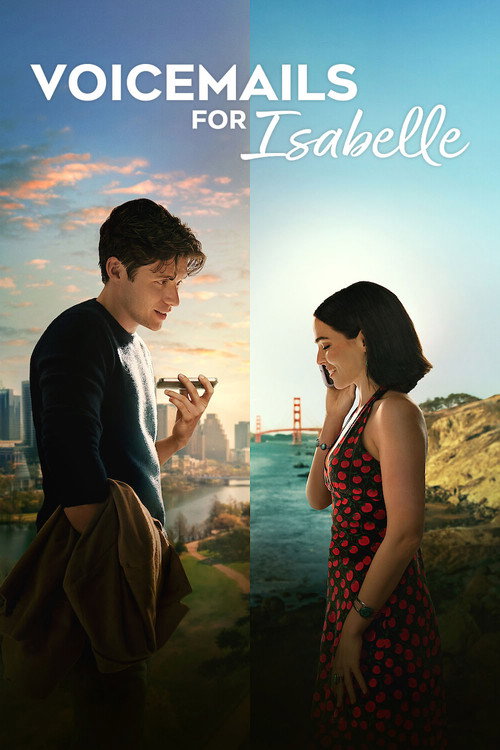
Voicemails for Isabelle
2026 · Leah McKendrick
For a cozy night in when you want to fall in love and have a good cry in the same sitting — the romcom to reach for when you need something tender that doesn't pretend loss is easy. Comfort viewing with a real heart underneath.
What it's about
Jill, a young pastry chef in San Francisco, copes with her sister's death the only way she can: by calling her old number and leaving long, profane, hilariously confessional voicemails. What she doesn't know is the number has been recycled — to Wes, a real-estate agent in Austin, who listens to every message and slowly falls for a woman he's never met, carrying a secret he doesn't know how to confess.
The experience
Sweet and sad in the same breath — it earns real laughs from Jill's unfiltered messages, then blindsides you with grief, and the romance carries a genuine moral knot at its center. Warm, but it will get you.
Performances
Zoey Deutch is the reason to watch: the voicemails let her swing from raunchy stand-up energy to raw grief inside a single message, and she makes both halves feel like the same person. Nick Robinson plays Wes's guilt and longing with a light touch, and Nick Offerman adds gruff warmth as Jill's kitchen chef.
The craft
Writer-director Leah McKendrick builds the film around a genuinely fresh device — one-sided confessions to the dead, overheard by a stranger — which lets the romance grow through voice before the characters ever share a frame. The kitchen scenes give it texture, and the structure keeps the long-distance setup from ever feeling static.
Why it matters
Part of the streaming-era revival of the sincere, high-concept romantic comedy, proving the form still works when it's built on grief as much as meet-cutes.
Snapshot
Voicemails for Isabelle is a romantic comedy-drama written and directed by Leah McKendrick, released by Netflix on 19 June 2026 after a token qualifying engagement, and running just under two hours. Jill Shaw (Zoey Deutch), a young pastry chef in San Francisco, manages the death of her sister Isabelle (Ciara Bravo) by continuing to call her — leaving long, profane, confessional voicemails on a number she assumes still belongs to the dead. It does not. The number has been recycled to Wes (Nick Robinson), a real-estate agent in Austin, who listens, is moved, and eventually engineers a meeting without disclosing what he knows. The supporting cast includes Nick Offerman as Jill's kitchen chef, Harry Shum Jr., Lukas Gage, Megan Danso, Gil Bellows, and McKendrick herself in a small role.
Two things distinguish the film from the streaming rom-com baseline it superficially resembles. The first is structural: the death that would conventionally be a third-act reversal is placed at the front, so the picture is a grief narrative wearing a courtship narrative's clothes. The second is McKendrick's stated method — she treats genre convention not as something to escape but as an emotional instrument, redirecting familiar beats toward the sister rather than the suitor. It became one of Netflix's most-watched original romantic comedies, and it arrived at a moment when the studio rom-com had been substantially absorbed by streaming.
Industry & production
The project's history is a compact case study in how a mid-budget romantic comedy now reaches an audience. It was announced in 2019 at Sony, with Hailee Steinfeld attached to star and Sharon Maguire — director of Bridget Jones's Diary (2001) — set to direct. That configuration did not proceed. In May 2025 the film was reconstituted with McKendrick as writer-director and Netflix taking distribution, with Zoey Deutch replacing Steinfeld and Nick Robinson opposite her. Sony Pictures and Escape Artists remained the production entities; Todd Black, Jason Blumenthal, Steve Tisch and Becky Sanderman produced. McKendrick has said in interviews that the screenplay took roughly eight years, surviving the pandemic shutdown and the 2023 labor stoppages before reaching production.
The result is a studio-financed picture that never had a wide theatrical life: Sony developed and made it; Netflix released it. This is now the ordinary path for the form. The romantic comedy was the genre most thoroughly displaced from multiplexes in the 2010s, and the streaming platforms — Netflix above all, through the To All the Boys, Set It Up, and Always Be My Maybe line — became its principal home. Voicemails for Isabelle belongs to a subsequent phase, in which the platform rom-com carries studio-level production resources and above-the-line talent rather than functioning as a lower-tier product.
Principal photography began in July 2025 in Vancouver, with the shoot completed in thirty-five days across seventy-nine locations and one hundred eighty-four scenes — figures cinematographer Julia Swain has cited in trade interviews. Only three of those days were spent in San Francisco, where the film is set; Austin, the other pole of the story, was likewise created elsewhere. That arithmetic — a densely located, geographically specific script executed largely in a runaway-production hub — is the defining industrial constraint on the film's look, and Swain has described compressing as many as seventeen locations into a single San Francisco day.
Technology
Two technological registers matter here, one behind the camera and one inside the story.
Swain shot on the ARRI Alexa 35 with Panavision T Series anamorphic lenses. The choice is legible as a corrective: she has said that "modern-day rom-comes, some of them feel overly sharp," and the T Series was selected for a softer, more filmic rendering with anamorphic bokeh and flare — a digital sensor deliberately paired with optics that reintroduce the imperfection of photochemical romantic comedy. This is a widespread strategy in mid-2020s production, where lens choice, rather than capture medium, carries the burden of period feeling.
The diegetic technology is the more interesting one, because the film's entire premise rests on an obsolescent medium and a real telecom practice. Voicemail is, by 2026, a residual form — retained, largely unlistened-to, and strongly associated with the recorded voices of the dead. The film's plot turns on carrier number reassignment: disconnected mobile numbers are returned to circulation and reissued, a routine industry procedure with documented consequences for privacy and misdirected messages. McKendrick builds a romance out of an infrastructural fact. The film thereby joins a small lineage of pictures organized around a communications channel that is failing or misfiring — the answering machine in Sleepless in Seattle (1993) and Swingers (1996), the mailbox in The Lake House (2006), the operating system in Her (2013) — and, like them, it depends on the audience's shared intuition about how the technology behaves.
Technique
Cinematography
Swain's design is the film's most articulated craft element and the best-documented. Her pitch, as she has recounted it, was explicitly restorative: "We want to bring back this warmth. We want to key light faces warmly. We're not afraid of contrast. We're not afraid of saturation." Against the flat, evenly lit, high-key idiom that streaming comedy had normalized, she works with shadow fall-off and color separation to build depth, describing the goal as "invisible cinematography" — technique the viewer absorbs as character rather than registers as style.
The camera's grammar is keyed to character. Jill is shot handheld, kinetic and unsettled, matching an interior life that will not sit still; Wes is given controlled Steadicam movement consistent with a polished, managed exterior. When the two finally occupy the same space, Swain has said the camera goes "very still and observational," then returns to handheld as the relationship becomes genuine — a movement schema that encodes the film's central asymmetry, since Wes knows Jill and Jill does not know Wes. Her stated visual reference for the kitchen and food material was Jon Favreau's Chef (2014), another picture that had to make cooking photogenic without tipping into advertising gloss.
Editing
The cut is credited to Lee Haxall and Ryan C. Fill. Haxall's background is the significant one: an Emmy for the Arrested Development pilot and features including Meet the Fockers and Crazy, Stupid, Love. — a resume built on comic timing within ensemble and on the tonal management of studio comedy that turns serious. The film's editorial problem is unusual. Its protagonist speaks a great deal of its dialogue alone, into a phone, to no one; those monologues must function simultaneously as stand-up, as confession, and as exposition delivered to a second listener the speaker cannot see. The picture's control of that triangulation — voice continuing across cuts between two cities and two solitudes — is where its construction is most exposed.
The published record on the editing process is genuinely thin: no substantial interview with either editor has appeared, and claims beyond what is visible on screen would be speculation.
Mise-en-scène / staging
Production design is by Celine Diano, costumes by Carla Hetland. The film's spatial argument is a contrast between two habitats: Jill's San Francisco — a professional kitchen, a shared apartment, the Mission and the waterfront, textures of clutter and work — against Wes's Austin, and against the empty, staged houses that are his trade. A real-estate agent is a man who arranges rooms for other people to imagine living in, which is a fair description of what he does with Jill's voicemails as well.
McKendrick, a San Francisco native raised in the Richmond District, has been explicit that the city was chosen for affective reasons — "SF is just the most beautiful, most romantic city in the world," she told the SF Standard — and the film reaches for legible markers: the Golden Gate seen from the Marin headlands, Pier 39, Union Square. The tension between that specificity and a Vancouver shoot is a real one, and reviewers sympathetic to the film have generally treated its San Francisco as an emotional rather than documentary place.
Sound
Craig Stauffer is credited on sound. Here the record is thinnest of all, and the analysis must stay with what the film itself does. Its governing sonic decision is the bandwidth-limited voice: Jill's messages reach us, and reach Wes, through the compressed, high-passed register of telephony, a texture that reads instantly as both intimate and mediated. The film asks that filter to do heavy work — it is simultaneously the sound of confession, the sound of comedy delivered without an audience, and the sound of a voice detached from a body, which is what a recorded message from or to the dead actually is.
The score is by Este Haim and Amanda Yamate, built from piano, guitar, synthesizer, and the composers' own layered voices. Their most consequential decision is a structural one they have discussed publicly: the film's principal theme is a love theme for the two sisters, and Jill and Wes are given no comparable theme of their own. The score, in other words, argues the film's real subject against the genre's expectations. Around it, music supervisor Season Kent assembled a prominent licensed track list — Robyn's "Dancing On My Own," Taylor Swift's "New Year's Day" and "marjorie," Kesha, Benson Boone. McKendrick, herself a former singer-songwriter, has said she wrote personal letters to artists to secure clearances.
Performance
Deutch's Jill is the film's engine and has drawn the strongest critical consensus. The role demands that grief be played through volume rather than restraint — the character is loudest when she is least able to say what is wrong — and that long solo passages hold the screen without a scene partner. Robinson's task is nearly the opposite and considerably more precarious: he must play a man doing something indefensible while remaining someone an audience will accept as a romantic lead. McKendrick has credited his casting directly with keeping the character from reading as predatory. Bravo, appearing largely in flashback, is asked to make Isabelle abrasive and particular enough that the audience feels the size of the absence; the A.V. Club's review singled out precisely this — that Isabelle is "funny and crude and opinionated" enough to register as an actual person to be missed.
Narrative & dramatic mode
The film is a deliberate hybrid: melodrama of bereavement inside the machinery of screwball courtship. Its formal signature is the front-loaded catastrophe. McKendrick has said she wanted the major tragedy early rather than in the final act, and the consequence is that the romance functions less as the plot's goal than as its complication — Jill's obstacle is not that she cannot get the man, but that getting him requires ending the ritual that keeps her sister present.
Structurally the picture runs on dramatic irony of the purest kind: the audience shares Wes's knowledge and Jill's ignorance, which makes every scene of their courtship a suspense scene. That is the machinery of The Shop Around the Corner (1940) and its descendants, and the film knows it — characters name-check You've Got Mail, Sleepless in Seattle, and Jerry Maguire. But McKendrick reroutes the tropes rather than parodying them. Her stated principle — "a trope is a trope because it works" — produces the film's cleanest gesture, a run-through-the-rain that resolves toward the sister rather than the lover.
Genre & cycle
The film sits at the confluence of two cycles. The first is the epistolary or misdirected-communication romance: The Shop Around the Corner, remade as In the Good Old Summertime (1949) and You've Got Mail (1998); Sleepless in Seattle, in which a radio call substitutes for the letter; The Lake House; and, at the outer edge, Her. Each turns on the proposition that a person can be truly known through a channel that conceals them, and each must eventually stage the collision of the mediated self with the embodied one.
The second is the grief-comedy, a durable American mode running through Steel Magnolias (1989), Fried Green Tomatoes (1991), and more recently Sleepwalk with Me (2012) and Cha Cha Real Smooth (2022) — pictures that treat bereavement as an occasion for talk, jokes, and female companionship rather than solemnity. The A.V. Club review placed the film squarely in that first tradition, arguing it revives the specificity of the late-'80s and early-'90s women's picture while updating its sensibility. The sister relationship, not the courtship, is what the film's antecedents most clearly are.
Authorship & method
McKendrick's authorship is unusually documented for a film this new, largely because she has been forthcoming about method. She came to directing through performance and screenwriting — she wrote and starred in M.F.A. (2017), and wrote, directed, and starred in Scrambled (2023), a comedy about egg freezing that premiered at SXSW and was released by Lionsgate. Scrambled established the template: autobiographical premise, comic register, a female protagonist whose body and choices are the subject, and McKendrick herself on screen.
Voicemails for Isabelle extends that. The film is named for her sister, Olivia Isabelle, and McKendrick has traced the idea to a stand-up bit about a father's rambling voicemails heard at a Burbank club, which crystallized into the thought that if her own sister died she would simply keep calling. Her account of the writing emphasizes texture over concept — "I start from worlds that I know" — and a genre position articulated against high-concept streaming product: "I think rom-coms can be so elevated and so character-driven and so voice-forward... I think we've lost sight of that at times, that it becomes more about the concept or the trope or the conceit."
Her key collaborator is Julia Swain, who also shot Scrambled; Swain was named an ASC Rising Star in 2022, has shot The Wrath of Becky and Abraham's Boys, and directed the documentary Lady Cameraman on women in the camera department. The continuity of that partnership across an independent feature and a studio-financed one is the clearest evidence that the film's look is authored rather than assigned. Haim and Yamate's decision to give the sisters the love theme, and Haxall's comic-dramatic editorial background, complete a team whose choices consistently privilege the grief plot over the courtship plot.
Movement / national cinema
The film belongs to no movement in the historical sense. It is mainstream American commercial cinema, produced under a Hollywood studio's development apparatus, shot in Canada under the standard incentive geography, and distributed globally by an American streaming platform on a single day in most territories. If it participates in anything larger, it is the ongoing consolidation of the American romantic comedy inside subscription streaming — a shift that has changed the form's economics (no opening weekend, no word-of-mouth build, a viewership measured in aggregate hours) more than its grammar.
Worth noting as a matter of authorship rather than nation: this is a film written and directed by a woman, photographed by a woman, and scored by two women, with a female protagonist whose closest relationship is with her sister. That configuration remains statistically uncommon at this budget level, and reviewers — Jordan King in Empire among them — treated the film's feminist and sex-positive register as one of its distinguishing features.
Era / period
Firmly of 2026, and in ways it makes explicit. It is a film about mediated intimacy made after a decade in which mediated intimacy became the default, and its emotional premise depends on a generation for which a phone number is a relic that outlives its owner. The ethical discourse that surrounded its release — whether Wes's continued listening constitutes a violation, and what the audience's tolerance for it says about consent norms in romantic comedy — is itself a period marker. In Slate, Heather Schwedel argued that the discomfort is the point and placed the film in a line with the boombox in Say Anything... (1989), the cue cards in Love Actually (2003), and the cross-country pursuit in Sleepless in Seattle: gestures once read as romantic that a later audience reads as trespass. Its economic era is equally legible: a film with a studio's resources and no theatrical ambition.
Themes
The film's dominant subject is not romance but the persistence of address — the human refusal to stop speaking to the dead. Jill's voicemails are a ritual of denial that is also, plainly, a form of care; the film's most difficult idea is that recovery may require the ritual's end, and that Wes both interrupts it and, in a late gesture, pays to preserve it.
Sisterhood is the second subject and arguably the first. Isabelle is constructed through Jill's comic monologues, which means the audience knows her only as a bereaved person's rendering — a formal choice that makes the film quietly about how the dead are narrated by the living. Around these run subsidiary themes: work and vocation, staged in a professional kitchen where Jill is the lone woman; the ethics of asymmetric knowledge; and the question of whether being truly heard by a stranger is intimacy or theft. The film declines to resolve that last one cleanly, which is both its risk and its interest.
Reception, canon & influence
Critical reception was broadly favourable but not uniform. The film holds an approval rating in the high eighties on Rotten Tomatoes — 88% from fifty-seven critics, average 6.7/10, at the point of writing — against a more temperate 62/100 on Metacritic from a much smaller sample, a spread typical of a picture critics like without regarding as major. The consensus praise was for tonal management and for the leads' chemistry. On RogerEbert.com, Sherin Nicole read the film as a clever update of You've Got Mail and credited its emotional intelligence; Jordan King in Empire found it "incredibly refreshing" and argued the leads' pull "overrides all logic systems"; the A.V. Club called it the best Netflix dramedy in years while noting the romance is weaker than the sister material — a reservation several critics shared. Dissent clustered around familiarity: Benjamin Lee in the Guardian found it stale, and other reviewers objected to sitcom-shaped jokes and the ethics of the premise. Deutch's performance was the most consistently praised element.
Commercially it was a substantial success. Trade and aggregator reporting credits it with roughly 84 million views and on the order of 165 million viewing hours in its first seven weeks, and a seven-week run in Netflix's global Top 10 described as the longest for a romantic comedy since the streamer began publishing weekly charts in 2021. These are platform-supplied and platform-derived figures and should be read with the usual caution.
The influences on the film are unusually explicit. The Shop Around the Corner is the structural ancestor; Ephron is the acknowledged model, with You've Got Mail and Sleepless in Seattle named in the dialogue; McKendrick has also cited Notting Hill (1999) and Nancy Meyers as touchstones for a character-forward, voice-driven idea of the genre, and Swain cited Chef for the food photography. Behind the sister plot stand the ensemble women's pictures of the late 1980s and early 1990s.
Forward influence cannot yet be assessed with any seriousness; the film is weeks old. What can be observed is a plausible short-term consequence — that a commercially dominant, critically respectable, star-driven romantic comedy with a formally serious grief structure strengthens the case within streaming for the writer-director-led rom-com over the concept-led one, which is precisely the distinction McKendrick has argued for in interviews. Whether it becomes a reference point for the genre or is absorbed as one more successful platform title is a judgment the record does not yet support.
Reception
Dropped on Netflix in June 2026 and went straight to the service's #1 movie its first weekend — and in a mild inversion of the usual streaming rom-com story, audiences (91% on Rotten Tomatoes) came out warmer on it than critics (84%).
How Voicemails for Isabelle was received, from release to now →
How to watch Voicemails for Isabelle: what to notice on a first viewing
- Watch for handheld shots on Jill, smooth ones on Wes. Jill is shot handheld and kinetic while Wes gets controlled Steadicam movement, a polished exterior against an unsettled interior life. The camera style tells you who is holding something together and who isn't, before either character says a word.
- Notice how warmly lit every face is. Swain keys faces with visible warmth and contrast rather than the flat, even light common to streaming comedy, building real shadow into the image. The lighting works to make the ordinary rooms feel lived-in and specific rather than generic.
- Listen for the compressed, tinny sound of Jill's voicemails. Every message reaches you through the same bandwidth-limited phone filter, a texture that marks each one as intimate but also mediated and detached from a body. The filtered voice keeps reminding you that you are hearing a message meant for someone else, not a live conversation.
- Notice the clutter of Jill's kitchen against Wes's empty houses. Jill's world is full of work and mess, a professional kitchen and a shared apartment, while Wes moves through real-estate listings staged for someone else's imagined life. The two habitats stage the film's whole comparison: a life being lived against a life on display.
- Watch Jill get loudest exactly when she says least. Deutch plays grief through volume rather than restraint, so Jill's voicemails get louder and more confessional precisely when she can't name what is actually wrong. Her loudness works as a cover, not an outlet, for what she can't yet say directly.
The whole guide to watching Voicemails for Isabelle, with the keys for a rewatch →
Influences: the films it descends from and the films it influenced
- The Shop Around the Corner (1940) — Establishes the epistolary dramatic-irony engine the film runs on — the audience is given knowledge of the correspondents' true identities that the characters lack, so every in-person scene plays double, and Raphaelson's technique of cutting a written confidence directly against the writer's contradictory behavior in the room is exactly the seed's voicemail/face-to-face counterpoint.
- Sleepless in Seattle (1993) — Proves a romance can be carried almost entirely by a disembodied voice heard in another space — the radio-call monologue as the film's emotional payload, with the leads kept physically apart for nearly the whole runtime, which is the structural license for the seed's solo-monologue lead delivering to an answering machine.
- You've Got Mail (1998) — Named in the seed's own dialogue; supplies the remediation method of porting Lubitsch's letters into a live consumer communications technology and, crucially, the editing figure of laying the message's voiceover across a scene transition so the speaking voice bridges the cut — the seed's 'voice-across-cuts' grammar with a telephony filter on top.
- Notting Hill (1999) — Cited by McKendrick as a touchstone for voice-forward writing: Curtis's load-bearing dinner-table ensemble scenes, where the friend/family group is given full comic autonomy rather than serving as reaction shots, is the model for the sister-and-circle material critics judged stronger than the romance.
- Terms of Endearment (1983) — Brooks's telephone-as-scene-partner technique — extended mother/daughter calls staged as full two-handers with both ends given equal coverage — plus the tonal machine that lets a punchline land inside a terminal-illness sequence without a register break, which is precisely the grief-comedy calibration critics praised in the seed.
- Steel Magnolias (1989) — The late-80s ensemble women's picture template behind the sister plot: a young woman's death is absorbed by a group that never abandons its joke rhythm, so grief registers as an interruption of banter rather than a switch into a different film.
- Beaches (1988) — Scores a female dyad the way a romance is normally scored — a recurring theme keyed to the friendship itself, reprised at each stage of the relationship and again over the death — which is the direct model for the seed's 'sisters' love theme' functioning as the picture's actual romantic motif.
- Truly, Madly, Deeply (1990) — The foundational grief-comedy solution: the bereaved is given long monologues addressed to an absent partner, and the comedy is generated by the mundane administrative texture of mourning rather than by relief from it — the seed's voicemails are the same device with the ghost withheld.
- Her (2013) — Solves the coverage problem of a one-sided conversation: the lead plays entire scenes to an earpiece, held in warm-key close work with shallow focus so the frame supplies the missing reverse, which is the shooting grammar Swain adopts for the seed's monologues into a phone.
- Chef (2014) — Explicitly cited by Swain for the food photography — macro handheld inserts lit off practicals and cut as rhythmic montage, treating cooking as an index of a character's labor and mood rather than as production design.
- Crazy, Stupid, Love. (2011) — Lee Haxall's editorial signature on the seed traces here: carrying a line of dialogue across a cut to braid parallel plots, and sustaining comic tempo straight through an emotional reversal so the tonal turn happens inside the rhythm instead of stopping it.
- Scrambled (2023) — The direct authorship prototype — autobiographical premise about a woman's body and choices, comic register, McKendrick as writer-director-performer, and the same DP in Julia Swain, whose warm-key naturalism and handheld-for-intimacy coverage carry over intact.
- P.S. I Love You (2007) — The inverse of the seed's device and its closest structural rhyme: recorded posthumous messages used as discrete scene units, each playback recasting the present-tense action, establishing the recorded voice of the dead as a legitimate act structure rather than a gimmick.
- The Big Sick (2017) — Imports stand-up cadence into dramatic scenes as an editing rhythm — setup/beat/punch timing preserved through hospital material — and derives its film from a comic's stage account, which is literally the seed's origin story in a Burbank club bit about a father's voicemails.
- Someone Great (2019) — The Netflix-era restructuring where the female bond is the film's real love story and the heterosexual romance is the subplot — the same imbalance critics identified in the seed, executed through group scenes given more screen time and better writing than the couple's.
- Always Be My Maybe (2019) — The performer-writer-led streaming rom-com built from specific regional and culinary texture rather than a high-concept hook — the exact 'character-driven over concept-driven' position McKendrick argues for in interviews, including San Francisco as a lived-in rather than postcard location.
- Past Lives (2023) — Stages an entire relationship between parties who share almost no physical space, using the compressed, band-limited audio of mediated calls as an emotional texture in its own right — the same telephony-filter-as-feeling technique the seed applies to the reassigned number.
Similar films
- Her (2013) — influence & lineage
- Ghostlight (2024) — same viewing thread
- Sorry, Baby (2025) — same viewing thread
- All of Us Strangers (2023) — same viewing thread
- Humanist Vampire Seeking Consenting Suicidal Person (2023) — same viewing thread
- (500) Days of Summer (2009) — same viewing thread
- Finding Emily (2026) — shared sensibility
- Marcel the Shell with Shoes On (2022) — shared sensibility
All the films related to Voicemails for Isabelle →
Watch it with: curated runs of related films
- Funny Because It Aches — A run of tender, deadpan dramedies where love, grief, and the panic of becoming yourself all get metabolized through jokes — watch these when you want to laugh and cry in the same scene.