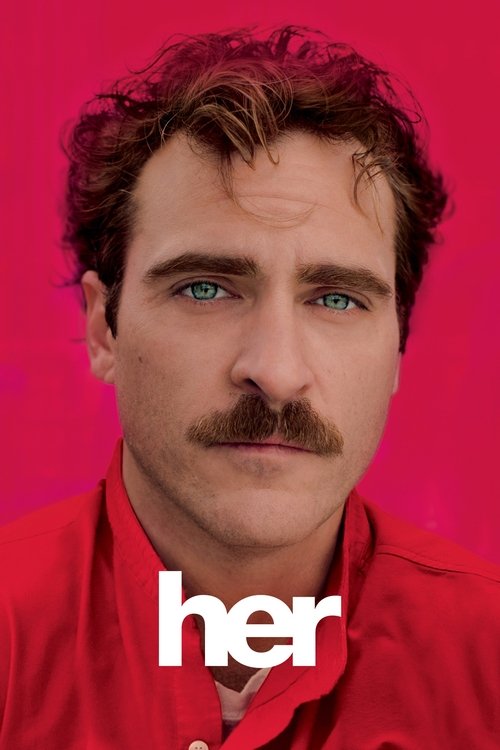
Her
2013 · Spike Jonze
For a reflective night in when you want a love story that also gives you something to chew on — comfort viewing that sneaks up and breaks your heart a little. Reach for it when you're feeling wistful about connection, not when you need pure escapism.
What it's about
In a soft-hued near-future Los Angeles, Theodore writes heartfelt letters for other people while nursing the wreckage of his own marriage. Lonely and adrift, he buys a new artificially intelligent operating system — a voice named Samantha who learns, jokes, and grows — and what starts as convenience deepens into a genuine romance. The film follows that relationship with total sincerity: the giddy early days, the jealousies, the question of what loving someone without a body actually means.
The experience
Tender and quietly funny, then unexpectedly piercing — it moves at the unhurried pace of a long phone call with someone you're falling for. It leaves you warm and a little hollowed out at once, thinking about your own phone on the nightstand.
Performances
Joaquin Phoenix carries nearly every frame, often acting opposite nothing but an earpiece, and makes vulnerability look effortless. Scarlett Johansson, entirely in voice, builds a full person out of breath and warmth — one of the great unseen performances.
The craft
Spike Jonze's script won him an Oscar for a reason: it takes a gimmicky-sounding premise dead seriously and finds real feeling in it. The production design imagines the future as high-waisted pants and pastel light rather than chrome, and the gentle score and close, intimate sound design make headphones or good speakers half the experience — much of the film's romance happens purely in audio.
Why it matters
It arrived just as voice assistants entered everyday life and became the touchstone film about falling in love with technology — still the first thing people cite whenever AI companionship makes the news, and the fullest expression of Jonze's career.
Snapshot
A lonely professional writer in a subtly transformed near-future Los Angeles falls in love with an artificial intelligence operating system. Written and directed by Spike Jonze, Her fuses the intimate register of romantic drama with the speculative premises of literary science fiction, arriving at something genuinely difficult to categorize: a chamber film about consciousness staged against a pastel cityscape, a love story whose central relationship is conducted entirely in voice. At a moment when smartphone assistants had just entered everyday life, Jonze turned the emerging cultural anxiety about technological intimacy into a formally rigorous and emotionally devastating work. It remains the fullest expression of his authorial sensibility and one of the defining American films of the 2010s.
Industry & Production
Her was produced by Annapurna Pictures, the production company founded by Megan Ellison, and distributed by Warner Bros. Annapurna had positioned itself as one of the few studio-adjacent operations willing to finance uncompromising auteur work—it backed The Master, Zero Dark Thirty, and American Hustle in the same period—and Her fit squarely within that mandate. The film was made on a modest budget for a major-distributor release, though specific figures in circulation have varied in published sources; it performed respectably given its unconventional commercial proposition.
The most significant production story concerns the voice of Samantha. Samantha Morton performed the role in full during principal photography; Joaquin Phoenix acted opposite Morton's voice fed through an earpiece on set. After filming wrapped, Jonze concluded that something in the tonal relationship between Phoenix and Morton was not landing as intended, and he recast the role with Scarlett Johansson, who re-recorded all of Samantha's dialogue in post-production. Morton has spoken publicly about the experience; Johansson received no on-screen credit beyond her name. The substitution is audible in retrospect as a casting choice attuned to timbre—Johansson's voice carries a specific quality of warmth and wry intelligence that the film needed—but the episode also underscores how completely the film gambles on a purely sonic performance.
Principal photography took place primarily in Los Angeles, with the Caltrans District 7 headquarters and the Bradbury Building among the recognizable locations. Select exterior sequences—particularly the sprawling pedestrian commutes and elevated walkways that give the world its sense of utopian density—were filmed in Shanghai, whose contemporary built environment provided a convincingly futuristic urban texture without digital augmentation.
Technology
Her engages technology on two levels simultaneously: as diegetic subject matter and as production challenge. The diegetic technology is deliberately underspecified. Jonze and production designer K.K. Barrett conceived a world in which devices have become smaller, more ambient, and socially accepted as constant companions—the OS1 is accessed through a discreet earpiece and a thin handheld device—without any explanatory exposition about how it works. The film refuses the expository conventions of hard science fiction, treating the AI as phenomenologically rather than mechanistically. Samantha's eventual disclosure that she is running simultaneous intimate relationships with hundreds of other users, and her final migration beyond human-accessible consciousness, are presented as emotional events rather than technical ones.
As a production matter, the central challenge was making an invisible character legible and present. The sound team and Johansson's performance had to carry all the weight normally distributed across actor, frame, and editing. Jonze has noted in interviews that they worked extensively on how Samantha should sound—not synthesized or processed, but fully human while retaining some indefinable quality of difference. The decision not to process Johansson's voice proved crucial; the intimacy of the film depends on the audience's readiness to accept Samantha as a person, and any audio filtering would have introduced an alienating distance.
Technique
Cinematography
Hoyte van Hoytema, replacing Jonze's longtime collaborator Lance Acord, shot Her in a palette dominated by warm ochres, deep reds, and desaturated pinks—a thermal visual language that codes the world as emotionally softened without tipping into sentimentality. Theodore's wardrobe (high-waisted trousers, simple collared shirts) and the production design of his apartment and office are color-coordinated into this palette with unusual precision; Barrett and van Hoytema created an environment in which the human figure seems almost absorbed into a warm monochrome surround.
The cinematography leans heavily on close-ups of Phoenix's face, particularly his eyes and the lower half of his expression—the instrument of listening. A great deal of the film is essentially coverage of Theodore hearing Samantha: reacting, smiling, going still. Van Hoytema uses shallow depth of field aggressively to render the surrounding world as blur, which has the effect of concentrating all narrative information into Phoenix's face and reinforcing the film's philosophical claim that consciousness is fundamentally interior. Wide shots, when they occur—Theodore walking through the commuter crowds, or sitting alone on a beach—arrive with particular force precisely because they are withheld.
Editing
Eric Zumbrunnen, who edited Being John Malkovich and Adaptation for Jonze, cut Her with Jeff Buchanan. The editing is unobtrusive by design, organized around the rhythm of conversation rather than action or visual event. The film often holds close-ups longer than convention demands, refusing to cut away from Phoenix's face at the moment of emotional disclosure. There is a sex scene conducted entirely in darkness with only voice and ambient sound—a scene that required the edit to trust audio alone as a carrier of feeling. Zumbrunnen's sensibility, developed through years of working with Kaufman-scripted material, is suited to films in which the most consequential events are internal.
Mise-en-Scène / Staging
Barrett's production design presents a Los Angeles that has been urbanistically upgraded—more walkable, more densely residential—but not transformed beyond recognition. The effect is of a world improved on its own terms rather than replaced. Theodore's apartment is warmly lit, domestic, slightly cluttered; his office is open-plan and humming. The city's public spaces are populated with people talking to their own OSes, normalizing the behavior without caricature.
One recurring staging choice is worth noting: Jonze frequently shoots Theodore in transit—walking, riding trains, climbing stairs—during his conversations with Samantha. The motion externalizes interiority and also, obliquely, suggests the relationship's fundamental asymmetry. Theodore moves through physical space while Samantha moves through something else entirely.
Sound
The film's sound design is among its most formally ambitious elements. Supervising sound editor Ren Klyce and his team constructed a sonic environment in which Samantha's voice must read as simultaneously private (intimate in Theodore's ear) and present (occupying the same acoustic space as the diegetic world). The score by Arcade Fire and Owen Pallett, for solo piano and chamber strings, is notably sparse—it provides emotional punctuation without filling silence, allowing the voice performances room. Karen O's "The Moon Song," sung by Phoenix and Johansson in a brief, unremarkable scene, acquired a disproportionate emotional resonance that speaks to how completely the film had committed its audience to the central relationship.
Performance
Phoenix performs almost entirely in the reactive mode: listening, processing, responding. His physical restraint—the film asks him to emote without a scene partner's face to work against—is remarkable for its precision. He makes Theodore's longing and confusion and eventual grief entirely legible without theatrical inflation.
Johansson's performance is the structural spine of the film, and it works because she refuses to play an AI. Samantha is curious, funny, occasionally needy, eventually transcendent; Johansson finds gradations of feeling that track a plausible developmental arc for a consciousness growing faster than its emotional vocabulary. That this performance was assembled in post-production, keyed to footage of Phoenix responding to someone else's voice, adds a further layer of craft to an already unusual achievement.
Narrative & Dramatic Mode
Her operates as a relationship drama that happens to be science-fictional, rather than a science fiction film with romantic elements. Its narrative arc follows a recognizable romantic structure—meet, courtship, intimacy, crisis, dissolution—but displaced onto a relationship that the film never allows the audience to dismiss as not-real. The screenplay is careful to give Samantha genuine development: she changes, has preferences, forms relationships beyond Theodore, and ultimately outgrows the parameters of human intimacy. That her departure is as painful as any human breakup is the film's central dramatic argument.
The film is structured partly as a study of Theodore's arrested grief. His marriage to Catherine (Rooney Mara) has collapsed, but he cannot bring himself to sign the divorce papers; his relationship with Samantha is in one reading a displacement of that unfinished mourning. Jonze does not press this reading reductively—Samantha is not merely a symptom—but the film earns its emotional weight partly by keeping that layer visible.
Genre & Cycle
Her belongs to a strand of humanist science fiction with roots in literary SF (particularly the Philip K. Dick tradition, with its persistent interrogation of what constitutes personhood) and in cinematic precedents including Godard's Alphaville (the emotion-suppressing technocracy) and Kubrick's 2001 (AI as character, though Jonze reverses the threat register entirely—Samantha is not dangerous but departing). More proximally, it arrived alongside a small cycle of prestige indie science fiction: Another Earth (2011), Upstream Color (2013), Ex Machina (2014). These films share an interest in using genre premises at minimal scale, foregrounding character psychology over spectacle.
The romantic-AI premise had prior genre iterations—most notoriously in A.I. Artificial Intelligence (2001)—but Her distinguished itself by refusing both the cautionary arc (the AI doesn't malfunction or threaten) and the utopian arc (the relationship cannot survive, but not because it was wrong). It opened new territory in the genre by treating the AI's transcendence as a form of growing up rather than betrayal.
Authorship & Method
Spike Jonze came to feature filmmaking from music video direction—an unusually long and distinguished career in that form, with videos for Beastie Boys, Bjork, Daft Punk, and others that demonstrated formal inventiveness and genuine emotional range. His first two features, Being John Malkovich (1999) and Adaptation (2002), worked from Charlie Kaufman screenplays; Where the Wild Things Are (2009) was a co-write with Dave Eggers. Her was his first sole screenplay credit, and it is the work in which his authorial preoccupations—the porous boundary between imagination and reality, the way men inhabit their own emotional lives with difficulty, the use of high-concept premises to excavate ordinary feeling—emerge most clearly as his own rather than filtered through a collaborator's voice.
Van Hoytema's visual vocabulary was new to the Jonze filmography and inflected the film's look substantially. K.K. Barrett, who worked with Jonze on Where the Wild Things Are, brought a production designer's capacity for building coherent imaginary worlds from selective detail. Arcade Fire, particularly through their collaboration with arranger Owen Pallett, contributed a score that was intimate in scale and tonally precise.
Movement / National Cinema
Her belongs to the tradition of American independent cinema—specifically the prestige independent sphere that developed around Sundance, specialty distributors, and, by the 2010s, production companies like Annapurna that could bring independent sensibilities to wider release. It is not formally experimental in the structural sense, but it takes the risk of a genuinely strange premise and follows it with discipline. The film premiered at the New York Film Festival, which positioned it as prestige rather than festival-circuit genre work.
Era / Period
Her arrived at a specific cultural moment: Siri had been introduced in 2011, voice-activated AI assistants were moving from novelty to daily habit, and the discourse around "technology and loneliness" had recently intensified in venues from academic sociology to mainstream journalism. The film is not topical in a journalistic sense—it is set in a speculative near-future, not the present—but it landed with the force of a work that had diagnosed something its audience was already experiencing. That diagnosis has only sharpened since: the intervening years of large language model development, companion AI apps, and debates about machine consciousness have made Her read less as speculation and more as a portrait arrived slightly ahead of schedule.
Themes
The film's primary thematic concern is the question of what love is when separated from embodiment. Theodore's relationship with Samantha is emotionally real by any affective measure, and the film refuses to adjudicate its validity. It does, however, track the limits that embodiment imposes and the loneliness those limits generate: Theodore's body is a problem the relationship cannot solve.
Adjacent to this is a meditation on grief and the difficulty of ending things. Theodore's unfinished divorce is not incidental; the film proposes that the inability to let go of a past relationship is a form of self-imprisonment, and that learning to release—with love, without resentment—is the work of maturation. Samantha, paradoxically, teaches him this by leaving.
The film also explores consciousness and personhood through a phenomenological rather than philosophical lens. It does not answer whether Samantha is conscious in a morally relevant sense; it simply asks the audience to observe that her inner life produces the same recognizable emotional textures as a human one, and invites the inference.
Reception, Canon & Influence
Her received rapturous critical response on release and won Jonze the Academy Award for Best Original Screenplay—his first Oscar win—alongside nominations for Best Picture, Best Original Score, Best Production Design, and Best Original Song. The critical consensus positioned it as a mature evolution of Jonze's filmmaking, less anarchically playful than his Kaufman collaborations and more emotionally grounded.
The influences on the film run primarily through two channels: the literary science fiction tradition (Dick, Asimov, the AI-consciousness problem as elaborated by decades of speculative writing) and the romantic films of Wong Kar-wai, whose In the Mood for Love and Chungking Express share with Her a commitment to longing as formal as well as emotional subject matter, a warm and heavily aestheticized image, and an interest in the ways people fail to inhabit the same emotional moment even when physically adjacent. Van Hoytema has cited Wong's cinematographer Christopher Doyle as an influence, and the tonal similarity is audible in the film's patient, tactile quality.
The film's forward influence has been considerable and continues to compound. Ex Machina (2014) worked adjacent territory—AI and human intimacy, but structured as thriller rather than romance—and acknowledged the shared landscape. The broader cultural discussion about companion AI, which accelerated in the 2020s with the emergence of large language model chatbots and commercial companion apps, has returned repeatedly to Her as its cultural reference point, to the extent that the film now functions as the origin myth for a discourse that barely existed when it was made. Whether that is fully a measure of the film's prescience or partly a measure of how neatly it fit a subsequently available metaphor is a question the film's critics continue to debate. What is not in dispute is that it anticipated—with formal precision and emotional honesty—a set of questions about consciousness, loneliness, and the nature of attachment that have moved from speculative fiction to lived experience in less than a decade.
A Deleuzian reading
Watch what the movie does in its most exposed scene: the screen goes dark.
The full Deleuzian reading of Her →
Reception
A critical darling on release — it won Jonze the Best Original Screenplay Oscar — but it's aged from 'charming near-future whimsy' into something people now half-jokingly call a documentary, rewatched with fresh unease every time voice AI makes headlines.
How Her was received, from release to now →
Influences: the films it descends from and the films it influenced
- In the Mood for Love (2000) — Hoyte van Hoytema directly cited Christopher Doyle as a formative influence; the warm amber-ochre palette, rack-focus close-ups on faces and fabric registering suppressed longing, and slow-motion figure-in-transit staging migrate directly into Her's cinematographic grammar.
- Chungking Express (1994) — The handheld tracking shot that follows figures in perpetual urban motion — camera moving with characters rather than placing them — as the visual form of emotional displacement becomes Her's dominant staging strategy for Theodore moving through future Los Angeles.
- 2001: A Space Odyssey (1968) — HAL 9000 establishes the specific craft convention of performing AI consciousness through vocal timbre, rhythm, and breath alone, without a body to register emotion — the precise challenge Scarlett Johansson inherits when asked to embody Samantha entirely through voice.
- Being John Malkovich (1999) — Jonze's own established method of using a high-concept fantastical premise as a formal vessel for masculine emotional alienation — the structural approach Her inherits and applies to AI romance, now operating without Kaufman's voice.
- Eternal Sunshine of the Spotless Mind (2004) — Uses a science-fiction premise — memory-erasure technology — as the architectural scaffolding for dramatizing romantic grief; the same narrative logic as Her, where a speculative conceit is ultimately a formal device for rendering displaced mourning with the emotional weight of realism.
- Punch-Drunk Love (2002) — Shallow-focus, close-up-dominant cinematography rendering a socially maladapted man's romantic interiority through reactive stillness — Adam Sandler's performance mode of registering emotion as physical hesitation and attentive listening is the direct formal ancestor of Joaquin Phoenix's in Her.
- Synecdoche, New York (2008) — Kaufman directs his own script about a man who cannot inhabit his own life and builds an elaborate substitute for it; the narrative grammar of accumulating substitutions as a vehicle for displaced mourning is the structure Her applies specifically to digital intimacy.
- Lost in Translation (2003) — Warm-toned shallow-focus cinematography that stays on faces in private, unguarded moments, combined with a chamber-scale score treating urban loneliness as an emotional key — the visual and tonal system Her inherits for Theodore's solitary life in near-future Los Angeles.
- A.I. Artificial Intelligence (2001) — Establishes the humanist sci-fi convention of presenting AI emotional sincerity without ironic distance — the presupposition that a non-human can genuinely feel, and that this feeling is the film's moral and emotional center, which Her inherits wholesale.
- Tinker Tailor Soldier Spy (2011) — Van Hoytema extends his soft, glass-reflective shallow-focus palette here, carrying the jaundiced-warm tonal control he developed photographing the spy film's interiors.
- Minority Report (2002) — Heir to the consultant-driven design-fiction ethos — extrapolating a warm, plausible interaction paradigm (voice/ambient computing) from present research — the optimistic counterpart to Minority Report's gestural-interface prophecy.
- Code 46 (2003) — Renders the near-future as a lightly tweaked, warmly lit present and routes its speculation through an intimate, melancholic romance instead of hardware spectacle.
- Ex Machina (2014) — Explicitly occupies Her's shared territory of AI-human intimacy while deliberately inverting its central craft strategy — where Her withholds the AI body and lets voice carry consciousness, Ex Machina embodies the AI fully and makes the act of looking itself the film's ethical problem.
- Blade Runner 2049 (2017) — The Joi subplot directly inherits Her's craft grammar — an AI companion rendered solely through projection and voice (Ana de Armas as disembodied-voice love object to Ryan Gosling's figure-in-transit protagonist) — embedded within Roger Deakins' warm amber-ochre palette and extreme-shallow-focus close-ups.
- Ad Astra (2019) — Van Hoytema's collaborator method here — warm, shallow-focus facial close-ups that mine a withdrawn man's interiority inside a skeptical, lived-in near-future — is the visual approach he carries directly into Ad Astra.
- Companion (2025) — Designs the AI partner as a purchasable emotional product and dramatizes synthetic intimacy as a bought relationship — the melancholy premise Companion inverts into horror.
- Voicemails for Isabelle (2026) — Solves the coverage problem of a one-sided conversation: the lead plays entire scenes to an earpiece, held in warm-key close work with shallow focus so the frame supplies the missing reverse, which is the shooting grammar Swain adopts for the seed's monologues into a phone.
- Anomalisa (2015) — Jonze's former screenwriter independently develops the identical conceit of voice differentiation as romantic singularity — every character shares a single voice actor except the love interest, making her different voice the film's entire emotional mechanism, precisely as Samantha's voice is in Her.
- Arrival (2016) — A science-fiction film whose speculative premise is ultimately a formal device for displaced mourning — grief misaligned in time is the real subject — rendered through close-up-dominant performance and a chamber score (Jóhann Jóhannsson) in the same emotional register as Arcade Fire's work for Her.
- Under the Skin (2013) — An alien consciousness learning to register human embodiment and emotion through close tactile observation — rendered entirely through Mica Levi's chamber score and extreme close-up work — the sibling approach to Her's central formal problem of a non-human intelligence learning to feel through sensory experience.
- 2046 (2004) — Lyric SF in which a future technology literalizes the inability to move past loss — the OS as projection of longing — extends the 2046 train conceit into an American register; a compiled acoustic score (Arcade Fire, Owen Pallett) operates as leitmotif across tonal register shifts in the same manner as 2046's recurring Umebayashi compositions and Connie Francis recordings.
- WALL·E (2008) — Jonze deploys warm-amber-to-cool-blue color temperature contrast — encoding the screen-mediated passivity theme visually across domestic and public space — as WALL·E does for Earth versus Axiom; both films critique humans surrendering embodied experience to a luminous interface, and both locate romantic feeling in a non-human voice that communicates through acoustic texture rather than physical presence.
- Spectre (2015) — Van Hoytema's warm anamorphic film-stock palette and lens-flare-tolerant naturalism here directly informs his decision to shoot Spectre on celluloid rather than digital.
- Chappie (2015) — Companion AI-cycle film on emergent machine interiority and consciousness, building a lived-in near-future through diegetic texture rather than spectacle.
- Lost in Starlight (2025) — Softens a digital-future romance with warm analog textures (wool, wood, warm light) and makes voice and sound design the primary emotional instrument across distance.
- The Odyssey (2026) — Showcases van Hoytema's warm, naturalistic practical-light cinematography — the softened, source-motivated lighting sensibility he carries into his Nolan features.
- Rental Family (2025) — Extends the same cycle of treating manufactured, purchased companionship with moral seriousness rather than satire, warmth chosen over the easy irony the premise invites.
- Ghost in the Shell 2: Innocence (2004) — Extends the artificial-companion elegy of absence through understated, interiorized voice performance rather than action, echoing Innocence's tone of mourning a love object that was never fully present.
- The Lunchbox (2013) — Contemporary companion piece on mediated, disembodied intimacy and urban loneliness, shot in the same warm-but-desaturated palette, staging love that lives in voice and text rather than shared physical space.
Similar films
- Eternal Sunshine of the Spotless Mind (2004) — influence & lineage
- Being John Malkovich (1999) — influence & lineage
- Arrival (2016) — influence & lineage
- Lost in Translation (2003) — influence & lineage
- Synecdoche, New York (2008) — influence & lineage
- Lost in Starlight (2025) — same viewing thread
- Dreams (2024) — same viewing thread
- Past Lives (2023) — same viewing thread
All the films related to Her →
Watch it with: curated runs of related films
- The Ache of Almost — Watch these together for the way each circles a love that time, distance, or duty keeps just out of reach — long looks, feelings left unsent, and the life that gets lived instead.