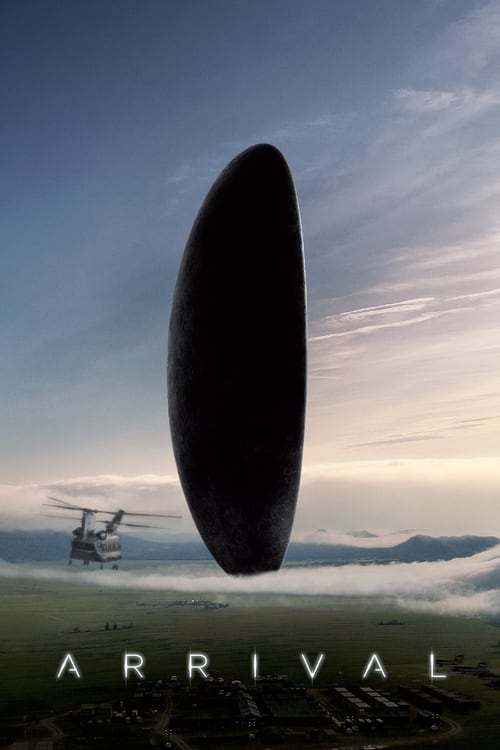
Arrival
2016 · Denis Villeneuve
The "serious sci-fi" standard-bearer whose Dune films made slow, austere blockbusters a mainstream event, and whose hiring to direct James Bond set off a fresh round of "can an auteur save a franchise" debate. Perpetually invoked in arguments about whether spectacle can still be art.
For when you want a film to chew on for days — cerebral but deeply felt, ideal for a contemplative night when you want wonder and a lump in your throat rather than explosions.
What it's about
Twelve enormous alien craft appear at scattered points around the globe, hanging silently over the landscape. Linguist Louise Banks is recruited by the military to answer the only question that matters — why are they here? — by doing something no one has done before: learning to communicate with a truly alien mind, while nervous governments edge toward panic.
The experience
Hushed, awe-struck, and quietly emotional — a first-contact story that trades laser battles for the thrill of understanding, with an undertow of grief that sneaks up on you. It's the rare science fiction film that ends in tears you didn't see coming.
Performances
Amy Adams gives one of her finest performances, carrying nearly every scene with an open, grieving intelligence — the film lives entirely on her face, and she never lets it down.
The craft
Villeneuve stages first contact as reverent ritual: fog-wrapped landscapes, the vertiginous approach into the ship, inky alien script blooming like smoke. Jóhann Jóhannsson's groaning, otherworldly score and the meticulous sound design make this one to watch big and loud, in the dark.
Why it matters
It confirmed Denis Villeneuve as the leading maker of serious, large-canvas science fiction and reset expectations for what a studio alien-contact film could be — thoughtful, humane, and still a hit.
Snapshot
A linguist named Louise Banks is summoned to decipher the language of twelve alien craft that have positioned themselves at irregular intervals around the globe. What appears to be a procedural first-contact thriller — government pressure, ticking clock, competing national responses — gradually reveals itself as a meditation on grief, free will, and the nature of time. The film's central conceit, drawn from Ted Chiang's 1998 short story "Story of Your Life," is rigorously Sapir-Whorfian: language does not merely describe reality but structures cognition, and learning the Heptapods' written language rewires Louise's perception of time itself. What the audience has been reading as flashbacks to a dead daughter are, in the final act, understood to be premonitions. The film made Denis Villeneuve a prestige-Hollywood fixture and stands as one of the more intellectually coherent science-fiction films of its decade.
Industry & production
Arrival was produced by Lava Bear Films and 21 Laps Entertainment, with Paramount Pictures handling North American distribution and FilmNation Entertainment overseeing international sales. Shawn Levy and Dan Cohen served as producers alongside David Linde. The production budget has been cited in the range of forty-seven million dollars — modest for a studio science-fiction film — and the film performed strongly relative to that investment, earning widespread theatrical attention in the autumn 2016 awards corridor. Paramount positioned it as prestige science fiction, a category the studio had not occupied with confidence since Contact (1997). Principal photography took place largely in and around Montreal, Quebec, with the alien contact site staged at a field location in the Eastern Townships region. The production design built the interior of the alien vessel as a practical set — a long, vertical corridor ending in a translucent membrane — which gave the actors a genuine spatial and gravitational disorientation to perform against. At the Academy Awards, the film received eight nominations including Best Picture, Best Director, and Best Adapted Screenplay, winning for Best Sound Editing.
Technology
Arrival was shot digitally on the Arri Alexa, cinematographer Bradford Young's preferred platform. Young exploited the camera's latitude for low-light work and natural exposure, eschewing supplementary fill light in favor of available and highly controlled practical sources. The alien vessel's interior was lit with a fine diffused mist that caught the beam sources installed in the set, creating the film's signature visual of luminous fog. The Heptapod logograms — the circular ink-wash symbols through which the aliens communicate — were designed by production designer Patrice Vermette in collaboration with artist Martine Bertrand, who developed a system of calligraphic logographic writing that had internal visual logic without resembling any terrestrial script. The visual effects, handled primarily by Hybrid Technologies and supplemented by other vendors, grounded the alien craft in a naturalistic aesthetic: the vessels are matte-black obloids, enormous but not baroque, hovering just above grade with a quality of mass that digital work in science fiction often fails to convey. No photorealistic biology was assigned to the Heptapods beyond their limb structure, keeping them partially obscured in steam and refracted light in a manner that served both the film's metaphysics and the VFX budget.
Technique
Cinematography
Bradford Young shoots with a darkness that is earned rather than decorative. His work on Arrival continues the approach visible in Ain't Them Bodies Saints (2013) and Selma (2014): a tight control of the light-dark gradient within the frame, faces half-described, backgrounds absorbing detail. The color palette is persistently gray-green and desaturated, calibrated for the overcast Quebec locations and reinforced in the grade. Wide compositions are used for the alien arrival sequences — low angles that dwarf the military staging against the oblong vessel, establishing scale without spectacle. Interior photography in the vessel prioritizes disorientation: Young and Villeneuve used forced perspective and low-contrast lighting to make the corridor feel bottomless. In scenes depicting Louise's domestic life with her daughter Hannah, Young lightens the palette perceptibly, a retrospectively legible coding that reads differently on second viewing.
Editing
Joe Walker cut the film. His background includes collaboration with Steve McQueen (Shame, 12 Years a Slave) as well as work on Villeneuve's Sicario (2015), establishing a working relationship that carried over. The editing of Arrival is its essential structural act: Walker and Villeneuve construct the intercutting between Louise's "memories" of Hannah and the present-tense contact mission so that the temporal ambiguity feels earned, not gimmicked. Cuts between the two registers use duration and rhythm rather than visual cues to modulate the viewer's sense of which strand is primary. The film does not accelerate into its revelation; it arrives at it with a deliberateness that requires the editing to never break the spell of linear chronology while actually being non-linear throughout.
Mise-en-scène / staging
Villeneuve's staging is architectural and restrained. Characters are placed against large empty volumes — the interior of the vessel, the open field site, the unfurnished university office — in a manner that emphasizes their smallness without sentimentalizing it. The approach to the alien encounter is treated as a procedural ritual: the team suiting up, the ascent into the vessel, the confrontation with the membrane. Each repetition of this sequence is shot and staged identically enough to create accumulative ritual weight, while the content of the encounters — what the Heptapods communicate — escalates. The film avoids the standard science-fiction grammar of the reveal: we never get a full-body reveal of the aliens under unflattering light; they remain compositionally partial throughout. Staging in the domestic Hannah sequences follows a contrasting logic — intimate, handheld, close, warm — which in context reads as memory but retrospectively reframes itself as anticipatory dreaming.
Sound
The sound design, which won the Academy Award, is organized around the idea of frequency as a mode of non-human communication. The Heptapod vocalizations — deep, reverberant, almost tectonic — were constructed by sound designer Sylvain Bellemare from a combination of manipulated voices, low-register bass, and metallic resonance. They register as physical sensation as much as sound, which is appropriate given the film's argument that communication can restructure cognition. Jóhann Jóhannsson composed the original score, an ambient orchestral work that is among his most desolate. The film's most emotionally decisive musical choice, however, is the placement of Max Richter's "On the Nature of Daylight" (2004) across the opening sequence and the final movement — a pre-existing piece whose strings carry the film's grief before its source is explained. The interplay between Jóhannsson's sourced original score and Richter's licensed piece gives the film an unusual tonal layering; whether the two composers' materials entirely cohere is a matter of critical debate.
Performance
Amy Adams carries the film in near-total isolation — her scenes with Jeremy Renner are collegial rather than dramatic, and Forest Whitaker's Colonel Weber functions as institutional pressure rather than character. Adams performs a particular quality of simultaneous competence and grief: Louise is authoritative in her linguistic work and visibly undone in her private interior, and Adams rarely lets these registers separate cleanly. Her physical performance in the vessel — the disorientation, the strain of sustained concentration, the moments of contact with the Heptapods — is notable for its restraint. She does not play wonder. She plays a person processing information under conditions of emotional extremity.
Narrative & dramatic mode
The film's narrative mode is one of structured deception that redeems itself philosophically. The intercutting between Louise's domestic life and the contact mission initially reads as conventional temporal fragmentation — a character defined by loss, her trauma counterpointing the crisis. The revelation that this structure is not retrospective but prospective — that Louise has already acquired the Heptapod perception of time and is experiencing her daughter's life as a known future — is not a trick but a thematic argument: the film has been demonstrating the subjective experience it is describing. This is unusually rigorous for mainstream science fiction. The screenplay by Eric Heisserer compresses and streamlines Chiang's story, which is written entirely in a retrospective mode that makes the temporal ambiguity more sustained, but preserves the core Sapir-Whorfian premise without falsifying it into mysticism. The dramatic mode is elegiac rather than thriller-shaped, despite the thriller architecture of competing governments, weaponized alien language, and countdown pressure.
Genre & cycle
Arrival belongs to a specific and relatively rare genre strain: the cerebral first-contact film, in which the encounter with extraterrestrial intelligence is framed as a problem of cognition and communication rather than military or survival conflict. The cycle includes Stanisław Lem's adaptation lineage (most directly Tarkovsky's Solaris, 1972), Robert Zemeckis's Contact (1997), and extends forward to Alex Garland's Annihilation (2018). What distinguishes Arrival from the adventure-SF tradition (Independence Day, War of the Worlds) is its refusal to make the alien encounter primarily a test of human physical courage. It also belongs to the cycle of literary SF adaptations that gathered around prestige cinema in the 2010s — Interstellar (2014), The Martian (2015), Annihilation — in which hard-SF premises were worked into studio or studio-adjacent productions with auteurist ambitions. Within Villeneuve's own filmography, it marks the consolidation of his move from the intimate psychological cinema of Enemy (2013) and the procedural darkness of Prisoners (2013) and Sicario (2015) toward large-canvas, idea-driven genre work.
Authorship & method
Denis Villeneuve was born in Gentilly, Quebec, in 1967 and trained at INIS, the Montreal film school. His early features — Un 32 août sur terre (1998), Maelström (2000) — established a style of psychological ellipsis and formal control within Québécois cinema. Incendies (2010), adapted from Wajdi Mouawad's play and nominated for the Academy Award for Best Foreign Language Film, brought him international attention and marks the emergence of his characteristic formal method: non-linear revelation, sustained withholding, grief as structural logic. Arrival is his first film for which he controlled every major element of the production with established collaborators. Bradford Young, engaged here after Sicario, shoots with the naturalistic severity that Villeneuve's aesthetic requires. Joe Walker edits with the same structural intelligence he brought to McQueen's films. Jóhann Jóhannsson had scored Prisoners and Enemy; his work here is his most spacious. Eric Heisserer's screenplay demonstrates that studio science fiction can be genuinely adapted rather than merely translated; his fidelity to the Chiang premise — rather than the premise of Chiang reduced to its plot mechanics — is the film's enabling condition. Production designer Patrice Vermette, a long-term Villeneuve collaborator, built the film's visual world with a restraint that prevents spectacle from overwhelming the cognitive argument.
Movement / national cinema
Villeneuve is the most prominent member of a wave of Québécois filmmakers who crossed into English-language cinema while retaining a formal austerity associated with Québécois auteur culture — a tradition that includes Jean-Claude Lauzon, Robert Lepage, and Xavier Dolan, though these are not direct influences. Arrival was shot in Quebec (Québécois crews, infrastructure, and locations) while operating as a Hollywood production — a characteristic of Montreal's role as a major location and production hub for Anglophone studio films. The film fits within a broader pattern of international auteurs — Alfonso Cuarón, Alejandro González Iñárritu, Christopher Nolan — operating inside the Hollywood production system with sufficient creative authority to make films that carry the formal signature of their makers. It does not belong to a national cinema in the conventional sense but rather to what might be called the prestige-auteur studio mode that consolidated in the 2010s.
Era / period
Arrival arrives in a specific cultural moment: the mid-2010s cycle of prestige science fiction, the late Obama years in the United States, a period of acute international anxiety about communication failure and nationalist retrenchment that the film engages — with some directness — in its subplot about competing national responses to the alien craft. China and Russia move toward military interpretation of the alien communication; the United States and its linguist counsel toward patience and translation. The film's argument that the refusal of translation leads to catastrophe was not difficult to read politically in 2016, though Villeneuve has been characteristically circumspect about programmatic readings. The film also arrives at the tail end of Jóhann Jóhannsson's career; he died in 2018, and Arrival represents one of his major statements.
Themes
The film's central argument is Sapir-Whorfian: language is not a neutral medium for expressing pre-formed thought but a structure that shapes what kinds of thought are possible. Learning the Heptapod language — with its non-sequential written form, in which the whole of a sentence's meaning is present in each stroke — teaches Louise to perceive time as the Heptapods do: not as a sequence but as a simultaneous field, all of it present at once. This is not mystical but cognitive, and the film treats it with the seriousness of a thought experiment. The grief dimension is inseparable: Louise knows that her daughter will die young and chooses to have her anyway. This frames the film's emotional argument as being about the knowledge of loss as opposed to its avoidance — a Stoic or Buddhist position rendered in science-fictional terms. The film also engages questions of translation across incommensurable systems — which is not merely a linguistic problem but a political and ethical one — and treats the military-scientific apparatus that frames the contact mission with neither satire nor endorsement, situating Louise's linguistic patience as the genuinely radical act.
Reception, canon & influence
Arrival received critical acclaim on release, with particular attention to its formal architecture and its fidelity to the Chiang source. It was widely positioned as a corrective to the spectacle-driven science fiction that dominated studio production, and its success — commercial as well as critical — was taken as evidence that the cerebral SF tradition had commercial viability if handled with sufficient craft.
The film's backward influences are traceable and significant. Kubrick's 2001: A Space Odyssey (1968) is the inescapable antecedent for any film that treats the alien encounter as a philosophical event rather than a military one; Arrival's measured pace and refusal of conventional dramatic catharsis belong to a Kubrickian lineage. Tarkovsky's Solaris (1972) and Stalker (1979) inform the film's investment in interior states, the treatment of consciousness as the film's true terrain, and the use of landscape as psychological space. Robert Zemeckis's Contact (1997) is a direct generic predecessor — the female scientist protagonist, the first-contact procedural, the resistance to easy answers about transcendence — and Villeneuve has acknowledged it. The structural conceit of the non-linear narrative that reveals its temporal logic late has debts to Christopher Nolan's formal experiments, though Arrival's non-linearity is philosophically motivated in a way Nolan's often is not. Ted Chiang's source story is also the foundation for a particular tradition of literary SF invested in the philosophy of language and consciousness, including work by Greg Egan.
The film's forward influence is harder to document with precision so soon after its release but is visible. Alex Garland's Annihilation (2018) shares its commitment to biological and cognitive SF horror within a studio-adjacent production context. Villeneuve himself moved immediately into Blade Runner 2049 (2017) and then Dune (2021, 2024), establishing a run of large-scale literary SF adaptations that constitute the most consequential auteurist science fiction career in contemporary Hollywood. Bradford Young's cinematographic reputation, consolidated here, has made him a first-call collaborator for prestige projects including Solo: A Star Wars Story (2018). The film's demonstration that a relatively low-budget science-fiction film could achieve mass theatrical success while remaining committed to a literary premise has been cited by producers and directors as a proof-of-concept for the cerebral SF mode — whether its example has been systematically followed is less clear.
A Deleuzian reading
The film opens on strings — Max Richter's "On the Nature of Daylight" — laid over a life in miniature: a daughter born, growing, laughing, dying young.
The full Deleuzian reading of Arrival →
Reception
No flop-to-classic arc here — Arrival landed acclaimed (Venice premiere, 8 Oscar nominations) and has only consolidated since, going from 'the smart sci-fi of 2016' to a fixture on best-of-the-2010s lists.
How Arrival was received, from release to now →
Influences: the films it descends from and the films it influenced
- 2001: A Space Odyssey (1968) — Codified the staging of human figures as geometric isolates within architecturally severe voids — airlocks, monolith face-offs — as the formal grammar for cognitive alienation that Arrival's heptapod chamber sequences inherit; the refusal of conventional dramatic catharsis in contact with the unknowable is the direct conceptual inheritance.
- Solaris (1972) — The alien rendered as a projection of human interiority rather than an external threat; the slow procedural rhythm with ambient sound design externalizing psychological states rather than advancing dramatic action — the conceptual and tonal framework Arrival builds on most directly.
- Stalker (1979) — The ritualized approach to a forbidden zone — teams in measured movement, governed by spiritual gravity and procedural repetition — is the formal ancestor of Arrival's suit-up-and-enter staging grammar; the Zone's refusal to be decoded is the prototype for the heptapod encounter's resistance to instrumental logic.
- Close Encounters of the Third Kind (1977) — The staged first-contact communication protocol using non-verbal notation — musical tones, light arrays — to negotiate meaning across cognitive difference; Arrival translates this exact formal device into semiotic-linguistic terms, replacing tonal call-and-response with written logograms.
- Contact (1997) — Female scientist protagonist who decodes alien signal against institutional resistance in a first-contact procedural that refuses easy transcendental resolution — the direct generic template Villeneuve has acknowledged; the film's agnostic treatment of scientific and spiritual epistemology is reproduced in Arrival's institutional friction sequences.
- Incendies (2010) — Non-linear revelation structure in which a late-act disclosure retroactively reframes all prior material as grief rather than mystery; Villeneuve's own formal laboratory for the exact narrative architecture — prospective revelation, withheld temporality — that Arrival extends into SF premises.
- Memento (2000) — Retrograde narrative architecture in which the audience discovers temporal inversion simultaneously with the protagonist, making form and theme inseparable; Arrival appropriates this device but grounds it in the Sapir-Whorf hypothesis rather than neurological disorder, giving the non-linearity metaphysical rather than procedural motivation.
- Shame (2011) — Editor Joe Walker's methodology — deliberate temporal withholding and fragmented chronology that creates cognitive suspension before emotional disclosure — brought directly into Arrival; Walker's structural intelligence developed across the McQueen collaborations is the editing grammar on which Arrival's temporal architecture runs.
- Sicario (2015) — The direct predecessor Bradford Young–Villeneuve collaboration, establishing the desaturated gray-green palette, naturalistic low-key practical-lighting scheme, and procedural staging of institutional entry sequences that Arrival's visual and tonal language inherits and refines for SF context.
- Interstellar (2014) — Prestige-studio SF in which temporal paradox and parental grief function as interlocking structural devices culminating in non-linear revelation — a parallel formal development that Arrival distinguishes itself from by grounding identical structure in linguistic philosophy rather than relativistic physics.
- Ex Machina (2014) — Cerebral SF using architecturally isolated procedural test sequences to stage a first-contact scenario with non-human intelligence within a studio-adjacent production that refuses genre spectacle; the mid-2010s parallel emergence of this mode makes Ex Machina a sibling film rather than a source.
- Prisoners (2013) — Displaces Prisoners's moral trap — a choice made in full knowledge of its cost — into science fiction; Jóhannsson's sub-bass drone and Villeneuve's duration-over-rhythm editing carry unchanged across the genre shift.
- Annihilation (2018) — Extends Arrival's proof-of-concept for studio-adjacent cerebral SF with a zone-entry procedural structure, female scientist as the consciousness the film maps, and commitment to metaphysical ambiguity over resolution; Garland has cited the production context Arrival established as enabling Annihilation's theatrical release on identical terms.
- First Man (2018) — Bradford Young's cinematographic methodology — naturalistic, underexposed, practical-light-first, avoiding the gloss of conventional studio production — transferred directly from the Arrival collaboration into another prestige literary adaptation about consciousness operating at extreme perceptual limit.
- Dune (2021) — Arrival's literary SF adaptation method — philosophical fidelity to source text over plot mechanics, treating the novel's ideas as the adaptation's primary material — extended to a larger production scale; the ritual-procedural staging grammar, architectural-scale emptiness, and measured refusal of catharsis carried forward as Villeneuve's consolidated auteurist grammar.
- Hamnet (2025) — Deploys Richter's 'On the Nature of Daylight' as a grief leitmotif bracketing a nonlinear narrative about a dead child — the exact musical-structural move Hamnet reprises.
- Blade Runner 2049 (2017) — The immediate stylistic precursor — restrained minimalist performance and slow, mournful SF that elevates emotional interiority and atmosphere over exposition and action.
- Hope (2026) — Commissioned a genuine constructed language from academic linguists and made its decipherment the dramatic action, then reordered its own timeline so the first act is revealed to have been misread — both the technical artefact and the retrospective-revelation device Hope borrows via its Seoul National University linguists.
- Under the Skin (2013) — Alien intelligence rendered through procedural opacity and physical ritual without expository disclosure; the desaturated visual palette, refusal of conventional narrative resolution, and treatment of the human body as site of cognitive estrangement run parallel to Arrival's formal commitments without direct influence.
- Disclosure Day (2026) — Extends the same craft: an acoustic/linguistic alien signature decoded against military-institutional distrust, with slow push-ins holding on awe rather than spectacle.
- Project Hail Mary (2026) — Builds an entire film around inventing a non-human language and dramatizing the labor of mutual translation — the direct model for treating communication itself as the plot mechanism.
- Her (2013) — A science-fiction film whose speculative premise is ultimately a formal device for displaced mourning — grief misaligned in time is the real subject — rendered through close-up-dominant performance and a chamber score (Jóhann Jóhannsson) in the same emotional register as Arcade Fire's work for Her.
- Tenet (2020) — Villeneuve and Bradford Young's wide-angle, desaturated staging of incomprehensible geometry, combined with a screenplay that retroactively reframes all prior footage through a temporal paradox reveal, constitutes the closest parallel to Tenet's epistemological strategy: both films use the retroactive reframing of the opening sequence as their central structural payoff.
- Nope (2022) — Villeneuve and editor Joe Walker embed pre-event sequences within the present-tense narrative to structurally withhold temporal orientation; this is the closest formal analog to Nicholas Monsour's management of Nope's non-linear prologue and the strategic delay of the Gordy flashbacks' meaning.
- Dune: Part Two (2024) — Establishes Villeneuve's invented-language sound design (Jóhannsson's vocalizations) and patient tonal seriousness, the method Mangini and Zimmer extend into Fremen Chakobsa acoustics and worm-sound vocabulary.
- Ad Astra (2019) — Shares the anti-spectacle, melancholic sci-fi register scored by Max Richter's mournful minimalist strings, reframing a first-contact premise as a fundamentally human, emotional reckoning.
- I Dream in Another Language (2017) — Makes a constructed language (Heptapod) the film's thematic engine, withholding comprehension from viewer and protagonist alike while fusing language with time, love, and death — the invented-language / language-love-death-equivalence device.
- The Lunchbox (2013) — Needle-drops the very same Max Richter cue, 'On the Nature of Daylight,' as its emotional signature, sharing The Lunchbox's practice of borrowing contemporary-classical music to set the register.
- Last and First Men (2020) — Jóhannsson's scoring method applied to another director's images — tape-degraded looping choir and low brass as the alien's voice, with the shell disclosed through a slow vertical tilt that refuses to establish its size.
- Enemy (2013) — Vermette's rectilinear monolith design and a final-shot reversal that retroactively rewrites every preceding scene carry Enemy's two signature devices — the geometric object as dread, the ending as detonator — into a studio picture.
Similar films
- 2001: A Space Odyssey (1968) — influence & lineage · same viewing thread · often watched together
- Contact (1997) — influence & lineage · same viewing thread
- Interstellar (2014) — influence & lineage · same viewing thread
- Project Hail Mary (2026) — influence & lineage · same viewing thread
- Incendies (2010) — influence & lineage · often watched together
- Disclosure Day (2026) — influence & lineage · often watched together
- First Man (2018) — influence & lineage
- Dune (2021) — influence & lineage
All the films related to Arrival →
Watch it with: curated runs of related films
- Alone in the Void — A run of films about a single mind pitted against the vastness — rationing air, doing the math, reaching across impossible distance — best watched together for how survival keeps tipping into awe.