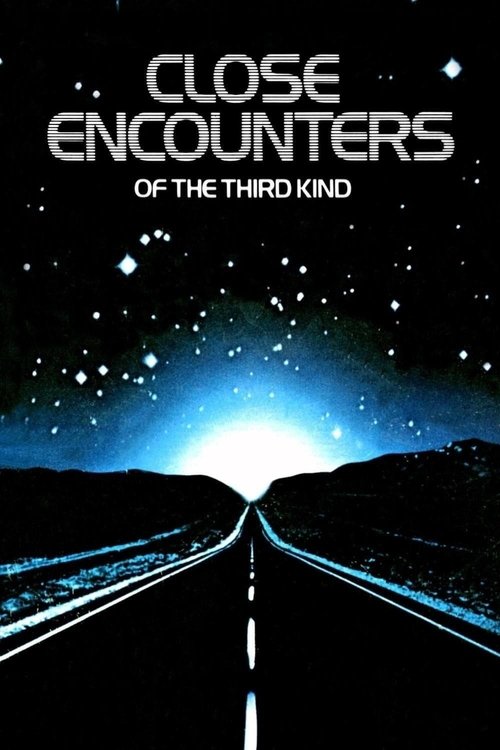
Close Encounters of the Third Kind
1977 · Steven Spielberg
For when you want wonder instead of dread — a look-up-at-the-sky film for a night when you'd like to feel small in the best way. Family-friendly on the surface, but with a real adult ache underneath.
What it's about
An ordinary Indiana power-line worker is sent out during a blackout and comes back changed: strange lights in the sky have left him with an obsession he can't name and a shape he can't stop sculpting — in shaving cream, in mashed potatoes, in mud. As his family life buckles under the fixation, he's drawn toward a remote mountain in Wyoming, where scientists and the military are quietly preparing for a meeting unlike any in human history.
The experience
Suspenseful and strange in its middle stretch — an ordinary man's life coming apart is genuinely unsettling — then it opens up into pure, goosebump-raising awe. The finale is less an action climax than a slow, luminous act of communication that leaves you a little teary without quite knowing why.
Performances
Richard Dreyfuss makes obsession sympathetic and scary at once — a suburban dad possessed by something he can't explain — and French director François Truffaut brings unexpected gentleness to the scientist leading the search.
The craft
The light-show finale remains one of the great spectacle sequences ever mounted, and the film's central idea — first contact conducted through a five-note musical phrase — fuses John Williams's score into the plot itself. This is the definition of a big-screen, good-speakers film: the images glow and the sound does the storytelling.
Why it matters
Landing months after the space-opera boom ignited, it staked out the other pole of the science-fiction revival — contact as wonder rather than war — and set the template for benevolent-alien stories for decades after.
Snapshot
Close Encounters of the Third Kind is Steven Spielberg's first film as sole credited author—director and screenwriter—and his most openly personal work of the decade. Released in November 1977, months after Star Wars had already detonated the popular science-fiction revival, it occupies the complementary pole of that cultural moment: where Lucas reached for myth and propulsion, Spielberg reached for awe and longing. The film follows Roy Neary (Richard Dreyfuss), an Indiana power-company linesman whose encounter with unidentified lights in the night sky plants an obsessive, inarticulate vision in his mind—a shape he sculpts and smears and finally recognizes as Devils Tower, Wyoming, the landing site chosen by an intelligence that communicates through music. The title adopts astronomer J. Allen Hynek's classification for close encounters involving contact with non-human occupants; Hynek appears in a brief cameo near the film's climax, an endorsement as much as a casting choice. Generous, open-ended, and structured toward revelation rather than conflict, Close Encounters remains one of American cinema's most sustained and serious expressions of wonder.
Industry & production
Spielberg had been nursing the idea that would become Close Encounters since childhood. His 1964 amateur science-fiction film Firelight—a feature-length production made while he was still in high school in Arizona—covers closely overlapping ground: mass UFO sightings, government secrecy, a climactic first contact. He brought the project to Columbia Pictures following the extraordinary success of Jaws (1975), which had been made for Universal. Columbia was in a precarious financial position in the mid-1970s and was willing to risk a costly, unusual film from a suddenly bankable director. Producers Julia Phillips and Michael Phillips, who had produced The Sting (1973), joined the package.
The production was large by any standard and enormous for a director who had made only three features. Location filming took crews to the Sonoran Desert (for the opening sequence in which Second World War fighter aircraft are found intact after three decades), to India (for the sequence of witnesses spontaneously singing the five-note contact theme), and to Devils Tower National Monument in Wyoming, whose strange volcanic geometry Spielberg uses as both landscape and prophecy. The bulk of the climactic arrival sequence was filmed inside a decommissioned airship hangar at Brookley Field in Mobile, Alabama—one of the largest interior shooting spaces employed for a Hollywood production to that point—allowing production designer Joe Alves to construct the full Wyoming valley floor with room to maneuver enormous model craft and accommodate thousands of extras.
Columbia, eager to extend the film's commercial life, persuaded Spielberg to produce a "Special Edition" for 1980 release. That version added footage shot inside the mothership (which Spielberg had previously declined to show) and trimmed certain earlier domestic scenes. Spielberg subsequently expressed ambivalence about the Special Edition; his preferred text, the "Director's Cut," was released in 1998, reinstating the original conclusion while excising the Special Edition's mothership interior. The existence of three versions is itself testimony to the film's contested status as both studio property and personal statement.
Technology
The visual-effects mandate of Close Encounters was unlike anything attempted in Hollywood since Kubrick's 2001: A Space Odyssey (1968). Spielberg hired Douglas Trumbull—who had supervised effects on 2001 as well as on his own directorial feature Silent Running (1972)—to design and execute the alien craft and light-show sequences. Trumbull's approach was resolutely photochemical: the alien vessels were built as large-scale practical models lit from within, then photographed through diffusion, atmospheric haze, and calibrated lens aberration to produce an effect of radiance rather than solidity. The mothership—a city-block-scale construction descending behind Devils Tower in the film's climax—was suspended from the hangar ceiling and studded with thousands of individually addressable practical lights, designed to suggest a moving city or oil refinery rather than a spacecraft in the conventional Hollywood sense.
For the light-communication sequences, Trumbull developed in-camera techniques including fiber-optic arrays and multiple-exposure photography; the system was designed to make light feel like language—purposeful, patterned, answering. The two major science-fiction productions of 1977—Close Encounters and Star Wars—were both pushing on emerging motion-control camera technology and reportedly exchanged information on photographic approaches to large-scale model work. The sound design was equally ambitious: the five-note contact motif was realized as a physical, environmental presence, the bass frequencies playing as sub-sonic weight as much as melody.
Technique
Cinematography
Vilmos Zsigmond, ASC, brought to Close Encounters an aesthetic of suffused, back-lit ambiguity. Zsigmond—Hungarian-born, trained at the Budapest Academy of Theater and Film Arts, and a central figure in New Hollywood cinematography through McCabe & Mrs. Miller (1971) and The Deer Hunter (1978)—shot the film in anamorphic widescreen, using extensive atmospheric diffusion, practical light sources within the frame, and deliberate lens flare to give the alien encounters the texture of witnessed reality: the light effects look like photographic artifacts, like something a camera would struggle to contain. The night-sky sequences in the early reels, in which Roy's truck is bathed in searchlight from above, remain models of how to render spectacle as experience rather than as display—the viewer is dazzled before they are informed. Zsigmond won the Academy Award for Best Cinematography for the film.
Editing
Michael Kahn edited Close Encounters, beginning what would become one of the most durable director-editor partnerships in American cinema. Kahn's contribution here is structural more than rhythmic: the film's architecture is patient, sometimes deliberately slow in its early reels, accumulating the domestic scenes that establish Roy's compulsion before pace tightens in the final act. The editorial strategy trusts the audience to remain with a protagonist whose behavior is alarming and whose goal is undefined until late in the story—a wager that holds because the cutting consistently locates wonder rather than menace in what Roy experiences. The final arrival sequence requires Kahn to orchestrate crowd, machine, officials, and individual human faces into a coherent emotional arc over an extended duration with minimal dialogue; it is editing as ceremony rather than editing as argument.
Mise-en-scène / staging
Spielberg's staging makes recurrent use of deep focus and layered frame depth: characters discovered small against vast landscapes, light sources positioned at the rear of the image drawing the eye through multiple planes of space. The domestic scenes in the Neary household are staged at a fractured, overlapping pitch—children, television, and argument competing for the same frame—before the film opens outward into geography and sky. The climactic contact is staged as a natural amphitheater, human witnesses on the surrounding slopes looking down into a valley lit from above, with the audience positioned among them: scale is established through the relationship between foreground bodies and the incomprehensible object in the distance. The child Barry Guiler (Cary Guffey) is consistently placed lower in the frame, looking upward toward light rather than recoiling from it—staging that makes undefended wonder its own argument.
Sound
The sound design of Close Encounters is inseparable from its meaning. The five-tone contact sequence—composed by John Williams as a universal greeting, short enough to be memorized, internally logical in its intervals—is not background scoring but diegetic narrative. When the mothership plays the theme back at the film's climax, enormous and modulated and harmonically ornamented across multiple registers, the sequence dramatizes the fact that communication has occurred: the sound is the event. The industrial audio textures of Roy's work world—transformer hum, the crack of electrical discharge, the mechanical noise of the power grid—are subtly echoed in the alien sound palette, connecting the human electrical infrastructure with whatever the visitors operate. The layering of crowd murmur, alien tone, and orchestral swell in the final sequence was considered state-of-the-art audio production for its moment.
Performance
Richard Dreyfuss plays Roy Neary as a man in arrested development who finds in his obsession something more nourishing than the suburban life it displaces. The performance is physically expressive and frankly comic in its early registers—Dreyfuss uses his body as a vehicle for compulsion, working mashed-potato mountain shapes at the dinner table, sculpting wire-mesh towers in the living room—before it opens into something rawer and more desperate. Spielberg draws from him a quality of hapless sincerity that prevents the film from reading as either heroism or tragedy, and keeps Roy legible as a recognizable rather than exceptional man.
The casting of François Truffaut as the French scientist Claude Lacombe is one of the film's most deliberate formal gestures. Truffaut—a founding figure of the French New Wave, director of The 400 Blows (1959), Jules and Jim (1962), and Day for Night (1973)—was not a trained actor, and Spielberg exploited the strangeness of the casting productively. Lacombe's patient humanism, his quality of witnessing something he has awaited his entire adult life, reads with an authenticity that is not entirely a performance. Truffaut worked largely in French on set, and the scenes manage his limited English diplomatically; the effect is of a man who communicates primarily through gesture and attention, which is entirely appropriate for a character whose specialty is non-verbal contact.
Narrative & dramatic mode
Close Encounters operates on a structure of withholding and disclosure, organized toward a third act that is essentially plotless by conventional standards. The first act accumulates incident without synthesis—mass sightings, government activity, Roy's roadside encounter—and refuses to connect the pieces. The second act narrows to Roy's obsession and the official machinery's convergence on Wyoming. The third act is phenomenological rather than dramatic: nothing is won, no antagonist is defeated, a question is answered and a departure takes place. The viewer's experience mirrors Roy's—the slow accumulation of evidence, the arrival at a place that was always the destination.
This structure breaks with the invasion narratives of 1950s science fiction and with the thriller conventions the film occasionally invokes: the government antagonism is too mild and too late to generate real jeopardy, and the film does not want jeopardy. It wants the feeling of arriving at something enormous and finding it benign. The dramatic risk is genuine—a third act without conflict is a structural wager—and the film's hold on audiences suggests the wager succeeds because the preceding ninety minutes have transferred Roy's compulsion to the viewer.
Genre & cycle
Close Encounters arrived as part of a transformative year for popular science fiction. Star Wars had already opened in May 1977 and redefined the commercial landscape. But where Star Wars is essentially fantasy in science-fiction dress—a quest narrative with swords and dynastic succession—Close Encounters belongs to a distinct tradition of speculative contact narrative more closely related to The Day the Earth Stood Still (Wise, 1951) and 2001: A Space Odyssey (Kubrick, 1968) than to space opera. The film enlarges the subgenre of benevolent-contact science fiction—alien intelligence imagined as superior and non-threatening—and situates it in a tension with the contemporaneous American paranoia cycle: Invasion of the Body Snatchers (1978), Alien (1979), and their kin imagine extraterrestrial presence as violation; Close Encounters imagines it as gift.
Within Spielberg's own filmography, the film anticipates E.T. the Extra-Terrestrial (1982), which is in many ways its domestic, stripped-down companion piece: the same unafraid child, the same government as obstacle, the same argument that wonder is available to the ordinary and the suburban.
Authorship & method
Spielberg is unusual among directors of his generation in having written Close Encounters alone. The screenplay reflects preoccupations visible across his early career: the ordinary American household disrupted by extraordinary intrusion, the tension between domestic obligation and transcendent aspiration, the privileged access of children and innocents to the numinous. He worked on the script across several years and drafts, reportedly consulting Hynek (who served as a technical advisor) and drawing on the growing literature of civilian UFO testimony.
John Williams's contribution is compositional and structural. The five-tone motif was developed in close dialogue with Spielberg, who had specified a greeting short enough to be memorized and played back; Williams tested numerous combinations of intervals before arriving at the sequence used. The score modulates between orchestral grandeur and near-silence in a way that serves the film's pacing: Williams understands that some of the film's most powerful passages require music to withdraw entirely and trust the image.
Zsigmond's visual aesthetic—diffusion, backlight, practical sources burning in the frame—was not merely stylistic but conceptual: the argument that alien technology would manifest as light, that the visitors use illumination as instrument and language, is as much his achievement as the script's.
Douglas Trumbull's effects work built on techniques refined across 2001 and established a visual vocabulary for large-scale alien craft that influenced science-fiction cinema through at least two subsequent decades. The decision to make the mothership appear lit from within, combining the functional and the decorative, enormous but not threatening, remains one of the most successful designs in the genre.
Movement / national cinema
Close Encounters is a product of the New Hollywood moment—the window between the early 1970s and early 1980s when American studio cinema briefly accommodated unusual structures, ambiguous protagonists, and elevated budgets in the service of personal vision. Spielberg belongs to the film-school generation (though he famously did not complete formal film school) absorbed into the studio system rather than working against it, and Close Encounters demonstrates both the possibilities and the pressures of that position: it is a major-studio spectacle that is also, without apology, a film about spiritual crisis in the American suburbs.
The casting of Truffaut positions the film in deliberate dialogue with European art cinema. Lacombe's methods—non-coercive, patient, fundamentally humanistic—implicitly contrast with the military-industrial management style of the American authorities. That the director of The 400 Blows embodies this opposition makes the argument simultaneously within the narrative and across the history of cinema.
Era / period
The film is saturated with its historical moment without being narrowly topical. The government's suppression of UFO evidence and the readiness of Roy and his fellow witnesses to distrust official accounts rhymes with the post-Watergate, post-Vietnam erosion of American institutional trust—but Spielberg does not press the point. The film has neither the bitterness of The Parallax View (1974) nor the resignation of The Conversation (1974); it prefers wonder to critique, and uses the anxious, watchful American public of 1977 as the appropriate soil for transcendence rather than as a subject for dissection.
The milieu is deliberately mid-American: Muncie, Indiana, divided highways, franchise-restaurant signs, tract housing. Spielberg uses this landscape not to satirize it but to make it the origin point for the extraordinary—the claim that ordinary American life is the proper vessel for the most improbable experience, that the suburbs are not a destination but a launching point.
Themes
The film's central tension—between domesticity and transcendence—is never cleanly resolved. Roy abandons his family to follow a vision the film validates, but it does not render Ronnie's departure with the children as mere obstacle: her exasperation is staged with sympathy, and the film acknowledges that Roy's obsession has destroyed his marriage without suggesting he should therefore have suppressed it. This ambivalence sets Close Encounters apart from simpler accounts of the "chosen man": Roy is not heroic, he is compelled, and the film honors the compulsion and mourns the cost in the same gesture.
Government secrecy and institutional mystification run as a counter-theme throughout: the military stages a false chemical emergency to evacuate Devils Tower, and the encounter itself is managed by authorities who have known more than the public for years. But conspiracy is background, not subject—the institutional machinery is an obstacle to clear before the real event can begin.
Communication across incommensurable difference is the film's most durable philosophical preoccupation. The five-note exchange is carefully thought through: it proposes that music—pattern, interval, call-and-response—might constitute a language prior to and more universal than speech. The moments in which the contact motif is taught to the visitors and returned amplified and harmonically enriched constitute the film's emotional climax because they dramatize understanding achieved without words, across a gap that should be unbridgeable.
Reception, canon & influence
Close Encounters was widely praised on release for its ambition, emotional reach, and visual invention. Spielberg received an Academy Award nomination for Best Director; Zsigmond won for Cinematography. The film was commercially successful—among the top-grossing American releases of 1977—though it operated in the long shadow of Star Wars, which had dominated the summer. The comparison was, and remains, somewhat misleading: the films address different registers of the same cultural moment, and critical estimation of Close Encounters has risen steadily as the novelty of Star Wars has become familiar.
Looking backward, the film draws substantially on 2001: A Space Odyssey—both in its willingness to conclude on vision rather than resolution and in its use of light and music as vehicles of meaning. It absorbs the tradition of 1950s contact narratives (The Day the Earth Stood Still, This Island Earth) while evacuating their Cold War anxieties. Hynek's non-fiction writing provided the title, the taxonomy, and an implicit epistemology: a framework for taking unexplained experience seriously without dismissing it or overclaiming it.
Looking forward, Close Encounters shaped the visual and dramatic grammar of benevolent-contact cinema for decades. Spielberg's own E.T. extends its premise into a fully domestic register. Robert Zemeckis's Contact (1997) revisits the communication-through-signal premise with more explicit scientific scaffolding and a similar structural bet on a contemplative third act. The film's visual argument about alien craft—large, lit from within, arriving with light rather than violence—became a genre default. More diffusely, the structural idea of a film whose climactic act consists in witnessing rather than acting, in which the protagonist's role is to be present at something enormous, was unusual in 1977 and remains unusual; its influence is felt in tone and aspiration more than in direct imitation, in the persistent strand of American science fiction that treats the encounter with the unknown as a spiritual rather than a military event.
A Deleuzian reading
Roy Neary stops his truck at a level crossing in the Indiana dark, and the light comes from above.
The full Deleuzian reading of Close Encounters of the Third Kind →
Reception
A hit and an Oscar contender on release in 1977, it's since settled into a strange spot: revered as maybe Spielberg's most personal film, yet perpetually overshadowed in pop memory by Star Wars (same year) and E.T. Cinephiles keep re-crowning it as the secret masterpiece of his early run.
How Close Encounters of the Third Kind was received, from release to now →
Influences: the films it descends from and the films it influenced
- 2001: A Space Odyssey (1968) — Douglas Trumbull supervised optical effects on both films; CE3K directly inherits 2001's photochemical model approach—backlit spacecraft photographed through atmospheric diffusion to produce luminosity rather than solidity, rendering alien presence as light phenomenon rather than legible object.
- The Day the Earth Stood Still (1951) — Establishes the benevolent-contact genre grammar CE3K inhabits: alien as emissary rather than invader, military response as catastrophic misreading, and climactic revelation staged for mass witness rather than private encounter.
- McCabe & Mrs. Miller (1971) — Vilmos Zsigmond's signature aesthetic—anamorphic diffusion filters, deliberate lens flare from practical sources within frame, soft-focus backlight—debuts here and carries intact into CE3K's night-encounter sequences, where the same photographic instability codes the alien as something a camera struggles to contain.
- Silent Running (1972) — Trumbull's own directorial feature deploys the same photochemical model-and-matte pipeline he would bring to CE3K—luminous spacecraft through in-camera optical layering—while establishing the emotional template of a lone male protagonist overwhelmed by wonder at a vanishing natural order.
- Blow-Up (1966) — Both films structure narrative around a protagonist's compulsive inability to decode perceptual evidence—photographic in Blow-Up, visionary in CE3K—staging withholding as an epistemological problem: the protagonist holds proof he cannot name or communicate to others.
- The Sugarland Express (1974) — The first Spielberg–Zsigmond collaboration: anamorphic widescreen with diffused natural light and working-class Americana, establishing the visual grammar and director-DP shorthand that CE3K would extend to supernatural scale.
- Jaws (1975) — CE3K inherits Jaws's withholding-disclosure grammar directly: the threat kept offscreen or in peripheral glimpse until a structured final revelation, and the suburban family as the unit whose coherence measures the stakes of the protagonist's consuming obsession.
- The War of the Worlds (1953) — Inverts the 1953 vocabulary item by item: wire-suspended, front-lit craft photographed from low angles against banal American middle-distance, and the farmhouse probe sequence — fragmented beams searching a domestic interior — restaged as wonder rather than threat.
- E.T. the Extra-Terrestrial (1982) — CE3K's benevolent-contact template compressed to domestic scale: Spielberg retains the suburban setting, the obsessively receptive protagonist, and the John Williams score as surrogate contact language, but transfers the awe from adult breadwinner to child and conceals the alien within the home rather than staging it at a national monument.
- The Abyss (1989) — Cameron directly extends CE3K's light-as-communication motif: the NTI sequences use practical underwater illumination as alien language, inheriting Trumbull's patterned-light-as-speech concept, while transposing CE3K's Wyoming amphitheater staging of benevolent disclosure to a mid-ocean floor.
- Contact (1997) — Inherits CE3K's structural patience toward a single disclosure event and its figure of the obsessive lone receiver—dismissed by institutions, sustained by private certainty—extending the diegetic contact motif from musical five-note sequence to mathematical prime-number signal transmitted via radio.
- Signs (2002) — Inherits CE3K's withholding-disclosure grammar while inverting its benevolent premise: alien sound and peripheral presence disclosed in fragments before full revelation, and the suburban patriarch's crisis of worldview mirrors Roy Neary's, using the same structural patience toward an opposite emotional conclusion.
- Interstellar (2014) — Hoyte van Hoytema's 70mm practical-backlight staging of the tesseract interior inherits CE3K's illuminated-darkness aesthetic; Hans Zimmer's sub-bass organ score extends CE3K's environmental-bass-as-physical-force concept; and the narrative of a suburban father compelled by cosmic forces away from his family directly extends CE3K's suburban-transcendence template.
- Arrival (2016) — Bradford Young's diffused, practical-backlit cinematography in the alien interior descends from Zsigmond's CE3K aesthetic; Villeneuve inherits the amphitheater staging of mass alien arrival and the withholding grammar—extended here to conceal not just alien intent but the film's own temporal structure.
- Disclosure Day (2026) — Originates the backlit-beam sky grammar and the obsessed-everyman witness, and codifies the alien-sonic-signature via Williams's five-note tonal 'language' that Disclosure Day's contact scenes inherit wholesale.
- Project Hail Mary (2026) — Establishes first contact achieved through a shared sonic vocabulary — the five-tone motif as handshake — the founding template for sound-as-contact-medium.
- Jurassic Park (1993) — Spielberg and Zsigmond developed the multi-plane depth staging for wonder sequences — small foreground figures dwarfed by an enormous background presence across a middle layer of environmental light — that Cundey applies directly in the brachiosaurus reveal, placing Grant and Ellie in the foreground against the dinosaur filling the upper background frame.
- Nope (2022) — Spielberg stages the Crescendo Summit encounter as a technologically mediated event requiring specialized apparatus — lights, sound equipment, airstrip — to facilitate contact; Nope inherits this grammar for OJ and Em's equipment-dependent approach to luring and documenting the creature.
- Godzilla (2014) — Models the awe-and-dread register of slow disclosure and upward-gazing human-figure-as-scale staging, the wonder-tinged sublime Edwards reaches for in his reveal set pieces.
- Jurassic World (2015) — Source of the Spielbergian 'wonder reaction shot' — upturned faces lit by an off-screen marvel — which Jurassic World deploys verbatim at the Mosasaurus tank and gyrosphere valley.
- Star Wars (1977) — The two productions occupied Hollywood simultaneously and reportedly exchanged motion-control camera data between ILM and Trumbull's crew; both deploy photochemical model work to render spacecraft as luminous presences, but diverge absolutely in their contact grammar—aggression versus welcome.
- The Deer Hunter (1978) — Shot by Zsigmond immediately after CE3K using the same anamorphic diffusion and practical-backlight toolkit; both exercise structural patience across extended working-class American domestic sequences before rupturing normality with an event the community cannot assimilate.
- The Andromeda Strain (1971) — The government containment facility at Devils Tower — decontamination airlocks, institutional scale of the specialist response, a hierarchical ensemble of technicians — echoes Wildfire's spatial organization and blueprint-coherence blocking, even as Spielberg inverts Wise's institutional ambivalence into wonder.
- Godzilla: King of the Monsters (2019) — Bequeaths the backlit-silhouette grammar of awe — vast forms emerging from haze and shafts of light, with upturned human faces lit by the spectacle, central to the film's reverent monster reveals.
- War of the Worlds (2005) — Supplies the awe-of-the-sky vocabulary (upturned faces, light from above, suburban man drawn skyward) that this film deliberately inverts from benevolent contact into annihilating menace.
- The Fabelmans (2022) — Establishes the awestruck-gaze staging the seed reprises—upturned faces raked by a single offscreen light source and choreographed beams, the 'headlight dance' vocabulary Kamiński would later refine into backlit silhouette.
Similar films
- Disclosure Day (2026) — influence & lineage
- E.T. the Extra-Terrestrial (1982) — influence & lineage
- Contact (1997) — influence & lineage
- 2001: A Space Odyssey (1968) — influence & lineage
- Star Wars (1977) — influence & lineage
- Arrival (2016) — influence & lineage
- The Day the Earth Stood Still (1951) — influence & lineage
- Signs (2002) — influence & lineage
All the films related to Close Encounters of the Third Kind →