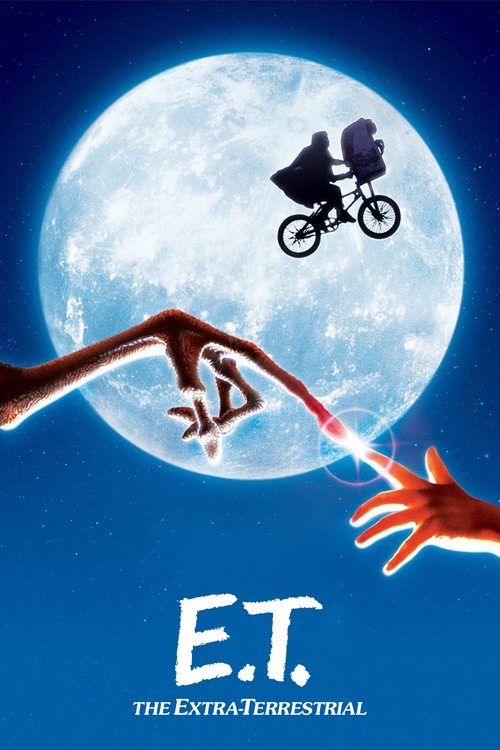
E.T. the Extra-Terrestrial
1982 · Steven Spielberg
For family movie night, a nostalgia fix, or when you need a good cry that leaves you feeling better rather than worse. One of the great comfort watches — reach for it when you want your heart worked on.
What it's about
A gentle alien botanist is accidentally left behind on Earth, and the ten-year-old boy who finds him hiding in the backyard decides to keep him secret. While government agents close in, Elliott, his older brother, and his little sister form a fierce bond with their strange new friend and try to help him find a way home — all from inside an ordinary suburban house in a family still aching from a father who left.
The experience
Pure wonder with a lump in the throat — funny and cozy in its kid's-eye suburban details, then quietly devastating in its feeling. It moves like a childhood summer and builds to moments of soaring, unashamed emotion that work on almost everyone, at almost any age.
Performances
Henry Thomas gives one of the most natural child performances ever filmed — Elliott's grief, loyalty, and joy never feel coached — and a tiny Drew Barrymore steals scenes as his little sister.
The craft
Spielberg shoots almost everything from a child's height, keeping adults faceless for long stretches, so the suburban world feels the way it does to a ten-year-old. John Williams's score does half the storytelling, and the bicycle-against-the-moon image remains one of cinema's most indelible; it still soars on a big screen.
Why it matters
For years the highest-grossing film ever made, it defined the warm, wonder-struck strain of Spielberg's cinema and set the template for generations of kid-and-creature stories and suburban-adventure filmmaking.
Snapshot
E.T. the Extra-Terrestrial is Steven Spielberg's intimate science-fiction fable about a stranded alien botanist and the suburban California boy who shelters him. Released by Universal in June 1982, it crystallized a strain of Spielberg's sensibility that Close Encounters of the Third Kind (1977) had opened: the alien encounter as benediction rather than menace, refracted through the perspective of a child. Where the era's other extraterrestrials arrived to invade or abduct, E.T. is a frightened, vulnerable visitor, and the film's drama is domestic and emotional rather than militarized. It became, for a long stretch, the highest-grossing film ever made, and it fixed an image — a boy and an alien silhouetted against the moon on a flying bicycle — that became one of the most reproduced icons in American popular culture. The film is also a key document of Spielberg's recurring preoccupation with fractured families and absent fathers, and it marks his fullest synthesis of technical bravura with a deliberately scaled-down, child's-eye-level intimacy.
Industry & production
E.T. emerged from a period in which Spielberg was juggling several alien-themed projects. The most documented origin is the imaginary friend Spielberg has said he conjured after his parents' divorce, and a darker science-fiction project, Night Skies, developed with screenwriter John Sayles as a kind of malevolent counter to Close Encounters. Out of that abandoned project, the gentler idea of a single benign stranded alien took shape. Spielberg engaged Melissa Mathison — then known for The Black Stallion (1979) — to write the screenplay; she worked closely with him during the Raiders of the Lost Ark shoot. Mathison's contribution is generally credited with much of the film's emotional precision, particularly the children's dialogue and the texture of the broken family.
The production was made for a modest budget by blockbuster standards (commonly reported in the low tens of millions, though I won't assert a precise figure). It was shot largely in sequence — unusual for a studio feature — to help the young cast build the emotional arc naturally, a decision Spielberg has cited as central to the performances. Universal released it in the summer of 1982 into a crowded science-fiction season that also included Blade Runner and The Thing; E.T. dramatically outperformed them commercially and enjoyed an exceptionally long theatrical run, the kind of sustained word-of-mouth engagement that the wide-release model would later make rare. A 20th-anniversary reissue in 2002 added effects and altered a few elements, a version Spielberg has since partly disowned in favor of the original.
Technology
The film's central technical problem was the creature itself. E.T. was realized through practical effects supervised by Carlo Rambaldi, the Italian designer who had worked on Close Encounters and Alien. Rambaldi built multiple animatronic and mechanical versions of the figure — electronically operated heads capable of nuanced facial articulation, plus suits worn by performers (including children and a man without legs) for full-body shots. The design famously blended disparate references; accounts of Rambaldi's inspirations vary, and I'll avoid repeating the more apocryphal ones as fact. The result was a creature able to register emotion in close-up, which the film depends on absolutely, since E.T. has no conventional dialogue and must communicate through expression, gesture, and a limited synthesized voice.
This was a film made on the cusp of the digital era but firmly committed to in-camera and practical illusion. The flying-bicycle sequences relied on a combination of full-scale rigs, matte work, and optical compositing rather than computer imagery. Industrial Light & Magic handled the optical effects. The famous glowing finger and glowing heart were practical lighting effects. The film stands, in retrospect, as a high-water mark of pre-CGI creature work, where the persuasiveness of the alien rests on physical craft and on the discipline of how it is shot and lit.
Technique
Cinematography
Allen Daviau, shooting the first of several collaborations with Spielberg, gives the film a warm, enveloping look built on backlight, atmospheric haze, and pools of practical-source illumination — the suburban kitchen, the closet, the headlights and flashlight beams of the pursuing adults. Daviau and Spielberg famously restrict the camera largely to a child's eye level, keeping adults headless or framed from the waist down through long stretches of the first act, so that the world is literally seen from Elliott's height. The pursuing authorities are introduced as jangling keys on a belt and disembodied legs, withholding adult faces until the narrative grants the children agency. The lighting trades the cool, clinical palette typical of the era's science fiction for amber domesticity, reserving harder, bluer light for the menace of the government incursion. The forest scenes and the climactic flight are staged against dusk and night skies that make the silhouette compositions legible — the moon shot being the apotheosis of this strategy.
Editing
Carol Littleton's editing modulates between patient domestic observation and bursts of kinetic chase. The film takes its time establishing the household rhythms and the slow trust between boy and alien, then accelerates sharply in the final act's bicycle pursuit and escape. The cross-cutting that binds Elliott's and E.T.'s shared physiology — the empathic link by which the boy feels what the alien feels — is an editorial as much as a narrative device, the cutting establishing simultaneity and emotional rhyme between the school sequence and E.T.'s drunken misadventure at home. The death-and-revival passage near the end is built on held, quiet shots that let the emotional reversal land before the rescue resumes momentum.
Mise-en-scène / staging
The production design renders an almost archetypal early-1980s American suburb — the cul-de-sac, the cluttered boy's bedroom, the closet of stuffed animals among which E.T. hides in one of the film's wittiest sight gags. The domestic clutter is essential: E.T. is camouflaged amid toys, concealed in plain sight, and the household objects (Reese's Pieces, a Speak & Spell, beer in the refrigerator) become his vocabulary for understanding Earth. Against this warm interior world, the staging sets the antiseptic plastic tunnels and hazmat-suited figures of the government quarantine that invades the house in the third act, the home itself transformed into a sterile laboratory — a violation of domestic space made physical.
Sound
John Williams's score is among the most celebrated of his Spielberg collaborations, built on a soaring, aspirational main theme that carries the flight sequences and the farewell. Spielberg has spoken about re-cutting the climactic flight to Williams's music rather than the reverse, letting the score dictate the final rhythm — a notable inversion of usual practice. Beyond the orchestral score, the sound design gives E.T. his rasping, otherworldly voice (a composite vocal performance, with sound designer Ben Burtt assembling it from multiple human and animal sources) and grounds the suburban world in ambient texture. The interplay of Williams's lyricism and Burtt's textured effects is central to the film's emotional machinery.
Performance
The film rests on its children. Henry Thomas as Elliott carries the central emotional burden, his audition (improvised around the imagined loss of E.T.) having become legend; his performance is remarkably unguarded. Drew Barrymore, then very young, as Gertie supplies comedy and disarming candor, and Robert MacNaughton as the older brother Michael completes the sibling triangle. Dee Wallace plays the harried single mother, often present in the frame but, by design, oblivious to the alien in her house. Peter Coyote, as the sympathetic scientist "Keys," shifts late in the film from faceless threat to fellow dreamer. The performances were shaped by the in-sequence shooting and by Spielberg's hands-on direction of the children, and the ensemble's naturalism is the foundation on which the fantastical creature becomes believable.
Narrative & dramatic mode
The film operates as a fairy tale in realist suburban dress — a "boy and his creature" story with deep roots, from The Yearling to The Black Stallion (whose writer Mathison brought that lineage with her). Its dramatic mode is melodrama in the precise sense: a structure built to produce and earn strong feeling, organized around separation, bonding, threatened loss, death, and resurrection. The empathic link between Elliott and E.T. literalizes the metaphor of childhood attachment, making the alien's decline the boy's decline. The narrative is also a quest — to "phone home," to build the improvised transmitter, to return E.T. to his kind — and its emotional climax is the renunciation at its heart: the love object must be released. The film's frequently noted religious resonances (the descent into death, the glowing heart, the ascension, the parting benediction "I'll be right here") are structural rather than doctrinal, giving the fable its mythic charge.
Genre & cycle
E.T. belongs to a brief, distinctive cycle of early-1980s family-centered fantasy and science fiction in which Spielberg was the presiding figure, much of it routed through his Amblin productions — Poltergeist (1982, which he produced and co-wrote), Gremlins (1984), The Goonies (1985), Back to the Future (1985). These films relocated genre spectacle into recognizable suburban childhoods. Within science fiction proper, E.T. is a deliberate counter-statement to the invasion tradition of the 1950s and to the era's more dystopian visions; it reclaims the alien as friend, extending the conciliatory vision of Close Encounters. It also helped consolidate the "family blockbuster" as a commercial category — the four-quadrant summer event film pitched as much to children and parents as to genre fans.
Authorship & method
E.T. is a touchstone of Spielberg authorship. Its central motifs — the broken suburban family, the absent or failed father (Elliott's father has left for Mexico, a wound the film treats with unusual directness), the child as the one who truly sees, the redemptive encounter with the extraordinary — recur across his filmography from Close Encounters through Empire of the Sun and beyond. Spielberg has repeatedly described the film as his most personal, rooted in his own experience of divorce and childhood loneliness. His method here favored intimacy: in-sequence shooting, child-height camera, and an unusual receptivity to the young actors' spontaneity.
The collaboration is essential to the achievement. Melissa Mathison's screenplay supplies the emotional architecture and the children's idiom. Allen Daviau's cinematography establishes the visual grammar of warmth and child's-eye perspective. John Williams's score is so load-bearing that the film's climax was cut to it. Carlo Rambaldi's creature design makes the impossible protagonist legible as a feeling being. Carol Littleton's editing balances domestic patience against chase momentum, and Ben Burtt's sound design gives E.T. a voice. The film is a strong case for Spielberg as an orchestrator of specialists toward a unified sensibility.
Movement / national cinema
The film is a product of New Hollywood's commercial maturation — the generation of "movie brat" directors (Spielberg, Lucas, Coppola, Scorsese) who had, by the early 1980s, transformed the industry they entered. Spielberg and Lucas in particular are credited (and sometimes blamed) for inaugurating the blockbuster era with Jaws (1975) and Star Wars (1977); E.T. is among that movement's defining works, demonstrating that the event film could be built on tenderness and small scale as readily as on action. As American national cinema, it is also a quintessential text of Reagan-era suburban mythology — its setting, its single-parent family, its anxieties about institutional intrusion all legible as cultural document, even as the film's sentiment cuts across political readings.
Era / period
Made and set in the early 1980s, E.T. is saturated with the period's suburban material culture — the consumer brands, the household electronics, the Halloween rituals, the latchkey rhythms of a single-parent home. It arrived at a hinge moment in exhibition and effects history: late enough to command sophisticated optical and animatronic craft, early enough to predate the CGI revolution that Jurassic Park would help launch a decade later under Spielberg himself. Its commercial performance and merchandising (the Reese's Pieces placement is a frequently cited landmark in product-tie-in history) mark the consolidation of the modern blockbuster's economic model. The 2002 reissue, with its digital alterations, belongs to a later moment of franchise-era revisionism and is generally regarded as a lesser version of a film whose original craft needed no augmentation.
Themes
The film's governing themes are childhood loneliness and the longing for connection; the wound of family rupture and the absent father; empathy literalized as a physical bond; and the necessity of letting go. Home is its central word — E.T.'s yearning to return home rhymes with Elliott's yearning for a whole family, and the film locates healing not in the alien's arrival but in the children's capacity to love and then release him. Adjacent themes include the suspicion of institutional authority (the faceless, intrusive government apparatus) set against the wonder available to those still young enough to see, and the redemptive, quasi-sacred dimension of the encounter with otherness. The film treats divorce and emotional neglect with a candor unusual for a family entertainment, which is part of why it reads as more than spectacle.
Reception, canon & influence
E.T. was met with broad critical acclaim and extraordinary commercial success, becoming for years the highest-grossing film ever and a genuine cultural phenomenon. It received multiple Academy Award nominations, winning in technical and music categories (notably John Williams's score); its loss of Best Picture to Gandhi is a frequently noted Oscar-history footnote. Over time it has settled firmly into the canon, appearing on major institutional best-of lists and entering the United States National Film Registry as a culturally significant work.
Looking backward, the film draws on the boy-and-his-animal tradition (the Black Stallion/Yearling lineage Mathison carried), on the conciliatory alien vision Spielberg had already advanced in Close Encounters, and on the deep structure of fairy tale and myth. Looking forward, its influence is pervasive. It is the template for the suburban-childhood-meets-the-fantastic story that runs through the Amblin productions of the 1980s and, decades later, through nostalgia-driven works that consciously revive that mode — Super 8 (2011, which Spielberg produced) and the Amblin-saturated Stranger Things among the most explicit. Its child's-eye perspective, its scoring practices, and its image vocabulary (the moon silhouette above all) have been endlessly cited, parodied, and homaged. As much as any single film, E.T. defined what a Spielberg picture — and a certain kind of American family blockbuster — could feel like, proving that the largest commercial scale was compatible with the most intimate emotional aims.
A Deleuzian reading
Watch the first act again and count the faces you're not allowed to see.
The full Deleuzian reading of E.T. the Extra-Terrestrial →
Reception
No reappraisal needed — it was a phenomenon on arrival in 1982, dethroning Star Wars as the highest-grossing film ever and holding the crown until Jurassic Park. If anything the arc runs the other way: dismissed by some as peak Spielberg schmaltz during the ironic decades, it's since been re-embraced as sincerity done right.
How E.T. the Extra-Terrestrial was received, from release to now →
Influences: the films it descends from and the films it influenced
- Close Encounters of the Third Kind (1977) — Established Spielberg and Daviau's vocabulary of benevolent contact rendered in backlit haze and god-rays pouring through suburban doorways, plus the awestruck low child-height upward gaze that E.T. inherits wholesale.
- The Black Stallion (1979) — Melissa Mathison's prior screenplay model—a near-wordless, intensely tactile bond between a lonely child and a non-speaking creature carried by looks and gesture rather than dialogue—is the emotional architecture she ports directly into E.T.
- The Yearling (1946) — The boy-and-animal melodrama whose engine is the inevitability of letting the beloved creature go; E.T.'s 'I'll be right here' climax is this lineage's grief-and-release mechanism updated.
- Jaws (1975) — Spielberg's training ground for sustaining suspense through cross-cutting and for animating a full-scale animatronic non-human (Bob Mattey's shark anticipating Rambaldi's E.T.) as a credible physical presence on set.
- Star Wars (1977) — Supplied the toolkit E.T. runs on—Ben Burtt's organic-sourced sound design and ILM-style optical compositing for the flying-bikes-across-the-moon mattes—proving creatures and effects could read as living beings.
- King Kong (1933) — The foundational case for an artificial creature engineered to register subtle emotion in the face, the design philosophy Carlo Rambaldi (who also rebuilt Kong in 1976) brings to making E.T. legible as a feeling being.
- The Day the Earth Stood Still (1951) — The pacifist-alien-as-Christ-figure template—an emissary who heals, dies, and returns—whose religious-resonance staging E.T.'s death-and-resurrection beat consciously echoes.
- Bambi (1942) — The Disney model of pitching primal childhood loss (the absent parent, mortality) at the smallest viewer's eye level, the melodramatic register E.T. adopts for a live-action audience.
- The Goonies (1985) — Extends E.T.'s Amblin model of overlapping, improvisation-receptive child-ensemble performance and bicycle-bound suburban adventure under Spielberg's production hand.
- Edward Scissorhands (1990) — Transplants the gentle, misunderstood outsider into the pastel suburban-domestic cul-de-sac, mining the same melodrama of a fragile non-human's bond with a child and inevitable parting.
- The Iron Giant (1999) — Reworks the boy-and-benevolent-creature bond with the absent-father wound and a self-sacrificing resurrection beat, scored and staged to wring the same letting-go catharsis.
- A.I. Artificial Intelligence (2001) — Spielberg's own return to the Pinocchio substructure beneath E.T.—an artificial child-creature longing for home and love—built on Williams's score and the letting-go motif.
- WALL-E (2008) — Ben Burtt again voices a near-wordless creature through expressive synthesized sound rather than dialogue, the exact technique that gave E.T. emotional speech without language.
- Super 8 (2011) — Spielberg-produced, deliberately reconstructs E.T.'s child-gang-meets-alien plot in Daviau-style anamorphic backlight and lens flare, a near-archaeological revival of the Amblin suburban-childhood mode.
- Stranger Things (2016) — Systematically rebuilds the E.T. template—the hidden non-human protected by bicycle-riding kids in a backlit Reagan-era suburb, scored and lit to quote Daviau and Williams directly.
- Disclosure Day (2026) — Supplies the intimacy-of-contact register — low child-eye-level staging and hazy backlight bloom — set against shadowy institutional pursuers, the same wonder-against-fear axis the seed organizes itself around.
- Jurassic Park (1993) — Carlo Rambaldi's servo-controlled animatronic E.T. — facial musculature capable of subtle expression, performers directed to treat the build as a living presence — established the craft standard that Stan Winston's team extended for the raptor builds and that defines Jurassic Park's physical-eccentricity register for human-creature contact scenes.
- How to Train Your Dragon (2010) — The friendship-across-fear architecture — a child conceals a feared creature from a militarized adult world, shot at kid's-eye low angles that render the 'monster' tender — is Spielberg's blueprint.
- Lilo & Stitch (2002) — Supplies the template of a lonely child secretly harboring a misunderstood alien who learns domestic human life — the 'creature learns family' structure Lilo & Stitch inherits.
- Transformers (2007) — Supplies the Amblin template of a suburban boy secretly bonding with a hidden nonhuman, including magic-hour reveal blocking and awe-struck child reaction shots Bay reuses for Sam and Bumblebee.
- Poltergeist (1982) — Spielberg's co-written same-year companion piece, sharing the exact Amblin grammar of the fractured Reagan-era suburban tract home invaded by the uncanny, shot at the children's height.
- Empire of the Sun (1987) — Spielberg and Williams pursue the same child's-eye-of-wonder framing and load-bearing choral scoring, the camera again organizing the world around a boy's perception.
- Stand by Me (1986) — The eye-level, kids-height framing of a child ensemble navigating a threatening adult world, rendered in suburban-Americana naturalism — the Amblin grammar Reiner shares.
- The Color Purple (1985) — The immediately preceding Spielberg–Daviau collaboration perfects the warm backlit, source-driven golden lighting and the child's/powerless-person's point of view that Color Purple transplants onto adult melodrama.
- The Fabelmans (2022) — The suburban-divorce, fatherless-boy scenario shot at child's-eye height with adults cropped or withheld—the autobiographical wound of The Fabelmans dramatized earlier through genre displacement.
Similar films
- Close Encounters of the Third Kind (1977) — influence & lineage
- Disclosure Day (2026) — influence & lineage
- A.I. Artificial Intelligence (2001) — influence & lineage
- Star Wars (1977) — influence & lineage
- The Iron Giant (1999) — influence & lineage
- WALL·E (2008) — influence & lineage
- Toy Story (1995) — shared sensibility
- Back to the Future (1985) — shared sensibility
All the films related to E.T. the Extra-Terrestrial →