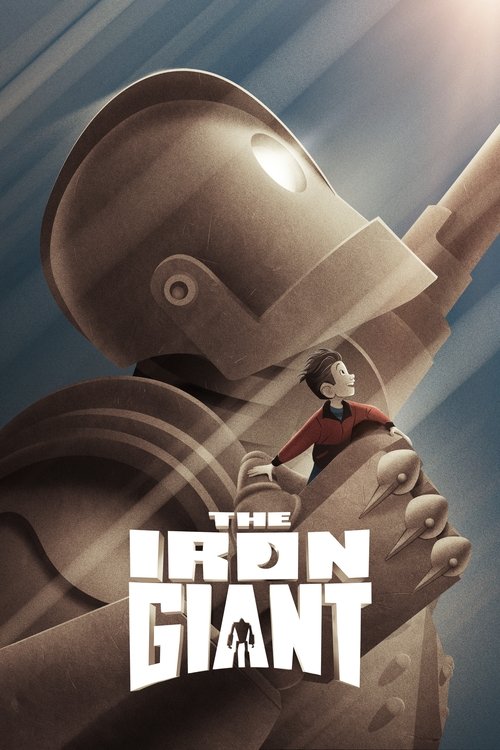
The Iron Giant
1999 · Brad Bird
For a family night, or when you need a good cry that leaves you feeling better about people. Pure comfort with real substance underneath.
What it's about
Maine, October 1957: Sputnik is overhead, kids practice duck-and-cover at school, and a lonely nine-year-old boy finds a hundred-foot metal giant in the woods — a machine with no memory and a growing conscience. He tries to hide his enormous new friend from a paranoid town and a zealous government agent, while the giant grapples with the question of what he was built for. It's a boy-and-his-monster story with the Cold War breathing down its neck.
The experience
Warm, funny, and briskly told, with an autumn-in-New-England glow — and then it lands an emotional wallop that flattens adults more reliably than kids. Few animated films earn their tears this honestly.
Performances
Vin Diesel voices the giant in a handful of rumbling syllables and somehow builds a whole soul out of them.
The craft
Brad Bird directs his debut with a classical economy rare in family animation — every scene earns its emotion, and the 1957 paranoia has real teeth rather than nostalgia. The computer-generated giant is painstakingly matched to the hand-drawn world, so the seams never show. Loosely adapted from Ted Hughes's fable The Iron Man, it's traditional animation at its late-century peak.
Why it matters
A box-office flop through studio neglect that grew into one of the most beloved American animated films of its era, and the launchpad for Bird's career at Pixar.
Brad Bird's debut feature arrived in 1999 as traditional animation was being written off, flopped at the box office through studio neglect, and has since become one of the most beloved American animated films of its era. Adapted loosely from Ted Hughes's 1968 fable The Iron Man, it transplants the story to Maine in 1957 — Sputnik overhead, duck-and-cover drills at school — where a lonely boy discovers a hundred-foot machine with no memory and a growing conscience. Bird, a Simpsons veteran who would go on to The Incredibles and Ratatouille, directs with a classical economy rare in family animation: every scene earns its emotion, and the Cold War paranoia is rendered with real teeth rather than nostalgia. The giant himself, voiced in a handful of rumbling syllables by Vin Diesel, was computer-generated but painstakingly matched to the hand-drawn world around him — a hybrid technique that let the film's warmest character be its most mechanical. Its central idea, that a soul is a matter of choice rather than design, lands with the force of the best children's literature.
A Deleuzian reading
A deer comes close enough to touch.
The full Deleuzian reading of The Iron Giant →
Reception
A notorious box-office flop in 1999 — Warner Bros barely marketed it after the studio's animation division had been burned by Quest for Camelot — but glowing reviews and word of mouth turned it into one of the great animation reappraisal stories, now routinely called a modern classic.
How The Iron Giant was received, from release to now →
Influences: the films it descends from and the films it influenced
- Superman: The Mechanical Monsters (1941) — Bird modeled the Giant's art-deco riveted-metal silhouette and its heavy, rotoscope-smooth mechanical locomotion on Fleischer's gleaming flying robots.
- King Kong (1933) — Establishes the sympathetic colossus whose inner life is carried entirely by anthropomorphic facial and gestural acting, ending in a tragic misunderstood-monster death Bird deliberately inverts.
- Frankenstein (1931) — Supplies the template of an innocent manufactured being learning gentleness through a child by the water while a fearful mob and authorities mobilize to destroy it.
- The Day the Earth Stood Still (1951) — Provides the Cold War arrival-from-the-sky robot (Gort) as a moral mirror of humanity's atomic militarism — the arms-race parable Bird relocates to 1957.
- Pinocchio (1940) — The soul-by-choice engine: a fabricated being earns a soul and becomes 'real' through a self-sacrificing moral choice, the root of 'you are who you choose to be.'
- E.T. the Extra-Terrestrial (1982) — Gives Bird the child-POV structure of hiding a hunted non-human in Americana suburbia from government agents, plus the death-and-resurrection climax.
- Castle in the Sky (1986) — Miyazaki's melancholic Laputa guardian-robots — gentle gardeners that convert into weapons — are the direct tonal and design antecedent of the Giant's 'gun / not a gun' duality.
- The Brave Little Toaster (1987) — Pioneers granting expressive interior life and pathos to a piece of machinery through pantomime and a single glowing focal 'face,' the acting problem Bird scales up to the Giant.
- My Neighbor Totoro (1988) — Bird, an avowed Miyazaki admirer, builds a hand-drawn child-and-gentle-giant bond with restrained pacing and emotional seriousness rather than conventional villainy, following Totoro's expansion of what animation can hold.
- The Secret of NIMH (1982) — Inherits NIMH's fusion of sincere, unironic voice performance with a large orchestral menace-and-scale score to make analog-drawn 2D animation carry adult dramatic weight.
- The Castle of Cagliostro (1979) — Bird's insistence on real weight, momentum, and clearly staged action from an animator's hand echoes Cagliostro's physics-grounded movement principles.
- The Thief and the Cobbler (1993) — The spacing, timing and weight principles Williams distilled from the Thief years into The Animator's Survival Kit inform the giant's convincing animated mass.
- Lilo & Stitch (2002) — Recasts the Iron Giant/E.T. premise — a child shelters a hunted, weaponized alien 'creature' from federal agents and teaches it to choose family over its destructive programming.
- The Incredibles (2004) — Bird ports his hand-animation-trained emphasis on caricatured, personality-first acting and retro mid-century Americana production design into CG.
- Ratatouille (2007) — Reprises Bird's auteur thesis that soul and greatness are a matter of choice, not origin ('anyone can cook'), a direct echo of 'you are who you choose to be.'
- WALL-E (2008) — Builds an entire feature on the Iron Giant discovery that a machine's soul can be conveyed through near-wordless pantomime and expressive binocular-'eye' acting.
- How to Train Your Dragon (2010) — A boy secretly bonds with a feared living 'weapon,' disarms it through patience and kindness, then must defend it from his own militarized community.
- Big Hero 6 (2014) — The gentle-giant robot befriending a grieving boy — its innocent bulk, childlike voice, and self-sacrificing finale descend directly from the Giant's characterization.
- Up (2009) — Bird established, within American studio animation, the formal grammar of staging genuine emotional loss without comedic deflection or resurrection — the Giant's sacrifice held in strategic silence and a sustained wide frame — that Docter extends in Up's treatment of Ellie's death and Carl's subsequent paralysis.
- Mission: Impossible - Ghost Protocol (2011) — Establishes Bird's insistence on clear scale-of-bodies-in-space staging so the viewer always reads relative size, distance, and threat — the legibility principle GP applies to the Burj Khalifa exterior.
- Klaus (2019) — Bird's model of grounding hand-drawn character warmth with restrained, invisible CG assistance is the hybrid-craft precedent for Klaus layering a digital lighting engine onto traditional 2D drawings.
- Robot Dreams (2023) — Establishes the hand-drawn robot as a fully emotive character whose interiority reads through posture and eye-design alone, proving a machine can carry a friendship film without speaking its feelings.
- Nimona (2023) — Character animation that makes a feared non-human 'weapon' read as gentle and sympathetic while a paranoid state institution mobilizes to exterminate it — the sympathy-for-the-monster staging Nimona inherits.
- Superman (2025) — The 'you are who you choose to be' thesis of an overpowered being electing gentleness, the direct craft template for decency-and-kindness-as-heroism.
- Tarzan (1999) — Same-year use of a CG-over-2D hybrid pipeline (Disney's 'Deep Canvas') to seat hand-drawn characters inside computer-generated space, the technique Iron Giant advanced for the Giant himself.
- Atlantis: The Lost Empire (2001) — Extends the CinemaScope hand-drawn-plus-CG sci-fi adventure at the tail of the 2D era, compositing computer-generated hardware with traditionally animated cast just as Iron Giant did.
- Treasure Planet (2002) — Carries the traditional-2D-plus-CG hybrid craft forward (Deep Canvas environments and a partly CG cyborg) at the dying edge of hand-drawn feature animation.
- Batman: Mask of the Phantasm (1993) — American cel animation integrating early CGI for a machine character while carrying genuine adult tragedy — the same craft bet that animation can hold serious emotional weight.
Similar films
- The Incredibles (2004) — influence & lineage
- E.T. the Extra-Terrestrial (1982) — influence & lineage
- How to Train Your Dragon (2010) — influence & lineage
- Big Hero 6 (2014) — influence & lineage
- Transformers One (2024) — same viewing thread
- Guillermo del Toro's Pinocchio (2022) — often watched together
- Edward Scissorhands (1990) — often watched together
- Isle of Dogs (2018) — often watched together
All the films related to The Iron Giant →
Watch it with: curated runs of related films
- You Are Who You Choose to Be — A run of origin stories where the real transformation isn't the powers but the choice to use them well — watch them together and the same good soul keeps getting reborn in steel and cape.