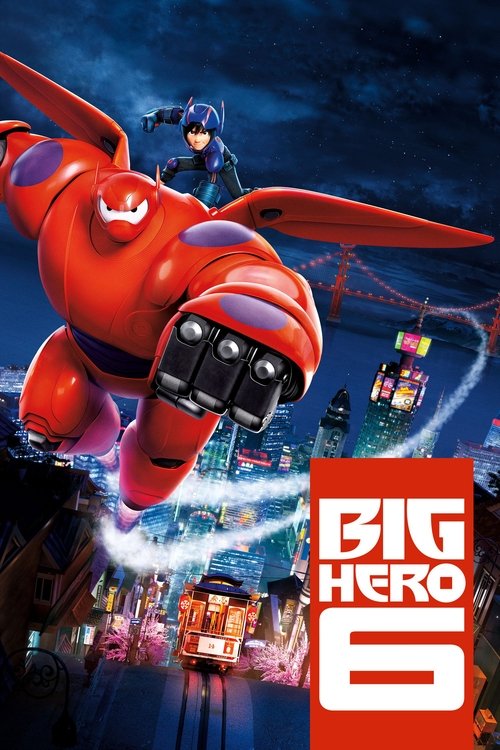
Big Hero 6
2014 · Don Hall
For a family movie night or when you want a big-hearted pick-me-up — reliable comfort viewing that's honest with kids about loss without ever getting heavy-handed.
What it's about
Hiro Hamada is a fourteen-year-old robotics genius coasting on back-alley bot fights in San Fransokyo, a gleaming mash-up of San Francisco and Tokyo, until his older brother steers him toward something better. When tragedy strikes, Hiro is left with Baymax — the huggable, balloon-bodied healthcare robot his brother built — and together with four science-nerd friends they suit up to unravel a masked villain's plot.
The experience
Fast, funny, and visually dazzling, with a soft center about grief and healing that sneaks up on you between the action beats. Baymax's deadpan gentleness gets laughs and lumps in the throat, sometimes in the same scene.
The craft
Disney built a new light-rendering engine to make San Fransokyo glow, and the city is a character in itself — every frame packed with invented signage and detail. Baymax is a masterclass in character design, an entire personality expressed through a vinyl balloon and two dot eyes. The flying sequences genuinely soar on a big screen.
Why it matters
The first Disney animated feature built from a Marvel property, it won the Oscar for Best Animated Feature and helped cement the studio's 2010s revival — while Baymax became an instantly iconic character.
Snapshot
Big Hero 6 is the fifty-fourth feature from Walt Disney Animation Studios and the first to draw on a property from Marvel Comics, which the Walt Disney Company had acquired in 2009. Directed by Don Hall and co-directed by Chris Williams, it reworks an obscure 1998 Marvel superhero team book into an accessible origin story about a robotics prodigy, Hiro Hamada, and Baymax, the soft, balloon-bodied nursing robot built by his late brother. The film is set in "San Fransokyo," an invented metropolis that fuses San Francisco's topography with Tokyo's density and signage. It occupies a pivotal place in what is often called the Disney Revival: released the year after Frozen, it confirmed the studio's return to commercial and critical dominance and won the Academy Award for Best Animated Feature. Just as important to specialists, it was the debut vehicle for Hyperion, Disney's in-house path-tracing renderer, which reset the studio's technical baseline for the decade that followed.
Industry & production
The project originated in Disney's post-Marvel-acquisition search for adaptable material. By well-documented account, Don Hall — who had just directed Winnie the Pooh (2011) — proposed a list of lesser-known Marvel titles to John Lasseter, and the Big Hero 6 team, created by Steven T. Seagle and Duncan Rouleau, was greenlit precisely because its obscurity gave the filmmakers freedom to reinvent it. The finished film retains little beyond character names and the basic premise; Baymax in particular was redesigned from a comparatively conventional comic robot into the now-iconic inflatable healthcare companion.
Production was overseen at Walt Disney Animation Studios in Burbank under the creative leadership of Lasseter, with Roy Conli producing. Hall and Williams shared directing duties, a common arrangement at the studio during this period, when tight pipelines and dense worldbuilding made a two-director structure practical. The screenplay is credited to Jordan Roberts, Robert L. Baird, and Daniel Gerson (the latter, a frequent Pixar/Disney writer, died shortly before the film's release). Marvel's involvement was largely at the licensing and cameo level rather than the day-to-day creative level — Stan Lee appears in a post-credits cameo, consistent with Marvel's house practice.
Disney positioned the film for a November 7, 2014 release, the studio's traditional Thanksgiving-corridor slot. It performed strongly worldwide and became a substantial hit; I will avoid citing a precise gross, as figures vary by source, but it was unambiguously one of the year's top-grossing animated features and outperformed expectations for a non-fairy-tale, superhero-inflected title. Its Best Animated Feature win — over strong competition — sealed its industry standing.
Technology
The single most consequential fact about Big Hero 6 in production-history terms is that it was the first feature rendered with Hyperion, the physically based path-tracing renderer developed internally at Disney Animation (its public technical name is the Disney "Hyperion Renderer"). Earlier Disney films had used more traditional rasterization-and-approximation lighting pipelines; Hyperion instead simulated light transport by tracing enormous numbers of rays and letting illumination bounce through the scene, producing genuinely global illumination — soft indirect light, color bleeding, realistic falloff — at feature scale. The technical challenge was managing billions of ray computations efficiently; Disney's engineers built a system that sorted and batched rays to make the workload tractable, and the studio has published on the architecture in SIGGRAPH-adjacent literature.
The payoff is visible throughout San Fransokyo: the warm interior of the Lucky Cat Café, the neon-soaked night skyline, and above all the way light interacts with Baymax's white vinyl skin, which reads as a soft, slightly translucent inflated surface. The city itself was engineered as a data problem — the filmmakers built a large virtual San Fransokyo with a procedurally assisted architecture that blended Victorian San Francisco building stock with Japanese elements, populated across many city blocks so that the camera could move through a coherent, deep environment rather than isolated sets.
The second technology thread is diegetic: Baymax's design was informed by real research into soft robotics, notably inflatable-actuator work associated with Carnegie Mellon University, which the filmmakers visited during development. That research directly motivated the decision to make Baymax non-threatening, huggable, and vinyl-skinned rather than metallic — a design choice that is simultaneously a character statement and a plausible engineering premise. Hiro's "microbots," swarms of small modular units controlled by a neural transmitter, similarly gesture toward real swarm-robotics and modular-robotics concepts, dramatized rather than documented.
Technique
Cinematography
As with all fully computer-animated features, "cinematography" here means virtual camera, layout, and lighting design rather than photographed light. The film's visual language leans on a mobile, often sweeping virtual camera — most conspicuously in the aerial flight sequence, where Hiro and Baymax soar over San Fransokyo and the camera behaves like an unchained helicopter shot, exploiting the fully modeled city and Hyperion's atmospheric lighting. Depth-of-field, lens-flare, and anamorphic-style framing cues are used to give the animation a live-action-blockbuster grammar, aligning the film with contemporary superhero cinema. The lighting palette shifts deliberately: warm domestic golds for the Hamada home and the café, cool blues and hot neons for the city at night, and clinical whites for the tech-institute and laboratory spaces.
Editing
The cutting follows mainstream feature-animation practice, alternating character-driven comic beats (Baymax's low-battery "drunk" behavior, the team's bickering) with escalating action set-pieces. The film's structure is efficient in the Disney mode: a fast establishment of Hiro and Tadashi, a sharp mid-film reversal built around Tadashi's death, and a rising action-and-reveal engine in the back half. The editing is credited to Tim Mertens; beyond the credit itself I would not overstate specific cutting-room decisions, as detailed accounts of the film's editorial process are thin in the public record.
Mise-en-scène / staging
Production design is the film's showcase. San Fransokyo is the central staging achievement: cable-car hills, Painted-Lady-style houses, torii-inflected signage, wind-turbine-topped suspension bridges, and dense Japanese-English bilingual advertising. The staging repeatedly uses verticality — rooftops, the flight arcs, the tech institute's soaring atrium — to open up the frame. Character staging privileges the visual contrast between Baymax's rounded, minimal silhouette and the busy human and urban geometry around him; the robot's simplicity is a deliberate design anchor amid a maximalist world. Paul Felix served as production designer, and the look reflects extensive location research in both San Francisco and Tokyo.
Sound
The sound design supports the soft-robot conceit closely — Baymax's movements are given a distinctive squeak-and-vinyl-rub tactility, and his flat synthesized-yet-gentle vocal delivery is a sound-and-performance hybrid. Action sequences use the full contemporary blockbuster low-end and impact palette. Henry Jackman's orchestral-electronic score threads an emotional theme for Hiro and Baymax against propulsive action cues. The end-credits song "Immortals," written and performed by Fall Out Boy, was commissioned for the film and became its most visible musical marketing asset.
Performance
The voice cast centers on Scott Adsit as Baymax, whose comedic restraint — measured, literal, unhurried — is essential to the character's warmth, and Ryan Potter as Hiro, who carries the grief arc. The ensemble team is voiced by T.J. Miller (Fred), Jamie Chung (GoGo Tomago), Damon Wayans Jr. (Wasabi), and Genesis Rodriguez (Honey Lemon), with Maya Rudolph as Aunt Cass, Alan Tudyk as the industrialist Alistair Krei, and James Cromwell as Professor Robert Callaghan. Daniel Henney voices Tadashi. The performances are animated to a naturalistic, expressive standard typical of the studio, with Baymax deliberately animated against type — minimal facial articulation (two dots and a line) forcing expressiveness into posture and timing.
Narrative & dramatic mode
The film runs on a superhero-origin skeleton grafted onto a grief narrative. Its dramatic engine is loss: Tadashi dies in a fire roughly a third of the way in, and the plot's mystery (who caused the catastrophe, and why) is ultimately a vehicle for Hiro's emotional arc. The most striking dramatic move is the way Baymax — built as a healthcare robot to treat physical injury — becomes the instrument of Hiro's emotional healing, and the near-climax turns on Hiro's temptation toward vengeance being checked by the memory of what Baymax, and Tadashi, were meant to be. The mode is family-adventure with genuine tonal weight: broad comedy and merchandisable heroics are load-bearing, but the film is unusually direct with children about death and mourning.
Genre & cycle
Big Hero 6 sits at the intersection of the animated family film and the 2010s superhero cycle. It is a team-origin story — the assembling of a group of amateurs into "high-tech heroes" — and it self-consciously borrows the beats and iconography of Marvel's live-action output (masks, suits, a tech-villain, a post-credits Stan Lee cameo) while translating them into Disney Animation's idiom. Within Disney's own cycle it belongs to the Revival run of features and is notable as the studio's first attempt to metabolize the Marvel brand into its animated house style, distinct from the concurrently expanding Marvel Cinematic Universe.
Authorship & method
The controlling authorship is institutional — this is a Walt Disney Animation Studios film shaped by its story-trust and pipeline — but the credited creative leads matter. Don Hall is the animator-turned-director who found and championed the property and shares the directing credit with Chris Williams, himself a veteran Disney story artist and co-director of Bolt (2008). Their method reflects the studio's research-driven development: field trips to robotics labs and to Tokyo and San Francisco, extensive story-reel iteration, and design work that treats worldbuilding as a primary authorial act. Key collaborators include producer Roy Conli; production designer Paul Felix; composer Henry Jackman, whose score gives the film its emotional through-line; editor Tim Mertens; and the writing team of Robert L. Baird, Daniel Gerson, and Jordan Roberts. Because Disney does not assign a single director of photography in the live-action sense, cinematographic authorship is distributed across the layout and lighting departments rather than vested in one named DP.
Movement / national cinema
The film is a product of the American studio-animation mainstream, specifically the computer-animated feature tradition that Pixar established and that Disney Animation re-energized after John Lasseter and Ed Catmull assumed leadership of the studio in 2006. It is not part of any avant-garde or auteur movement; its lineage is corporate, technological, and pipeline-driven. Its most interesting "national" dimension is aesthetic rather than industrial: San Fransokyo stages a deliberate, affectionate American-Japanese cultural fusion — a Hollywood film borrowing anime and Japanese urban iconography — though the film remains fundamentally a Burbank production rather than a genuine co-production with Japanese studios.
Era / period
Big Hero 6 is a keystone of the Disney Revival (roughly 2009–2019), the period bracketed by The Princess and the Frog and Frozen II in which Disney Animation regained parity with and then surpassed Pixar commercially. Technologically it marks a clear inflection point: as the first Hyperion feature, it opens the studio's path-traced era, and the renderer's introduction here made possible the lighting and complexity of the films that immediately followed. Culturally it lands in the early boom of the superhero decade and in a moment when Disney was learning how to deploy its newly acquired Marvel and (from 2012) Lucasfilm assets.
Themes
The film's dominant theme is grief and its management — the loss of a sibling, and the danger of letting mourning curdle into revenge. Around that core it develops several linked ideas: care as technology (Baymax embodies the notion that the most valuable machine is one built to heal rather than to fight), the tension between invention for good and invention weaponized (Hiro's microbots and Krei's ambitions both dramatize how neutral technology acquires morality through use), and found family and mentorship (Tadashi's legacy, Aunt Cass's home, the improvised hero team). The recurring line "Are you satisfied with your care?" turns Baymax's clinical script into the film's emotional refrain, binding the healthcare premise to the grief arc.
Reception, canon & influence
Critically, Big Hero 6 was well received, praised especially for Baymax as a character and for the richness of San Fransokyo, with the most common reservations concerning a relatively formulaic superhero third act. Its Academy Award for Best Animated Feature is the clearest marker of its canonical standing, and it has retained strong affection among audiences, with Baymax becoming a durable and heavily merchandised character.
Looking backward, the film's influences are legible: the Marvel superhero-origin template; Japanese popular culture and anime aesthetics filtered through American animation; and real soft-robotics research (the Carnegie Mellon inflatable-robot work) that shaped Baymax's body. The buddy dynamic and the grief-driven kid-and-robot pairing also sit in a long lineage of boy-and-his-robot stories, of which The Iron Giant is the most frequently cited touchstone, though I would present that as thematic kinship rather than documented direct influence.
Looking forward, its most concrete legacy is technical: Hyperion, proven here, became the rendering backbone for Zootopia, Moana, and subsequent Disney features, so the film's true influence on the medium runs through its pipeline as much as its screen. As franchise, it spawned the Disney XD animated series Big Hero 6: The Series (2017–2021) and the Disney+ shorts series Baymax! (2022), keeping the characters in circulation. Within Disney's own history it stands as the proof-of-concept that the studio could absorb an outside comics property and remake it wholesale in its own voice — a template that shaped how Disney Animation thought about IP in the years that followed.
A Deleuzian reading
Baymax's face is two black dots and a line.
The full Deleuzian reading of Big Hero 6 →
Reception
It won the 2015 Best Animated Feature Oscar and was the highest-grossing animated film of 2014 worldwide, yet it's since settled into the comfy middle of the Disney Revival ranking — while Baymax himself only grew, spinning off a Disney+ series and permanent theme-park residency.
How Big Hero 6 was received, from release to now →
How to watch Big Hero 6: what to notice on a first viewing
- Watch Baymax's face: two dots, one line, nothing moves. Scott Adsit plays him slow and literal. All his feeling moves into posture, timing, and the squeak of his vinyl skin instead of an expression. This is what the reading calls the centre of indetermination: a living thing that hesitates instead of reacting, and care starts in that pause.
- Notice the light change: café gold, lab white, street neon-blue. The film sorts scenes by color: warm gold at home and the café, clinical white in the lab, blue and neon at night in the city. The palette does moral work instead of decoration, telling you what kind of space you are in before anything happens.
- Listen for the squeak and rub of Baymax's vinyl body. Every time Baymax moves, sound design adds a small vinyl-on-vinyl noise, a tactile detail that never lets you forget what he is made of. The sound keeps Baymax's softness physically real, so his care reads as a body doing something, not a special effect.
- Track the camera during the flight over San Fransokyo. The virtual camera swoops and banks like an unchained helicopter shot, following Hiro and Baymax continuously through the modeled city rather than cutting between angles. Nothing is resolved during the flight; movement itself is the film's language for release.
- Notice how often the frame opens upward: rooftops, atriums, bridges. Don Hall and production designer Paul Felix keep finding vertical space, cable-car hills, a soaring tech-institute atrium, suspension bridges, to open the frame rather than filling it with clutter. Verticality gives the crowded city room to breathe and sets up the flight sequence's sense of lift.
The whole guide to watching Big Hero 6, with the keys for a rewatch →
Influences: the films it descends from and the films it influenced
- The Iron Giant (1999) — Establishes the design grammar of an emotionally expressive robot that reads feeling through slow posture and rounded silhouette rather than facial articulation — the economy of gesture Baymax's blank vinyl face and deliberate movement inherit wholesale.
- Astro Boy (Tetsuwan Atom) (1963) — Codifies the boy-genius-and-benevolent-robot archetype and the soft, big-eyed rounded robot body as a vessel for pathos, the Japanese lineage Baymax's caregiving huggable form descends from.
- Mazinger Z (1972) — Originates the 'Rocket Punch' launching fist that Baymax's detachable rocket fist directly quotes, and the ritual of suiting a robot with add-on armor for battle.
- Akira (1988) — Supplies the vertical neon megacity and the light-trailing motorcycle chase whose motion language and dense signage San Fransokyo's cityscape and Hiro's bike staging openly cite.
- Blade Runner (1982) — Pioneers the layered East-meets-West hybrid metropolis rendered through volumetric atmospheric light and bilingual signage — the exact urban-design fusion San Fransokyo grafts San Francisco onto Tokyo to achieve.
- How to Train Your Dragon (2010) — Sets the template for the exhilarating 'test flight' sequence staged with a naturalistic, weight-aware virtual camera swooping alongside rider and creature — the language Hiro and Baymax's first flight over the city reproduces beat for beat.
- The Incredibles (2004) — Demonstrates superhero action choreographed to exploit animation's unconstrained camera and impossible physics, proving the genre's set-pieces could be authored in CG rather than filmed — the staging vocabulary the third-act team battle draws on.
- Iron Man (2008) — Provides the tech-genius-armors-a-body origin template and the team-assembly structure of the MCU that Big Hero 6 absorbs wholesale, down to Baymax's fabricated carbon-fiber suit echoing the workshop suit-up montage.
- Bolt (2008) — Williams' prior film establishes his method of anchoring a high-concept action-comedy premise in a grieving character's emotional reality, the through-line he carries directly into co-directing Big Hero 6.
- Tangled (2010) — Launches the Disney-revival pipeline that marries painterly art-directed lighting to CG surfaces, the non-photoreal-yet-illuminated look Big Hero 6 refines before Hyperion replaces the hand-tuned approach.
- Wreck-It Ralph (2012) — Immediately precedes it in the revival cycle with densely populated, pop-culture-saturated worldbuilding as a primary authorial act — the design-first approach San Fransokyo scales up into a full city.
- Toy Story (1995) — Founds the CG-animated feature and the mismatched-buddy dynamic between a human-surrogate and a naive artificial companion that Hiro-and-Baymax structurally reprises.
- Zootopia (2016) — Runs on the Hyperion path-tracer that Big Hero 6 debugged in production, and inherits its dense multi-district city built as a photometrically consistent lit environment.
- Moana (2016) — Extends the same Hyperion global-illumination pipeline into ocean subsurface scattering and translucency, a direct technical continuation of the renderer Big Hero 6 proved.
- Ralph Breaks the Internet (2018) — Builds its sprawling internet-city on the Hyperion worldbuilding-at-scale approach pioneered by San Fransokyo, rendering a vast populated environment under unified path-traced light.
- Baymax! (2022) — Hall's episodic spin-off distills the film's 'care-as-technology' conceit and the soft-robotics healthcare-companion design into its purest form, keeping Baymax's gentle-caregiver behavior as the sole engine.
- Frozen II (2019) — Was the first Disney feature built on the in-house Hyperion path-tracing renderer whose physically-based light transport makes Frozen II's translucent ice, mist and forest lighting possible.
- Zootopia 2 (2025) — Debuts Disney's Hyperion renderer, whose global-illumination path-tracing architecture is the direct technical ancestor of Zootopia 2's lighting pipeline.
- Spider-Man: Into the Spider-Verse (2018) — Parallel animated superhero-origin that fuses comics panel logic with anime-derived stylization and a grief-arc mentorship, extending the same anime-plus-superhero hybrid craft toward an explicitly non-photoreal rendering.
- The Wild Robot (2024) — Baymax establishes the nurturing-robot-as-reluctant-caregiver figure — a machine whose programd function becomes tenderness — the character logic Roz inherits.
- How to Train Your Dragon 2 (2014) — Its head-to-head Oscar rival built on the same then-new global-illumination push, using physically accurate light bounce and grief-driven story to raise the technical and emotional bar for studio animation.
- Transformers One (2024) — Engineered an expressive, huggable robot lead (Baymax) from deliberately simple hard-surface geometry, showing how appeal and emotion can be sculpted from mechanical parts in a family-animation blockbuster.
Similar films
- The Incredibles (2004) — influence & lineage
- Spider-Man: Into the Spider-Verse (2018) — influence & lineage
- Toy Story (1995) — influence & lineage
- How to Train Your Dragon (2010) — influence & lineage
- Finding Dory (2016) — shared sensibility
- Toy Story 5 (2026) — shared sensibility
- Boy & the World (2014) — shared sensibility
- Toy Story 3 (2010) — shared sensibility