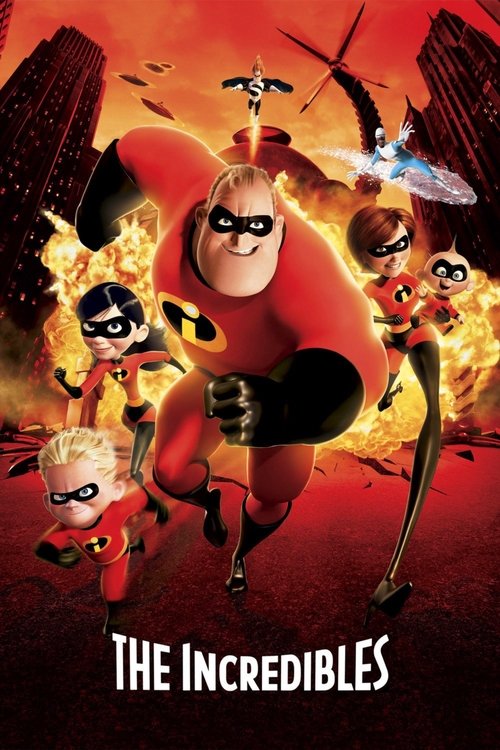
The Incredibles
2004 · Brad Bird
For family movie night when you want everyone — kids, parents, the friend who claims to be over superheroes — actually laughing at the same jokes. Pure comfort with real velocity.
What it's about
Superheroes have been sued into retirement, and the strongest of them all now files insurance claims in a gray cubicle. Bob Parr misses being Mr. Incredible; his wife Helen has made peace with suburbia and raising three kids who must hide their powers. Then a secretive assignment lures Bob back into costume, and the double life he's keeping from his family starts pulling everyone into real danger.
The experience
A rocket-paced action comedy with a surprising ache under it — midlife frustration, marriage friction, sibling squabbles — that keeps landing jokes while the set pieces build to genuinely thrilling. It moves like a great spy caper and feels warm the whole way through.
Performances
Holly Hunter gives Helen a full, flinty inner life rare in animated voice work, and Craig T. Nelson makes Bob's restlessness feel lived-in; Samuel L. Jackson's Frozone and Brad Bird's own scene-stealing turn as designer Edna Mode are instant classics.
The craft
Pixar's first film built entirely around human characters, and Brad Bird pushes the animation toward caricature that expresses feeling rather than photorealism — stretch, speed, and force all read viscerally. Michael Giacchino's brassy, jazz-inflected spy score gives it a swagger no live-action superhero film of its era had. The action geography is crystal clear and sings on a big screen.
Why it matters
It won the Oscar for Best Animated Feature, proved animation could carry a character drama about adults, and anticipated the superhero-family and lapsed-hero stories that would dominate the following two decades.
Snapshot
The Incredibles is Pixar's sixth feature and its first built entirely around human characters — a superhero domestic comedy that doubles as a mid-career crisis story. Written and directed by Brad Bird, freshly arrived from Warner Bros. after The Iron Giant (1999), the film follows Bob Parr (Mr. Incredible), a super forced into anonymous suburban insurance work after lawsuits drive costumed heroes underground, and his family — the elastic Helen, the force-field-and-invisibility teenager Violet, the hyperspeed Dash, and baby Jack-Jack. Its animating idea is not "what if superheroes were real" but "what if a superpowered family had to be an ordinary family," a premise Bird has repeatedly linked to his own anxieties about balancing ambition with fatherhood. Released in November 2004, it won the Academy Awards for Best Animated Feature and Best Sound Editing and was nominated for Best Original Screenplay and Best Sound Mixing — an unusually strong showing for an animated film in the sound and writing categories. It is remembered as a high point of pre-MCU superhero cinema and as the film that established Michael Giacchino as a major screen composer.
Industry & production
The film sits at a hinge moment for Pixar. It was made under the studio's original distribution deal with Disney, during the period when the Disney–Pixar relationship was fraying (the partnership would nearly collapse before Disney's 2006 acquisition of Pixar). Bird was an outside hire in Pixar terms: a CalArts contemporary and friend of John Lasseter, but someone whose feature résumé was The Iron Giant, a critically admired traditionally-animated film that had underperformed commercially. Lasseter brought him in with an unusual mandate to make the film his way.
Bird has spoken about deliberately staffing the production with artists and technicians who were considered risky or underused elsewhere at Pixar — pitching them on tackling problems the studio's pipeline supposedly couldn't handle, on the logic that people told something is impossible often solve it. The project was also famously ambitious in scope: a large human cast, extensive crowds, hair, cloth, water, and skin, all of which pushed against the limits of what Pixar had attempted after the toys, bugs, and monsters of its earlier films. At roughly 115 minutes it was the longest Pixar feature to that point, closer to a live-action feature's runtime than to the standard family-animation length. Commercially it was a major success, grossing well over $600 million worldwide and helping cement animation's viability as a vehicle for older-skewing, action-driven material.
Technology
The Incredibles is a landmark in Pixar's technical history precisely because it committed to humans. Earlier Pixar films had largely avoided realistic people (the humans in Toy Story were stylized and secondary) because believable skin, hair, and cloth were notoriously hard to render. Bird's film required all three at scale.
Key challenges the production is documented as having pushed on include: cloth simulation for costumes that had to move convincingly over stylized bodies; hair simulation, including Violet's long curtain of hair as a near-character in itself; subsurface scattering to make skin read as translucent flesh rather than plastic; and water, including realistic surf and rain. The film also involved substantial crowd work and complex environments — the modernist island lair, the city, the suburban interiors. Because so many shots combined multiple simulated systems, the production sat at the edge of the studio's available computing power for its era. The result mattered beyond this one film: the human-figure, hair, and cloth work fed directly into Pixar's later capacity to build casts of people, and the film is routinely cited as the point where Pixar proved it could animate humans as leads.
Technique
Cinematography
Because it is fully computer-animated, "cinematography" here means the design of a virtual camera, and this is one of the film's signal achievements. Bird staged the film like a live-action action picture rather than a cartoon. The camera favors longer lenses, handheld-style shake in action, whip pans, rack focus, and lens flares — the visual grammar of 1960s and 1970s spy and adventure filmmaking. Bird has said he wanted the film to feel photographed, with imperfections a real operator might introduce, in deliberate contrast to the frictionless, all-in-focus clarity that CG easily produces. Sequences such as Mr. Incredible's flight from the Omnidroid in the jungle, or Dash's chase across the water, are blocked with the geography and momentum of practical action cinema.
Editing
Stephen Schaffer edited the film. Its cutting is notably muscular for animation: action scenes are built with the accelerating rhythm of a live-action thriller, while the domestic scenes — the dinner-table argument, Helen discovering Bob's secret — are allowed to play in sustained, dialogue-driven beats. The screenplay's structure gives the editing an unusually adult shape, moving through a genuine second-act low (Bob's apparent affair, which is really a return to heroism) before the family reunites for the climax. In animation, editorial choices are effectively locked far earlier than in live action, so the pacing reflects Bird's storyboard-stage decisions as much as post-production assembly.
Mise-en-scène / staging
Visually the film is a coherent mid-century modern object. Production designer Lou Romano and the art team drew on 1950s–60s design — Googie and atomic-age architecture, Eero Saarinen–style furniture, the graphic look of period advertising and Jonny Quest. Syndrome's volcano lair, the retro-futurist gadgets, the palette of oranges, teals, and blacks, and the stylized, caricatured human bodies (broad-shouldered heroes, spindly designers) all belong to one design language. The stylization is functional: by pushing the characters away from realism, Bird makes the emotional and physical exaggeration legible. Edna Mode's atelier, all glass and stone and modernist restraint, is a mise-en-scène joke and a character portrait at once.
Sound
Sound is central to the film's identity, and its Best Sound Editing Oscar was earned. Randy Thom (a longtime Bird collaborator, going back to The Iron Giant) led sound design at Skywalker Sound, with Michael Silvers among the credited sound editors. Bird is known for bringing sound in early rather than treating it as a finishing layer, and the film's action reads with weight and clarity — the impact of blows, the whir of gadgets, the different textures of each power. The soundscape works hand in glove with Giacchino's score to sell a world of physical superheroics.
Performance
The vocal cast is unusually well matched to character. Craig T. Nelson gives Bob a weary, thwarted decency; Holly Hunter's Helen is sharp, exasperated, and warm; Samuel L. Jackson's Frozone supplies cool comic counterpoint (the "Where is my super suit?" exchange with Kimberly Adair Clark's unseen Honey is among the film's most quoted). Jason Lee plays Syndrome as a wounded, motor-mouthed fan turned villain. Sarah Vowell — the writer and radio essayist, a piece of atypical casting — gives Violet a genuinely adolescent reticence, and Spencer Fox voices Dash. Bird himself voices the diminutive designer Edna Mode, a performance that became one of the film's breakout elements. The animation performances are equally deliberate: acting choices in gesture and expression carry the domestic drama without leaning on realism.
Narrative & dramatic mode
The film's dramatic mode is domestic melodrama fused with adventure. Its true subject is midlife frustration and the temptation to relive past glory: Bob's secret hero work reads structurally as an affair, complete with lies, a rejuvenated body, and a wife's dawning suspicion. The superhero apparatus is the vehicle for a family therapy plot in which each member must accept, rather than suppress, what they are — Violet her visibility, Dash his speed, the parents their partnership. Bird structures it in three clean acts with a real crisis at the midpoint, and he trusts the audience with adult stakes: characters are threatened with death, minor heroes are shown to have been killed, and the moral questions are not resolved by a simple lesson. The tone modulates confidently between screwball domestic comedy, spy thriller, and sincere family drama.
Genre & cycle
The Incredibles arrived inside a specific superhero moment — the early-2000s revival led by X-Men (2000) and Spider-Man (2002), with Spider-Man 2 opening the same summer of 2004 — but predates the Iron Man (2008) launch of the Marvel Cinematic Universe. It is therefore a superhero film made before the genre's later conventions hardened, and it functions partly as commentary on the form. Its family-of-supers premise invites obvious comparison to Marvel's Fantastic Four (elasticity, force fields/invisibility, super-strength), though Bird approaches it as pastiche and homage rather than adaptation. It also belongs to the spy-adventure cycle: its DNA is as much James Bond, The Outer Limits, and Jonny Quest as it is comic books. Within animation, it helped expand the sense of what the medium's genre range could be, treating action seriously rather than as slapstick.
Authorship & method
The film is strongly auteurist. Brad Bird wrote and directed it, and it bears the continuities of his career: the mixture of Americana, genre affection, and emotional sincerity seen in The Iron Giant, and later in Ratatouille (2007) and the live-action Mission: Impossible – Ghost Protocol (2011). Bird's stated method is to storyboard heavily and to stage animation with live-action filmmaking logic, and he is known for advocating for artistic risk within a studio pipeline. His key collaborators here recur across his work: composer Michael Giacchino, for whom this was a breakout — his brassy, big-band, John Barry/Henry Mancini–inflected spy score is inseparable from the film's identity, and it launched a career that ran on through Pixar, Star Trek, and much of modern blockbuster scoring; sound designer Randy Thom, a fellow Iron Giant veteran; editor Stephen Schaffer; and production designer Lou Romano. The absence of a traditional live-action cinematographer is itself telling: in this mode, authorship over the image is shared between director, art department, and lighting/camera technicians who translate Bird's live-action-camera instincts into virtual space.
Movement / national cinema
It is an American studio film, a product of Pixar's Emeryville, California operation within the Disney orbit. It belongs to the American computer-animation movement Pixar itself largely founded, and specifically to that movement's early-2000s expansion beyond talking-animal and toy premises into human-centered, genre-inflected storytelling. Its sensibility is thoroughly Californian mid-century-modern in design and thoroughly Hollywood in narrative craft.
Era / period
The film is a 2004 release that looks backward, aesthetically, to an idealized late-1950s/early-1960s America — the atomic-age optimism of period design, advertising, and spy fiction — while telling a story about early-2000s adult malaise. This double temporality is deliberate: the retro-futurism gives the world a timeless, storybook quality and lets Bird sidestep the specifics of any real decade. Industrially, it belongs to the moment just before both the MCU and Pixar's absorption into Disney, when Pixar was proving how far it could push its technology and its audience's age range.
Themes
The film's central theme — that exceptional people should not have to suppress their gifts to make others comfortable — has generated sustained critical debate. Syndrome's line, that "when everyone's super, no one will be," and the film's broader suspicion of forced mediocrity, led some critics to read the film as Randian or elitist; others countered that the film is really about family, responsibility, and the ethical use of gifts, and that Syndrome (a resentful, murderous fan) is precisely the film's warning against weaponized specialness. Bird has generally rejected a strict ideological reading, framing the theme as a plea against a culture that punishes excellence. Around that core sit the film's other, warmer concerns: midlife regret and the pull of the past; marriage as partnership; adolescence and the fear of being seen; and the idea that heroism, domestic or costumed, is ongoing work rather than a finished triumph.
Reception, canon & influence
Critical reception was strongly positive on release, with particular praise for its wit, its action staging, its design, and its emotional maturity relative to genre expectations; it is consistently ranked among Pixar's and among the era's best. Its Oscars for Best Animated Feature and Best Sound Editing, plus nominations for Original Screenplay and Sound Mixing, marked it as a film taken seriously beyond the animation ghetto.
Its influences run backward to James Bond and 1960s spy cinema, to The Outer Limits and Jonny Quest, to superhero comics generally and the Fantastic Four in particular, and to mid-century modern design and Cold War Americana. Its own forward influence is substantial. It stands as one of the most respected superhero films made before the MCU standardized the genre, and it is frequently invoked in later debates about superhero fatigue as an example of the form done with craft and character. It confirmed that mainstream animation could carry sustained action and adult emotional stakes, expanding the ambitions of subsequent CG features. For Pixar specifically, its human, hair, and cloth work fed the studio's later capabilities. Michael Giacchino's score reoriented a strand of blockbuster music back toward melodic, orchestral, genre-savvy writing. Brad Bird's success led directly to Ratatouille and to his move into live-action tentpoles. The film's long-delayed sequel, Incredibles 2 (2018), again written and directed by Bird, arrived fourteen years later to enormous commercial success — a testament to how durable the original's characters and premise proved. Where the historical record on internal production details is thinner — for instance, the precise attribution of individual technical breakthroughs across a large crew — this account leaves those claims general rather than assigning them falsely.
A Deleuzian reading
Dash runs across water.
The full Deleuzian reading of The Incredibles →
Reception
An instant hit in 2004 — huge box office, Best Animated Feature Oscar, hailed as Pixar at its peak. Two decades of superhero saturation later, it's only risen: routinely called one of the genre's best films, full stop, and half-jokingly 'the best Fantastic Four movie ever made.'
How The Incredibles was received, from release to now →
How to watch The Incredibles: what to notice on a first viewing
- Watch the camera shake and flare like a real operator's. Bird's virtual camera whip-pans, racks focus, and catches lens flares instead of holding everything crisp and steady the way computer animation easily can. The imperfections are put there on purpose. You are being asked to believe a person is filming this, which gives the action real weight and geography.
- Look at the palette: oranges, teals, and blacks in every room. Lou Romano's art department holds one design language across suburbia, the office, the island, and the gadgets. Atomic-age architecture and Saarinen-style furniture keep recurring in the background. A 2004 film set in an idealized early 1960s gives the whole world a storybook, out-of-time feeling.
- Listen for the brass to punch in whenever action starts. Giacchino scores with big-band horns in the John Barry and Henry Mancini spy tradition. The brass arrives and leaves sharply, marking exactly when the film switches from kitchen to caper. The score tells you which genre you are in at any moment, comedy at home or thriller abroad.
- Notice how long domestic scenes hold while action scenes speed up. Stephen Schaffer lets the dinner-table argument and the kitchen conversations run on dialogue in sustained beats, then cuts the chases with the accelerating rhythm of a live-action thriller. The film gives the family fights as much time as the fights with robots, so both register as stakes.
- Watch Violet's hair fall across her face when anyone looks. Sarah Vowell's delivery is hesitant and clipped, and the animators built her a long curtain of simulated hair she constantly hides behind. The hair does as much acting as the face. A teenager who can turn invisible is already hiding before she uses the power, which is the whole point of her.
The whole guide to watching The Incredibles, with the keys for a rewatch →
Influences: the films it descends from and the films it influenced
- Goldfinger (1964) — Michael Giacchino's brassy big-band spy score directly channels John Barry's Bond idiom, and the film's gadget-and-briefing set-piece grammar is lifted wholesale into Syndrome's scheme.
- You Only Live Twice (1967) — Ken Adam's modernist volcano-lair production design is the direct model for Syndrome's island base — the vast open-plan control rooms, monorails, and clean geometric menace.
- North by Northwest (1959) — The innocent-man-in-exposed-geography chase construction and Bernard Herrmann's propulsive cutting rhythm underwrite Bird's live-action thriller editing logic.
- Superman: The Movie (1978) — John Williams' melodic, unironic orchestral heroism is the scoring tradition Giacchino consciously revives against the era's percussive, atonal action music.
- The Iron Giant (1999) — Bird's storyboard-heavy, live-action staging discipline and Randy Thom's character-driven sound design carry over intact; it is the direct proving ground for his method.
- Toy Story (1995) — Established the Pixar RenderMan CG pipeline whose human-skin, cloth, and hair simulation the Incredibles pushed to its first sustained full-human, full-figure test.
- Playtime (1967) — Tati's comedic staging within pristine mid-century-modern glass-and-steel interiors prefigures the film's use of clean modernist environments as both design idiom and spatial gag.
- Finding Nemo (2003) — Inherits Nemo's newly built water and fluid simulation toolset for its ocean and crash sequences while pushing Pixar's rendering toward more complex human characters.
- The Castle of Cagliostro (1979) — Extends Cagliostro's legible spatial action and vertical-chase staging — the Pixar circle's oft-cited debt to Miyazaki's clear geography of motion.
- Ratatouille (2007) — Bird's next Pixar film extends the same subsurface-scattering skin and fur/hair-simulation R&D, and reunites Giacchino for another orchestral, Euro-genre-savvy score.
- Mission: Impossible – Ghost Protocol (2011) — Bird transfers his animation-honed clarity of spatial staging — legible set-piece geography and escalating gag-logic — directly into live-action tentpole action.
- Incredibles 2 (2018) — The direct sequel reprises the virtual-camera 'shot on a real lens' aesthetic, the domestic-melodrama structure, and Giacchino's scoring, fourteen years on.
- Big Hero 6 (2014) — CG-animated superhero action staging carrying real emotional stakes for a mainstream family audience — the exact combination the Incredibles proved commercially viable.
- Spider-Man: Into the Spider-Verse (2018) — Advances animation-native superhero action staging — using the virtual camera to compose kinetic sequences no live-action rig could achieve, the logic the Incredibles pioneered.
- Megamind (2010) — A CG feature built on affectionate superhero-genre pastiche and archetype inversion, working the same comic-savvy, design-forward register the Incredibles opened up.
- The Fantastic 4: First Steps (2025) — Blueprint for the superpowered nuclear family as domestic melodrama, staged in atomic-age Googie and mid-century-modern design — and, like First Steps, scored by Michael Giacchino in a retro-orchestral idiom.
- Zootopia 2 (2025) — Michael Giacchino's brass-and-jazz, spy-caper orchestral idiom originates here and is the scoring voice he carried into the Zootopia franchise's detective register.
- Zootopia (2016) — Michael Giacchino's genre-pastiche scoring method — deploying period jazz/noir idiom as narrative signposting rather than wallpaper — is the composer technique he reprises in Zootopia's noir score.
- Star Trek (2009) — Giacchino's brassy heroic main-title writing plus the aggressive anamorphic lens-flare image — the very flares the Incredibles simulated in CG — mark a shared house style.
- Up (2009) — Giacchino weds a melodic, motif-driven orchestral score to genuinely adult domestic-emotional stakes inside CG animation — the emotional-maturity ambition the Incredibles legitimized.
- WALL-E (2008) — Extends Pixar's move toward cinematic virtual cinematography — deliberate lens characteristics and lighting (with Roger Deakins consulting) — that the Incredibles' fake-camera approach began.
- Toy Story 2 (1999) — Turns affectionate genre pastiche — 1960s spy-fi and superhero idiom — into a feature-animation mode the way TS2 pastiches Star Wars and the TV Western.
- Superman (2025) — Parallel Silver Age superhero-family sincerity and mid-century optimism, treating heroism as a domestic-moral vocation rather than trauma.
Similar films
- Spider-Man: Into the Spider-Verse (2018) — influence & lineage
- Big Hero 6 (2014) — influence & lineage
- Toy Story (1995) — influence & lineage
- Up (2009) — influence & lineage
- Ratatouille (2007) — influence & lineage
- The Iron Giant (1999) — influence & lineage
- The Lego Movie (2014) — shared sensibility
- Monsters, Inc. (2001) — shared sensibility