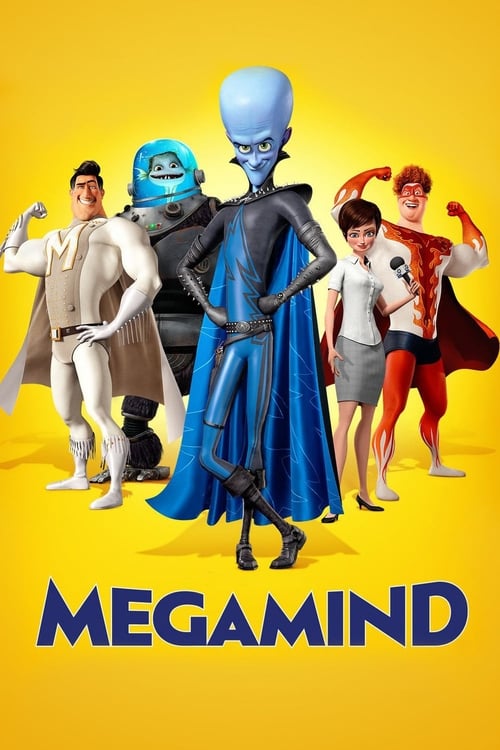
Megamind
2010 · Tom McGrath
For a family movie night or a comfort rewatch when you want superhero spectacle without the solemnity — easy, funny, and warmer than its premise suggests. It's the pick when someone in the room says they're tired of hero movies.
What it's about
A blue-headed alien supervillain has spent his whole life losing spectacularly to the same square-jawed superhero — until one day, to everyone's shock including his own, he wins. With his nemesis gone and the city his, Megamind discovers that victory is unbearably boring, so he builds himself a new hero to fight. The plan goes sideways when his creation turns out to be a far worse villain than he ever was, and the bad guy has to decide what he actually is.
The experience
Fast, snappy, and sneakily sweet — a superhero spoof that opens with the villain winning and then has honest fun figuring out what comes after. The gags land for kids while the midlife-crisis-of-a-supervillain material winks at adults, and there's a surprisingly tender romance threaded through the chaos.
Performances
Will Ferrell gives Megamind a needy, showboating charm that makes the villain the most lovable character on screen, with Tina Fey's dry, quick-witted reporter as the perfect foil and David Cross stealing scenes as the loyal fish sidekick.
The craft
DreamWorks animation in its confident era — big Metro City vistas, inventive gadget-battle set pieces, and a script that inverts the superhero origin story beat by beat, starting with the bold move of burning through its supposed climax in the first act. The rock-and-roll swagger of Megamind's entrances is half the joke and all spectacle.
Why it matters
Modestly received in 2010, it aged into a genuine cult favorite as superhero movies took over — rediscovered and re-championed online as the villain-turnaround comedy that got there early.
Snapshot
Megamind arrived in November 2010 as DreamWorks Animation's second CG feature of that year, following How to Train Your Dragon in March — a pairing that marked the studio's most artistically confident stretch since its founding. Directed by Tom McGrath, who had co-directed the Madagascar films, and written by Alan J. Schoolcraft and Brent Simons from a spec script, the film takes the superhero origin story and inverts its moral polarity: two infants are launched from dying worlds toward Earth, one lands in a mansion and one in a prison, and the resulting lives follow the accident of address rather than any intrinsic destiny.
The film's structural gambit is that it dispenses with its ostensible climax in the first act. Megamind (Will Ferrell) actually kills — or believes he kills — his nemesis Metro Man (Brad Pitt) roughly twenty minutes in, and the remaining film is about what a villain does when he has won and discovered that victory is a form of unemployment. The resulting picture is a comedy of vocational crisis dressed as a superhero parody, in which the antagonist's problem is not defeat but the collapse of the oppositional structure that gave him meaning.
Megamind was released into a crowded season and has generally been read as the lesser of DreamWorks' two 2010 features, a solid commercial performer that fell short of How to Train Your Dragon's cultural durability. Its afterlife has been unusual: the film accrued a substantial online following over the following decade, largely as a source of reaction images and as a touchstone in fan discussion of "sympathetic villain" writing, and that persistence is arguably more consequential to its standing than its original reception was.
Industry & production
The film emerged from a period of deliberate repositioning at DreamWorks Animation. After separating from DreamWorks SKG and going public in 2004, the animation studio spent the mid-2000s associated with a house style of celebrity-voiced pop-culture pastiche — the Shrek sequels and the first Madagascar being the emblematic cases. Under Jeffrey Katzenberg, the studio moved through the late 2000s toward features with more sincere emotional architecture and more considered visual design, a shift most visible in Kung Fu Panda (2008) and How to Train Your Dragon (2010). Megamind sits inside that transition and shows the strain of it: it wants the joke density of the older mode and the character interiority of the newer one.
The project's development history involved a title change — it circulated during production under earlier working titles before settling on Megamind — and, as is standard at DreamWorks, a long gestation in which the story was reworked through the studio's story-trust process. Schoolcraft and Simons' script was acquired as a spec, which was somewhat atypical for a major CG animated feature; most such films are developed in-house from a pitch. Ben Stiller and Stuart Cornfeld produced through Red Hour, alongside DreamWorks' own production apparatus, and Stiller took a small voice role.
Casting followed the studio's established star-voice strategy but with more attention to comic register than usual. Will Ferrell's Megamind is played with a particular mispronunciation gag running through it — the character's habitual misstressing of words like "Metrocity" — which is the sort of performance-driven writing that only works when the actor is central to the conception rather than layered on afterward. Tina Fey as Roxanne Ritchi, Jonah Hill as Hal/Titan, David Cross as Minion, and Brad Pitt as Metro Man round out the principal cast. Pitt's casting is itself a joke about casting: the effortlessly charismatic superhero is voiced by an actor whose public image is effortless charisma.
The film was released theatrically in November 2010 in 2D and 3D, DreamWorks having committed to stereoscopic release across its slate from Monsters vs. Aliens (2009) onward. It performed respectably worldwide without becoming a franchise anchor of the Shrek or Madagascar order. A short film, Megamind: The Button of Doom, followed on home video, and the property was later revived for streaming television — a 2024 sequel and series that were poorly received and that most accounts treat as separate from the original film's standing rather than continuous with it.
Technology
Megamind was produced on DreamWorks Animation's proprietary pipeline of the period, built around the studio's in-house tools for animation, lighting, and effects, with commercial packages integrated at various stages. The relevant technical context is the studio's mid-2000s transition to a fully stereoscopic production model and its concurrent investment in more physically grounded lighting.
Three technical demands shape the film's look. First, stereoscopic 3D was designed in from the start rather than converted in post — DreamWorks made this a point of policy — which affects staging: the film favors deep compositions with clearly separated foreground, middle, and background planes, and its action sequences are built around movement along the Z-axis, toward and away from the camera, in ways that read as depth cues.
Second, the film required extensive hard-surface and metallic rendering. Megamind's lair, his gadgets, Minion's robotic gorilla body with its glass fishbowl head, and the invisible car all demand convincing specular reflection and refraction. Minion in particular is a technical showpiece: a fish suspended in water inside a transparent sphere mounted on a mechanical body, which combines refraction through curved glass, a liquid volume, an organic character inside it, and reflective metal around it. That the character reads as legible and expressive rather than as a rendering demonstration is the achievement.
Third, the film's energy effects — Megamind's blue plasma weapons, Titan's laser vision, the destruction of Metro Man's supposed death by "copper" exposure, the climactic city-wrecking — required volumetric and particle work at scale. The recurring blue-versus-white palette of the two characters' powers is an effects decision as much as a design one, giving the film a consistent chromatic logic for its superhuman energy.
Character design leans on caricature proportions — Megamind's enormous cranium, spindly limbs, and enormous eyes — which places demands on rigging: a head that large must not read as a balloon, and the facial rig has to carry a great deal of the performance because the body silhouette is so exaggerated. The blue skin was a further complication for lighting, since it sits outside the range of skin tones the studio's subsurface-scattering setups were tuned for.
Technique
Cinematography
The film's virtual cinematography, supervised in DreamWorks' system by a head of layout and lighting rather than a photographic cinematographer in the live-action sense, is unusually committed to superhero-genre visual quotation. Metro Man's introduction is shot in the vocabulary of Richard Donner's Superman (1978) and Sam Raimi's Spider-Man cycle: low angles, sweeping crane moves, backlit hovering figures, lens flares deployed as heroic punctuation. The film then applies the same grammar to Megamind and lets the mismatch produce the comedy — a villain granted heroic framing he has not earned.
Camera movement is generally more mobile than DreamWorks' earlier features. Flight and fall sequences use continuous virtual takes that follow bodies through the city's vertical space, and the film exploits the freedom of the virtual camera in ways that would be impossible or ruinously expensive in live action, then partially disguises that freedom with simulated handheld shake and rack focus to keep the images legible as "photography."
The lighting design carries thematic weight. Megamind's lair is lit in cold blues and deep shadow with hard practical sources; Metro Man's Metro City is bright, high-key, and warm. As Megamind moves toward the hero position — particularly in the sequences where he courts Roxanne under the assumed identity of the museum curator Bernard — the palette warms with him. The reversal is completed when Titan's rampage floods the city with the sickly greens and oranges of a superhero-movie third act, and Megamind, in blue, becomes the figure of rescue.
Editing
The editorial strategy is front-loaded and deliberately disorienting. The film opens in medias res with Megamind falling to his apparent death, then executes an extended flashback that compresses two parallel origin stories into a montage running on a voiceover — a sequence that has to establish two infancies, two childhoods, a school rivalry, and an adult career of mutual antagonism, and does so in a few minutes.
That compression is what makes the first-act reversal possible. By the time Metro Man dies, the film has supplied enough backstory that the audience registers the death as the end of a long relationship rather than the disposal of a new character. The subsequent middle section slows markedly: the Bernard courtship sequences are given room, and the film's comic rhythm shifts from montage to sustained dialogue scenes.
The film's most-discussed editorial passage is the montage in which Megamind, having won, wanders his conquered city in a state of anhedonia — a sequence that borrows the melancholy-montage grammar of live-action comedy and uses it for a villain's depression. Editorial pacing in the Titan sequences returns to the accelerated cutting of contemporary superhero action, and the film is arguably weakest there, where it most closely imitates the thing it has been parodying.
Mise-en-scène / staging
Metro City is designed as a composite of American comic-book metropolises with a specific art-deco-and-glass hybrid architecture, its skyline dominated by monuments to Metro Man — a museum, a statue, a school named for him. The production design makes the city a physical record of hero worship, which pays off narratively when Megamind, taking power, redecorates it with images of himself and discovers that the vandalism is unsatisfying because no one is left to be offended.
The lair is a study in villain-iconography: cavernous, cluttered with half-finished doomsday devices, dominated by scale that dwarfs its occupant. Megamind's costumes — the spiked collar, the cape, the leather — are self-consciously theatrical, and the film treats villainy as performance. His entrances are staged as stage entrances, with pyrotechnics, cued music, and a robotic backup ensemble; the joke is that he has designed his own show and is playing to an audience that has stopped attending.
The staging of Megamind's body is careful. The character is small, thin, and top-heavy, and the animators keep him in postures of assertion — arms spread, chest out, chin up — that his physique cannot support, so that the assertion reads as compensation. Metro Man, by contrast, is staged in almost no postures at all: he stands, hovers, and smiles, and the absence of effort is the characterization.
Sound
The score is by Hans Zimmer with Lorne Balfe, and it operates on two levels. There is a genuine orchestral superhero idiom — brass fanfares, rising string figures — deployed straight for Metro Man and later for Megamind's redemptive turn, and there is a parodic use of the same idiom when Megamind scores his own entrances. The joke depends on the music being good enough to work sincerely.
The film also makes heavy and pointed use of licensed rock: AC/DC's "Highway to Hell" for Megamind's arrivals, Michael Jackson's "Bad" during the sequence in which he trains Hal, Guns N' Roses' "Welcome to the Jungle," Ozzy Osbourne's "Crazy Train," and Elvis Presley's "A Little Less Conversation." The needle-drops are diegetically motivated — Megamind cues his own soundtrack — which distinguishes this from the reflexive pop-song usage that had become a DreamWorks house tic. Here the character is choosing the music, and the choices characterize him.
Sound design gives the two powers distinct signatures: Metro Man's flight is a clean whoosh, Megamind's technology a cluttered array of servo whines, capacitor charges, and malfunctions. The gag that Megamind's devices are always slightly failing is carried substantially by sound.
Performance
Ferrell's Megamind is the film's engine, and the performance is built on a mismatch between vocabulary and delivery: the character speaks in florid villain rhetoric with the timing of an insecure man improvising. The mispronunciations — "Metrocity," "school-ah," and others — function as characterization rather than as isolated gags, marking him as self-taught, working from books read in a prison. Ferrell also plays the character's collapse without much protective irony; the post-victory scenes are performed with an ordinariness that the design does not prepare you for.
David Cross's Minion is played with unfussy loyalty, avoiding the sidekick-as-comic-relief default. Tina Fey's Roxanne Ritchi is written and performed as a reporter who has been kidnapped so many times that she has become bored of it, and Fey's flat, unimpressed line readings are what make the character more than a Lois Lane parody. Jonah Hill's Hal is the film's riskiest performance — a whining, entitled cameraman whose transformation into Titan is a study in wounded male grievance, and Hill plays the shift from pathetic to menacing without a clear seam.
Brad Pitt's Metro Man is a small performance with one real note: the revelation that his heroism was an obligation he never chose, delivered in a scene that recasts the entire first act.
Narrative & dramatic mode
The film's dramatic mode is comic-ironic with a sincere third act — the structure DreamWorks had been refining since Kung Fu Panda. Its distinctive move is structural: it places the conventional climax at the end of act one and then asks what remains.
The underlying argument is about identity as relation. Megamind is a villain because Metro Man is a hero; remove the hero and the villain has no content. The film literalizes this by having him manufacture a replacement nemesis, which fails, and then by having him assume the hero role himself, which succeeds only after he stops performing it. The dramatic question is not "will good defeat evil" but "what is a person when the role that defined him is vacant" — a question closer to the workplace comedy of vocational displacement than to the superhero film.
The film also runs a nature-versus-circumstance argument. The prologue's parallel infancies establish that the two characters differ by landing site alone, and the school sequences show Megamind being sorted into villainy by a system that has already decided what he is. The film's position is deterministic about origins and voluntarist about the present: you did not choose the role you were assigned, but you can decline to keep playing it. The line the film gives its protagonist near the end — that a hero's destiny is chosen rather than given — is the thesis stated plainly, which is both the film's clarity and its limitation.
The Roxanne romance is handled with more craft than the genre usually manages. The Bernard deception is a lie that the film does not resolve painlessly: Roxanne's discovery is played as a real betrayal, and the reconciliation is earned by action rather than apology.
Genre & cycle
Megamind belongs to a short, dense cycle of animated superhero-adjacent features clustered around 2010: Despicable Me (Universal/Illumination, July 2010) and Megamind (DreamWorks, November 2010) share a premise — supervillain protagonist undergoes redemption — closely enough that the coincidence was widely remarked at the time. There is no evidence that either film derived from the other; both were in development independently, and simultaneous development of similar premises was by then a recognized pattern in the animation industry, with the Antz/A Bug's Life and Shark Tale/Finding Nemo pairs as precedents.
Within superhero parody, the film inherits from The Incredibles (2004), which had established that a CG animated feature could take the genre seriously enough to critique it, and from the deconstructive comics tradition — Watchmen, Kurt Busiek's Astro City, and the broader post-1986 project of asking what superheroes would actually be like. It also draws directly on the Silver Age Superman corpus, particularly the Superman/Lex Luthor dynamic, with Metro Man as a Superman analog and Megamind as a Luthor whose intellect is real but whose competence is not.
The film's genre position is complicated by timing. It arrived in the middle of the post-Iron Man superhero boom but before the genre's saturation point, so its parody of superhero conventions landed as affectionate rather than corrective. Read now, after a decade of superhero-fatigue discourse, the film's central observation — that heroes and villains need each other to exist and that the system is self-perpetuating — reads as more pointed than it did in 2010.
Authorship & method
Tom McGrath came to Megamind from Madagascar (2005) and Madagascar: Escape 2 Africa (2008), both co-directed with Eric Darnell, and before that from storyboard and animation work at Amblimation and DreamWorks. His background is in physical comedy and ensemble staging, and Megamind is his first feature-directing credit without Darnell. McGrath also has a performing sideline — he voices the penguin Skipper in the Madagascar films — which is consistent with a director whose comic sensibility is timing-driven.
The screenplay by Alan J. Schoolcraft and Brent Simons was the pair's first produced feature credit, and the film's structural cleverness — the discarded first-act climax, the manufactured nemesis — belongs to them. The DreamWorks development process reshapes scripts substantially, so attribution of specific beats is uncertain; the public record on this film's story development is thinner than for the studio's tentpoles.
Hans Zimmer's involvement connects the film to his long DreamWorks relationship, going back to the studio's founding, and to his simultaneous work in the live-action superhero space — he had scored Batman Begins and The Dark Knight with James Newton Howard, and would score Man of Steel in 2013. That the composer parodying superhero scoring in Megamind was one of the principal authors of contemporary superhero scoring is the film's neatest authorship irony. Lorne Balfe, then a frequent Zimmer collaborator through Remote Control Productions, shares the credit.
Production design was led by David James, with the film's visual conception owing a good deal to the studio's art department work on Metro City's retro-futurist architecture. Editing credit belongs to Michael Andrews. On an animated feature, the editor's role differs from live action — the cut is largely determined in story reels months before final animation — so the editorial decisions described above are properly shared between the editor, the head of story, and the director.
Movement / national cinema
Megamind is a product of the American studio CG animation system at its commercial peak, and belongs to no movement in the auteurist sense. The relevant frame is industrial: the period between roughly 2004 and 2013 when DreamWorks Animation, Pixar, Blue Sky, Sony Pictures Animation, and the newly formed Illumination competed for a family audience that had shifted almost entirely from hand-drawn to computer-generated features.
Within that system, DreamWorks occupied a specific position defined largely in opposition to Pixar: faster production cycles, more features per year, heavier reliance on star voices, more contemporary-referential humor, and a franchise-first commercial strategy. The studio's mid-period ambition was to close the perceived quality gap, and Megamind is legible as part of that campaign — a film with a genuinely clever premise, high-end craft, and a persistent inability to decide whether it wants to be a satire or a crowd-pleaser.
The film is also American in a more specific sense: the superhero is a substantially American genre form, and Megamind's Metro City is an American comic-book city, its civic religion built around a single protective figure. The film's interest in what happens when that figure withdraws has an obvious national reading available, though the film does not press it.
Era / period
The film sits at a hinge in three overlapping histories.
In animation, 2010 was the year the CG family feature reached full maturity and near-total market dominance — Toy Story 3, How to Train Your Dragon, Despicable Me, Tangled, and Megamind in a single calendar year — and also the year that stereoscopic 3D peaked as a theatrical proposition in the wake of Avatar (2009). Megamind's 3D release was standard practice by then, and the format's commercial decline began shortly after.
In the superhero genre, 2010 falls between Iron Man 2 and the consolidation of the Marvel Cinematic Universe with The Avengers (2012). The genre was ascendant but not yet ubiquitous, and its conventions were established enough to parody without being exhausted enough to make parody feel redundant. The film's post-superhero questions — what is left after the hero, who benefits from the eternal conflict — anticipate concerns that the genre itself would take up later in the decade.
In the studio's own history, Megamind closes the ambitious stretch that began with Kung Fu Panda. DreamWorks Animation's subsequent years brought commercial volatility, and the studio was acquired by NBCUniversal in 2016.
Reception, canon & influence
Critical reception in November 2010 was moderately positive and consistently qualified. The recurring critical observation was that the premise was smarter than the execution: reviewers credited the first-act inversion and the vocational-crisis conceit while noting that the third act reverted to conventional superhero spectacle, and that the film's satirical energy dissipated as it moved toward resolution. Comparisons with Despicable Me, released four months earlier, were near-universal and rarely favorable to Megamind, which was widely judged the wittier film and the less emotionally effective one. Comparisons with the studio's own How to Train Your Dragon were similarly common and similarly unfavorable. Ferrell's vocal performance and the film's design were the most consistently praised elements.
Commercially the film was a solid rather than exceptional performer, profitable but not of a scale to make it a franchise priority; specific figures vary by source and I will not assert them here.
Its influences run backward to a clear set of sources: the Donner Superman and its establishment of the sincere superhero idiom; the Superman/Luthor relationship as a template for symbiotic antagonism; The Incredibles as proof of concept for animated superhero critique; the post-Watchmen deconstructive comics tradition; and the DreamWorks house comedy of the Shrek era, from which it inherits the pop-song needle-drop and the celebrity-voice architecture even as it puts both to more disciplined use.
Forward influence is where the film's case is genuinely unusual. Its immediate industrial legacy was slight — it spawned a home-video short, video-game tie-ins, and, fourteen years later, a poorly received streaming sequel and series that damaged rather than extended the property. It did not shift DreamWorks' direction; the studio's subsequent identity was shaped by How to Train Your Dragon and the Kung Fu Panda sequels.
But the film acquired a substantial second life online during the 2010s and 2020s. It became a persistent source of reaction images and quotations in internet vernacular, and — more substantively — a recurring reference point in fan and critical discussion of villain-protagonist writing, frequently cited as an example of a redemption arc that does its work structurally rather than by assertion. Its central observation about the interdependence of hero and villain has been repeatedly invoked in commentary on the later superhero cycle. This is a real form of cultural persistence, though it belongs to reception history rather than to production influence: there is little evidence of Megamind shaping subsequent films in the way that The Incredibles demonstrably did. What it shaped, instead, was a durable piece of the vocabulary that audiences now use to talk about the genre — a modest legacy, but a more lasting one than its 2010 reviews would have predicted.
Reception
In 2010 it opened at #1 but got shrugged off as the also-ran to Despicable Me, which beat it to the villain-protagonist premise by four months. The internet has since flipped that verdict entirely — Megamind is now the standard-issue example of an 'unfairly overlooked' DreamWorks film.
How Megamind was received, from release to now →
How to watch Megamind: what to notice on a first viewing
- Notice how blue and gold light divide the city. Megamind's lair stays cold and shadowed while Metro City glows warm and high-key; the palette shifts as Megamind edges toward the hero role. The color scheme tracks a moral shift before the plot announces it.
- Watch the low angles and lens flares on Metro Man. The film shoots Metro Man's entrance like Donner's Superman, then later gives Megamind the same heroic camera treatment he hasn't earned. The mismatch between heroic framing and a villain's body is where the comedy lives.
- Listen for the rock song each time Megamind arrives. AC/DC, Michael Jackson, and others play because Megamind cues them himself, not as background score. He is directing his own soundtrack, which tells you he's directing his own image.
- Listen for Megamind's mispronounced words, like 'Metrocity.' Ferrell keeps the misstressing consistent across the film rather than treating it as a one-off gag. The mistakes mark him as self-taught, learning villainy from books instead of a life.
- Watch how Megamind stages his entrances with pyrotechnics and music. Every appearance is built like a stage show, complete with cued lighting and a robotic backup ensemble. Villainy here is a performance he designed, playing to an audience that stopped watching.
The whole guide to watching Megamind, with the keys for a rewatch →
Influences: the films it descends from and the films it influenced
- Sunset Boulevard (1950) — Supplies the doomed-narrator opening Megamind runs verbatim in structure — first-person voice-over delivered mid-fall by a man narrating his own death, then a hard cut back to origin, so the whole film plays as a flashback toward an ending the audience believes it has already watched.
- Superman (1978) — Megamind restages the Krypton prologue beat for beat — dying world, infant sealed in a crystalline pod, parental farewell, drift through starfield, Fortress of Solitude — and runs a second pod alongside it in split staging; the joke only works because Donner's sincere framing and Williams-idiom fanfare are quoted intact rather than burlesqued.
- Batman (1989) — Burton's Joker turned villainy into staged public performance with its own entrance cue, pyrotechnics and pop-song accompaniment; Megamind's 'Presentation' — smoke, brainbots, AC/DC dropped on the beat — is that theatrical grammar handed to a villain who functions as his own opening act.
- The Iron Giant (1999) — Bird's device of a being with a hardwired destructive default overriding it by choosing an address — identity as elected rather than issued — plus the weapons-system-malfunction sound design that makes involuntary armament comic and tragic at once, is Megamind's nature-versus-address engine and its gadget-failure comedy.
- Unbreakable (2000) — States hero/villain symbiosis as explicit structural thesis — the nemesis exists to give the hero definition — which Megamind literalizes by having the villain, once the hero is gone, manufacture a replacement in order to keep his own job description coherent.
- Shrek (2001) — The DreamWorks house architecture Megamind inherits wholesale: genre inversion as premise, celebrity-voice casting as primary characterization, and the pop needle-drop as act punctuation — redeployed with tighter diegetic motivation, since Megamind cues his own soundtrack in-world.
- Anchorman: The Legend of Ron Burgundy (2004) — Establishes Ferrell's load-bearing comic instrument — confident malapropism and sustained mispronunciation delivered with total sincerity and no wink — which is the entire mechanism of 'Metrocity,' 'school for the gifted' and the character's compensatory verbal grandiosity.
- The Incredibles (2004) — Proof of concept that superhero critique survives animation: supers in forced vocational retirement, the fan-turned-villain whose grievance is unrequited attention, and CG action staged with a mobile virtual camera that imitates live-action lens weight, whip-pans and focus behavior — all three are load-bearing in Megamind.
- Madagascar (2005) — McGrath's own prior grammar — anticipation-and-snap physical comedy timing, and ensemble staging in which a small manic figure commands a frame his scale shouldn't allow — carried directly into the Megamind/Minion two-hander blocking and the lair's oversized-throne compositions.
- Hancock (2008) — Introduces the superhero-as-PR-problem device — heroism as a managed public image requiring handlers, apology tours and rebranding — which Megamind transfers to the villain's side, where reputation maintenance, not the crime itself, is the actual occupation.
- The Dark Knight (2008) — The Zimmer villain-scoring method Lorne Balfe carried into Megamind: antagonist motif written as sustained texture and rising two-note ostinato rather than melodic theme, produced through the Remote Control pipeline in which the additional-music collaborator effectively becomes co-composer.
- Wreck-It Ralph (2012) — Formalizes Megamind's structural move — villainy as an assigned job title rather than a moral condition — into an outright workplace comedy, including a support group for antagonists seeking reassignment and a climax that restores the role rather than abolishing it.
- Iron Man 3 (2013) — Pushes villainy-as-performance to its endpoint: the terrifying nemesis is a fabricated media production fronted by a hired actor — the same manufactured-antagonist device Megamind runs when it builds Titan to fill a vacancy in its own narrative.
- Deadpool (2016) — Inherits the in-medias-res-then-flashback parody scaffold — open at the disaster, arrest the image, let the protagonist narrate the audience back through his own origin while mocking genre convention from inside a film that still obeys it in the third act.
- The Lego Batman Movie (2017) — Builds a whole feature on Megamind's codependency thesis — the antagonist who needs to be needed, negotiating for recognition as the hero's greatest enemy — with matching method: needle-drop cues, an origin-parody prologue, and comedy generated by playing Donner/Burton-era iconography straight.
- The Bad Guys (2022) — DreamWorks descendant that runs Megamind's nature-versus-address argument as its entire premise — figures typecast as villains by public expectation testing whether a reputation can be re-authored — using the same celebrity-voice ensemble architecture and self-consciously staged criminal set pieces.
- Despicable Me (2010) — Solves the same design problem four months earlier — animated villain-protagonist with lair, henchmen and an evil-industry bureaucracy that makes supervillainy a career — but places a domestic softening arc exactly where Megamind places a vocational one.
- Brightburn (2019) — Also uses the Donner infant-pod arrival as its structuring quotation, inverting the moral valence where Megamind inverts the comic one — evidence that the Superman prologue had become a modular sequence a film could reset to argue that upbringing, not origin, assigns the role.
Similar films
- The Iron Giant (1999) — influence & lineage · same viewing thread
- Deadpool (2016) — influence & lineage
- The Incredibles (2004) — influence & lineage
- The Lego Batman Movie (2017) — influence & lineage
- Shrek (2001) — influence & lineage
- Superman (1978) — influence & lineage · same viewing thread
- Transformers One (2024) — same viewing thread
- Iron Man (2008) — same viewing thread
All the films related to Megamind →
Watch it with: curated runs of related films
- You Are Who You Choose to Be — A run of origin stories where the real transformation isn't the powers but the choice to use them well — watch them together and the same good soul keeps getting reborn in steel and cape.