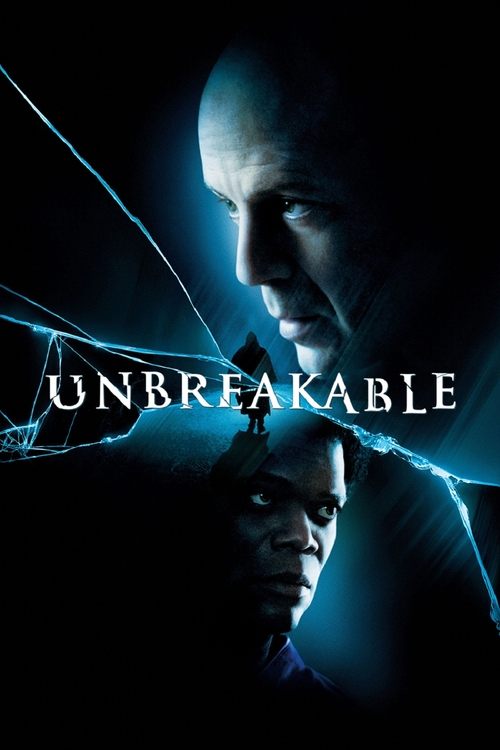
Unbreakable
2000 · M. Night Shyamalan
For when you want a slow-burn mystery to chew on rather than a spectacle — a rainy-Sunday film that treats a fantastical premise with complete seriousness. Bring patience; it pays off.
What it's about
David Dunn, a Philadelphia stadium security guard in a quietly failing marriage, is the sole survivor of a catastrophic train derailment — and he doesn't have a scratch on him. The mystery draws him to Elijah Price, an elegant comic-book art dealer whose bones shatter like glass, who believes David's survival is proof of something extraordinary. What follows is an ordinary man reluctantly testing the limits of who he might be.
The experience
Hushed, melancholy, and deliberately paced — closer to a grief drama than an action film, with tension that accumulates in long, still shots rather than set pieces. It sneaks up on you, and the final minutes recast everything.
Performances
Bruce Willis gives one of his most restrained, sorrowful performances, all heaviness and doubt, while Samuel L. Jackson makes Elijah's brittle-boned intensity both regal and heartbreaking.
The craft
Shyamalan stages the film in long, austere, carefully held takes — conversations caught in mirrors, through train-seat gaps, across muted color schemes — so that the comic-book material feels grave and real. The quiet sound design and unhurried editing make its few eruptions land hard.
Why it matters
Initially overshadowed by the film Shyamalan made before it, it has been steadily revalued as one of the great superhero origin stories told before the genre boom — a grounded, adult take that later comic-book cinema kept circling back to.
Snapshot
A Philadelphia security guard named David Dunn walks away without a scratch from a catastrophic train derailment that kills every other passenger. The accident draws the attention of Elijah Price, a comic-book art dealer whose own bones fracture with devastating ease — a man who has spent his life searching for proof that the human figures in superhero comics are mythological echoes of real extremity. What follows is not a thriller in any conventional sense but a slow, grieving negotiation with destiny: two men at opposite ends of a biological spectrum discovering, across a series of austere and carefully held shots, what it means to be built for catastrophe. The twist that closes the film — Elijah has caused mass disasters across his lifetime solely to locate his antithesis — reframes everything that preceded it as origin mythology and shatters the film's studied quietude in a single breath.
Industry & production
Unbreakable arrived as the direct follow-up to The Sixth Sense (1999), which had become one of the highest-grossing films in Hollywood history and transformed Shyamalan overnight into a director of unusual commercial leverage. Touchstone Pictures and Shyamalan's own Blinding Edge Pictures co-produced; Disney's distribution arm handled theatrical release on November 22, 2000, targeting the Thanksgiving corridor. The film carried a reported production budget in the range of $75 million — a significant allocation that reflected both the studio's confidence in its director and the material demands of a superhero narrative stripped of action-spectacle. The film's domestic theatrical performance, while profitable, fell measurably short of The Sixth Sense's totals, a disparity that shaped how the studio and portions of the critical press received it. Shyamalan has acknowledged in interviews that the film's commercial underperformance relative to its predecessor created lasting friction with Touchstone, and that Unbreakable remained — for nearly two decades — his most personal and least commercially vindicated work.
Technology
Unbreakable was shot on 35mm anamorphic, a format whose wide aspect ratio and specific optical character are integral to the film's compositional grammar. Cinematographer Eduardo Serra (Wings of the Dove, What Dreams May Come) exploited the anamorphic frame to construct lateral arrangements — characters positioned at edges, objects and architectural elements commanding center — that mimic the discrete, bordered panels of printed comics. The production avoided digital intermediate manipulation in ways that would become standard within a few years; the color palette was achieved largely in-camera and through photochemical grading, producing a distinctive muted quality in which saturation is depleted rather than amplified. No significant digital visual effects appear in the film; the action sequences are achieved practically, reinforcing the aesthetic of documentary restraint that governs the whole.
Technique
Cinematography
Serra's work on Unbreakable is among the most disciplined and conceptually integrated studio cinematography of its era. The camera moves infrequently and, when it does, with deliberate slowness — slow pans and gentle tracks rather than motivated cuts. Shyamalan and Serra developed a methodology of holding shots beyond comfort, allowing pauses and silences to accumulate weight inside fixed frames. The result is an observational quality closer to surveillance than classical Hollywood coverage: the camera watches events from positions that feel contingent, accidental, as if it happened to be there. A recurring compositional motif places characters bisected by walls, doorways, or foreground objects, so that human figures are always partially obscured or framed by architectural geometry — a technique that literalizes the comic-panel structure the film meditates on. Color is used symbolically with unusual consistency: David Dunn moves through desaturated greens and browns, while Elijah is associated with deep purple — a coding that runs through costuming, set dressing, and lighting throughout. The film's most celebrated single image may be the overhead shot of David in the hospital bed immediately following the crash, his prone figure centered against institutional white linens in a tableau of eerie composure.
Editing
The editing maintains the camera's patient tempo. Cuts are sparse and never rhythmic in a conventional sense; scenes run long enough that the viewer registers when action is not occurring, when characters simply inhabit space. The decision to withhold conventional reaction-shot coverage — to linger on a speaker rather than cut to the listener — places the audience in a state of prolonged, slightly unsettled attention. The finale, in which on-screen title cards deliver the film's epilogue in the manner of a comic-book text box, functions as an editorial declaration: this is the concluding panel. The critical literature on the film's editing is less extensive than on its cinematography, but the cutting is inseparable from the overall atmosphere of suspended unease Serra's photography establishes.
Mise-en-scène / staging
Staging in Unbreakable is consistently frontal and theatrical, with blocking that isolates characters in depth rather than grouping them. Shyamalan stages conversations so that characters frequently face away from each other — a physical encoding of the marital and emotional estrangement that runs beneath the superhero premise. The scene in which Joseph, David's son, holds a loaded gun and tells his father to prove his invulnerability is staged with both figures separated in the frame, the spatial gap between them measuring the distance between the child's faith and the father's self-doubt. The film's action climaxes — including David's confrontation with a murderer in a suburban home — are staged slowly and without kinetic editing, making violence feel heavy and consequential rather than choreographed. Shyamalan's recurring use of reflections (in glass, in water) multiplies figures within frames, suggesting the doubled, mirrored relationship between David and Elijah that structures the film's symbolic architecture.
Sound
James Newton Howard's score is among the most formally interesting in his extensive collaboration with Shyamalan, which began with The Sixth Sense and extended across multiple subsequent films. The Unbreakable score is sparse, atmospheric, and modal — built on sustained string textures and a recurring piano theme of unusual simplicity that refuses melodic elaboration in the manner of conventional film scoring. Howard withholds musical underscoring in scenes where standard practice would supply it, a restraint that intensifies the film's peculiar quietude. The sound design similarly leans on ambient texture — the ambient hum of the stadium, the specific acoustic character of empty train cars — rather than shock effects. Dialogue is often allowed to drop below ambient sound, requiring the viewer to lean in.
Performance
Bruce Willis gives what many critics, upon reappraisal, identify as the finest performance of his career. David Dunn is a figure of radical interiority: Willis plays him in a near-continuous state of subdued bewilderment, speaking minimally, registering information through micro-adjustments of expression rather than declarative acting. The physical performance is crucial — Willis carries David's invulnerability as a kind of weight rather than a gift, hunching slightly as though exhausted by an existence he cannot fully comprehend. Samuel L. Jackson's Elijah is constructed on opposite principles: precise, highly verbal, mannered in gesture and diction, physically held very still as though every movement carries cost. The chemistry between the two performances is one of strange, wary tenderness, two men who recognize each other across an unbridgeable divide. Robin Wright Penn as Audrey Dunn is largely relegated to the margins of the narrative, though her controlled distance articulates a marriage in quiet collapse without ever overstating it. Spencer Treat Clark as Joseph is required to carry the film's most emotionally exposed scenes and does so without sentimentality.
Narrative & dramatic mode
Unbreakable is structured as a detective narrative in which the mystery is ontological rather than criminal: the central question is not who committed a crime but what kind of being David Dunn is. Shyamalan withholds genre identification; the film refuses to declare itself a superhero film until its closing minutes, maintaining instead the register of a domestic drama with anomalous edges. The slow accumulation of evidence — David's instinctive avoidance of water, his unbroken injury record, his capacity to lift increasingly improbable weights, his visionary access to strangers' sins — follows the rhythm of a case being built rather than a spectacle being assembled. The twist ending operates differently from the one in The Sixth Sense: rather than retroactively altering the plot's facts, it retroactively alters the moral valence of a character we have watched with sympathy and some admiration. Elijah's final revelation is genuinely tragic — the film has been, among other things, a portrait of obsession, and the monster is made of the same material as the miracle.
Genre & cycle
Unbreakable occupies a singular position in the history of American superhero cinema. It was produced in the extended valley between the collapse of the Tim Burton/Joel Schumacher Batman cycle (effectively ended by Batman & Robin in 1997) and the inaugurating moment of the modern Marvel era (Spider-Man, 2002). In this interval, the genre had no dominant template, and Shyamalan exploited the gap to construct a superhero narrative that rejected spectacular convention entirely — no costume, no declared villain identity, no action set pieces in the genre register. The film belongs, generically, to a tradition of mythological realism: the attempt to imagine what heroic archetypes would look and feel like if they happened inside an ordinary, worn, muted American life. Its closest tonal relatives at the time of release were films like Michael Mann's Manhunter (the procedural beneath the surface) and Terrence Malick's contemplative American dramas, though Shyamalan's generic debt is explicitly, and unusually, to the printed comic book rather than to literary or theatrical antecedents.
Authorship & method
Shyamalan wrote, directed, and produced Unbreakable — a triple credit that reflects the degree of personal investment he has described in interviews. He has indicated that the concept underlying Unbreakable was among the ideas he had been developing for years, making it in some respects a more genuinely authored project than The Sixth Sense. The Blinding Edge Productions setup secured him considerable creative autonomy within the studio system, an autonomy that the film's conspicuous lack of conventional entertainment mechanics makes evident. Eduardo Serra's cinematographic collaboration is central to the film's visual identity; the two developed the comic-panel framing methodology explicitly for this project. James Newton Howard's score represents the second installment of a composer-director partnership that shaped the sonic world of Shyamalan's early peak period. Shyamalan makes a cameo appearance — a practice consistent across his filmography — here as a drug dealer briefly encountered in the stadium sequence.
Movement / national cinema
Unbreakable is an American studio film inflected by the specific geography of Philadelphia, where Shyamalan — born in India, raised in the Philadelphia suburbs — has set much of his work. The film's Philadelphia is unglamorous and autumnal: row houses, stadium car parks, commuter trains, the Delaware River. This regional specificity distinguishes Shyamalan's early work from the generic American placelessness of most Hollywood product and gives the film an atmospheric particularity that reinforces its themes of ordinary life concealing extraordinary circumstance. Unbreakable participates in no formally defined national cinema movement, but belongs to a strand of American prestige filmmaking in the late 1990s and early 2000s — associated with figures such as Paul Thomas Anderson, David Fincher, and Steven Soderbergh — that engaged seriously with genre while refusing its conventional satisfactions.
Era / period
Released in November 2000, Unbreakable belongs to a specific pre-9/11 American moment. The film's quiet, melancholic register — its preoccupation with a man unable to locate purpose in peacetime domesticity — reads differently after September 2001 reorganized American cultural narratives around catastrophe and heroic sacrifice. Critics and scholars have noted, without overstating the point, that the film's interest in ordinary men discovering they were built for something catastrophic acquired unexpected resonance in the years following its release. More structurally, it belongs to the brief window in which the superhero genre had not yet been colonized by franchise imperatives, allowing a director to engage with superhero mythology at an oblique, essayistic angle unlikely to be sanctioned by post-MCU commercial logic.
Themes
The film's governing theme is the burden of exceptionality: the question of what it costs, and what it means, to be constitutively unlike the people around you. David's invulnerability is not a gift he desires but a condition he has suppressed and hidden, its disclosure threatening the already fragile accommodation he has made with an ordinary life. Elijah's fragility is the symmetrical curse — an extremity of vulnerability that has driven him to destructive obsession. The film meditates on comic books as a popular mythology that encodes, in displaced form, real truths about human range and fate. Father-son relationship and its stakes — Joseph's faith in his father against David's terror at that faith — runs alongside the primary plot as a more intimate version of the film's central argument: that we are not always equipped to be what the people who love us need us to be. Marriage as quiet catastrophe; the self-knowledge deferred for decades; purpose discovered too late and at too great a cost: these are Unbreakable's real subjects, dressed in the costume of genre.
Reception, canon & influence
Initial critical reception was divided and cooler than its predecessor had generated. Many reviewers found the film slow, self-serious, and willfully withholding — resistant to the pleasures an audience primed by The Sixth Sense might reasonably expect. The box office underperformance relative to The Sixth Sense reinforced a perception that Shyamalan had overreached. In subsequent years, however, Unbreakable underwent one of the more thoroughgoing critical reappraisals in recent American film history. As the superhero genre expanded to cultural dominance through the 2000s and 2010s, critics and cinephiles returned to the film and found it not merely prescient but formally superior to almost everything the MCU era produced — a film that treated the mythological content of the superhero story with exactly the seriousness it warranted while refusing all the genre's compensatory entertainments. By the mid-2010s, it had acquired the status of a canonical work within the genre, regularly cited alongside Batman Begins (2005) and Logan (2017) as evidence that the superhero film was capable of genuine drama.
The influences behind the film are explicit and acknowledged: Shyamalan has cited the earnest mythological ambition of Richard Donner's Superman (1978) as a tonal reference point, and the film's formal construction engages directly with printed comic-book grammar as a visual language rather than treating it as mere source material. The long-take, surveillance-inflected cinematography draws on a tradition of slow European cinema that Serra brought from his European work.
The film's forward influence is substantial. Christopher Nolan has cited a debt to Unbreakable in constructing the grounded, psychologically serious register of Batman Begins and The Dark Knight trilogy, and the film's treatment of superheroism as vocation and identity crisis rather than power fantasy can be traced through Logan, and through the MCU's periodically serious dramatic departures. Most concretely, Shyamalan himself returned to the material eighteen years later: Split (2016) was revealed, in a final scene, to be set in the same universe — a disclosure that constituted perhaps the most effective post-credits sequence in recent genre cinema and inaugurated the so-called Eastrail 177 Trilogy, completed by Glass (2019). That trilogy constitutes an unusual case in contemporary film: a superhero franchise assembled retrospectively around a film that, at its release, had been received as a relative commercial disappointment, and whose rehabilitation was effected not by the industry but by the audience.
A Deleuzian reading
The camera hangs directly above a hospital bed.
The full Deleuzian reading of Unbreakable →
Reception
In 2000 it landed as a muted, 'disappointing' follow-up to The Sixth Sense — critics were lukewarm and Disney marketed it as a spooky thriller rather than what it was. Now it's widely reappraised as maybe Shyamalan's best film, a grounded superhero origin story made almost a decade before the genre took over Hollywood.
How Unbreakable was received, from release to now →
Influences: the films it descends from and the films it influenced
- Vertigo (1958) — The ontological detective structure — an investigator's relentless pursuit of a case that ultimately exposes his own moral complicity — is Hitchcock's formal template that Shyamalan inherits wholesale for Elijah's revelation as architect of his own mythology.
- 2001: A Space Odyssey (1968) — The overhead tableau shot — Kubrick's device for abstracting the human figure into compositional geometry and stripping it of agency — is directly appropriated in the hospital crash sequence that opens Unbreakable, rendering David Dunn as symbol before he is character.
- Le Samouraï (1967) — Melville's construction of a male protagonist who communicates exclusively through spatial behavior and gesture rather than dialogue — radical interiority performed as near-total surface opacity — establishes the performance template Shyamalan adapts for Bruce Willis's near-silent self-excavation.
- Pickpocket (1959) — Bresson's instruction to non-professional models to suppress emotional display — producing behavioral restraint beneath which psychological transformation remains invisible — is the performance methodology Shyamalan applies to both Willis and Jackson, treating affect as something withheld rather than projected.
- Klute (1971) — Gordon Willis's technique of bisecting figures through doorways, walls, and foreground architectural elements — fragmenting bodies to encode surveillance anxiety spatially — is the direct compositional precedent for Eduardo Serra's systematic comic-panel framing throughout Unbreakable.
- The Conversation (1974) — Coppola's placement of the camera at observational remove — subjects filmed as if unknowingly monitored, with ambient sound texture (the crowd noise, the recording hiss) carrying emotional weight that conventional score would undercut — is the aesthetic grammar Serra and Shyamalan inherit for their surveillance-inflected visual style.
- Badlands (1973) — Malick's staging of emotional estrangement through figures facing away from each other inside static wide frames, with an observational camera that refuses to cue or punctuate behavior, is absorbed directly into Shyamalan's blocking methodology for the Dunn marriage scenes.
- Eyes Wide Shut (1999) — Kubrick's anamorphic 35mm framework with color symbolism coded through costuming and set dressing (blue-yellow-red vs. Unbreakable's green-purple), lateral staging of marital estrangement between protagonists sharing domestic space, and the decision to hold on one face rather than cut to the reacting listener, all arrive in Unbreakable as inherited formal choices.
- Chronicle (2012) — Trank inherits Unbreakable's strategy of withholding genre declaration through documentary-style visual restraint, building the emergence of superhero capacity as an ontological discovery filmed in surveillance-camera vocabulary — the found-footage apparatus substituting for Serra's observational remove.
- Logan (2017) — Mangold reconceives the superhero figure as mythological realism — stripping the genre of kinetic spectacle and shooting anamorphic widescreen with a patient, body-in-landscape camera that holds rather than propels — directly inheriting Unbreakable's visual grammar for the superhero as archetype rather than action vehicle.
- Prisoners (2013) — Roger Deakins's anamorphic 35mm compositional grammar — figures fragmented by architectural shadow, ambient texture over conventional effects — applied to an ontological detective narrative whose procedural surface conceals a moral reframing of the investigator's own culpability, extending the formal inheritance Unbreakable established.
- Split (2016) — Shyamalan's direct formal continuation of Unbreakable's cinematographic methodology — anamorphic 35mm panel framing, radical performance interiority, sustained withheld genre declaration — revealed in its final shot to share the same diegetic universe, making Split's entire visual grammar a descendant echo.
- Megamind (2010) — States hero/villain symbiosis as explicit structural thesis — the nemesis exists to give the hero definition — which Megamind literalizes by having the villain, once the hero is gone, manufacture a replacement in order to keep his own job description coherent.
- Caché (2005) — Haneke's fixed surveillance frame — held beyond comfort so that the stillness of observed domestic space becomes structurally menacing — and his closing moral reframing that implicates the protagonist in the violence the film has been recording are exact structural parallels to Unbreakable's observational camera posture and epilogue twist.
- Mulholland Drive (2001) — Lynch's withheld genre declaration — sustaining the syntax of a noir long past the moment a conventional thriller would announce itself, then deploying a structural reframing that retroactively reconfigures all prior footage — is the formal operation Shyamalan executes with Unbreakable's title-card epilogue; both films also use reflective surfaces to literalize doubled or fractured identity.
- A History of Violence (2005) — Cronenberg sustains the syntax of a small-town domestic drama past any conventional genre announcement, then reveals that the ordinary male protagonist's identity is built on concealed extraordinary violent capacity — the same withheld genre declaration and moral-reframing structure that Unbreakable executes across its superhero premise.
- Zodiac (2007) — Fincher's anamorphic procedural grammar — ambient sound texture over conventional score, investigative interiority that cannot achieve closure, and the structural decision to withhold confirmation from an obsessive who has nonetheless identified the truth — runs parallel to Unbreakable's ontological detective architecture and its refusal of conventional revelation.
- The Sixth Sense (1999) — Shyamalan's immediate self-extension — same Philadelphia setting, Fujimoto master-shots, James Newton Howard elegiac score, damaged-father/child dyad, and engineered final-scene twist, made as a deliberate companion.
- Signs (2002) — Shares the house-style of patient long takes, understated performance, and a high-concept premise stated simply then withheld, with the same core craft team.
Similar films
- Signs (2002) — same viewing thread · often watched together
- The Sixth Sense (1999) — same viewing thread
- Split (2017) — same viewing thread
- Zodiac (2007) — influence & lineage · often watched together
- Prisoners (2013) — influence & lineage · often watched together
- Batman Begins (2005) — shared sensibility
- I Am Legend (2007) — shared sensibility
- The Invisible Man (2020) — shared sensibility
All the films related to Unbreakable →
Watch it with: curated runs of related films
- Shyamalan's Wounded Believers — A run of Shyamalan's ordinary-people-meet-the-extraordinary parables — grief, faith, and hidden gifts surfacing in quiet Pennsylvania lives — that reward being watched in sequence as the twist-craft and the belief questions deepen from one to the next.