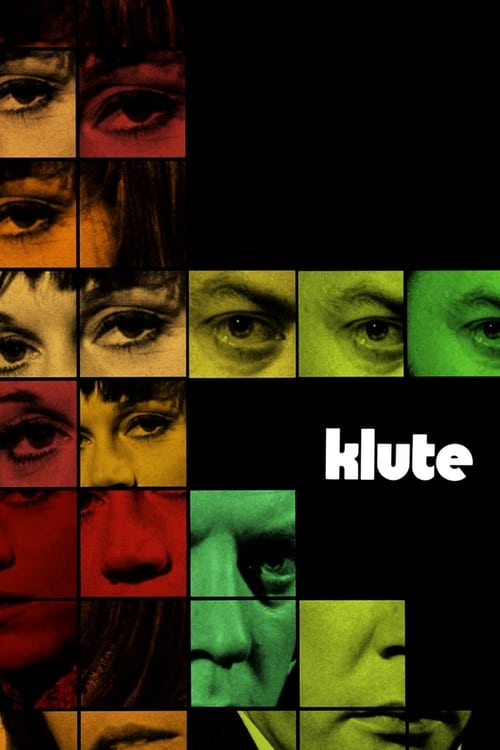
Klute
1971 · Alan J. Pakula
For a moody night when you want a thriller with a brain and a pulse — something to lean into, not veg out to. Reach for it when you're craving atmosphere and a character you'll keep thinking about after.
What it's about
Bree Daniels is a high-priced Manhattan call girl trying to claw her way into acting and out of the life — smart, guarded, and fiercely in control of everything except the fact that someone is stalking her. John Klute, a taciturn small-town detective, comes to New York hunting a missing friend, and his investigation leads straight to Bree. What looks like a thriller becomes a slow-burning study of two wary people circling each other while a killer circles them both.
The experience
Quiet, tense, and grown-up — the dread comes from shadows, tape recordings, and silence rather than shocks. It gets under your skin slowly, and the intimacy is as unnerving as the menace.
Performances
Jane Fonda's Bree is one of the great screen performances — brittle, funny, self-aware, and heartbreakingly exposed in her sessions with a therapist — and it won her the Academy Award. Donald Sutherland does remarkable work in the quieter role, all watchfulness and restraint.
The craft
Gordon Willis shoots New York in deep, encroaching shadow — rooms half-swallowed by darkness, faces lit like confessions — and Michael Small's eerie, chiming score does more with a few notes than most thrillers manage with an orchestra. Pakula's direction turns surveillance itself into the film's texture: everyone is being listened to.
Why it matters
The first film in Pakula's celebrated run of 1970s paranoia thrillers, it helped define the decade's shadowy, psychologically driven American cinema and gave Fonda the role that transformed her career.
Snapshot
A Manhattan call girl named Bree Daniels is being stalked by a killer who has already claimed other victims from her world. A taciturn Pennsylvania detective, John Klute, arrives in the city to investigate the disappearance of a colleague and finds Bree at the center of the case. What unfolds is nominally a thriller — the genre is kept in careful tension — but the film's true subject is Bree's psychology, her ambivalent grip on the independence she has carved from a hostile city, and the ways in which surveillance, desire, and power shape a woman's interior life. The film is named for its male protagonist but belongs, unmistakably, to its female one.
Industry & production
Klute was released by Warner Bros. in June 1971, produced by Alan J. Pakula, who had spent the previous decade as one of Hollywood's most respected producers — his credits included Robert Mulligan's To Kill a Mockingbird (1962), Inside Daisy Clover (1965), and The Sterile Cuckoo (1969), which was also his directorial debut. Klute was his second feature as director and announced, retrospectively, the beginning of what critics would call his "paranoia trilogy," completed by The Parallax View (1974) and All the President's Men (1976). The script was written by brothers Andy Lewis and Dave Lewis from an original story; it was among the first produced works for both writers and shows, in its structural intelligence, a sophistication that outstripped their subsequent careers. The film was shot on location in New York City, principally in Manhattan, which was then undergoing the visible social deterioration — vacant storefronts, street-level vice, fiscal stress — that would make the city a recurring setting for the decade's hardest American films. Detailed production records for Klute are not widely available in the scholarly literature; the internal documentation of the shoot has been sparsely treated in published accounts.
Technology
Gordon Willis served as director of photography. By 1971 Willis had not yet shot The Godfather — that came the following year — and Klute was among the first films to put his approach before a wide audience. Willis worked with available or near-available light sources, supplementing practical lamps and windows rather than flooding the image with studio illumination. He consistently underexposed his negatives and left large portions of the frame in deep shadow, a strategy that ran against prevailing Hollywood norms and initially alarmed lab technicians. The resulting image — dense, grain-forward, radically de-saturated in its shadow areas — became the template for the decade's urban thrillers. The film used long and telephoto lenses extensively, flattening space and creating a sense of compression or enclosure appropriate to the surveillance theme. Pakula and Willis also employed high overhead angles and compositions in which Bree is observed from above or from a concealed vantage, embedding a voyeuristic grammar into the visual grammar of the film before any explicit surveillance device appears in the narrative.
Technique
Cinematography
Willis's signature darkness is not decorative; it performs an argument. The film's villain uses audio recordings to stalk his victims — he is a watcher, a listener, a man who converts intimacy into control — and Willis's camera embodies that predatory perspective. Bree's apartment, a high-ceilinged bohemian space, is lit so that corners and doorways hold impenetrable shadow; even in daylight sequences there is an ambient sense that something is being withheld from view. The climactic sequence in a cavernous, nearly lightless underground space pushes this further, reducing the image to faces caught in narrow shafts of light, the rest of the frame an absorbing black. Pakula and Willis frequently position the camera at a remove from Bree — across a room, behind a window, from above — so that even moments of apparent safety carry a surveillance charge. The visual language of the film prefigures the more explicit meditation on surveillance that Francis Ford Coppola would undertake in The Conversation three years later.
Editing
Carl Lerner edited the film. The cutting pace is deliberately restrained by the standards of contemporary commercial cinema, and particularly slow in the therapy sequences that punctuate the film's structure. Lerner allows Fonda's face sustained duration — reaction shots that extend past the point of conventional comfort, inviting the audience into Bree's hesitation, guardedness, and moments of unguarded revelation. The transitions between Bree's therapy sessions (in which her voice is used as voiceover) and the thriller action create an unusual double register: psychological interiority threaded through a genre framework.
Mise-en-scène / staging
Pakula stages Bree's apartment as a contested space — books, photographs, plants, and the paraphernalia of an active inner life in evident tension with the transactional encounters that also occur there. The garment district locations and the sex-industry interiors of the film's New York are rendered with documentary sobriety rather than sensationalism, consistent with the period's broader New Hollywood commitment to location verisimilitude. A recurring staging choice places male characters at the edges of Bree's space, partially hidden or positioned above her, while placing the camera — and by extension the audience — in similarly ambiguous proximity. The film refuses the objectifying wide shots that would convert Bree into spectacle, consistently privileging close work that keeps her expression legible.
Sound
Michael Small composed the score, a dissonant, jazz-inflected work that operates at the edge of audibility for much of the film. Small's approach — spare orchestration, intrusive silences, melodic lines that refuse resolution — suited the film's refusal of genre comfort. More significant to the film's texture is its use of diegetic sound as a plot mechanism: the killer communicates and pursues through audio recordings, and the thin, distorted quality of tape playback becomes one of the film's most disturbing tonal signatures. The breathing on those recordings — intimate, deliberate, effortful — is among the period's most economical expressions of menace.
Performance
Jane Fonda's performance won the Academy Award for Best Actress and has since been widely regarded as one of the essential performances of American cinema in the 1970s. Fonda researched the role through sustained contact with sex workers in New York and approached the character as a study in self-protective intelligence rather than victimhood. Bree is never passive, never merely frightened; she thinks, calculates, defends, and occasionally advances, even against the man who nominally has power over the investigation. The therapy sessions — in which Fonda speaks directly and without genre performance — became the film's most discussed passages, and their confessional directness set a standard for screen authenticity that few contemporaries matched. Donald Sutherland's Klute is a deliberately counter-expressive creation: quiet, still, observant, present without being comprehensible. The asymmetry between Sutherland's compressed interiority and Fonda's expansive one generates the film's central erotic and dramatic tension. Roy Scheider appears in a significant supporting role as Bree's former pimp; the performance is economical and subtly threatening, a preparation for the fuller work he would do in the following years.
Narrative & dramatic mode
The script is structured around a conventional mystery — a missing man, a series of murders, a revelation of identity — but this armature is consistently subordinated to character process. The mystery is solved, eventually, but the audience's investment has migrated to questions that the genre cannot answer: whether Bree will remain in New York or leave with Klute, and whether that choice constitutes liberation or capitulation. The film's ending is deliberately ambiguous in this regard — Bree's voiceover acknowledges her own uncertainty — and the refusal of a tidy emotional resolution aligns Klute with the contemporary European art film as much as with Hollywood genre. The therapy sessions function as a structural device borrowed more from Bergman or Cassavetes than from the thriller tradition: they interrupt momentum to create depth, and they establish Bree's subjectivity as the film's primary locus of meaning rather than John Klute's investigation.
Genre & cycle
Klute belongs to the early phase of what would become one of the defining generic formations of the 1970s: the American paranoia film. This cycle, which reached its peak between roughly 1971 and 1976, took as its subject the surveillance and corruption of private life by institutional and criminal power — a set of preoccupations that drew obvious energy from Watergate, Vietnam, the exposure of domestic intelligence programs, and a general collapse of faith in authority. Pakula's trilogy is the cycle's most coherent authorial expression, but the concerns Klute articulates are visible across an enormous range of films of the period. Within that cycle, Klute is also a neo-noir: it inherits the femme fatale's milieu (a woman whose sexuality is both weapon and vulnerability in a dangerous urban landscape) while refusing the misogyny that typically structures that figure's narrative function. Bree is not a threat to be neutralized but a subject to be understood, which makes Klute one of the more quietly radical deployments of noir materials in American cinema.
Authorship & method
Pakula came to directing from producing, and the producer's habit of managing collaborative processes — rather than imposing a singular vision — shaped his directorial approach. He described his working method as primarily about creating conditions in which actors could discover rather than executing a predetermined result. His relationship with Fonda on Klute was by several accounts genuinely collaborative; specific accounts of the development of individual scenes are not extensively documented in published sources. His partnership with Gordon Willis, which extended across the paranoia trilogy, was the formative technical relationship of his directorial career and central to establishing the visual identity of his films. Willis brought a cameraman's structural intelligence to the collaboration; Pakula brought a dramaturgist's instinct for psychological rhythm. Michael Small's scores for the trilogy created an atmospheric continuity across the three films, developing a sonic signature that matched Willis's visual one. The Lewis brothers' screenplay, though not revisited by either writer in work of similar ambition, gave Pakula the structural clarity and character depth that his method required.
Movement / national cinema
Klute is squarely a product of New Hollywood: the industry moment, beginning roughly in the late 1960s, when the collapse of the old studio system and the commercial success of films like Bonnie and Clyde (1967), Easy Rider (1969), and Midnight Cowboy (1969) created space for more adult, formally ambitious American films. The movement drew on European art cinema — particularly the French Nouvelle Vague and Italian art film — and on the American independent and documentary traditions, but filtered these influences through commercial frameworks. Klute's location shooting, its tolerance for moral and narrative ambiguity, its centering of a sex worker as a fully realized protagonist, and its distrust of resolution are all characteristic New Hollywood moves. Within that movement, the film belongs to a specifically New York inflection: alongside The French Connection (1971), Mean Streets (1973), Serpico (1973), and Dog Day Afternoon (1975), it helped construct the image of the city as a site of systemic dysfunction and extraordinary human tenacity.
Era / period
The film is a product of the precise cultural moment of 1971: the year of the Pentagon Papers, eighteen months after the killings at Kent State, deep into a protracted and discrediting war, and at a point in second-wave feminism when questions about women's sexual autonomy and the structures that circumscribed it were being articulated with new urgency in public discourse. The film does not address these contexts directly or didactically, but Bree's situation — a woman whose sexuality is simultaneously her source of power and the primary medium through which men attempt to control her — carried a charge in 1971 that was inseparable from its political moment. The therapy sessions, in which Bree articulates her resistance to intimacy in explicitly political terms (the dependency of love as loss of self), spoke to a generation of women working out similar propositions in more ordinary settings.
Themes
Surveillance operates as both plot mechanism and thematic preoccupation: the killer surveils Bree through recordings; Klute surveils her through his investigation; the camera, following Willis's grammar, surveils her continuously. The film asks what it means to live under this kind of observation, and how much of Bree's guardedness — her irony, her professional control — is a response to being perpetually watched. Alongside surveillance runs the theme of power and intimacy: the film is interested in who has the right to know another person and on what terms, and in the ways in which care can be indistinguishable from control. The psychotherapy sessions introduce a parallel theme of self-knowledge as project: Bree's analysis is inconclusive, ongoing, resistant to resolution, which aligns it with the film's broader skepticism about tidy answers. Female autonomy and the costs of its maintenance constitute the film's deepest preoccupation; Bree's professionalism — her insistence on the transactional, her discomfort with the affective — is rendered with enough specificity that it registers as a survival strategy rather than a character flaw.
Reception, canon & influence
On release, Klute was received as a superior commercial thriller distinguished by Fonda's performance. The Academy's recognition of that performance (and a nomination for the Lewis screenplay) reflected a critical consensus that the film was exceptional in its register without fully accounting for what made it exceptional. Over the following decades, feminist film scholarship returned to Klute repeatedly — E. Ann Kaplan and others placed it in discussions of the male gaze and female subjectivity in narrative cinema — and the film's reputation shifted from "accomplished thriller with a great performance" to "central text in the study of gender and representation." Its influence runs in several directions. Within Pakula's own career it established the visual and thematic vocabulary he would refine through The Parallax View and All the President's Men. Gordon Willis's work on Klute, developed through The Godfather the following year and into the rest of the decade, reshaped American cinematographic practice and remains a primary influence on dark, low-key lighting approaches to the present day. The film's surveillance aesthetics feed directly into The Conversation (1974), where Coppola makes the politics of audio monitoring fully explicit; Pakula and Coppola were working in parallel, and the resonances are too close to be accidental.
Looking backward, Klute's most evident predecessors are in classic film noir — its debt to the cynical urban atmosphere and the dangerous-woman figure of 1940s Hollywood is clear — but filtered through the post-Psycho thriller and the psychological realism of 1960s European cinema. Cassavetes' Faces (1968) is a plausible point of reference for the raw, therapy-adjacent quality of the confessional passages. The French Connection (1971), shot in the same city at almost the same moment, shares its documentary texture and its interest in the corruption running beneath the city's surface, though the two films are otherwise temperamentally opposed. What Klute did, at the intersection of these influences, was produce something that could not comfortably be reduced to any of them — a genre film that used genre as cover for a sustained inquiry into interiority, and a feminist film that operated entirely within the commercial system without announcing itself as such.
A Deleuzian reading
Start with a sound.
The full Deleuzian reading of Klute →
Reception
In 1971 it was received as a sleek thriller carried by a career-best Jane Fonda; today it's revered as the opening chapter of Pakula's 'paranoia trilogy' (with The Parallax View and All the President's Men) and a Gordon Willis shadow-drenched masterclass, cemented by its Criterion canonization.
How Klute was received, from release to now →
Influences: the films it descends from and the films it influenced
- The Sweet Smell of Success (1957) — James Wong Howe's Manhattan location cinematography — supplementing practical lamps and windows rather than flooding with studio light, leaving deep shadow pools — established the available-light grammar Willis cited as direct precedent and systematized for Klute.
- Touch of Evil (1958) — Welles and Russell Metty's overhead surveillance framings — the crane shot descending on Charlton Heston through a parking-lot grid — established the predatory bird's-eye angle that Pakula and Willis embed throughout Klute to implicate the camera itself in the stalker's gaze.
- Repulsion (1965) — Polanski stages a single woman's apartment as a contested psychological space where male presences accumulate at the edges and doorways hold threatening shadow; the strategy of making domestic interiors legible as sites of power rather than safety is Klute's direct inheritance.
- Seconds (1966) — James Wong Howe's extreme telephoto compression and the sustained use of high-angle concealed framings to render the protagonist perpetually observed created the paranoia-cinema optics vocabulary Willis refined — particularly the sense that spatial flatness itself encodes surveillance.
- Persona (1966) — Bergman holds reaction close-ups on a woman's face well past the point of dramatic necessity, making silence and guarded expression the film's primary information delivery — the template for Carl Lerner's extended Fonda reaction shots and for using therapy-adjacent sessions as structural anchors.
- Le Samouraï (1967) — Melville structures the entire film as sustained police surveillance — long sequences of officers tailing their suspect through the Metro — and pairs this with François de Roubaix's sparse, harmonically unresolved score; both the surveillance-as-narrative-engine and the dissonant-score-as-unease are foundational to Klute.
- Midnight Cowboy (1969) — Schlesinger and Adam Holender's documentary-realist treatment of New York's sex-trade margins — location shooting in actual hotels, parks, and storefronts, available-light textures — establishes the milieu fidelity and anti-sensationalist sobriety Pakula and Willis adopt wholesale for Bree Daniels's world.
- Marnie (1964) — Pakula systematizes Hitchcock's surveillance-framing as the thriller's formal engine — wire recordings, long-lens trailing, the stalker's hidden observation — while literalizing Marnie's psychoanalytic case study by staging Bree Daniel's actual therapy sessions on screen; Jane Fonda's surface-opacity performance is the direct descendant of Hedren's register.
- Laura (1944) — Pakula extends Laura's investigation-as-archaeology: the detective's psychology is progressively corrupted by erotic entanglement with the case's subject, and a woman's voice on tape recordings functions as the fetish object in place of a portrait — the same mechanism of male obsession organized around a mediated trace of the feminine, with Fonda's withheld interiority sustaining the ambiguity Tierney established.
- Petulia (1968) — Gordon Willis's telephoto surveillance framing — figures observed from distance through environmental obstruction, the camera positioned as a watching instrument — inherits Petulia's observational aesthetic; Jane Fonda's Method internalization, playing concealment and exposure simultaneously within a single scene, extends the register of internalized realism that Julie Christie established in Petulia for female performance under institutional threat.
- The Ipcress File (1965) — Builds the surveillance theme into structure — recorded-tape eavesdropping and off-center framing that isolates the watched figure in oppressive, listening space.
- Breakfast at Tiffany's (1961) — Takes the Manhattan call-girl heroine in the serious, psychologically exposed direction Capote's novella implied — the dark answer to the romance Axelrod sweetened away.
- The Conversation (1974) — Coppola and sound designer Walter Murch take Klute's conceit — diegetic audio recordings as both investigative evidence and moral trap — and build an entire film around it; the tape recorder as a physical object carrying ethical weight, and surveillance as a form of self-destruction, follow directly from Klute's grammar.
- The Parallax View (1974) — Pakula and Willis carry forward Klute's exact visual grammar — telephoto compression flattening crowds into anonymous masses, deep shadow blocking faces, overhead shots positioning the protagonist as unknowing subject of institutional gaze — and extend the surveillance argument from a single predator to a corporate apparatus.
- Three Days of the Condor (1975) — Pollack and Owen Roizman's location-shot New York paranoia thriller deploys the institutional surveillance apparatus and the individual-under-observation grammar that Klute's visual language inaugurated — Roizman's underlit interiors and street-level texture follow directly from Willis's influence on mid-70s DP practice.
- All the President's Men (1976) — Willis's third Pakula collaboration completes the paranoia trilogy by applying Klute's deliberate underexposure and shadow architecture to a documentary-realist newsroom setting — including a famous overhead surveillance shot of the Library of Congress that quotes directly from Klute's grammar.
- Blow Out (1981) — De Palma takes Klute's diegetic-recording device — the stalker's tapes as the mechanism converting intimacy into control — and builds the entire thriller's moral architecture around audio surveillance; Pino Donaggio's spare, unresolved score continues the jazz-inflected dissonance that Michael Small pioneered for the film.
- The Mastermind (2025) — Gordon Willis's underexposed, low-key 1970s palette codified the muted-naturalist look that Blauvelt's desaturated period photography quotes.
- Absolute Power (1997) — Gordon Willis's low-key naturalistic lighting—figures emerging from and receding into shadow without atmospheric embellishment—provides the direct visual grammar Jack N. Green extends throughout the mansion robbery and Washington location sequences.
- The China Syndrome (1979) — Fonda's suppression register here — professional competence as armor over disclosed interiority, the character's ethics enacted through behavioral accumulation rather than declaration — is the exact performance mode she imports as Kimberly Wells; Bridges and Fonda explicitly modeled the character's emotional architecture on Bree Daniell's controlled self-concealment under surveillance.
- Unbreakable (2000) — Gordon Willis's technique of bisecting figures through doorways, walls, and foreground architectural elements — fragmenting bodies to encode surveillance anxiety spatially — is the direct compositional precedent for Eduardo Serra's systematic comic-panel framing throughout Unbreakable.
- The Silence of the Lambs (1991) — Female protagonist navigating predatory male surveillance via shallow-focus intimate singles and a paranoid, restrained sound design — the procedural's gaze-and-vulnerability blueprint.
- Michael Clayton (2007) — Pakula and Willis's claustrophobic, shadow-pooled framing of surveillance and unseen menace pioneers the intimate paranoia that Michael Clayton restages in corporate registers.
- The Insider (1999) — Model for the watched-protagonist drama where surveillance and shadow-heavy interiors externalize a character's vulnerability, anticipating Mann's institutional-isolation staging.
- Chinatown (1974) — Polanski structures his neo-noir investigation around a woman's hidden interior life that the male detective cannot finally penetrate, and refuses genre resolution with a bleakly ambiguous ending — both the detective/woman power dynamic and the anti-cathartic close are crystallized from the template Klute established.
- Night Moves (1975) — Penn and cinematographer Bruce Surtees build a detective thriller in which the investigation ultimately fails and the ending withholds resolution entirely; the film inherits Klute's refusal of genre comfort and extends its analysis of sexual-power asymmetry through the detective/young-woman dynamic.
- Looking for Mr. Goodbar (1977) — Brooks structures the film through recurring therapy sessions that function as voiceover containers for the female protagonist's psychology — directly extending Klute's device of therapy-as-structural-frame — while Diane Keaton's method-research preparation follows the Fonda model of grounding performance in documented social reality.
- Frenzy (1972) — Pakula discloses the killer's identity in the opening sequence and runs suspense entirely through the audience's knowledge gap—the same irony engine as Frenzy—while deploying diegetic sound recordings (the killer's taped voice) as the central dramatic-irony instrument, a structural parallel to Hitchcock's diegetic-ambient counterpoint.
- Serpico (1973) — Gordon Willis's low-key, high-contrast lighting of New York institutional interiors—figures isolated in enclosing darkness, rack-focus shifts between surveillance position and subject—establishes alongside Serpico a shared New Hollywood visual grammar for institutional threat in which the city's architecture itself functions as apparatus; both films use Willis's principle that underexposure of institutional space implies institutional illegibility.
- McCabe & Mrs. Miller (1971) — Gordon Willis's extreme telephoto compression in deep shadow — figures barely distinct from surrounding darkness, ambient urban noise competing with dialogue clarity — pursues the same New Hollywood program as Zsigmond's work on McCabe: using cinematographic technique to destabilize genre legibility and replace convention with unease.
Similar films
- The Conversation (1974) — influence & lineage
- The Parallax View (1974) — influence & lineage
- All the President's Men (1976) — influence & lineage
- Chinatown (1974) — influence & lineage
- Taxi Driver (1976) — shared sensibility
- Fatal Attraction (1987) — shared sensibility
- Basic Instinct (1992) — shared sensibility
- Dirty Harry (1971) — shared sensibility
All the films related to Klute →