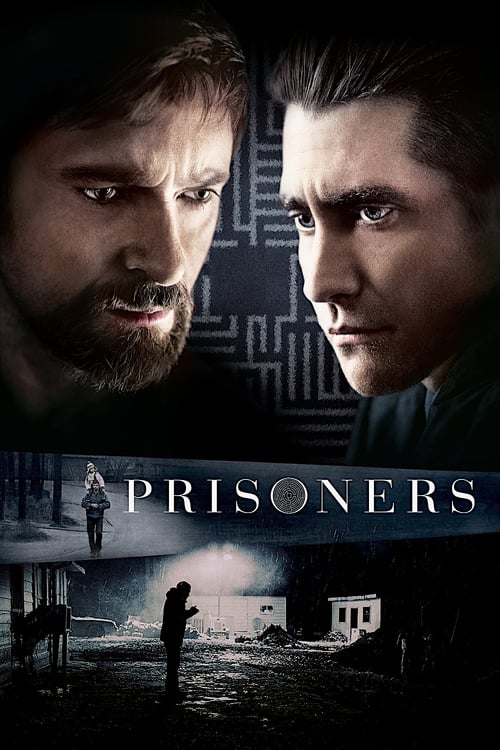
Prisoners
2013 · Denis Villeneuve
The "serious sci-fi" standard-bearer whose Dune films made slow, austere blockbusters a mainstream event, and whose hiring to direct James Bond set off a fresh round of "can an auteur save a franchise" debate. Perpetually invoked in arguments about whether spectacle can still be art.
For a night when you want to be gripped and challenged, not comforted — when you're up for a dark, serious thriller you'll be arguing about at breakfast. Not the pick when you need something light.
What it's about
Two little girls vanish from a quiet Pennsylvania street on Thanksgiving, and the only lead is a shabby RV that was parked nearby. One of the fathers, a survivalist carpenter with a basement full of supplies, decides the police aren't moving fast enough and starts taking matters into his own hands, while a lone-wolf detective works the case through official channels. The two searches run side by side — one methodical, one increasingly desperate — as the hours turn into days.
The experience
A slow, crushing tightening — two and a half hours of gray skies, rain, and dread that never lets you exhale. It's genuinely suspenseful as a mystery, but what lingers is the queasy moral weight: you keep asking yourself what you would do, and you don't like the answer.
Performances
Hugh Jackman burns off every trace of movie-star charm as the father coming apart at the seams, and Jake Gyllenhaal, all blinks and buttoned-up tension, makes a stock detective role feel like a fully lived-in person. They're two of the best performances in either actor's career.
The craft
Roger Deakins shoots a Pennsylvania November so you can feel the cold — rain-streaked windshields, sodium-lit streets, woods the color of wet cardboard — while Jóhann Jóhannsson's score rumbles underneath like a held breath. It's patient, precise filmmaking that earns its length; watch it in the dark with the sound up.
Why it matters
This was Denis Villeneuve's Hollywood arrival, the film that proved he could bring art-house gravity to a studio thriller and set up everything from Sicario to Dune. It's become the modern benchmark for the prestige abduction drama.
Snapshot
Prisoners opens on a deer moving through bare Pennsylvania trees, a boy's rifle trained on it, his father reciting the Lord's Prayer. By its final frames, the film has converted that opening act of controlled violence into a devastating moral question: what does a man become when he does the thing he believes he must? Denis Villeneuve's English-language debut is a 153-minute thriller that refuses the genre's usual consolations — its procedural tension is real, its set-pieces are gut-knotting, but its deepest attention is on how grief and fear strip civilization from a man one justification at a time. Shot by Roger Deakins in the gray-brown palette of a Pennsylvania November, scored by Jóhann Jóhannsson in sub-bass rumble and high string agony, and anchored by performances that run far past the demands of the genre, Prisoners stands as one of the more formally severe and morally unresolved thrillers produced inside the Hollywood studio system in the 2010s.
Industry & production
Prisoners was produced by Alcon Entertainment and released by Warner Bros. Pictures in September 2013. The screenplay by Aaron Guzikowski had circulated in Hollywood for some years and attracted considerable industry attention before finding its footing as a Villeneuve project. For the director, the film represented a decisive pivot: he arrived in Hollywood following the international success of Incendies (2010), his Québécois drama that earned an Academy Award nomination for Best International Feature Film and established him in the serious-auteur tier that studios occasionally court for prestige-thriller material.
The film was shot primarily in and around Atlanta, Georgia, with locations standing in for the fictional Pennsylvanian suburb in which the story unfolds. The casting assembled a formidable ensemble — Hugh Jackman and Viola Davis as one set of parents, Terrence Howard and Maria Bello as another, Jake Gyllenhaal as the lead detective, Melissa Leo in a key supporting role, and Paul Dano as the central suspect. The budget was in the range appropriate to a studio prestige production with above-the-line name talent; exact figures vary by source and the film's producers have not publicized them with precision. The theatrical release was timed to the early fall awards corridor, a positioning that proved commercially and critically astute.
Technology
Deakins shot Prisoners digitally on the ARRI Alexa, continuing his transition away from photochemical film that had accelerated through the early 2010s. He had worked with the Alexa on Skyfall the prior year, and by Prisoners had largely committed to digital acquisition while maintaining the latitude and color discipline of his earlier film work. The choice suited the material: the Alexa's low-light sensitivity allowed Deakins to work with minimal supplemental illumination in many interiors, pushing available light to its limit. Post-production color grading on a digital negative afforded the kind of granular control over the drained, amber-and-gray winter tones that define the film's visual identity. The 2.39:1 anamorphic aspect ratio is retained, giving the Pennsylvania exteriors an expansive, landscape-painting quality that exaggerates the smallness of the human figures against bleak skies.
Technique
Cinematography
Deakins's work in Prisoners is among the most studied of his career, and rightly so: it solves a genuine problem. The film must be oppressive without being inert, and claustrophobic without losing geographical legibility. His solution is tonal consistency over stylistic showmanship — the camera rarely announces itself, yet the cumulative pressure of the image is enormous. Rain is almost constant, not dramatized in heaving downpours but present as a cold fact, slicking every exterior surface. The light is overcast and low, giving faces a flat, exposed quality that removes the glamour usually afforded to Hollywood close-ups.
Several compositional choices recur with structural intent. Vertical lines — bare tree trunks, fences, the slats of the RV — divide frames in ways that suggest confinement and surveillance. Faces are often partially obscured: doorways, reflections, fog. The decision to frequently photograph Keller Dover (Jackman) from slightly below, and Detective Loki (Gyllenhaal) at level or slight elevation, subtly marks their different relationships to authority and legibility without explicit staging instruction. The basement sequences — the site of Dover's most terrible acts — are shot in available-source light pushed to discomfort, never reaching the decorative noir shadows that might aestheticize what is happening there.
Editing
Joel Cox and Gary D. Roach edited the film. Cox's previous work was primarily with Clint Eastwood across several decades (he shared an Academy Award for Unforgiven), and his appointment on a Villeneuve production represented a departure from both men's usual collaborative patterns. The 153-minute runtime was an unusual choice for a studio thriller, and the editing defends it without padding: the film's length is an argument about the weight of the experience, refusing the efficiency that genre convention encourages. Cuts are typically functional rather than expressive — Villeneuve and his editors trust duration over rhythm, allowing scenes to breathe past the point where a genre-coded cut would have released the tension.
Mise-en-scène / staging
The production design establishes the two Dover and Birch households as working- and lower-middle-class American homes — cluttered with the evidence of real domestic life, seasonally decorated, recognizable rather than generic. The contrast with the crime's geography — the dilapidated RV, a labyrinthine house associated with the perpetrators, an abandoned building used as a detention space — is consistent but unforced. Villeneuve stages physical confrontations in wide shots before moving in, so that the spatial logic of violence is always clear; the viewer is never disoriented about where bodies are in relation to one another, which makes the moral disorientation all the more legible as the film's true subject.
The maze motif — drawn and sculpted throughout the film's margins — operates as mise-en-scène rather than exposition: mazes appear in children's drawings, on surfaces, in spatial arrangements, functioning as a visual grammar for entrapment that the film never condescends to explain.
Sound
Jóhann Jóhannsson's score operates in the register of dread rather than shock. The Icelandic composer, who would continue his collaboration with Villeneuve through Sicario, Arrival, and the beginning of Blade Runner 2049 before his death in 2018, builds the Prisoners soundtrack from dense low-string clusters, sub-bass drones, and occasional passages of near-silence that make the next sound event more destabilising. The score avoids melodic resolution in a way that mirrors the film's narrative; it does not comfort, and it does not conclude. Sound design amplifies the cold: rain on rooftops, the particular acoustic of an empty suburban street at night, the contained sound of an interior interrogation.
Performance
Hugh Jackman gives what many consider his most fully realized screen performance, trading on his physique and screen magnetism not to produce heroism but to chart its corruption. Dover is a man of action whose theology of righteous force runs ahead of his morality; Jackman plays this not as villainy but as sincere conviction curdling in real time. Jake Gyllenhaal's Detective Loki is an exercise in precise physical characterization — the neck tattoos suggestive of a past the film doesn't excavate, an involuntary eye-blink that reads as suppressed affect, a contained intensity that contrasts with Jackman's barely-leashed energy. Paul Dano, working at the boundary between sympathy and menace, carries the most difficult assignment in the cast: his Alex Jones must be simultaneously a plausible suspect and an authentic victim without either quality canceling the other. Melissa Leo, in a role that requires revelation in its final act, prepares that revelation almost invisibly across her earlier scenes. Viola Davis brings a gravitational moral weight to a role that the script underserves, her presence alone complicating the film's implicit racial dynamics.
Narrative & dramatic mode
Guzikowski's screenplay is structured as a double procedural: Dover conducts an extralegal investigation grounded in parental terror, Loki a legal one grounded in professional method. The film withholds resolution on whether either procedure actually works — the break in the case, when it comes, arrives from neither's linear effort but from the accumulation of separate partial knowledge. The narrative mode is what might be called moral thriller: the investigation plot is genuine and the mystery is genuinely constructed, but the film's real dramatic engine is the question of what Dover's choices cost him in excess of whatever pragmatic results they produce. The ending — Dover trapped in a pit, a whistle blown, Loki possibly pausing to listen — is an act of deliberate irresolution. The film does not confirm whether Dover is rescued. It refuses catharsis in the way that would allow the audience to retrospectively endorse what he did to obtain survival.
Genre & cycle
Prisoners is a prestige thriller, a category that had been consolidating critical legitimacy since the 1990s (The Silence of the Lambs, Se7en) and expanded in the 2000s and 2010s through films like Zodiac, No Country for Old Men, and The Girl with the Dragon Tattoo. The genre is characterized by extended runtime, serious thematic ambition, A-list casting, auteur-grade cinematography, and a willingness to withhold the genre's conventional satisfactions. Prisoners fits this cycle precisely and contributes to its conventions: the kidnapping-thriller subgenre it inhabits is extended into areas of vigilante morality that earlier iterations (Ransom, Changeling) approached differently. The film also participates in a specifically early-2010s interest in rural and suburban American uncanny — the idea that the manicured surface of community life conceals systematic violence, a cycle that includes films like Prisoners, True Detective (the television series that premiered the following year), and Gone Girl.
Authorship & method
Villeneuve's signature across his career is the moral trap: characters in his films are repeatedly placed in situations where every choice damages something, and where the film refuses to adjudicate between competing damages. This is visible in Incendies (the revelation that collapses the protagonist's moral universe), in Sicario (complicity in state violence), in Arrival (the foreknowledge problem). Prisoners is the first full expression of this method in English-language Hollywood production. His working method is notable for intense pre-production collaboration with his director of photography — Deakins and Villeneuve are reported to have conducted extensive location work before shooting began, establishing the visual grammar of the film in scouting rather than on set, which accounts for the unusual consistency of the image. The Villeneuve-Jóhannsson collaboration, established here and continued through Arrival and Blade Runner 2049, represents one of the more productive director-composer partnerships of the decade: Jóhannsson's scores function as a second layer of psychological temperature, not illustrating emotion but establishing the atmospheric condition in which emotion is experienced.
Aaron Guzikowski's screenplay provides a structural rigor that Villeneuve's instinct for abstraction could have otherwise dissolved. The plot mechanics are carefully engineered — clues, misdirections, and revelations are placed with precision — and this provides the genre armature against which the film's moral ambiguities can be properly experienced as disturbances rather than as mere thematic statements.
Movement / national cinema
Villeneuve is Québécois — educated at the Université du Québec in Montréal, formed in the francophone Canadian film culture that has historically maintained closer aesthetic ties to European cinema than to Hollywood. His early features (Maelström, Polytechnique, Incendies) were produced in that tradition: long-gestating personal projects with strong literary and theatrical antecedents, made in French, resistant to genre. Prisoners inaugurates his Hollywood phase but does not represent a rupture from this formation; rather, it demonstrates how a director shaped by French-Canadian art cinema applies that formation to genre material. The film belongs, then, to a broader phenomenon of the 2000s and 2010s: the absorption of international auteur directors into the Hollywood production system without the corresponding domestication of their sensibilities that the earlier studio system demanded. Villeneuve joins figures like Alfonso Cuarón, Guillermo del Toro, and Park Chan-wook in this trajectory, each bringing a national-cinema toolkit to bear on Hollywood resources and genre conventions.
Era / period
Prisoners is a product of the post-financial-crisis American cultural moment — a period in which mainstream cinema showed renewed appetite for films that dramatize the failure of institutions, the unreliability of community, and the violence that ordinary people commit under ordinary pressures. The film's portrait of suburban Pennsylvania in winter — a world of church attendance, home preparedness, decent neighborly surface — treats that surface as exactly that: a surface above something considerably darker. This is also the era of digital intermediate post-production as standard practice, of the ARRI Alexa's consolidation as the premium acquisition format for prestige productions, and of a particular kind of serious-minded studio filmmaking that greenlit long runtimes and ambiguous endings when attached to recognizable talent.
Themes
The film's central moral inquiry concerns what love permits — specifically, whether the intensity of parental love for a child can justify violence against a person who may or may not be responsible for the child's disappearance. Dover's Calvinist worldhood view — his survivalism, his prayer, his self-reliance — is presented as the ideological infrastructure that makes his actions available to him, and the film does not exempt that worldview from its critical attention. The detective story's usual reassurance (crime will be solved, order will be restored, the right person will suffer) is systematically withheld: the film suggests that in the world it depicts, what actually happens is that wrong people suffer, institutions stumble toward partial solutions, and the person most directly responsible for the greatest violence to an innocent may be the film's protagonist.
The maze — physically realized in the plot, present as motif throughout — figures moral entrapment. Characters who believe themselves to be navigating toward resolution are shown to be tracing circles. The title operates on multiple registers: the obvious referent is the abducted children, but Dover becomes a prisoner of his own method, and the film's ending literalises this in a way that refuses redemptive escape.
Faith, particularly American Protestant faith, is engaged with directly rather than used as atmosphere. Dover's theology is internally coherent; it is also shown to be the mechanism by which a decent man commits atrocity.
Reception, canon & influence
Prisoners premiered at the Toronto International Film Festival in September 2013, where it received the kind of serious critical attention that positioned it for the awards season. Reviews across major critical organs were strongly positive, with Deakins's cinematography and the lead performances attracting particular notice. The film performed well commercially for its genre tier and runtime.
At the 86th Academy Awards, Roger Deakins received a nomination for Best Cinematography — one of his many nominations before his eventual win for Blade Runner 2049 in 2018. The nomination was widely considered deserved; his loss to Emmanuel Lubezki for Gravity was, in retrospect, a collision of two exceptional pieces of work rather than a correction.
The film's backward influences are legible throughout: David Fincher's procedural mode (Se7en, Zodiac) in the investigative structure and color environment; Sidney Lumet's interest in moral corruption under institutional and social pressure; the psychological thriller grammar established by The Silence of the Lambs; and, at the level of moral seriousness and landscape-inflected dread, the Coen Brothers' American Gothic strand (Fargo, No Country for Old Men). The rain-soaked Pacific Northwest and New England crime thriller had a visual tradition Deakins both draws from and clarifies.
The forward influence of Prisoners is most directly traceable through Villeneuve's own subsequent career. Sicario (2015) — again with Deakins, again with Jóhannsson — extends the investigation into institutional violence and moral complicity. Arrival (2016) displaces these concerns into science fiction. Blade Runner 2049 (2017) reunites Villeneuve and Deakins on an even larger canvas. In each case, the film is recognizable as the work of the sensibility that produced Prisoners: extended duration, moral irresolution, formal severity, collaboration with composers and cinematographers across multiple projects. More broadly, Prisoners contributed to making the severe prestige thriller a viable studio proposition — demonstrating that audiences would attend, in large numbers, a 153-minute film that offered no clean resolution and a protagonist whose actions were deeply, uncomfortably wrong.
A Deleuzian reading
A buck steps through bare trees.
The full Deleuzian reading of Prisoners →
Reception
A well-reviewed hit in 2013 (Deakins got an Oscar nod), it has only grown since — retroactively canonized as the film that announced Villeneuve to Hollywood, and now routinely tops 'best thrillers of the 2010s' lists.
How Prisoners was received, from release to now →
Influences: the films it descends from and the films it influenced
- Chinatown (1974) — Structural template of the investigator who uncovers a crime too embedded to correct, producing moral defeat rather than resolution; Guzikowski's screenplay inherits this formal encoding of procedural futility.
- The Silence of the Lambs (1991) — Confinement-staging grammar — tight framing of a captive figure in enclosed space against an investigator operating in open corridors — which Villeneuve redeployed as the visual schema for the Keller/Alex/Loki triptych.
- Heat (1995) — Low-key naturalistic anamorphic widescreen cinematography treating suburb as moral landscape through lens and lighting choice; Deakins inherits Mann and Spinotti's spatial precision for crime environments.
- Se7en (1995) — Rain-drenched desaturated color environment achieved through bleach-bypass and DI processing to encode moral dread within the image; Deakins and Villeneuve extended this photochemical-to-digital grammar via ARRI Alexa on Prisoners.
- Fargo (1996) — American Gothic suburban uncanny — the provincial landscape as location of incomprehensible violence, with procedural investigation that produces no adequate moral accounting; the winter/rain contrast in palette maps directly.
- Memories of Murder (2003) — Double-investigator procedural structure — two investigators with opposed methods working a case that yields no arrest — which Prisoners inherits as its central device (Keller's amateur search running parallel to Loki's police procedural).
- Mystic River (2003) — Suburban procedural that excavates childhood trauma to reveal moral failure in the domestic sphere, using extended performance duration and ambient landscape dread as emotional grammar rather than plot mechanics.
- Zodiac (2007) — Duration-over-rhythm editing strategy in a procedural investigation — scenes run long past conventional dramatic payoff to accumulate investigative texture — used as direct template for Prisoners's 153-minute architecture.
- No Country for Old Men (2007) — Near-silence scoring strategy: radical withholding of non-diegetic music forces sound design and ambient texture to carry emotional freight, which Jóhannsson's sub-bass drone score on Prisoners inherits and extends.
- Gone Baby Gone (2007) — Suburban procedural vigilante morality dilemma — an investigator must choose between lawful process and direct action to protect a child, and either choice damages — which directly precedes Prisoners's philosophical architecture.
- Incendies (2010) — Villeneuve's own double-revelation moral trap: the investigation that collapses the protagonist's ethical universe by making the investigator complicit, transposed from Québécois theatrical drama to Hollywood genre production in Prisoners.
- Insomnia (2002) — Villeneuve and Deakins inherit the moral-inversion investigation thriller set in a winter landscape of spatial ambiguity: Deakins's overlit snow world directly extends Pfister's hostile ambient light, while Jake Gyllenhaal's Loki — a detective whose perceptual failures compromise the investigation — is the formal descendant of Dormer's guilt-shaped consciousness.
- Sicario (2015) — Direct continuation of the Villeneuve-Deakins-Jóhannsson three-way collaboration, extending Prisoners's interrogation of institutional violence and moral complicity via the same sub-bass score architecture, anamorphic widescreen staging, and withheld catharsis.
- Arrival (2016) — Displaces Prisoners's moral trap — a choice made in full knowledge of its cost — into science fiction; Jóhannsson's sub-bass drone and Villeneuve's duration-over-rhythm editing carry unchanged across the genre shift.
- Blade Runner 2049 (2017) — Villeneuve-Deakins collaboration at maximum scale: anamorphic widescreen and vertical confinement framing extended into sci-fi world-building, and duration-over-rhythm editing applied to a 163-minute studio production.
- Wind River (2017) — Rural American landscape as hostile moral terrain in a prestige thriller investigating child death; physical characterization driving procedural investigation that produces accountability without healing — the genre mode Prisoners established as commercially viable.
- Chithha (2023) — Threads a thriller through a guardian's desperation after a child vanishes, sustaining dread via withheld information and moral corrosion rather than action set-pieces.
- Gone Girl (2014) — Suburban American uncanny prestige thriller demonstrating that wide audiences would attend a film whose domestic order conceals irreparable moral damage; the digital intermediate palette and refusal of catharsis as a viable market proposition.
- Nocturnal Animals (2016) — Double procedural structure — a nested fictional thriller embedded within a contemporary frame — in which both layers withhold catharsis; physical characterization as the primary emotional engine in a prestige-thriller formal register.
- I Saw the Devil (2010) — The surveillance-as-complicity structure — Villeneuve positions the audience as voyeurs to a vigilante's escalating torture using sustained, uncut observation rather than editorial fragmentation, forcing a complicity structurally parallel to I Saw the Devil's GPS-monitoring device where the audience witnesses murders it cannot prevent.
- Three Billboards Outside Ebbing, Missouri (2017) — Roger Deakins' systematic frontal-wide framing of interrogation and confrontation scenes between characters with incommensurable moral positions — the grieving father, the detective, the suspect — and the prestige crime drama's refusal to cleanly endorse the protagonist's extralegal violence constitute parallel formal and ethical strategies.
- Weapons (2025) — Missing-child procedural using de-dramatized cinematography and silence as primary dread instruments; the investigative structure functioning as a container for distributed community trauma rather than a mechanism oriented toward closure.
- The Batman (2022) — A grim, rain-dark abduction procedural with a clue-leaving antagonist and a morally exhausted investigator, shot in Deakins's low-key palette — the same tonal register of the elevated genre thriller.
- To Catch a Killer (2023) — The closest tonal sibling: a grave, slow-build abduction procedural in cold winter light where moral discomfort is sustained unrelieved and the genre's grim atmosphere is treated with prestige seriousness.
- Luther: The Fallen Sun (2023) — A grim abduction-manhunt thriller built on doubling between hunter and quarry, shot in Deakins's rain-soaked, near-monochrome nocturnal gloom.
- The Lovely Bones (2009) — The American suburban child-abduction thriller built on withholding suspense framing around an ordinary neighborhood predator — extends the crime-thriller half of the hybrid without the fantasy register.
- The Black Phone (2022) — A child-abduction procedural whose wintry, desaturated cinematography and slow-dread staging of parental helplessness parallel the film's kidnapping engine and period-cold palette.
- Changeling (2008) — Reworks the child-abduction-plus-failing-authorities procedural in the same muted, photochemical-look register, centering a parent's ordeal against a police apparatus that cannot deliver justice.
- Law Abiding Citizen (2009) — Runs the duel-of-proceduralisms in parallel — a detective's methodical casework cross-cut against a private, extralegal interrogation — sustained by patient dialogue holds and an audio floor that drops to room tone before each act of violence.
Similar films
- Sicario (2015) — influence & lineage · same viewing thread · often watched together
- Incendies (2010) — influence & lineage · same viewing thread
- Zodiac (2007) — influence & lineage · often watched together
- Blade Runner 2049 (2017) — influence & lineage · often watched together
- Arrival (2016) — influence & lineage
- Wind River (2017) — influence & lineage
- Enemy (2013) — same viewing thread
- Memories of Murder (2003) — influence & lineage · often watched together
All the films related to Prisoners →
Watch it with: curated runs of related films
- Villeneuve's Kingdom of Dread — A run through Denis Villeneuve's dread years — vanished people, buried family secrets, moral rot, and uncanny doubles — best watched in order to feel one director tighten his grip on unease from Quebec art house to Hollywood thriller.