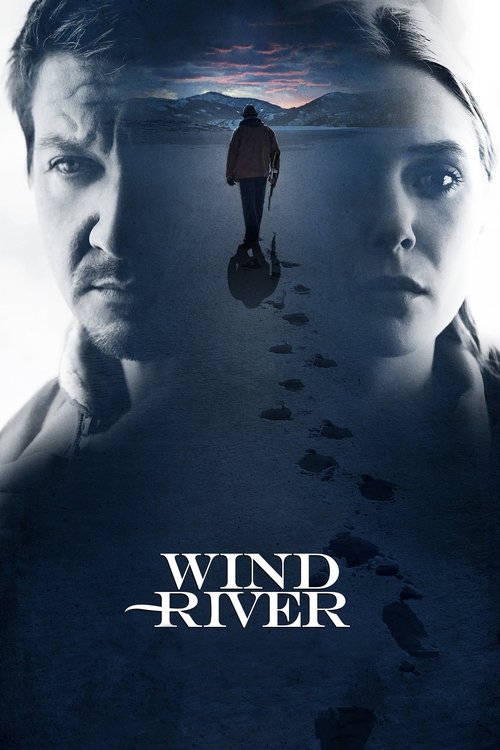
Wind River
2017 · Taylor Sheridan
For when you want a serious, absorbing crime story that treats its subject with weight — think slow-burn thriller for a winter night, one that leaves you sadder and angrier than you expected.
What it's about
A young Native American woman is found dead in the Wyoming snow, miles from anywhere, and the case lands on an underprepared FBI agent flown in alone from Las Vegas. She partners with a local wildlife tracker — a man carrying his own loss — to work the case across the frozen expanse of the Wind River reservation, where jurisdiction is murky and help is hours away. It's a murder investigation that doubles as a portrait of a community the system has abandoned.
The experience
Cold, quiet, and coiled — long stretches of snowbound stillness broken by sudden, brutal violence, with an undertow of grief running beneath the procedural. It ends somewhere between catharsis and heartbreak.
Performances
Jeremy Renner gives one of his best performances as the tracker, all restraint and buried sorrow, and Elizabeth Olsen makes the agent's out-of-her-depth determination feel real. Gil Birmingham, as a grieving father, delivers the film's most devastating scenes in just a handful of minutes.
The craft
Taylor Sheridan's directing debut pairs his flinty, plainspoken dialogue with a real feel for landscape — the white emptiness of Wyoming becomes the film's true antagonist. The violence, when it comes, is staged with shocking clarity, and one mid-film sequence is a masterclass in escalating dread.
Why it matters
It completed Sheridan's loose trilogy of modern-frontier crime films and drew national attention to the crisis of missing and murdered Indigenous women — the closing title card became one of the most-cited endings of its decade.
Snapshot
A young Native American woman is found frozen in the Wyoming snow, miles from any road, barefoot. Her death opens Taylor Sheridan's directorial debut — a slow-burn crime film set on the Wind River Indian Reservation that doubles as an elegy for the victims of systemic state neglect. Where Sheridan's previous scripts (Sicario, Hell or High Water) were filtered through the visions of other directors, Wind River is the first work in which his thematic preoccupations — the failure of institutions, masculine grief, the American frontier as moral vacuum — are fused directly with compositional choices. The result is a film whose procedural surface conceals an almost classical tragic structure, and whose final title card — noting that the United States keeps missing-persons statistics for every demographic except Native American women — converts genre entertainment into accusation.
Industry & production
Wind River was produced on a modest budget, estimated in the low-to-mid eight figures, by Acacia Filmed Entertainment and Film 44, the production company of actor-director Peter Berg, who served as a producer. Berg had already collaborated with Sheridan's world of lean, location-driven American genre work, and his involvement helped secure cast and financing for a project that major studios would likely have considered uncommercial. The Weinstein Company acquired US distribution rights and opened the film wide in August 2017; the film outperformed expectations at the specialty box office before the Weinstein scandal broke that October, a coincidence of timing that left the film stranded in an awkward cultural moment. Despite the reputational contamination of its distributor, Wind River retained critical goodwill and found an extended life on streaming platforms, where its audience grew substantially.
The production shot primarily in Utah — Park City and the Uinta Mountains standing in for the Wyoming reservation — with some material captured on location in Wyoming itself. Shooting in deep winter provided both authentic atmosphere and considerable logistical difficulty. The decision to film on or near reservation land and to cast Native American actors in substantive roles (Graham Greene, Gil Birmingham, Julia Jones) rather than in purely peripheral parts was a deliberate gesture toward a production practice that the film's politics demanded.
Technology
Wind River was shot on 35mm film using anamorphic lenses, a choice that cinematographer Ben Richardson has cited as essential to the film's spatial ambition: the wide aspect ratio (approximately 2.39:1) allowed the landscape to press into every frame, keeping the human figures dwarfed and contextually diminished. The grain structure of 35mm added a tactile coldness that digital acquisition would have cleaned away. No significant visual effects work was required; the film's aesthetic is one of radical location fidelity. Color grading leaned into the blue-gray tones of winter light without overcooking the desaturation — shadows retain texture, and the occasional warmth of an interior becomes a zone of precarious refuge rather than comfort.
Technique
Cinematography
Ben Richardson — best known before Wind River for Beasts of the Southern Wild (2012), a film of swampy, verité warmth — here inverts his typical register entirely. The camera in Wind River is deliberate and often still, holding compositions long enough to let silence and geography accumulate meaning. Richardson favors wide establishing shots that place the reservation's infrastructure — a scattering of trailers, a gas station, a few government buildings — against an annihilating snow field. The effect is not merely scenic; it visualizes the film's central argument about jurisdictional abandonment, the way a landscape this extreme makes governance feel optional.
The tracking sequences — Cory Lambert (Jeremy Renner) moving through snow on snowshoes, following animal and human trails — are shot with a restrained steadiness that emphasizes competence and purpose. In contrast, the film's violence erupts in sequences shot with more aggressive cutting and closer framings. The most technically remarkable sequence, a sexual assault rendered in retrospective reconstruction, uses a handheld register that conveys violation without explicit depiction, cutting away before the worst and returning to consequence.
Editing
Gary D. Roach's editing operates at a pace that modern studio genre films rarely permit. Scenes breathe. Conversations are not cut for efficiency but for emotional weight, allowing actors to register responses rather than simply deliver lines. The structural boldness of the film lies in its handling of the climactic confrontation: Sheridan and Roach present a standoff that erupts simultaneously from two angles, cross-cutting in a way that withholds narrative satisfaction by distributing violence symmetrically. No single moment of catharsis is available; instead, the editing insists on the mutual bloodshed as a kind of tragic equivalence.
Mise-en-scène / staging
Sheridan stages scenes with a writer's instinct for dramatic economy. The interior sequences — Lambert's conversations with the bereaved father Martin (Gil Birmingham), the FBI agent Jane Banner's (Elizabeth Olsen) negotiations with tribal police chief Ben (Graham Greene) — are positioned and blocked with a minimum of cinematic flourish, keeping emphasis on performance and word. The outdoor sequences use geography as motivation: characters must work to move through space, and the physical effort of trudging through snow is never elided. The final standoff is choreographed with a precision that recalls the functional violence staging of Michael Mann — positions are established, sightlines matter, and the terrain is treated as a tactical grid.
Sound
Nick Cave and Warren Ellis composed the score, continuing what had by 2017 become one of the more distinctive partnerships in American film music — they had previously scored The Proposition (2005), The Road (2009), Lawless (2012), and Sheridan's own Hell or High Water (2016). Their Wind River work is characteristically bleak: sustained string tones, electronic drone textures, and the occasional sparse melody that sits at the edge of the audible. The score rarely asserts itself; it behaves more like weather than commentary, filling silence without directing emotional response. Sound design is used sparingly but effectively — the crunch of snow, the howl of wind, the distant sound of a snowmobile — to keep the physical environment present in every scene.
Performance
Jeremy Renner gives perhaps the most fully realized performance of his career in Wind River, playing a man whose grief over the death of his own mixed-race daughter — a fact disclosed gradually — is held under such rigid containment that it seems physically structural, like a supporting wall. Renner conveys backstory through posture and cadence rather than exposition, and the few scenes in which Lambert's control fractures are the more devastating for their rarity. Elizabeth Olsen is somewhat underserved by the script, her Banner functioning partly as an expository stand-in for the audience's outsider perspective, but she handles the physical and emotional demands of the role with credibility.
The supporting cast anchors the film's moral weight. Gil Birmingham, as the bereaved father Martin Hanson, delivers a monologue on grief — delivered sitting in a chair, speaking with the even tone of a man who has already survived the worst — that is one of the most quietly devastating pieces of acting in an American film of the decade. Graham Greene brings his customary authority and dry irony to the tribal police chief, a figure who understands the jurisdictional inadequacy of his situation without being broken by it.
Narrative & dramatic mode
Wind River is structured as a procedural — the investigation of a death — but its procedural mechanics are a delivery system for something older: a tragedy of irresolvable guilt, set in a landscape where the state has effectively absented itself. The detective plot arrives at a solution, but the solution offers no comfort; the answer merely confirms what the film has been arguing all along, that the violence visited on Native American women is systemic, predictable, and willfully ignored. Sheridan's screenplay withholds the assault sequence until late in the film, reversing the standard crime-drama practice of opening with the victim's suffering, instead requiring the audience to build a relationship with the consequences of violence before being made to witness its origins.
The narrative's final movement — the standoff, the revelation, the grieving father's final frame — refuses closure. Lambert's final act, sitting vigil with Martin in the manner of a Comanche tradition Martin teaches him, gestures toward a cultural exchange that cannot undo the loss but represents what remains after institutions have failed.
Genre & cycle
Wind River belongs to the neo-Western crime thriller cycle that dominated serious American genre filmmaking in the 2010s, a cycle with roots in No Country for Old Men (2007) and Winter's Bone (2010) and a particular momentum in the mid-decade cluster that includes True Grit (2010), Prisoners (2013), Sicario (2015), Hell or High Water (2016), and Arrival's cinematographer Roger Deakins's sustained dominance of the visual grammar of bleak American space. These films share an investment in landscapes as moral indexes, in institutional failure as a given rather than a surprise, and in violence as consequence rather than spectacle.
Within this cycle, Wind River is notable for its foregrounding of a historically marginalized subject: the MMIW (Missing and Murdered Indigenous Women) crisis. While films had occasionally addressed reservation life and Native American experience, the combination of genre accessibility and direct advocacy language — the final title card — made Wind River unusual in its willingness to convert entertainment into public-health argument.
Authorship & method
Taylor Sheridan had established himself as one of the more capable screenwriters of his generation before directing Wind River, working from an instinct for landscape-embedded morality that critics aligned with the tradition of Cormac McCarthy. His method as writer-director appears consistent with his work as writer-for-hire: he begins with place as moral condition, constructs characters whose interiority is expressed through occupation and physical relationship to landscape, and engineers dramatic confrontations that resist the catharsis they appear to promise.
Ben Richardson's cinematographic sensibility — his willingness to let the camera be patient, to treat landscape as a collaborator rather than a backdrop — proved well matched to Sheridan's material. Nick Cave and Warren Ellis brought a continuity of tone from Hell or High Water (2016), their previous Sheridan collaboration, cementing a house style across Sheridan's emerging body of work as director. The editorial collaboration with Gary D. Roach appears to have been decisive in establishing the film's disciplined pace, though detailed accounts of the editing process are not well documented in the public record.
Movement / national cinema
Wind River is an American film without obvious attachment to a regional movement, though its investment in Western landscape aesthetics, Indigenous subject matter, and neo-frontier mythology places it within a strain of American cinema that has intermittently engaged with the actual human cost of the settler-colonial project. It is not a film of the American independent scene in the Sundance mode — its genre infrastructure and star casting position it closer to prestige-adjacent commercial cinema — yet its subject matter and advocacy function gave it a different cultural circulation than its marketing suggested.
Era / period
The film is a product of the mid-2010s moment of American genre cinema, when a generation of crime and Western films sought moral seriousness by foregrounding systemic failure — the war on drugs, predatory banking, reservation poverty — as the context for individual drama. It belongs to the same cultural moment as the renewed public discourse around Indigenous rights that intensified around the Standing Rock protests of 2016, though Wind River was written before that crisis reached national visibility and its alignment with that conversation was coincidental rather than calculated.
Themes
Grief — specifically masculine grief, its encoding in physical labor and controlled affect — is the film's primary emotional territory. Cory Lambert's survival after his daughter's death is inseparable from his occupation: he stays alive by moving through the landscape, tracking, killing, maintaining a relationship to a world that has not become abstract to him.
The failure of the American state to provide protection to its most marginal populations is the film's structural argument. The overlapping and often contradictory jurisdiction of federal, tribal, and state law enforcement on reservation land is presented not as procedural complexity but as designed abandonment. Jane Banner's repeated acknowledgment that she is operating outside her competence is less a character flaw than a diagnosis: the system sends its least-resourced representative to the most neglected corner.
The film also meditates on the specific violence of isolation — geographic, cultural, economic — and on the way extreme environments both attract and destroy the people who stay within them.
Reception, canon & influence
Wind River premiered at the Sundance Film Festival in January 2017 and subsequently screened at Cannes, where Sheridan was awarded the Best Director prize in the Un Certain Regard section. Critical reception was strong, with particular praise directed at Renner's performance, Richardson's cinematography, and Sheridan's willingness to embed genre mechanics within an explicit advocacy framework. Some critics noted the structural centrality of a white male protagonist in a story about Native American women's suffering as an unresolved tension — the film's outsider-investigator framing is a formal choice that carries ideological weight.
Looking backward, the film's most visible influences include the spare, landscape-embedded menace of No Country for Old Men; the working-class crime moral seriousness of Winter's Bone; and the visual grammar of survival-in-winter established by The Revenant (2015), which likely contributed to the market viability of anamorphic, 35mm-shot extreme-weather Americana in the mid-decade period.
Looking forward, Wind River consolidated Sheridan's position as a filmmaker with a definable aesthetic and thematic signature, leading directly to Yellowstone (2018), the Paramount Network series that has become one of the highest-rated cable dramas of the era, and its subsequent franchise offshoots (1883, 1923, etc.). Sheridan's influence on American prestige television's engagement with Western landscapes and neo-frontier mythology is substantial and largely traceable to the credibility he accrued through this trilogy. The film also had a modest but measurable effect on media visibility of the MMIW crisis, cited in several subsequent journalistic investigations and advocacy campaigns as a catalyst for general-audience awareness.
A Deleuzian reading
She is barefoot.
The full Deleuzian reading of Wind River →
Reception
It landed at Sundance 2017 to warm reviews and won Sheridan the Un Certain Regard directing prize at Cannes, but the Weinstein Company's collapse that fall torpedoed its awards push — since then it's steadily climbed into 'most underrated film of the 2010s' territory, endlessly rediscovered as Sheridan's Yellowstone empire grew.
How Wind River was received, from release to now →
Influences: the films it descends from and the films it influenced
- Fargo (1996) — The Coens establish the template Wind River directly mirrors: extreme winter landscape as moral isolator for a crime procedural, with symmetrical investigator/criminal cross-cutting and a structure in which the investigation illuminates community devastation without delivering catharsis.
- A Simple Plan (1998) — Alar Kivilo's deep Minnesota winter functions as moral pressure rather than atmosphere — a crime thriller built on contained-affect performances and slow deliberate pace in which the landscape itself seems to foreclose escape and judgment — an ancestor of Wind River's genre logic.
- Brokeback Mountain (2005) — Rodrigo Prieto's anamorphic wide-establishing shots encode masculine grief as landscape condition — men structurally incapable of expressing emotion against vast Western terrain — the visual and emotional grammar Wind River inherits directly for its own masculine-grief theme.
- No Country for Old Men (2007) — Deakins' anamorphic wide frames render violence small against indifferent West Texas landscape, and the procedural ends without justice or catharsis — both the visual grammar and the catharsis-refused structure are the templates Sheridan rebuilds in Wyoming snow.
- Frozen River (2008) — Hunt's crime procedural set in winter on Mohawk reservation territory critiques law enforcement's institutional failure to protect Indigenous women with contained-affect performance and documentary-register cinematography — the specific political-formal combination Wind River refines.
- Winter's Bone (2010) — Granik embeds a working-class crime procedural in specific regional American landscape with a protagonist navigating masculine institutional failure through contained-affect determination — the register, architecture, and casting instinct Wind River directly inherits.
- True Grit (2010) — Deakins' 35mm anamorphic cinematography places a justice-seeking protagonist inside a procedural Western in which unglamorous violence is staged functionally and the ending withholds the moral resolution the genre appears to promise — a formal predecessor to Wind River's procedural architecture.
- Prisoners (2013) — Villeneuve's withheld-violence reconstruction structure — the crime against a child is narrated through investigation, testimony, and physical evidence rather than staged — is the specific narrative device Wind River deploys for its own central sexual assault.
- The Revenant (2015) — Lubezki's 35mm anamorphic shooting of extreme winter wilderness — light-source discipline, patient wide frames, landscape treated as collaborator rather than backdrop — established the market vocabulary Ben Richardson's Wind River cinematography explicitly builds on.
- Sicario (2015) — Sheridan's own screenplay established the outsider-investigator entering an opaque institutional landscape that fails morally — the procedural withholding architecture, the law-enforcement protagonist who learns the system is the corruption, is the formal proposition Wind River repeats as writer-director.
- Hell or High Water (2016) — Nick Cave and Warren Ellis's drone-ambient score aesthetic — the tonal language of working-class Western despair they built for this Sheridan-scripted film — was carried directly into Wind River, cementing a Cave/Ellis/Sheridan house sound across the frontier trilogy.
- Insomnia (2002) — Sheridan transposes the perpetual-daylight-as-guilt device into a snowbound register: the white, featureless winter terrain functions as moral exposure — a world in which wrongdoing cannot hide in shadow — extending the visual grammar Pfister established in Insomnia's Arctic summer sequences to a contemporary crime procedural.
- The Power of the Dog (2021) — Ari Wegner's patient anamorphic wide frames, Jonny Greenwood's ambient-texture score, and contained-affect masculine repression rendered through procedural tension extend the neo-western emotional register Wind River helped consolidate — the formal vocabulary refined to a literary pitch.
- Yellowstone (2018) — Sheridan deploys the same anamorphic wide-establishing landscape grammar, character-through-occupation interiority, and ambient-drone score aesthetic in prestige television — a franchise whose scale and audience are directly traceable to the authorial credibility Wind River established.
- Hostiles (2017) — Cooper's period Western uses 35mm cinematography to render violence against Indigenous peoples within a procedural journey structure, sharing Wind River's unresolved tension between centering Native trauma and filtering it through a white male protagonist's moral reckoning.
- Three Billboards Outside Ebbing, Missouri (2017) — A sibling in the 2017 prestige crime cycle: institutional failure in the investigation of violence against a woman, contained-affect performance, and a procedural-as-tragedy structure that withholds the moral resolution the genre architecture promises.
- Sicario: Day of the Soldado (2018) — Sheridan's directorial companion piece — the same surrogate-paternity motif and avenging-protector framework set against a lawless American periphery.
- To Catch a Killer (2023) — Extends the snowbound, cold-light investigation as character study, using a frozen landscape and interiorized, withholding performances to carry a procedural about violence at the social margins.
- The Order (2024) — Anthropological restraint toward violence in the rural American margins, with a suppressed-register lawman and a refusal of sensationalism that mirrors Kurzel's sobriety.
Similar films
- Hell or High Water (2016) — influence & lineage · same viewing thread
- True Grit (2010) — influence & lineage · same viewing thread
- Hostiles (2017) — influence & lineage
- No Country for Old Men (2007) — influence & lineage
- Sicario (2015) — influence & lineage
- The Revenant (2015) — influence & lineage
- Brokeback Mountain (2005) — influence & lineage
- Prisoners (2013) — influence & lineage
All the films related to Wind River →
Watch it with: curated runs of related films
- The Frontier's Long Shadow — A run of American myths going to seed — outlaws, oilmen, and foreclosed ranchers set against big country that outlasts them all; watch them close together and the classic Western slowly dissolves into its elegiac modern kin.