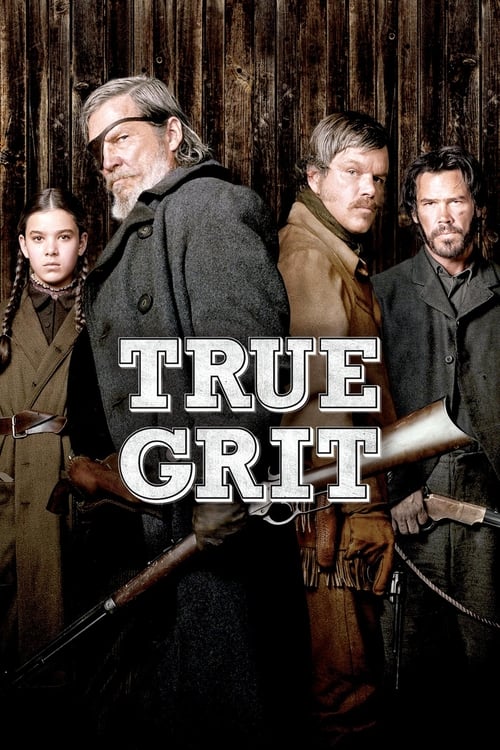
True Grit
2010 · Joel Coen
For a wintry evening when you want a proper story — a quest, vivid characters, gorgeous country — with more soul than a popcorn Western. Comfort viewing with a melancholy aftertaste.
What it's about
After her father is murdered by a hired hand who rides off into Indian Territory, fourteen-year-old Mattie Ross decides the law will do nothing unless she makes it. So she hires the meanest U.S. Marshal she can find — the one-eyed, whiskey-soaked Rooster Cogburn — and insists on riding along, with a preening Texas Ranger complicating the party. What follows is a manhunt across hard winter country, narrated years later by the woman that girl became.
The experience
Funnier than you expect and sadder than it lets on — the formal, King-James-flavored dialogue gives every exchange a strange music, and the adventure keeps deepening into an elegy about what stubbornness costs. It's brisk, violent in sudden bursts, and quietly devastating around the edges.
Performances
Hailee Steinfeld, in her screen debut at thirteen, carries the film — she delivers dense, archaic dialogue like she was born to it and out-stares every adult in the frame, earning an Oscar nomination. Jeff Bridges makes Rooster Cogburn a growling ruin with a buried decency, and Matt Damon is a sly comic surprise as the vain Texas Ranger.
The craft
The Coen brothers adapt Charles Portis's novel with unusual fidelity, keeping its dry wit and its narrator's proud, rueful voice. Roger Deakins's cinematography turns the winter plains into something stark and biblical, and Carter Burwell's hymn-based score gives the whole pursuit the feel of a remembered psalm. Absolutely worth the biggest screen you have.
Why it matters
A rare thing — a Western that was both a major box-office hit and a ten-time Oscar nominee — it proved the genre still had commercial life and launched Hailee Steinfeld's career overnight.
Snapshot
The Coen Brothers' adaptation of Charles Portis's 1968 novel is a fastidiously faithful literary Western, as much an exercise in American vernacular prose as it is a genre picture. Where Henry Hathaway's 1969 version with John Wayne filtered the story through the conventions of the classical Hollywood Western, the Coens return to Portis's first-person voice—the retrospective memoir of a one-armed spinster named Mattie Ross, recounting events from her fourteenth year with an unmistakable mixture of pride and rue. The result is an elegy dressed as an adventure, in which the pursuit of a hired killer across Indian Territory becomes an inquiry into what grit actually costs.
Industry & production
Paramount Pictures produced and distributed the film, with Scott Rudin among the producers. The Coens had long admired Portis's novel; they have cited their adaptation as a corrective restoration rather than a reinvention, distinguishing it clearly from the 1969 Hathaway film. Casting Mattie Ross required an extensive search among young actresses; Hailee Steinfeld, then thirteen, was selected after the Coens reportedly saw hundreds of candidates. Her casting as the nominal lead under the "supporting actress" category at the Academy Awards generated significant commentary about the industry's reluctance to center major films on a young female protagonist.
The production filmed largely in New Mexico and Texas—the former standing in for both the Arkansas river-bottom towns and the Indian Territory plains of the novel's world—with certain sequences drawing on the landscape of the Texas Panhandle. The period reconstruction, under production designer Jess Gonchor, aimed for material authenticity: the Arkansas frontier of the 1870s as a place of mud, commerce, and improvised civilization rather than the burnished myth of the classical Western. Costume designer Mary Zophres dressed the cast in clothing that reads as worn and functional rather than decorative.
The film was budgeted modestly by studio standards for a prestige production and earned a substantial return at the box office, performing well beyond expectations for a widescreen Western with no major action star in the lead role. It received ten Academy Award nominations—including Best Picture and Best Director—but won none, a shut-out that surprised many observers given the breadth of the nomination sweep.
Technology
Roger Deakins shot the film on 35mm film using anamorphic lenses, yielding a 2.39:1 aspect ratio that grants the landscape sequences their full panoramic weight. The choice of photochemical acquisition for a 2010 studio production was already becoming less common; Deakins, who would later move substantially toward digital acquisition, here made full use of film's particular grain structure and tonal latitude. A digital intermediate was used in post-production for grading, allowing a controlled desaturation of the palette and the careful calibration of contrast that characterizes the film's look. No significant digital visual effects are present—the period world is built practically on location and on set.
Technique
Cinematography
Deakins' work on True Grit is among the most discussed of his long collaboration with the Coens. The palette is deliberately muted—dusty ochres, gray-browns, the pale sky of an open plains winter—with color temperature and saturation tuned to evoke a world before the myth of the West had been burnished. The film resists the golden-hour cinematography that has sentimentalized the genre; light here is flat, cold, or firelit. The campfire scenes carry a warm luminescence that reads as intimate and precarious against the surrounding darkness, and the film's night sequences—particularly the ride through the wilderness under a hard moon—use natural-source logic with a spareness that is almost theatrical.
Deakins composes in long focal lengths that compress figure and landscape, placing characters against vast backgrounds that dwarf them without romanticizing their scale. The anamorphic frame is used for stillness as often as for sweep; many of the most characteristic shots are static two-shots or single close-ups in which the wide frame produces a slightly alienating negative space. There is none of the handheld urgency common to contemporaneous prestige films—camera movement is deliberate and motivated, and the film's most violent moments are handled with an abruptness, rather than a stylized kineticism, that recalls the Coens' own earlier work.
Editing
The film is edited under the pseudonym Roderick Jaynes, the fictional English editor the Coens have used as their shared credit since the 1990s. The cutting rhythm is unhurried by modern standards, allowing scenes to breathe well past the point where a more conventionally paced film would cut. Dialogue scenes carry their full weight; the Coens do not trim Portis's language for speed. The result is a film that runs slightly over two hours and feels neither padded nor tight—each scene occupying exactly the space required by its verbal and dramatic content. The action sequences—most notably the climactic open-field confrontation—are cut with a brisk, almost casual brevity that makes violence feel sudden and provisional rather than choreographed.
Mise-en-scène / staging
The Coens stage principally for the camera and for language. Character blocking tends toward formal arrangements—figures placed in deliberate spatial relationship to one another, with movement used sparingly and expressively. The negotiating scenes between Mattie and the adults who underestimate her are staged as comedic power struggles in which the teenager systematically occupies ground; she enters spaces, declines to be dismissed, controls exits. These scenes owe their comedy to spatial positioning as much as to dialogue. The period world is presented without apology or explanation: the hanging, the dead men, the frontier justice are simply the texture of this world, treated with Portis's own matter-of-fact register.
Sound
Skip Lievsay, the Coens' long-term sound collaborator, designs a soundscape that insists on the emptiness and strangeness of the wilderness. Ambient sound is used with deliberate restraint—wind, horse hooves on hard ground, birdsong that draws attention to itself by its presence or absence. Gunshots are sharp and unglamourized. The score by Carter Burwell weaves arrangements of nineteenth-century Protestant hymns—most prominently "Leaning on the Everlasting Arms"—through the film, present most often as a solo or small ensemble rather than full orchestration. This choice roots the music in the period's actual devotional culture and gives the film an elegiac, slightly spectral quality that underscores the retrospective frame.
Performance
Jeff Bridges' Rooster Cogburn is the most deliberate departure from the 1969 film, and from the mythology of the frontier marshal more broadly. Where John Wayne's Cogburn was garrulous and broadly loveable, Bridges plays him as genuinely ravaged: physically deteriorating, morally equivocal, often difficult to understand. Bridges made the bold choice to deliver much of his dialogue in a compressed mumble that requires the audience's attention, treating the character's verbal style as an expression of someone who has stopped performing for outside observation. The character's actual heroism, when it finally arrives, is tinged with the desperate rather than the triumphant.
Hailee Steinfeld is the film's center of gravity, and her performance is technically and tonally remarkable. Mattie speaks in the novel's archaizing, contractual formality—no contractions, no sentimentality—and Steinfeld sustains this register without making it feel like a stunt. The character's certainty is absolute and slightly frightening; the performance conveys a child who has, in some essential way, already decided to be old. Matt Damon as LaBoeuf provides ironic counterweight, embodying a version of masculine competence that the film steadily punctures; his performance is finely calibrated for a comedy of wounded vanity. Barry Pepper's Lucky Ned Pepper, with limited screen time, suggests a fully inhabited figure, and Josh Brolin's Tom Chaney is notable precisely for being unremarkable—the murderer at the center of the story is merely a brutish, frightened man.
Narrative & dramatic mode
The film's governing narrative device—older Mattie's voice-over, beginning and ending the story—is taken directly from Portis and transforms genre convention. Elizabeth Marvel voices the elderly Mattie in the coda, making explicit what the entire film implies: that this is a story told from the distance of decades, shaped by a consciousness that has made meaning of it. The retrospective frame produces a specific tonal register that the Coens sustain throughout: the story is already over, its outcome already known to the teller, and what we are watching is the construction of a myth that the teller both endorses and regards with ironic clarity.
The film resists classical Western plotting in several respects. The antagonist, Tom Chaney, is neither imposing nor particularly dangerous; justice, when it arrives, is grotesque rather than satisfying; and the epilogue, in which an older, one-armed Mattie visits a now-declining Cogburn at a Wild West show, refuses the transcendence that the genre customarily provides. True grit, the film suggests, is real but costs something.
Genre & cycle
True Grit belongs to the literary Western, a strand of the genre that has periodically attempted to recover or construct an "authentic" frontier as against the myth. It arrived at a moment—roughly the first two decades of the twenty-first century—when the Western was undergoing a sustained critical reconsideration in American cinema, with films like No Country for Old Men (2007), Meek's Cutoff (2010), Django Unchained (2012), The Assassination of Jesse James by the Coward Robert Ford (2007), and Hell or High Water (2016) constituting something like a loose cycle of anti-mythological or revisionist Westerns that returned to the genre's historical and moral materials with new skepticism. True Grit is unusual within this cycle for declining the label of revisionism—the Coens have said they intended to make, simply, a Western—and for deriving its formal severity from fidelity to a literary source rather than from ideological critique.
Authorship & method
The film is credited to Joel Coen as director and Ethan Coen as producer, but this represents the formal division required by guild agreements rather than the actual working method; the brothers write, develop, and direct in full collaboration, and the "Roderick Jaynes" editing credit makes explicit the indivisibility of their process. The Coens' method on True Grit was, by their accounts, unusually faithful to a source text—they have described the screenplay as close transcription from Portis, aiming to translate his prose rhythms directly into dialogue.
Roger Deakins joined the Coens beginning with Barton Fink (1991) and has been central to their visual language ever since. His work here exhibits the compositional stillness and landscape grandeur of their shared visual grammar at a high point of refinement. Carter Burwell has scored every Coen Brothers film; his use here of preexisting hymn material rather than original composition represents an adaptation of his usual method to the film's period world. The screenplay is adapted from Portis by the Coens themselves, making this one of their rare literary adaptations rather than original scripts, alongside No Country for Old Men.
Movement / national cinema
American cinema, specifically the strand of Hollywood filmmaking that emerged from the independent and art-house traditions of the 1980s and achieved mainstream studio integration in the 1990s and 2000s. The Coens represent a particular version of American auteurism—studio-financed, genre-rooted, formally rigorous—and True Grit is one of their most commercially legible works, presenting an auteurist sensibility through the most canonical American genre. There is no meaningful international film movement context beyond this: it is, deliberately, a deeply American work.
Era / period
The film is set in the early 1870s in Arkansas and the Indian Territory (present-day Oklahoma), a period the film handles with some historical sobriety. The Indian Territory—land held by the Five Civilized Tribes under treaty—appears as a space of contested jurisdiction, beyond the reach of U.S. law, which the film presents as an actual legal and territorial condition rather than simple frontier metaphor. The hanging sequence early in the film registers this historical period with unusual specificity; the hanged men include a Native man whose execution is interrupted before he can speak, a detail Portis included and the Coens preserve.
Themes
Justice and its limits are the film's central preoccupation. Mattie's quest is framed as a legal and moral project—she seeks lawful hanging, not simply revenge—but the narrative steadily reveals the gap between stated aims and actual outcomes. The man she hunts is less formidable than her sense of justice requires; the marshal she hires is far less upright. The film is interested in the relationship between certainty and cost: Mattie's undeviating moral conviction is presented as admirable and, ultimately, as the quality that loses her an arm and leads her to a life defined by isolation and remembered injury.
Memory and narration are structural concerns. The older Mattie is not a sentimental narrator; she is precise, slightly cold, and aware of the gap between the story as it should be told and what actually happened. The film is also interested, obliquely, in commerce and negotiation—Mattie is a relentless businessperson, and her scenes of financial dickering are among the film's most comic—as a form of human activity that the Western genre has generally overlooked.
Reception, canon & influence
Critical reception was strongly positive on release, with Deakins' cinematography and Steinfeld's performance attracting particular praise. The ten Academy Award nominations constituted an unusual breadth of industry recognition for a Western—a genre rarely favored by the Academy—and the shutout was widely noted as anomalous given the breadth of recognition. Several critics who had been skeptical of the Coens during their more abrasive early career phase received True Grit as evidence of a productive late-career maturation toward emotional openness.
The film's backward influences are traceable to Portis's novel as primary source; the 1969 Hathaway film as a predecessor to be revised or superseded; and the Coens' own No Country for Old Men as the immediate antecedent that established the register of violent, morally serious, landscape-oriented American genre filmmaking in which True Grit participates. Sergio Leone's grammar of wide-frame Western space is a diffuse influence on the visual language, mediated through Deakins.
Its forward influence is harder to isolate precisely. It contributed to and helped legitimize the Western cycle of the 2010s; Quentin Tarantino's Django Unchained and The Hateful Eight can be seen in part as responses to the possibility of the literary, serious-minded Western that True Grit demonstrated was commercially viable. Steinfeld's career as a leading actress derives entirely from this film. The dossier of Deakins' work on the Coen films remains among the most studied bodies of cinematographic practice in contemporary American cinema, and True Grit occupies a central position in that body. Its specific long-term influence on filmmaking practice, beyond its role in the Western cycle, remains to be fully assessed.
A Deleuzian reading
The last image is a woman walking away from a grave.
The full Deleuzian reading of True Grit →
Reception
A hit from day one — the Coens' biggest box-office success and a 10-Oscar nominee — but it's since settled into an odd spot: fans keep 're-discovering' it as secretly top-tier Coen rather than the 'minor, classical' entry it was first filed under.
How True Grit was received, from release to now →
Influences: the films it descends from and the films it influenced
- True Grit (1969) — The Coens adapted Portis's archaizing dialogue rhythms directly from the novel rather than updating them, treating this film as a predecessor to supersede; Mattie's formal speech register and the prose texture of the source are the shared raw material both versions transcribe.
- No Country for Old Men (2007) — The Coens' immediately prior film established the precise template carried into True Grit: Deakins' anamorphic long-focal compression of sun-bleached American landscape, unhurried editing punctuated by abrupt violence, and literary adaptation of a morally serious genre novel as the production method.
- The Assassination of Jesse James by the Coward Robert Ford (2007) — Deakins shot both films, carrying his anamorphic ultra-long-focal technique—severe background compression, optical vignetting, and period-correct desaturation—directly from Jesse James into True Grit; the visual grammar of both is functionally identical, including the retrospective-voiceover temporal structure.
- Once Upon a Time in the West (1968) — Leone's grammar of staging power relationships through extreme spatial distance within the anamorphic frame—figures placed at opposite poles of a wide composition to encode hierarchy before a word is spoken—is the direct formal ancestor of Deakins' compositions for True Grit, as the dossier explicitly notes.
- Unforgiven (1992) — Eastwood established the revisionist template of the anti-heroic marshal whose violence is morally contaminating rather than redemptive, paired with a desaturated palette that systematically denied the golden-light convention of classical Westerns; both structural choices are the bedrock True Grit inherits.
- McCabe & Mrs. Miller (1971) — Vilmos Zsigmond's deliberately underexposed, diffusion-filtered, winter-light photography was the first systematic break with the golden-hour convention in Western cinematography; the anti-golden-hour, overcast-light palette Deakins deploys throughout True Grit extends this specific innovation.
- Days of Heaven (1978) — Linda Manz's retrospective voiceover—a young female narrator recounting violent events in an American landscape, grammatically vernacular but poetically charged—is the formal model for Mattie Ross's adult retrospective narration, which uses the same device to simultaneously produce and undercut nostalgic distance from frontier violence.
- O Brother, Where Art Thou? (2000) — T Bone Burnett's assembly of preexisting sacred and folk recordings as dramatic underscore—rather than original composition—established the Coens' appetite for this scoring method, which Carter Burwell then adapted for True Grit by treating preexisting hymn material as the film's musical identity rather than composing original cues.
- 3:10 to Yuma (2007) — Roger Deakins's 2.39:1 anamorphic widescreen uses period-naturalistic lamplight and overcast exteriors in the same compositional mode as Papamichael, while Carter Burwell's minor-key score sustains irresolution; the journey structure accumulates calibrated counterpoint performance in explicit continuation of the post-classical Western grammar Mangold advanced.
- Paper Moon (1973) — Sends a hardened adult and a relentlessly capable, deadpan-articulate child across a period landscape, extending the criminally-tinged surrogate bond with an unresolved parting.
- Hell or High Water (2016) — Part of the Western revival True Grit helped legitimize; Giles Nuttgen's long focal length compression of Texas scrubland and desaturated daylight palette directly extends Deakins' visual grammar, and the film's unhurried editing rhythm punctuated by abrupt violence replicates the Coen pacing signature within a neo-Western frame.
- The Ballad of Buster Scruggs (2018) — Deakins carried his True Grit anamorphic long-focal grammar directly into this Coens Western anthology; the archaizing dialogue register, deliberate desaturation of period landscape, and Carter Burwell's folk-hymn scoring approach are all continuations of True Grit's specific formal vocabulary within the same authorial collaboration.
- Wind River (2017) — Deakins' 35mm anamorphic cinematography places a justice-seeking protagonist inside a procedural Western in which unglamorous violence is staged functionally and the ending withholds the moral resolution the genre appears to promise — a formal predecessor to Wind River's procedural architecture.
- Django Unchained (2012) — Tarantino has identified True Grit as demonstrating the commercial viability of the serious, literarily-grounded American period film; Django shares its use of long focal length landscape compression, its structure of a single-minded avenger pursuing justice through morally contaminated means, and its refusal to apologize for formal deliberateness.
- The Hateful Eight (2015) — Shot in Ultra Panavision 70mm anamorphic as an explicit engagement with the expressive potential of wide-format composition that True Grit's Deakins imagery demonstrated; both films structure their drama through the spatial power negotiation of armed characters with competing legal claims, and both use hymn-adjacent sacred music as underscore.
- Slow West (2015) — Maclean's literary Western uses the same anti-golden-hour, overcast-light palette and long focal length landscape compression to demythologize the West; its archaizing narrative register and abrupt action cutting within passages of deliberate quiet replicate the specific editorial rhythm the Coens established.
- Bone Tomahawk (2015) — Zahler employs an archaizing dialogue register—formal, grammatically elaborate, period-accurate diction delivered without ironic distancing—that parallels the Coens' direct transcription of Portis's speech rhythms; both films also use unhurried editing that allows character exchange to breathe at length before abrupt, devastating violence.
- The Revenant (2015) — Lubezki's natural-light-only photography, explicitly eschewing golden-hour warmth for harsh blue-gray winter light, extends the anti-golden-hour methodology Deakins deployed in True Grit; both films also frame the revenge drive as a morally exhausting rather than satisfying process against desolate American wilderness.
- Logan (2017) — Pairs a grizzled, depleted guardian with a precocious child on a Western journey, framing the mentor's obsolescence and mortality as the emotional spine.
Similar films
- Hell or High Water (2016) — influence & lineage · same viewing thread
- The Assassination of Jesse James by the Coward Robert Ford (2007) — influence & lineage · same viewing thread
- Unforgiven (1992) — influence & lineage · often watched together
- No Country for Old Men (2007) — influence & lineage
- The Hateful Eight (2015) — influence & lineage
- The Revenant (2015) — influence & lineage
- O Brother, Where Art Thou? (2000) — influence & lineage
- 3:10 to Yuma (2007) — same viewing thread · often watched together
All the films related to True Grit →
Watch it with: curated runs of related films
- The Frontier's Long Shadow — A run of American myths going to seed — outlaws, oilmen, and foreclosed ranchers set against big country that outlasts them all; watch them close together and the classic Western slowly dissolves into its elegiac modern kin.