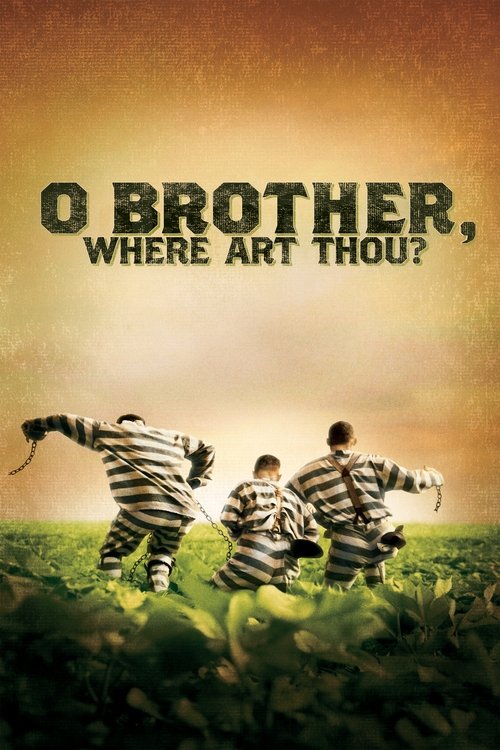
O Brother, Where Art Thou?
2000 · Joel Coen
A perfect crowd-pleaser for when you want to laugh without turning your brain off — great with friends, great on a rewatch, comfort viewing with craft under the hood.
What it's about
Mississippi, the 1930s: three convicts — fast-talking Ulysses Everett McGill, ornery Pete, and sweet dim Delmar — bust off a chain gang to recover a buried treasure before a dam floods the valley. What follows is a tall-tale odyssey through the Depression-era South, complete with a blind prophet, singing sirens, a one-eyed Bible salesman, crooked politicians, and an accidental hit record.
The experience
Breezy, silly, and endlessly quotable — it rolls along like a folk song, one absurd episode after another, with the music doing half the storytelling. You grin most of the way through and hum the rest of the week.
Performances
George Clooney is a revelation in full screwball mode, all pomade and ten-dollar words as Everett; John Turturro and Tim Blake Nelson round out one of the great comic trios, and Nelson's guileless Delmar quietly steals scenes.
The craft
This was a landmark of digital color grading — the Coens and cinematographer Roger Deakins bleached the green out of the South to get that dusty, sepia storybook look, essentially inventing a technique now used everywhere. T Bone Burnett's old-time gospel, blues, and bluegrass soundtrack is inseparable from the film. Sounds glorious on good speakers.
Why it matters
The soundtrack became a phenomenon bigger than the film itself, selling millions and single-handedly reviving mainstream interest in American roots music. Its pioneering digital color work changed how movies look.
Snapshot
O Brother, Where Art Thou? is a Depression-era picaresque comedy that recasts Homer's Odyssey as a chain-gang escape through the American South. Made by Joel and Ethan Coen — credited at the time to Joel as director and Ethan as producer, though both functioned as co-authors throughout their career — the film follows Ulysses Everett McGill (George Clooney) and two fellow convicts, Pete (John Turturro) and Delmar (Tim Blake Nelson), as they flee a Mississippi prison farm in pursuit of buried treasure, encountering sirens, a one-eyed Bible salesman, a blind prophet, and the machinery of 1930s Southern politics. Its most consequential gesture was aesthetic and musical rather than narrative: a sepia, sun-bleached digitally-graded image and a roots-music soundtrack curated by T Bone Burnett that became a genuine cultural phenomenon, far outstripping the film itself in long-term reach. The picture sits at a hinge in the Coens' filmography — between the cold formalism of Fargo (1996) and The Big Lebowski (1998) and the more openly musical, performative comedies that followed — and at a technical hinge for the industry, as one of the first studio features fully color-graded by a digital intermediate.
Industry & production
The film was produced by Working Title Films, the British company run by Tim Bevan and Eric Fellner, and released through Touchstone Pictures (Buena Vista / Disney) in the United States and Universal internationally — a distribution split typical of Working Title's late-1990s output and its relationships with both studios. The Coens had an established working partnership with Working Title dating to Fargo and The Big Lebowski, which gave them a degree of autonomy unusual for a studio comedy. Principal photography took place largely in Mississippi in 1999, using rural locations, small towns, and rivers to stand in for the Depression South.
The casting of George Clooney was significant for both star and filmmakers: Clooney, then transitioning from television (ER) to film leading-man status, took a broadly comic, vain, fast-talking role that played against his emerging matinee image, and the collaboration became a recurring one (he later appeared in the Coens' Intolerable Cruelty and Burn After Reading, the loosely linked "numbskull trilogy"). The supporting ensemble drew on Coen regulars (John Turturro, John Goodman, Charles Durning, Holly Hunter, Michael Badalucco) and newcomers to their world.
The single most important production decision was musical. T Bone Burnett was engaged as music producer and assembled the soundtrack of pre-war and traditional American songs — bluegrass, gospel, blues, country, and old-time string-band music — before and during production, with several sequences shot to playback. The soundtrack album, released on Mercury/Lost Highway, became a major commercial success on its own terms, won the Grammy for Album of the Year, and is widely credited with catalyzing a wider revival of interest in American roots and "Americana" music in the early 2000s. The album's success, including the touring concert film and live event Down from the Mountain, is one of the clearest cases of a film's ancillary music outpacing the film in cultural durability.
Technology
O Brother, Where Art Thou? is routinely cited as a landmark in the adoption of the digital intermediate (DI). The Coens and cinematographer Roger Deakins wanted a parched, autumnal, sepia-and-gold palette evoking hand-tinted photographs and faded postcards of the Depression era. The Mississippi summer locations were, in reality, lush and green. Conventional photochemical timing could not reliably suppress that green and impose the desired warm, dust-bowl tonality across an entire feature.
The solution was to scan the photographed negative into digital files, color-grade the film digitally (work carried out at Cinesite), and record the result back out to film for release prints. This made it, by broad consensus in the cinematography and post-production literature, the first feature film to be digitally color-graded in its entirety — a process that within a few years became standard for studio filmmaking. Deakins has discussed the project repeatedly as a turning point in his understanding of what the image could be manipulated to do after the camera. The film thus occupies a documented place in the historiography of post-production technology, independent of its other merits.
Technique
Cinematography
Roger Deakins, the Coens' principal cinematographer from Barton Fink onward, shot the film in anamorphic widescreen (a 2.39:1 frame), exploiting the format's horizontal sweep for the long Southern roads, cotton fields, and river vistas the journey traverses. The signature is the aforementioned color treatment: desaturated greens, warm ambers and ochres, and a slightly hazy, sunstruck quality that gives the whole film the look of a recovered artifact. The lighting favors hard Southern daylight and golden-hour warmth, with set-piece exceptions — the nighttime Klan rally staged with torch-lit, theatrically choreographed geometry, and the eerie underwater/flood imagery near the close. Deakins's compositions are characteristically precise and frontal, organizing the trio in balanced, almost tableau-like arrangements.
Editing
The Coens edit their own films under the pseudonym Roderick Jaynes (a fictional editor who has, notably, received Oscar nominations). The cutting here serves an episodic, road-movie rhythm: the narrative proceeds as a series of discrete encounters, each given a self-contained comic shape, strung along the throughline of the journey and the pursuit. The editing supports the film's tonal control — the precise timing of deadpan reactions, the abrupt arrival and departure of figures (the baptism procession, the sirens, the bank robber Babyface Nelson) — and synchronizes tightly with the pre-recorded musical numbers, where performance, image, and song are cut together as integrated sequences rather than score laid over footage.
Mise-en-scène / staging
Production design (Dennis Gassner) and costume (Mary Zophres) reconstruct a stylized 1930s South: weathered storefronts, gospel-tent revivals, political stump speeches, radio stations, and chain-gang labor, all rendered with the slightly heightened, fable-like clarity the Coens favor. The staging is frequently theatrical and frontal — characters arranged for the audience, gestures broad — consistent with the film's roots in myth and tall tale rather than realism. Recurring motifs (the trio handcuffed or moving in a line, the pomade obsession, signage and period graphics) give the world a designed, legible texture.
Sound
Sound is arguably the film's organizing principle. Music is diegetic and structural: the convicts become, almost accidentally, the recording act "the Soggy Bottom Boys," whose performance of "Man of Constant Sorrow" becomes a plot engine. Rather than orchestral underscore, the film leans on a continuous fabric of period-style roots songs — "Down to the River to Pray," "I'll Fly Away," "O Death," "In the Highways," "Keep on the Sunny Side" — performed by artists including Alison Krauss, Emmylou Harris, Gillian Welch, Ralph Stanley, Dan Tyminski (who provided Clooney's singing voice), and others. The sound design integrates these with environmental textures of the rural South, and the music carries thematic weight (mortality, salvation, deliverance) that the dialogue treats comically.
Performance
Clooney's Everett is a verbose, vain, self-mythologizing con man, and the performance is built on rapid patter, physical comedy, and an undercurrent of genuine yearning to return to his wife and family — the Odyssean homecoming. Turturro and Nelson supply contrasting registers (Pete's volatility, Delmar's wide-eyed credulity), forming a classic comic trio. The supporting turns are vivid and stylized: John Goodman's menacing one-eyed Big Dan Teague (the Cyclops), Charles Durning's incumbent governor Pappy O'Daniel, Tim Blake Nelson's gentle simplicity, Chris Thomas King as bluesman Tommy Johnson, and Holly Hunter as the pragmatic Penny. The acting style is pitched toward caricature and fable rather than psychological naturalism, in keeping with the film's mode.
Narrative & dramatic mode
The film is openly framed as an adaptation of Homer's Odyssey — the opening titles credit Homer, a characteristic Coen joke that is also a sincere structural key — though the brothers have said they never actually read the poem in full, drawing instead on its mythic outline. The mode is picaresque: an episodic journey narrative in which a roguish protagonist passes through a sequence of self-contained adventures, encountering archetypal figures (the prophet, the sirens, the Cyclops, the suitor, the temptress) reimagined in Depression-South dress. The treasure quest functions as a MacGuffin and a lie — the "treasure" is revealed to be Everett's scheme to reach his estranged wife before she remarries — folding the Odyssey's nostos (homecoming) into the structure. The narrative braids myth with American folklore and history: a thinly veiled Klan rally, a populist gubernatorial campaign, a blind seer on a railway handcar, a flood that resolves the plot like a deus ex machina (rooted in real New Deal–era dam and electrification projects). The tone is comic and fabulistic, holding violence and historical horror at an ironic, stylized distance.
Genre & cycle
The film is a hybrid: road movie, prison-break comedy, musical, and mock-epic. It belongs to a lineage of Depression-set American films — its title is lifted directly from the fictional socially-conscious movie that the director Sullivan dreams of making in Preston Sturges's Sullivan's Travels (1941), a knowing meta-reference, since Sturges's film argues that comedy, not earnest social drama, is what suffering people actually need. O Brother effectively makes the comedy Sullivan never made. Within the Coens' own output it inaugurates a more musical, performative comic strain and continues their recurring fascination with American regional vernacular, scams, and idiots and innocents adrift in larger schemes. As a musical it is unusual: a non-musical narrative saturated with diegetic song, closer to a folk-music revue than to the integrated book musical.
Authorship & method
The film is a paradigmatic Coen brothers work, even with Joel solo-credited as director and Ethan as producer (they would later share directing credit openly). Their method is visible throughout: meticulous scripting, tight storyboarding, control over editing under the Jaynes pseudonym, deadpan irony, literary and cinematic allusion worn lightly, and a fascination with American idiom and place. The key collaborators form the Coens' long-running repertory of craftspeople: cinematographer Roger Deakins, whose look and DI innovation define the film visually; music producer T Bone Burnett, whose curatorial role here is arguably co-authorial, shaping the film's identity and its afterlife; production designer Dennis Gassner and costume designer Mary Zophres, both frequent Coen collaborators; and the Coens themselves as writers and (as Jaynes) editors. The screenplay's authorship is itself a Coen game — crediting Homer while freely inventing — characteristic of their habit of citing sources they then thoroughly transform.
Movement / national cinema
The Coens are central figures of American independent-minded filmmaking that operated within, and in productive tension with, the studio system — an authorial, genre-revisionist tradition descended from the New Hollywood of the 1970s but cooler and more formalist. O Brother is a thoroughly American film in subject (the Depression South, its music, politics, and folklore) yet was financed and shepherded by a British company, Working Title, reflecting the transatlantic production patterns of late-1990s "specialty" cinema. It does not belong to a national-cinema movement in the strict sense; its affiliations are authorial (the Coen sensibility) and traditional (American roots music and Southern folklore) rather than to any organized film movement.
Era / period
Released in 2000, the film arrives at the threshold of the digital-post era it helped inaugurate, and within the Coens' most acclaimed decade-spanning run. Its diegetic period is the 1930s Depression South — Mississippi during the New Deal, with rural electrification, populist politics, the Klan, prison farms, and a pre-war recording and radio culture forming the historical backdrop. The film's engagement with that period is mythic and selective rather than documentary: it uses real historical textures (electrification, populist campaigns, racial terror, the recording of "hillbilly" and "race" records) as the furniture of a fable.
Themes
Central themes include homecoming and return (the Odyssean nostos, Everett's drive to reclaim his family); fate versus self-reliance (the blind prophet's predictions against Everett's rationalist self-assertion, a tension the flood resolves ambiguously); the rituals of salvation and grace (baptism, the repeated imagery of being washed clean, gospel music's promise of deliverance, set against the characters' cheerful sinfulness); mythmaking and self-invention, both personal (Everett's tall tales) and national (the film's construction of a usable American past); and modernity arriving in the rural South — electrification, mass media, recorded music, and political modernization sweeping away an older world, literally flooded at the film's end. Race and the legacy of Southern violence run through the film, most pointedly in the Klan sequence and the figure of Tommy Johnson (an allusion to the bluesman Tommy Johnson and the Robert Johnson crossroads legend), though the film's stylized, comic treatment of these subjects has drawn both praise and criticism.
Reception, canon & influence
Critical reception on release was generally positive but somewhat divided: many critics admired the look, the music, the performances, and the comic invention, while some found the film slighter or more diffuse than the Coens' best work, its episodic structure preventing cumulative force. It was recognized at major awards — the screenplay and Roger Deakins's cinematography drew the most acclaim, with Deakins receiving an Academy Award nomination for the latter; Clooney won a Golden Globe for his performance. (I am stating these in general terms; exact award tallies should be verified against the record before publication.)
The influences on the film are explicit and braided: Homer's Odyssey as structural template; Preston Sturges's Sullivan's Travels as title and thematic touchstone; the broader tradition of Depression-era American cinema and folklore; and the deep well of pre-war American vernacular music — bluegrass, gospel, Delta blues, old-time string band — that supplies its soul. The crossroads/devil legend and the figures of Tommy and Robert Johnson feed its mythology.
The influence of the film runs in two distinct channels. Cinematically and technically, it is a documented milestone in the adoption of the digital intermediate, accelerating the industry-wide shift to digital color grading within a few years — a genuine, traceable legacy. Culturally, its larger impact was musical: the T Bone Burnett soundtrack ignited a mainstream revival of American roots and "Americana" music in the early 2000s, lifting the profiles of artists such as Alison Krauss, Gillian Welch, and Ralph Stanley, spawning the Down from the Mountain concert and tour, and helping seed an Americana movement that shaped popular music well beyond film. In that sense O Brother, Where Art Thou? is the rare film whose most enduring influence was felt not on screens but on the radio and the record shelf — an outcome its own story about an accidental hit recording uncannily anticipates.
A Deleuzian reading
Start with the color.
The full Deleuzian reading of O Brother, Where Art Thou? →
Reception
Landed in 2000 to warm-but-not-rapturous reviews as a 'minor Coens' lark — then its T Bone Burnett soundtrack went stratospheric, won Album of the Year at the Grammys, and dragged the film upward with it; today it's one of the Coens' most rewatched and quoted comfort classics.
How O Brother, Where Art Thou? was received, from release to now →
Influences: the films it descends from and the films it influenced
- Sullivan's Travels (1941) — Direct source of the title and the within-film movie; the Coens borrow Sturges's rapid-fire ensemble vernacular comedy and its Depression-road structure that swings between slapstick and sudden gravity (the chain-gang/church sequence is echoed almost shot-for-shot).
- The Grapes of Wrath (1940) — Establishes the Depression-South road-pilgrimage as a chain of self-contained tableaux; Deakins's frontal, deep-staged group compositions of the dispossessed descend from Gregg Toland's stark documentary-inflected framing of migrant Americana.
- Cool Hand Luke (1967) — Template for the Southern chain-gang escape picture — the sweat-and-stripes work detail, the folkloric outlaw-hero, and the heat-blanched exterior look the Coens stylize into sepia.
- I Am a Fugitive from a Chain Gang (1932) — Founding 1930s chain-gang-on-the-run narrative whose period iconography (shackles, swamp pursuit, fugitive picaresque) the film cites as part of its braided Depression-cinema vernacular.
- Bonnie and Clyde (1967) — Model for romanticizing Depression-era rural outlawry as folk myth, with bluegrass-flavored scoring ('Foggy Mountain Breakdown') marrying picaresque crime to old-time string-band music — a pairing the Coens invert into mock-epic.
- Blood Simple (1984) — The Coens' own debut establishes their authorial method imported wholesale here: Roderick Jaynes pseudonymous editing, deadpan irony, meticulous storyboarding, and the heat-soaked Southern milieu shot by a single controlling DP.
- Raising Arizona (1987) — Earlier Coen experiment in regional-American tall-tale comedy — biblical-cadence voiceover, caricature-fable performances, and a babies/MacGuffin chase structure that prefigures O Brother's picaresque mock-epic register.
- The Hudsucker Proxy (1994) — Coen exercise in fully stylized period pastiche with Dennis Gassner production design, demonstrating the studio-built, heightened-Americana world-making that O Brother applies to the 1930s South.
- Pennies from Heaven (1981) — Depression-set musical built on lip-synced shot-to-playback performances of vintage recordings, the same diegetic-period-music device O Brother uses with its pre-war roots catalog.
- Nashville (1975) — Precedent for a film whose roots/country music is co-authorial rather than decorative — songs as narrative engine and cultural commentary, anticipating T Bone Burnett's structuring role.
- The Blues Brothers (1980) — Applies Blues Brothers' picaresque-quest-with-musician-performers formula to Depression-era roots music: an accretion-over-causality episodic structure in which musicians-in-character-roles stage climactic folk performance, with wall-to-wall period music scaffolding narrative momentum in place of causally driven plot.
- The Miracle of Morgan's Creek (1944) — Takes its title and picaresque populist-Americana satire directly from Sturges's Sullivan's Travels, the most explicit token of the Coens' ongoing engagement with his methods.
- Cold Mountain (2003) — Directly rides the O Brother roots-music revival, hiring T Bone Burnett to assemble period Appalachian and Sacred Harp music as a co-authoring sonic identity for a Southern wartime odyssey.
- Walk the Line (2005) — Product of the Americana wave O Brother ignited, with T Bone Burnett producing live-tracked roots performances and coaching actors to sing on-camera in the period idiom.
- O' Horten / Crazy Heart (2009) — Burnett-scored Americana drama that extends O Brother's model of music supervision as authorship, building a film's emotional and commercial identity around newly recorded roots songs.
- Inside Llewyn Davis (2013) — The Coens and T Bone Burnett reunite to make folk music structurally central again, with live-to-playback performances of period songs driving an episodic, Odyssean wandering narrative — O Brother's direct musical-method descendant.
- True Grit (2010) — Continues the Deakins-shot, sepia-leaning period-Americana lineage — anamorphic frontal tableaux, scripture-cadenced dialogue, and a picaresque journey through a mythologized old-weird-America landscape.
- Sinners (2025) — T-Bone Burnett's acoustic reconstruction of Depression-era Delta gospel, blues, and folk as diegetic texture — researched documents of a sonic world — provides the model of acoustic archaeology that Göransson's score extends, scaling the Coens' historical sound design into a device for temporal rupture.
- The Broken Circle Breakdown (2012) — Proves old-time/bluegrass Americana (the 'Will the Circle Be Unbroken' hymn tradition) can be the structural and tonal spine of a non-American film, the exact imported-idiom move van Groeningen builds the film's sound and title on.
- The Man Who Wasn't There (2001) — Made immediately after with Deakins, it extends the same digital-intermediate experimentation — shot in color and graded to a controlled monochrome, the direct technical heir to O Brother's pioneering DI sepia wash.
- Pleasantville (1998) — The other landmark early adopter of large-scale digital color manipulation, using software grading to selectively decolor/recolor frames — a parallel proof-of-concept for the DI workflow O Brother scaled to a whole feature.
- The Big Lebowski (1998) — Coen/Deakins/Jaynes continuing the picaresque-loser structure with T Bone Burnett's period needle-drop music supervision performing the same structural function as Lebowski's eclectic soundtrack — music as connective tissue between tonal registers and ironic commentary on characters' self-images.
- Cinderella Man (2005) — Roger Deakins' digitally graded sepia Depression palette is a parallel two-register color strategy for evoking the 1930s.
Similar films
- Inside Llewyn Davis (2013) — influence & lineage
- The Man Who Wasn't There (2001) — influence & lineage
- True Grit (2010) — influence & lineage
- The Grapes of Wrath (1940) — influence & lineage
- Sullivan's Travels (1941) — influence & lineage
- Nebraska (2013) — same viewing thread
- Paper Moon (1973) — same viewing thread
- Little Miss Sunshine (2006) — same viewing thread
All the films related to O Brother, Where Art Thou? →
Watch it with: curated runs of related films
- Misfits on the American Backroads — A run of journeys across the American map, each hauling someone who doesn't fit — a con man and his maybe-daughter, a losing family in a yellow bus, two outlaws outrunning the century, and a pair of lovers who eat people — watch them near each other and the road itself starts to feel like the family.