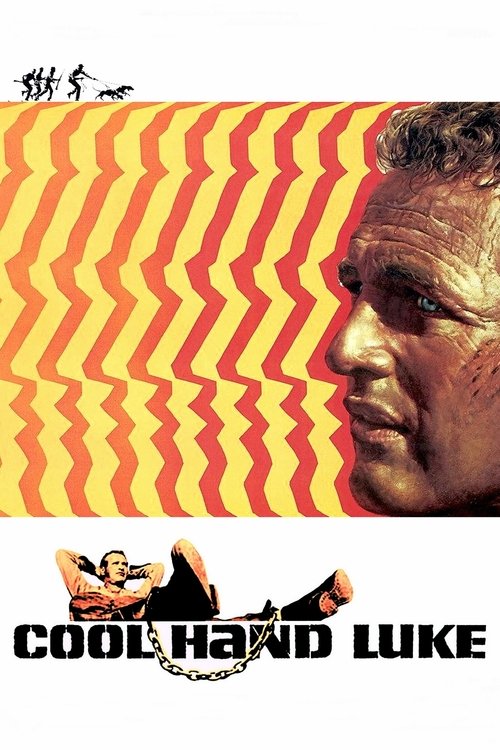
Cool Hand Luke
1967 · Stuart Rosenberg
For when you want a classic that earns its reputation — a story of stubborn defiance to watch when you need a shot of spine, and don't mind it costing you something by the end.
What it's about
Luke Jackson, a small-time Florida offender, is sentenced to two years on a chain gang for drunkenly beheading parking meters. Inside, he refuses to bow to the sadistic warden, the guards, or the yard's reigning heavyweight, Dragline — and his sheer refusal to be broken, through beatings, bets, and stints in the punishment box, turns him into a legend among the convicts. The prison keeps raising the price of defiance, and Luke keeps paying it.
The experience
Sweaty, funny, and slowly heartbreaking — it plays like a hangout movie among convicts until you realize how high the stakes have crept. The famous set pieces (a boxing match that won't end, a fifty-egg bet) are pure pleasure, and the undertow beneath them is genuinely moving.
Performances
Paul Newman at his absolute peak: charm, insolence, and a bone-deep loneliness in one grin. George Kennedy won an Oscar as Dragline, whose journey from rival to true believer gives the film its heart, and Strother Martin's warden delivers one of the most quoted lines in American movies.
The craft
Conrad Hall's cinematography turns the Florida road-gang world into shimmering heat-haze and hard light, and Lalo Schifrin's score works a single banjo-inflected theme into something mythic. Stuart Rosenberg paces it like a folk tale, letting small routines of prison life build the legend brick by brick.
Why it matters
A defining film of late-1960s anti-authoritarian Hollywood, it fixed Newman's screen persona and gave the culture the phrase 'failure to communicate.' Nearly every prison movie since lives in its shadow.
Snapshot
Cool Hand Luke stands as one of the defining statements of late-studio Hollywood's turn toward existential rebellion. Paul Newman plays Lucas Jackson, a small-time Florida criminal sentenced to a prison road gang for cutting the heads off parking meters in a mood of drunken insolence — an act whose symbolic charge the film never lets you forget. Over two hours, the film transforms this unremarkable offender into a secular saint, a mythological outlaw whose refusal to be broken by institutional authority becomes both inspiration and tragedy. The picture arrived at an exact hinge moment: the studio system still intact enough to produce a prestige genre picture, yet porous enough to absorb anti-authoritarian energies that would fully fracture Hollywood within two years. Its legacy is anchored by a single, devastating line — "What we've got here is a failure to communicate" — that has become one of American cinema's most quoted utterances, applied to institutional arrogance far beyond any prison farm.
Industry & production
Cool Hand Luke was produced by Gordon Carroll for Jalem Productions and distributed by Warner Bros.-Seven Arts, which was itself in a transitional phase before the full corporate churn of the early 1970s. The source material was Donn Pearce's 1965 novel of the same name — a work with autobiographical roots, as Pearce had served time on a Florida chain gang in the late 1940s, lending the book a documentary authenticity about the rhythms and humiliations of road-gang life. Pearce co-wrote the screenplay with Frank Pierson, whose career would become central to New Hollywood (he later scripted Dog Day Afternoon in 1975 and directed A Star Is Born in 1976). The two writers received an Academy Award nomination for Best Adapted Screenplay.
Newman was by 1967 already a major star, with The Hustler (1961) and Hud (1963) having established him as the preeminent emblem of American masculine ambivalence — handsome and charismatic but constitutionally restless, unsuited to accommodation. Casting him as Luke was not a stretch but a consolidation, and the film was understood from the start as a Newman vehicle in the highest sense. George Kennedy, cast as Dragline, the yard's reigning tough who becomes Luke's champion, delivered the performance of his career; he won the Academy Award for Best Supporting Actor, the film's sole competitive Oscar. Newman was nominated for Best Actor. Lalo Schifrin received a nomination for Best Original Music Score.
Shooting took place primarily in California's Central Valley — Stockton-area locations standing in for the Florida panhandle — a displacement that signals the film's relationship to its Southern setting: less sociological document than American mythscape.
Technology
The film was photographed in Panavision anamorphic widescreen and released in color through Technicolor processing, placing it squarely within the high-craft mainstream of late-1960s studio production. Conrad Hall, who would become one of American cinema's most celebrated cinematographers (winning Academy Awards for Butch Cassidy and the Sundance Kid in 1969 and, decades later, American Beauty and Road to Perdition), did some of his most distinctive early work here. Hall's approach to the California sun — treating it not as a convenient light source but as a physical antagonist, bleaching skin and flattening shadow — gave the film's outdoor sequences a scorched, airless quality that reinforced the characters' physical and psychological exposure.
The Panavision frame is exploited with unusual intelligence for a genre picture: the width creates relentless horizontal compositions suited to the flat road-gang landscape, while interiors use the format to trap characters in suffocating depth, guard towers looming in background space. Hall's skill with available and near-available light — approaches more associated with the New American Cinema's documentary impulses — infused this otherwise conventionally mounted studio picture with a tactile naturalism.
Technique
Cinematography
Hall's most celebrated sequence in the film is not the egg-eating contest or the car wash but the quieter work he does with faces: Newman's in particular, often caught in three-quarter profile against flat horizon light, registering an interior distance that pure acting rarely achieves alone. The relationship between the camera and Newman's eyes — Hall's instinct for finding the moment when a face becomes a landscape — is where the film's visual intelligence concentrates. In the later sections, as Luke is progressively broken and reconstituted, the lighting grows harsher and less forgiving, the shadows deeper. The climactic church scene — Luke alone in a rural church confronting God and finding only silence — is photographed in a way that strips the earlier charisma down to raw exposure.
Editing
Sam O'Steen edited the picture during one of the most remarkable years in American editing: he cut The Graduate in the same period, and the tonal contrast between the two films is instructive about his range. Cool Hand Luke is cut more conventionally than The Graduate, respecting continuity and building sequences through accumulation rather than fragmentation. The egg-eating scene — Luke consuming fifty hard-boiled eggs on a bet — is a masterclass in comedic rhythmic editing: O'Steen calibrates each cut to the audience's rising disbelief, managing pace so that the sequence is simultaneously funny, grotesque, and quietly admirable. His instinct for when to hold and when to cut shapes the film's distinctive oscillation between communal comedy and isolation.
Mise-en-scène / staging
Rosenberg's staging is most confident in the ensemble scenes — the road gang at work, at leisure, gathered to watch the car wash, rallied around Luke in crisis. These scenes carry an almost theatrical depth, with characters arranged in loose democracy around a performing center. Luke's performances for the gang — whether eating eggs, fighting Dragline, or flirting outrageously with Arletta the washerwoman (Joy Harmon) — are staged as performances within the film, the prisoners as audience surrogate. The famous car wash sequence, with its slow-motion, male-gaze duration, functions as a shared erotic fantasy and a demonstration of what Luke makes possible for his fellow inmates: a temporary suspension of institutional reality through sheer imaginative presence.
The box — the solitary confinement cell barely large enough to stand in — is a piece of production design whose horror is almost entirely architectural. Rosenberg lets the space work rather than elaborating it with camera moves.
Sound
Lalo Schifrin's score draws on folk, country, and bluegrass idioms to anchor the film in Southern vernacular tradition — a deliberate contrast with the jazz-inflected scores Schifrin was producing simultaneously for genre pictures. The banjo and harmonica textures locate Luke within an American outlaw mythology stretching back to frontier ballads. The score knows when to withdraw: the egg-eating scene proceeds largely without music, its comedy dependent on silence and reaction. The film's sound design generally emphasizes ambient heat and the mechanical drone of road work.
Performance
Newman's performance is the film's armature, and it works through a strategy of strategic withholding. Luke's inner life is never explained or sentimentalized; Newman conveys it through physical carriage, reaction timing, and a quality of preoccupied distance even in social scenes. The famous blue eyes, so often used to signal sincerity in his earlier star vehicles, here carry something closer to vacancy — a man genuinely unsure what he wants except for the negative certainty that he will not be owned. Kennedy's Dragline is the emotional center in a different register, all bluster and loyalty, a man who needs Luke to be the hero he himself cannot be. The supporting cast — a roster of character actors including Strother Martin as the Captain, whose delivery of the "failure to communicate" speech is one of American cinema's great examples of comic menace — gives the prison world a social texture that sustains the film's longer sequences.
Narrative & dramatic mode
The film operates in a mode that is simultaneously realistic and allegorical, a tension it never fully resolves and never needs to. The plot follows a simple punitive arc — Luke resists, is punished, escapes, is caught, escapes again, is finally killed — but layered over this skeleton is an elaborate Christ typology that the film announces almost too explicitly and then earns anyway. Luke's initials are L.J.; his name invokes the Gospel; the egg-eating sequence positions him in a Christ-like repose that the film explicitly lingers over; he is ultimately betrayed, hunted down, and martyred while seeking a transcendent communication with God that is met only by gunfire. The film's final image — a double exposure combining the cracked windshield through which Luke has been shot with a cross-shaped road intersection from earlier in the film — announces the allegory with a heaviness that some critics have found too schematic and others have found genuinely moving.
What prevents the allegory from collapsing into Sunday-school illustration is Luke's essential opacity: he is not clearly sacrificing himself for his companions, not clearly driven by principle, not clearly anything except unable to stop. His refusal to accommodate is existential rather than political, which gives the film its melancholy and distinguishes it from the more programmatically oppositional pictures that followed in the New Hollywood period.
Genre & cycle
Cool Hand Luke belongs to the prison film, a genre with deep roots in the American social-problem picture of the 1930s (I Am a Fugitive from a Chain Gang, 1932) and the darker postwar realism of pictures like Brute Force (1947) and The Defiant Ones (1958). The genre conventionally uses imprisonment to make visible power structures that are normally naturalized — the prison as concentrated expression of coercive institutional authority. Cool Hand Luke updates this formula by shifting its center of gravity from social critique to individual myth; the chain gang is less analyzed as a Southern penal institution than deployed as an arena for the testing of a particular kind of American masculinity.
The film also participates in the cycle of rebel-male pictures that Newman himself had helped define through the 1960s, alongside figures like James Dean (retrospectively) and Steve McQueen (contemporaneously). This cycle — anti-heroes whose defiance is personal rather than ideological — fed directly into the New Hollywood anti-establishment films of 1967–1975 and helped legitimize the emotional vocabulary those films would use.
Authorship & method
Stuart Rosenberg came to the feature from extensive television work, including episodes of The Defenders and other prestige drama series of the early 1960s. He was not, by training or temperament, an auteur in the sense that term was acquiring in American criticism at the time; his feature career (WUSA in 1969 with Newman again, Voyage of the Damned in 1976, The Amityville Horror in 1979) suggests a skilled craftsman drawn to difficult material rather than a director with a distinctive visual or thematic signature. Cool Hand Luke's distinction owes more to the convergence of source material, star, cinematographer, and cultural moment than to a coherent directorial vision. Donn Pearce's autobiographical novel is the film's irreducible core — without the lived specificity of the chain-gang world, the allegory has nothing to attach to. Conrad Hall's cinematography is the film's visual intelligence. Frank Pierson's screenplay contribution brings structural compression and the ear for institutional dialogue. Newman's performance is its emotional reason for existing.
Movement / national cinema
The film sits at the threshold of New Hollywood without fully belonging to it. Its production and distribution infrastructure are entirely conventional; it is a studio picture, not an independent incursion. But its ideological content — the glorification of reflexive anti-authoritarian refusal, the institution as irredeemably oppressive, the individual as authentic only in defiance — anticipates the counterculture films that would follow within months (Bonnie and Clyde was released the same year). Cool Hand Luke helped demonstrate that anti-establishment feeling could be packaged for mainstream audiences and that the prestige star system could accommodate it. In this sense it belongs to a transitional Americancinema of the mid-to-late 1960s that prepared the ground for New Hollywood without yet breaking with the old structures.
Era / period
1967 is the film's precise cultural location. The year of the Summer of Love, of anti-Vietnam protest's escalation, of a generational fracture in American culture whose political implications were not yet fully articulated but were viscerally felt. A film about a man whose only politics is that he will not be broken resonated differently in that climate than it would have in 1957 or 1977. The prison farm setting also carries specific American freight: the chain gang as a Southern institution with racial overtones (though the film's prison population is almost entirely white, a historical distortion that received little critical attention at the time) links to civil rights anxieties even while the film declines to address them directly. This evasion is itself historically informative about the limits of Hollywood's engagement with American racism in 1967.
Themes
The film's central preoccupation is the phenomenology of institutional power and the question of what constitutes authentic selfhood within it. The Captain's "failure to communicate" speech, delivered after Luke's latest recapture, is the film's key thematic statement: the institution understands resistance only as a communication problem, a matter of getting its message across more effectively, and is genuinely bewildered by the possibility that some people cannot be made to receive it. Luke's resistance is not strategic — he has no exit plan, no ideology, no community goal — and this is precisely what makes him dangerous and what the film most wants to celebrate.
Secondary themes include the construction of community and solidarity among the powerless (the gang's worship of Luke as collective ego ideal), the nature of masculine friendship and admiration (the Dragline–Luke relationship has been read as containing repressed erotic devotion, a reading the film's staging supports without acknowledging), the function of performance within constrained social space, and the specifically American mythological inheritance of the outlaw-as-saint.
Reception, canon & influence
Cool Hand Luke was a substantial commercial and critical success on release. Newman's nomination for Best Actor and Kennedy's win for Supporting Actor signaled the film's prestige standing, and Pierson and Pearce's nomination for their screenplay indicated recognition of the literary source's quality. Critical response treated it as serious popular cinema; its Christ allegory was identified and debated without being dismissed.
The film's backward influences are traceable: the Newman rebel-male cycle from The Hustler through Hud; the prison film tradition from I Am a Fugitive from a Chain Gang through Brute Force; the American outlaw mythology that had run from silent Westerns through the Bogart pictures. The egg-eating scene draws on the vaudeville endurance-stunt tradition; the escape sequences on adventure serial conventions. The film assimilates these influences into a coherent emotional register without visible strain.
Its forward influence has been enormous and largely diffuse. The "failure to communicate" line entered the American idiom within years and has been repurposed continuously across political, cultural, and commercial discourse for six decades; its most famous recycling is in Guns N' Roses' "Civil War" (1990), where it is quoted verbatim at the track's opening. The film established a template for the anti-institutional rebel that can be traced through the 1970s prison cycle (including Escape from Alcatraz, 1979), through the anti-authority pictures of the Reagan era, and into contemporary prestige television's obsession with charismatic outlaws who break institutional codes on principle. Newman's performance, specifically, has been cited by actors across generations as a model for the art of apparent effortlessness — the quality of seeming not to perform while giving a performance of total technical control. The film is held in the National Film Registry of the Library of Congress, an acknowledgment of its cultural permanence that its initial reception anticipated but perhaps could not have guaranteed.
A Deleuzian reading
A man walks down an empty street at night, drunk and grinning, and cuts the heads off parking meters with a pipe cutter.
The full Deleuzian reading of Cool Hand Luke →
Reception
A hit and an Oscar player on release in 1967 (George Kennedy won Best Supporting Actor), it's since hardened into one of the definitive anti-establishment films of the decade, sealed by a National Film Registry induction in 2005.
How Cool Hand Luke was received, from release to now →
Influences: the films it descends from and the films it influenced
- I Am a Fugitive from a Chain Gang (1932) — LeRoy establishes the American chain-gang prison picture's dramatic grammar — the state as inexorable antagonist, the work crew as oppressive ritual, the escape doomed to failure — that Rosenberg inherits wholesale and existentializes; the open-ended, bleak final image of the system's total victory over the individual is the structural template Luke's ending reprises.
- The Hustler (1961) — Newman's performance mode of strategic withholding — the still face that conceals ambition and despair behind charisma, the body that holds its interior at a distance from the camera — is fully developed here by director and star together; Cool Hand Luke is architecturally built on the same psycho-physical grammar, Luke's cool opacity a direct reprise of Fast Eddie Felson's.
- Hud (1963) — James Wong Howe's anamorphic Panavision treatment of Southwest sunlight as moral climate — bleaching faces, collapsing shadow, rendering the landscape indifferent to human suffering — is the immediate technical precursor to Conrad Hall's approach in Luke; Newman's rebel-male who refuses the community's terms while inspiring those around him is reprised almost character-for-character.
- Paths of Glory (1957) — Kubrick's democratic ensemble staging of condemned men in rough solidarity against an institutional authority too vast to fight — the lateral tracking shots that traverse the condemned community without privileging any single face — and his construction of a doomed Christ-figure among common soldiers directly anticipate Rosenberg's road-gang staging grammar and Luke's sacrificial narrative logic.
- On the Waterfront (1954) — Kazan's ensemble blocking of working-class men in rough democratic proximity — the dock community as collective background pressure on the individual conscience — and his use of Method performance to layer interiority beneath genre surfaces are the structural and staging precedents for Rosenberg's road-gang scenes, where the gang's faces register Luke's every act as communal event.
- Lonely Are the Brave (1962) — The first American film to frame the rebel-male's refusal as a chosen metaphysical stance against modernity rather than simple anachronism — Kirk Douglas refuses to accommodate, rides into oncoming traffic — structuring the outlaw narrative as genuine tragedy of selfhood that cannot survive institutional reality; Cool Hand Luke inherits this existential-refusal-as-identity architecture almost intact.
- The Hill (1965) — Oswald Morris's anamorphic widescreen work in a British military prison uses the wide frame to create suffocating institutional compositions — men trapped in deep lateral space under a punishing North African sun — as a direct formal model for Hall and Rosenberg's Panavision grammar; Lumet's ensemble of men broken by arbitrary authority and the sergeant-as-sadist anticipate the Captain's function in Luke.
- Brute Force (1947) — Inherits the sadistic-institution template: the composed, sunglassed authority whose cruelty is bureaucratic ritual, opposite the martyr-inmate whose defiance the system must break.
- The Defiant Ones (1958) — Inherits the chain-gang penal setting with its sweat-and-dust realism and the diegetic work-song sound motif structuring the prisoners' labor.
- Butch Cassidy and the Sundance Kid (1969) — Conrad Hall carries his Cool Hand Luke visual grammar directly into this film — anamorphic Panavision, warm-bleached outdoor light, faces exposed against the indifferent landscape — while the rebel-male duo's doomed-by-modernity trajectory extends Luke's narrative logic: charisma and refusal cannot ultimately survive the institution's patient machinery, and the freeze-frame ending quotes Luke's sacrificial irresolution.
- Five Easy Pieces (1970) — László Kovács's location-based available-light cinematography and Rafelson's staging of Nicholson's existential refusal — the character's inability to accommodate any institutional or social structure, his strategic withholding of self from anyone who tries to name him — extends Luke's rebel-male psychological grammar into a fully post-New Hollywood realism without genre scaffolding.
- Papillon (1973) — Schaffner and cinematographer Fred Koenekamp use harsh tropical Panavision light and monumental prison architecture to construct escape as existential refusal — the protagonist's repeated attempts framed as spiritual necessity rather than practical strategy — directly extending Luke's narrative logic that rebellion-as-selfhood must continue even when tactically pointless.
- One Flew Over the Cuckoo's Nest (1975) — Forman's democratic ensemble staging of institutionalized men around a Christ-figure rebel — the camera giving equal weight to the ward community's faces as to McMurphy's performance — directly extends Rosenberg's road-gang ensemble arrangement; the Christ-typology of a charismatic rebel who is broken by the institution specifically because he cannot stop inspiring others is structurally identical to Luke's.
- Bound for Glory (1976) — Haskell Wexler's Panavision available-light cinematography of Depression-era landscape — the same bleached-sky naturalism Hall developed in Luke — combined with diegetic folk music used as social and spiritual document extends both Luke's visual grammar and its use of American vernacular music as existential counterpoint; the Steadicam long take through the migrant camp is the mature development of Hall's fluid ensemble staging.
- O Brother, Where Art Thou? (2000) — The Coens transpose Luke's Southern chain-gang setting, folk/bluegrass score as period authenticity and existential counterpoint, and Christ-typology directly into a picaresque framework; Roger Deakins's digitally color-graded Panavision photography — sepia-bleached to simulate the scorched-earth quality of Hall's natural-light approach — is the post-digital reinterpretation of Luke's cinematographic grammar.
- The Shawshank Redemption (1994) — Establishes the prison-yard-as-society staging in which an unbreakable individual's quiet defiance is read through the admiring eyes of fellow inmates, with authority shot as faceless mirrored-shade menace.
- Dead Man Walking (1995) — Source of the crucifixion-composition vocabulary — framing the incarcerated man as a Christ figure in cruciform poses, the visual theology Deakins quotes in Penn's final walk.
- Midnight Express (1978) — Supplies the escalating-ordeal architecture: a charismatic prisoner systematically broken by repeated, ritualized punishment, the structural spine Stone's script reproduces beat for beat.
- Toy Story 3 (2010) — Transposes its prison-camp iconography onto Sunnyside — the charismatic-tyrant warden (Lotso), the confinement 'box,' and the bus-arrival ritual of processing new inmates.
- Escape from Alcatraz (1979) — Pairs granular institutional routine with a coldly bureaucratic antagonist and a minimalist antihero whose defiance is expressed through withholding rather than speech.
- Bonnie and Clyde (1967) — Penn and cinematographer Burnett Guffey use tonal instability — abrupt shifts between comedic accumulation and sudden violence — to frame their outlaw rebels as existential refusers in genre disguise, the same strategy as Luke at the identical New Hollywood threshold moment; both films use the system's lethal final response to non-conformity as the genre's inevitable punctuation.
- In Cold Blood (1967) — Conrad Hall's same-year black-and-white work deploys the identical available-light naturalism — harsh outdoor exposure, faces stripped of glamour, institutional spaces rendered without melodramatic shadow — that he was simultaneously applying in color to Luke; the two films constitute a single year's demonstration of Hall's consistent aesthetic vision across opposite tonal registers.
Similar films
- One Flew Over the Cuckoo's Nest (1975) — influence & lineage · same viewing thread · often watched together
- Hud (1963) — influence & lineage
- The Hustler (1961) — influence & lineage
- I Am a Fugitive from a Chain Gang (1932) — influence & lineage
- Butch Cassidy and the Sundance Kid (1969) — influence & lineage
- In Cold Blood (1967) — influence & lineage
- A Clockwork Orange (1971) — same viewing thread
- On the Waterfront (1954) — influence & lineage · often watched together
All the films related to Cool Hand Luke →
Watch it with: curated runs of related films
- Discipline and Defiance — A run of men pitted against total institutions — prisons, wards, camps, the state — where the only freedom left is refusing to break.