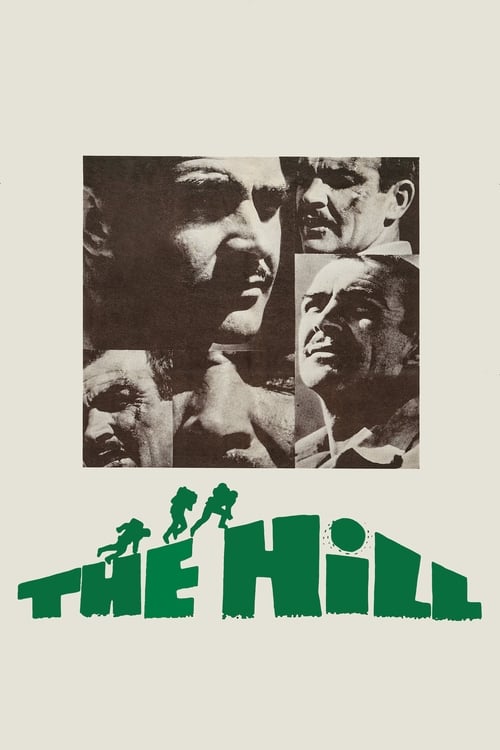
The Hill
1965 · Sidney Lumet
For when you want something hard and honest — a film that grabs you by the collar rather than entertains you. This is a challenge, not comfort viewing: reach for it when you're ready to be furious at injustice for two hours.
What it's about
A British military detention camp in the North African desert, deep in the Second World War — but the enemy never appears. The prisoners are British soldiers, convicted by their own army, and the men breaking them are their own comrades. At the center of the stockade stands the hill itself: a manmade mountain of sand the inmates are forced to climb in full kit under a murderous sun, a punishment with no purpose except to prove who's in charge. A new batch of prisoners arrives, and one of them refuses to be ground down quietly.
The experience
Punishing in the best sense — you feel the heat, the sand, the shouting, the slow crushing of men by routine. It's a pressure-cooker film that builds through confrontation rather than action, and it leaves you angry in a clean, clarifying way.
Performances
Sean Connery, mid-Bond, strips away every ounce of glamour to play a sweating, stubborn man of principle — it's the performance that proved he was an actor, not just a star. Harry Andrews is terrifying as the camp's regimental sergeant major, and Ossie Davis walks off with several scenes through sheer defiant wit.
The craft
Shot in scorched black and white with wide, distorting lenses that make the stockade feel like a trap you can't crawl out of, the film runs almost entirely on shouted dialogue, boots on sand, and merciless sun. Sidney Lumet directs it like a stage pressure-chamber blown open into the desert. Loud, sweaty, and abrasive — it rewards a dark room and good speakers more than you'd expect from a talk-driven drama.
Why it matters
This was Connery's most pointed early escape from James Bond and the film that established he could carry serious drama, and it stands with Lumet's great studies of men trapped inside institutions. It remains a touchstone for war films where the real enemy is the system itself.
Snapshot
The Hill is a film about a war in which the enemy never appears. Set in a British military detention camp ("glasshouse") in the North African desert during the Second World War, it confines its drama to the closed world of the prison stockade, where soldiers convicted of military offenses are broken down and rebuilt — or simply broken — by their own army. The film's central object is exactly what its title names: a steep, manmade mound of sand the prisoners are forced to climb in full kit under a punishing sun, a punishment with no military purpose beyond the assertion of authority. Sidney Lumet, an American working in Britain for MGM, directs from a screenplay by Ray Rigby drawn from Rigby's own wartime imprisonment. The picture is best remembered today as Sean Connery's most pointed early bid to escape the gravity of James Bond, made between his Bond engagements, and as a showcase for one of the great performances of institutional authority in British cinema, Harry Andrews's Regimental Sergeant-Major Wilson. It is a hard, airless, morally serious film — a study of cruelty, conscience, and the machinery of obedience.
Industry & production
The Hill was produced for Metro-Goldwyn-Mayer's British operation, with interiors at the MGM-British studios at Borehamwood and exterior work shot in the arid landscape around Almería in southern Spain — the same sun-blasted region that would shortly become Europe's standing stand-in for deserts and frontier wastes in the spaghetti-Western boom. The production's defining physical fact was the hill itself, a large artificial sand structure built to be climbed, fallen down, and climbed again; its construction and the brutal heat of the location are part of the film's lived texture, and the visible exhaustion of the cast reads as more than performance.
The project originated with Ray Rigby, who had served time in a military prison during the war and who developed the material first for the stage and television before the feature screenplay. The story carried, for British audiences of the period, the charge of lived institutional memory rather than invention.
Commercially, The Hill is generally understood to have been a critical success that did not translate into major box-office return; precise figures are not something I will assert here. Its cultural weight came instead from its festival reception and from Connery's casting, which gave a grim ensemble drama a marquee draw. The film also inaugurated the most durable director–star partnership of Lumet's career: he and Connery would reunite on The Anderson Tapes (1971), The Offence (1972), Murder on the Orient Express (1974), and Family Business (1989).
Technology
The film was shot in black and white in an era when color had become the commercial default, and that choice is itself a statement of intent: monochrome strips the desert of any picturesque allure and pushes the image toward documentary harshness and graphic abstraction. The most consequential technological decision is cinematographer Oswald Morris's deployment of very wide-angle lenses. Wide-angle optics at close range distort facial features, exaggerate the depth between near and far figures, and bend the architecture of the camp into something oppressive; combined with deep-focus staging, they keep tormentor and tormented in the same sharp frame. The technology serves the theme — the lens makes the institution feel both vast and suffocating, with no soft long-lens flattery anywhere in it.
Technique
Cinematography
Oswald Morris's photography is the film's signature achievement. Working in high-contrast black and white, he renders the sky as a hard glare and the sand as a featureless expanse, so that the hill stands as a stark graphic shape against nothing. The wide-angle lenses produce a recurring grammar of looming foreground faces and steeply receding backgrounds; low angles aggrandize the standing officers and crush the prisoners, while high and overhead angles flatten men against the ground as they crawl. The camera is frequently mobile, tracking alongside the climbing men, and the framing repeatedly isolates the hill at the top of the composition as a goal that is also a trap. The visual scheme refuses relief: there is little shade, little interior softness, and almost no beauty offered as escape.
Editing
Thelma Connell's editing builds the film's rhythm of repetition and escalation. The ascents up the hill are cut to emphasize duration and futility — the same brutal action recurring — so that punishment accumulates as physical fact. Inside the camp, the editing favours sustained confrontation over fragmentation, holding on the verbal duels among the staff and prisoners long enough for the moral pressure to build. The cutting tightens as the narrative moves toward its crises, but the overall design is one of mounting endurance rather than montage flash.
Mise-en-scène / staging
Lumet stages The Hill as a chamber drama in an open-air prison. The camp's geometry — the parade square, the cells, the watching windows, and above all the hill — becomes a fixed theater of power in which blocking carries meaning: who stands above whom, who is made to look up, who controls the empty center of the yard. The set's enclosure is total; there is no glimpse of a world beyond the wire and the sand. Lumet, who built his craft in live television and theater, choreographs the ensemble so that authority is expressed spatially, through posture, distance, and the ritualized movement of bodies under command.
Sound
The Hill is notable for its near-total refusal of non-diegetic music. There is no swelling orchestral score to cushion the cruelty or cue the audience's emotion; the soundtrack is instead dominated by diegetic noise — barked commands, the crunch of boots on sand, ragged breathing, the bugle and the drill, the silence of the heat. This austerity is one of the film's strongest formal decisions, leaving the viewer without the customary musical mediation and forcing direct confrontation with the action. (I note this absence as a deliberate aesthetic feature rather than attributing a conventional "score" to a credited composer.)
Performance
Performance is where The Hill lives. Harry Andrews's RSM Wilson is the axis of the film: a man who believes utterly in the system he serves, capable of brutality and of a perverse code of honor, played without caricature so that his authority remains genuinely imposing rather than merely villainous. Ian Hendry plays Staff Sergeant Williams as the camp's true sadist, the rot inside the machine; Ian Bannen, as the more conscience-stricken Staff Sergeant Harris, supplies the moral friction within the staff. Among the prisoners, Connery's Joe Roberts — a man jailed for striking an officer, who becomes the chief locus of resistance — is a deliberately deglamorized, sweat-soaked, defiant turn that uses the actor's physical authority against the Bond persona. Ossie Davis's Jacko King brings the question of racism within the army to the surface, and his late acts of refusal are among the film's most pointed gestures. Roy Kinnear, Jack Watson, Alfred Lynch, and Michael Redgrave (as the camp's medical officer, complicit through weakness) fill out an ensemble in which institutional evil is distributed across ordinary men.
Narrative & dramatic mode
The film's mode is tragic and confrontational, closer to filmed theater than to the action-driven war picture. Its dramatic engine is not a campaign but a moral contest: a death on the hill becomes the hinge on which questions of culpability, testimony, and justice turn, and the back half of the film moves toward a reckoning that the institution is structurally designed to absorb and deflect. The narrative is unities-bound — essentially one place, a compressed span of time — and built from successive face-to-face confrontations. It is a drama of pressure and breakdown rather than plot reversal, and its ending withholds catharsis, insisting that the machine grinds on.
Genre & cycle
The Hill is a war film without a battle and a prison film without an escape — a hybrid that uses the military stockade as a microcosm of the war's deeper subject, the subordination of the individual to the institution. It belongs to a mid-1960s cycle of films interrogating military authority and its capacity for cruelty, a lineage that runs back to Kubrick's Paths of Glory (1957) and sits beside Joseph Losey's King & Country (1964) as part of a specifically anti-authoritarian, often anti-war strain in the period's cinema. It also draws on the moral and physical realism of the British social-realist tradition, transposing that movement's interest in class and institution into a closed, all-male crucible.
Authorship & method
The Hill is a key early statement of Sidney Lumet's career-long preoccupation: the individual conscience pitted against the institution, and the institution's mechanisms of self-protection. The concerns that define 12 Angry Men (1957) before it, and Serpico (1973), Dog Day Afternoon (1975), and Prince of the City (1981) after, are all present here — justice as procedure, authority as performance, the costs of refusal. Lumet's method, rooted in live television and the theater, shows in his disciplined ensemble work, his trust in actors and sustained confrontation, and his spatial dramaturgy of power.
The authorship is genuinely collaborative. Oswald Morris's wide-angle, high-contrast monochrome is inseparable from the film's meaning, one of the great director–cinematographer matches of mood and method. Ray Rigby's screenplay supplies the autobiographical authority and the verbal density of the camp's confrontations; Rigby's writing was honored at Cannes (the festival's screenplay award), a recognition of the script as the film's structural backbone. Thelma Connell's editing shapes the rhythm of endurance. And the decision to forgo a conventional musical score is itself an authorial signature shared between Lumet and his collaborators.
Movement / national cinema
The film is a British production with an American director, made at the tail of the British New Wave and within the orbit of Hollywood's investment in British filmmaking during the 1960s. It carries the New Wave's social-realist seriousness — its attention to class, its unglamorous textures, its distrust of institutions — while applying it to a setting outside the movement's usual domestic and industrial milieus. Lumet's presence marks the period's transatlantic traffic, in which American directors brought a different sensibility to British subjects and crews.
Era / period
The Hill arrives in 1965, at a moment when the old studio certainties and censorship regimes were loosening, the antihero was ascending, and a broadly anti-authoritarian mood was gathering force across Western culture. Though set two decades earlier in the Second World War, the film's interrogation of obedience, institutional cruelty, and the legitimacy of command speaks directly to the mid-1960s — a sensibility that the deepening conflict in Vietnam would soon sharpen further. Its monochrome austerity, made deliberately against the grain of color spectacle, places it among the era's serious, adult dramas rather than its entertainments.
Themes
The film's governing theme is institutional power and the cruelty it licenses: the hill is punishment as pure assertion, discipline detached from purpose. Around this turn the film's other concerns — obedience and conscience, the question of whether a man inside a system can refuse it; masculinity tested to destruction, with endurance demanded as proof of worth; class, in the gulf between the men and those who command them; and race, made explicit in Jacko King's treatment and his refusal. Beneath all of these runs the problem of justice: when a man dies on the hill, the film asks whether the institution can ever hold itself accountable, and answers, bleakly, that it is built precisely not to. The dehumanization of the prisoners and the moral corrosion of their keepers are shown as two faces of the same machine.
Reception, canon & influence
The Hill was received as a serious and powerful work, with particular praise for its performances — Andrews's RSM is frequently cited among the finest portraits of military authority on film, and Connery's casting-against-type drew significant attention as evidence of a range the Bond films had obscured. Its recognition at the Cannes Film Festival, where Ray Rigby's screenplay was honored, anchored its critical standing.
Looking backward, the film draws on the anti-military tradition of Paths of Glory, on the moral-confrontation structure Lumet had already perfected in 12 Angry Men, and on the British social-realist commitment to class and institutional truth; Rigby's autobiographical source gives it a documentary authority that distinguishes it from more abstract anti-war statements. Looking forward, its legacy is twofold. Within Lumet's own work it is a foundational entry in his institutional cycle, the template for the conscience-versus-system dramas that became his signature. More broadly, it stands as a touchstone of the prison-as-microcosm war film and of the "glasshouse" military-detention subgenre, a model for later films that locate the war's real violence inside the disciplinary machinery of one's own side. Its most concrete legacy, though, may be the director–star bond it forged: the Lumet–Connery partnership that The Hill began would shape both men's careers across the next quarter-century, and the film remains the place where Connery first demonstrated, decisively, that he could act far beyond the role that had made him famous.
A Deleuzian reading
A man in full kit drags himself up a slope of loose sand under a white sun.
The full Deleuzian reading of The Hill →
Reception
Buried on release — it landed between Goldfinger and Thunderball and audiences wanting Bond stayed away — despite winning Best Screenplay at Cannes. Now it's routinely ranked among Sidney Lumet's very best and the standard exhibit that Sean Connery was a great actor, not just 007.
How The Hill was received, from release to now →
Influences: the films it descends from and the films it influenced
- Paths of Glory (1957) — Establishes the anti-military court-martial as a moral-confrontation engine, where the chain of command itself is the antagonist and the war's real violence is inflicted by one's own side's disciplinary machinery.
- 12 Angry Men (1957) — Lumet's own template for The Hill: a single-location chamber drama built on dramatic unities, sustained ensemble confrontation, and spatial blocking that registers each shift of power as bodies move through a confined set.
- Citizen Kane (1941) — Gregg Toland's wide-angle, deep-focus, low-angle high-contrast monochrome is the vocabulary Oswald Morris inherits to make ceilings, walls, and the camp's geometry press oppressively on the men.
- The Loneliness of the Long Distance Runner (1962) — British social-realist study of a punitive institution (the borstal) versus the individual, with the governor as an authority figure whose performance of discipline masks self-interest — the class-and-institution truth Rigby's script extends.
- Sweet Smell of Success (1957) — High-contrast monochrome married to verbally dense, predatory power confrontations — the model for staging authority as performance through language and lighting rather than action.
- This Sporting Life (1963) — Kitchen-sink monochrome realism built on against-type physical casting and a brutalized male body, the British-realist register Connery's against-type performance draws on.
- Grand Illusion (1937) — Founds the military-detention-as-microcosm structure, where the prison camp becomes a closed laboratory for examining class, rank, and the rituals of institutional authority.
- Stalag 17 (1953) — The POW-camp-as-microcosm with its own internal social order and disciplinary economy, a self-contained world whose hierarchy substitutes for the wider war.
- The Wages of Fear (1953) — Lumet and cinematographer Oswald Morris use high-contrast widescreen to trap men in an institutional space where physical ordeal (forcing soldiers to run an artificial hill) systematically dismantles masculine pretension — extending individual sequences of suffering without the rhythmic relief Hollywood convention requires.
- Brute Force (1947) — Directly extends the guard-as-refined-sadist figure Cronyn originated — the coolly rational authority who tortures within the rules — inside a military prison staged as a fascist totalitarian microcosm.
- Cool Hand Luke (1967) — Prison-as-microcosm built on repetition-escalation of punishment — the box, the pointlessly dug-and-refilled holes — pitting charismatic refusal against an institution's escalating, ritualized sadism, exactly The Hill's punishment-mound logic.
- The Offence (1973) — Direct issue of the Lumet–Connery bond The Hill forged: an interrogation-room chamber drama where institutional violence turns inward, sustained on long-take confrontation and against-type Connery.
- Serpico (1973) — Extends Lumet's conscience-versus-system institutional cycle that The Hill inaugurates — justice as procedure, authority as self-protecting performance, the personal cost of refusal.
- Full Metal Jacket (1987) — The boot-camp glasshouse with the drill instructor as an RSM analog, escalating dehumanizing drill through repetition until the disciplinary machinery produces its own catastrophe.
- Scum (1979) — Glasshouse/borstal brutality rendered with diegetic-only sound, no musical score, and institutional violence as the film's true subject — the disciplinary system as the engine of cruelty.
- Breaker Morant (1980) — Anti-military court-martial chamber drama in which the army sacrifices its own men to protect the institution, carrying forward the moral-confrontation structure and withheld catharsis.
- The Shawshank Redemption (1994) — Prison-as-microcosm sustained on deferred, withheld catharsis and the slow accretion of institutional routine, with the warden as an authority whose performance of order conceals corruption.
- The Spy Who Came In from the Cold (1965) — Made the same year using Oswald Morris, who deployed identical wide-angle, low-horizon framing to make British military architecture into a psychological trap; the two films are companion studies in Morris's method of using the deep-focus frame as an instrument of institutional oppression.
- King and Country (1964) — Near-contemporary British anti-military chamber drama confined to a court-martial, sharing the withheld catharsis of an inevitable execution and the system devouring its own soldier.
Similar films
- Paths of Glory (1957) — influence & lineage
- 12 Angry Men (1957) — influence & lineage
- Full Metal Jacket (1987) — influence & lineage
- Army of Shadows (1969) — shared sensibility
- Platoon (1986) — shared sensibility
- Twelve O'Clock High (1949) — shared sensibility
- Hunger (2008) — shared sensibility
- Lawrence of Arabia (1962) — shared sensibility