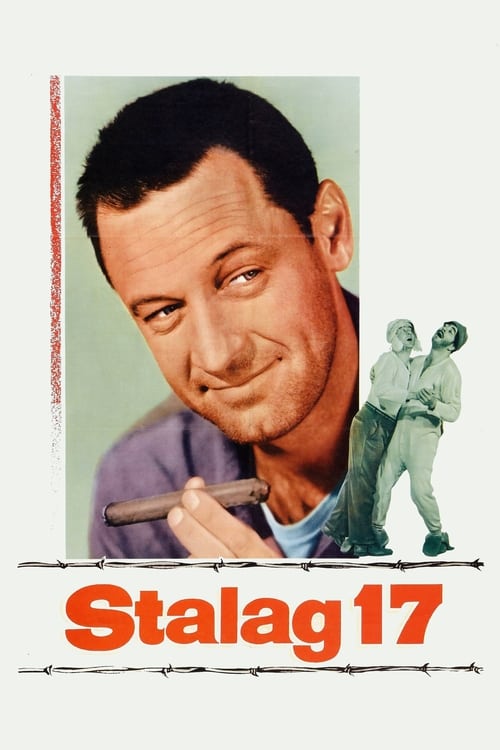
Stalag 17
1953 · Billy Wilder
For when you want a classic that's actually fun — sharp talk, a great mystery, and an antihero you can't help siding with. An ideal pick for a movie night with someone who thinks old films are stuffy.
What it's about
In a German POW camp during World War II, a barracks full of American sergeants keeps trying to escape — and keeps getting caught, because someone inside is informing. Suspicion lands on J.J. Sefton, the barracks black-marketeer who trades with the guards, wins every bet, and makes no apologies for looking out for himself. As the evidence mounts and the men close in on him, Sefton has to figure out who the real traitor is before his fellow prisoners deliver their own justice.
The experience
A high-wire mix of broad barracks comedy and genuinely tightening menace — you laugh, then remember men are dying, and the film means for both to be true at once. The whodunit grip is real, and the cynicism has a surprising sting.
Performances
William Holden won the Best Actor Oscar as Sefton, playing a man who refuses to be liked and is riveting because of it — one of the great screen antiheroes. Otto Preminger, the director, is memorably smug as the camp commandant, and Robert Strauss's broad clowning gives the comedy its engine.
The craft
Billy Wilder adapts a Broadway play written by two former POWs and pulls off a tonal balancing act few directors would attempt — vaudeville and paranoia in the same cramped barracks. The confined black-and-white staging turns one hut into a pressure cooker, and the mystery plotting is watchmaker-precise.
Why it matters
A hit that won Holden his Oscar and cemented Wilder's reputation for fusing comedy with dark material, it shaped the POW-camp genre for decades and made the cynical operator a permanent fixture of American war movies.
Snapshot
Stalag 17 is Billy Wilder's cynical, tonally daring account of life inside a German prisoner-of-war camp, in which a barracks of American sergeants convinces itself that one of their own — the sardonic hustler and black-marketeer J.J. Sefton — is feeding information to the enemy. Adapted from the 1951 Broadway play by Donald Bevan and Edmund Trzcinski, both former POWs, the film fuses two registers that rarely share a screen: broad, almost vaudevillian barracks comedy and a tightening informer-whodunit shot through with genuine menace. William Holden's Sefton, a man who profits from the war and refuses to be liked, won the Academy Award for Best Actor and became one of the defining antiheroes of postwar American cinema. The picture stands as one of Wilder's most confident tonal high-wire acts, made by a Jewish émigré from Central Europe turning the machinery of a German camp into the setting for both laughter and moral reckoning.
Industry & production
The film was produced and released by Paramount, the studio where Wilder had built his directorial career through the 1940s (Double Indemnity, The Lost Weekend, Sunset Boulevard). It originates in a hit stage property: the Broadway Stalag 17, drawn from Bevan and Trzcinski's own captivity, which gave Wilder pre-tested comic business and a ready-made ensemble structure. Wilder and co-writer Edwin Blum reworked the material substantially, sharpening the informer plot and darkening the central character.
The production's most-discussed friction concerns Holden. By multiple accounts, Holden was reluctant to play Sefton as written — an unsentimental profiteer with no redeeming speeches — and pressed for softening material; Wilder refused to sand down the character's edges. The result is a star performance built against the grain of star likability, and Holden's subsequent Oscar is often read, in the industry's retrospective telling, as partly a make-good for his loss for Sunset Boulevard. Casting also drew directly from the stage: Robert Strauss ("Animal") and Harvey Lembeck (Shapiro) reprised their Broadway roles, importing the play's comic timing intact.
Technology
Stalag 17 arrived at a pivotal moment in Hollywood's technological history. 1953 was the year the industry embraced widescreen and color as weapons against television — CinemaScope debuted that year — yet Wilder shot in black-and-white and in the classical Academy-era framing rather than chasing the new anamorphic novelty. That choice reads as deliberate: monochrome suits the mud, cold, and moral grayness of the camp, and the tighter frame reinforces the claustrophobia of men penned into a single wooden barracks. The film's technology is, in effect, an argument for restraint at exactly the moment the industry was reaching for spectacle.
Technique
Cinematography
Ernest Laszlo photographed the film in black and white, and the visual scheme is functional and enclosing rather than showy. The barracks interior — the film's dominant space — is lit to register bunk-level shadow, breath in cold air, and the grime of confinement. Laszlo's camera favors ensemble staging in depth over isolating close-ups, so that suspicion can circulate visibly through a crowded room; when the film does move in tight, on Sefton in particular, the effect is pointed. The monochrome palette keeps the tonal shifts — from slapstick to interrogation — from curdling, holding comedy and dread within a single consistent surface.
Editing
The film is cut for the slow accumulation of suspicion. Its editing paces the whodunit as a gradually tightening noose: information passed, glances registered, the barracks' collective mood hardening against Sefton before the true informer is exposed. Wilder worked throughout his career under the close editorial guidance of Doane Harrison, his longtime cutter and editorial associate, whose sense of structure shaped Wilder's films at the writing stage as much as the assembly stage; the credited editing on Stalag 17 is generally attributed to George Tomasini, shortly before his long association with Alfred Hitchcock, though the controlling editorial sensibility here is unmistakably Wilder's own.
Mise-en-scène / staging
The single dominant set — the barracks — is the film's great staging asset and its inheritance from the theater. Wilder blocks the space as a social ecosystem: bunks as territory, the stove and the improvised distillery and the mousetrap-and-hidden-radio as loci of daily invention, the men's routines (the "roll call," the ogling of Russian women prisoners through binoculars) as recurring comic set-pieces. The staging keeps everyone in view, which is dramatically essential: because the informer is among them, the ensemble must remain a legible collective for suspicion to move through. Wilder exploits the stage origins rather than disguising them, using the enclosure as pressure.
Sound
The score is by Franz Waxman — like Wilder and like composer-collaborators across this émigré generation, a German-Jewish exile whose presence lends a quiet historical irony to a film about a German camp. Diegetic sound carries much of the film's texture: the men's singing and whistling, the tinny camp loudspeaker, the guards' barked German. The recurring musical and vocal motifs (the barracks' communal songs) function as morale and as camouflage, part of the daily performance the prisoners stage for their captors.
Performance
Performance is where Stalag 17 takes its greatest risks and reaps its greatest rewards. Holden plays Sefton as flatly transactional — trading, betting, hoarding — and withholds the reassurance that he is secretly noble; the character earns the audience's respect through competence and refusal rather than warmth. Around him, Strauss and Lembeck play "Animal" and Shapiro at full comic volume, a knockabout double act imported from Broadway (Strauss earned a Best Supporting Actor nomination). Sig Ruman's Sergeant Schulz is genial menace; Otto Preminger — himself a director, and an Austrian émigré like Wilder — plays the camp commandant von Scherbach with theatrical hauteur, complete with the much-noted ritual of donning boots to place phone calls to Berlin. The film asks each performer to hold a fixed register while the whole modulates around them, and the ensemble does.
Narrative & dramatic mode
Structurally, the film is a whodunit set inside a closed community — the classic locked-room logic transposed to a POW barracks, where the pool of suspects is finite and the stakes are lethal. It is narrated retrospectively by Cookie, Sefton's assistant, which frames the events as recollected testimony and lets the film withhold and time its revelations. The dramatic engine is misdirection: the barracks (and the audience) fixes on the wrong man, and the film's moral argument is precisely about the ugliness of collective certainty. Sefton, shunned and beaten by his own side, turns detective less from virtue than from self-interest and spite — and in exposing the real informer, Price, restores no easy warmth to the group. The mode is comedy braided with suspense and a hard vein of cynicism, the tonal signature Wilder made his own.
Genre & cycle
The film sits at the intersection of the war film, the prison/POW picture, and comedy — and it helped consolidate the POW-camp movie as a durable genre with its own furniture: the tunnel, the roll call, the improvised economy, the buffoonish guard, the tension between escape and survival. Its deepest genre inheritance is the humane POW tradition of Jean Renoir's La Grande Illusion (1937), which Wilder revered, though Stalag 17 replaces Renoir's elegiac cross-class fraternity with something more abrasive and American. It also belongs to Wilder's own running cycle of films built around morally compromised operators who see the angles more clearly than anyone else in the room.
Authorship & method
This is a characteristic Wilder film in construction and worldview: co-written by Wilder (with Edwin Blum), directed with an eye for verbal wit and structural economy, and organized around a protagonist whose cynicism is a form of clear sight. Wilder's method — building the screenplay meticulously before shooting, in tight partnership with his editorial associate Doane Harrison so that the film is largely "cut" on the page — is visible in the film's efficiency. Wilder's biography presses on the material: an Austrian-born Jew who left Germany as the Nazis rose and lost family members in the Holocaust, he directs the German camp not as pure villainy but through irony, refusing both sentimentality and easy vilification while never softening what the setting means.
Among key collaborators: cinematographer Ernest Laszlo grounds the film in unglamorous monochrome; composer Franz Waxman, another German-Jewish émigré and a frequent Wilder-adjacent figure, supplies the score; the editing (credited to George Tomasini, under Wilder and Harrison's structural control) paces the suspense; and co-writer Edwin Blum helped Wilder transpose stage comedy into cinematic suspense. Otto Preminger's presence as an actor-director in front of the camera is itself an authorship curiosity of the production.
Movement / national cinema
Stalag 17 is a Hollywood studio production, but it is inseparable from the émigré strand of American cinema — the wave of Central European filmmakers, composers, and actors (Wilder, Waxman, Preminger, Ruman) who shaped mid-century Hollywood after fleeing Europe. That community's fingerprints give the film its particular authority: its Germans are rendered by people who knew the culture and the language, and its treatment of the war is neither naïve nor triumphalist. It belongs, too, to postwar American cinema's growing appetite for cynical, morally ambiguous protagonists, a sensibility Wilder did as much as anyone to license.
Era / period
Released in 1953, the film speaks to a postwar America processing the recent conflict at an eight-year remove — close enough for the events to feel real (the source authors had lived them), distant enough to permit comedy. It also sits inside the early-1950s film industry's defensive scramble against television and its embrace of widescreen color, against which Wilder's austere monochrome reads as a statement. The undercurrent of suspicion, denunciation, and the destructive power of a crowd's certainty can be felt against the era's broader political climate of accusation, though the film keeps its allegory implicit and its setting firmly wartime.
Themes
The film's central theme is the ethics of survival: what a man owes his fellow prisoners, and whether self-interest and decency can coexist in a system designed to corrode both. Sefton embodies the argument — his refusal to perform solidarity is both his sin (in the barracks' eyes) and his integrity. Around this sits a sharp study of mob psychology: how a frightened, confined group converts fear into certainty and turns on the most convenient outsider, punishing the wrong man with righteous conviction. Further threads run through it: performance and disguise (the prisoners stage a version of themselves for their captors; the real traitor hides behind loud patriotism); the improvised economy of confinement as a mirror of capitalism itself; and, beneath the comedy, the constant proximity of death, established brutally in the opening escape that leaves two men dead in the wire.
Reception, canon & influence
Critically and commercially, Stalag 17 was a substantial success, and it is anchored in the canon above all by Holden's Best Actor Oscar; the film also drew nominations for Wilder's direction and for Robert Strauss's supporting performance. Its enduring reputation rests on the tonal achievement — that it holds slapstick and moral seriousness in the same frame without either collapsing — and on Sefton as a landmark screen antihero.
Looking backward, the film's clearest influence is the humane European POW tradition, Renoir's La Grande Illusion foremost, refracted through Wilder's harder American irony; it also draws on the whodunit's locked-room structure and on the stage comedy of its source. Looking forward, its impact on the POW subgenre is broad. It helped codify the conventions that John Sturges's The Great Escape (1963) would elaborate on an epic scale, and its DNA is unmistakable in King Rat (1965), another study of a camp operator who thrives by trade. Most contentiously, the CBS sitcom Hogan's Heroes (1965) — a comedy set in a German POW camp, complete with a bumbling Sergeant "Schultz" echoing Sig Ruman's Schulz — drew accusations of having lifted from Stalag 17; the play's authors, Bevan and Trzcinski, are generally reported to have pursued legal action over the resemblance. (Accounts of the suit's specifics vary, and the precise outcome is not something to state with confidence here.) More diffusely, Sefton belongs to the lineage of Wilder's clear-eyed cynics and helped normalize the compromised American protagonist that later decades would embrace as a default.
A Deleuzian reading
Before Colonel von Scherbach telephones Berlin, he sits down and pulls on his boots.
The full Deleuzian reading of Stalag 17 →
Reception
A hit in 1953 that won William Holden the Oscar, it later got overshadowed by Wilder's flashier classics — cinephiles now routinely rank it among his best, the 'underrated Wilder' pick that keeps climbing.
How Stalag 17 was received, from release to now →
Influences: the films it descends from and the films it influenced
- La Grande Illusion (1937) — Establishes the multinational POW barracks as a stratified society-in-miniature — prisoners blocked as an ensemble whose class and loyalty frictions drive the drama — the confined-community structure Wilder inherits and hardens into American irony.
- Double Indemnity (1944) — Wilder's own template for the retrospective confessional voiceover and the morally compromised narrator whose cynicism reads as clear sight; Sefton descends directly from Walter Neff's antihero-against-likability.
- Sunset Boulevard (1950) — Refines the doomed-narrator framing device and Wilder's method of 'cutting on the page' with Doane Harrison, so the picture's structure is locked in the screenplay before a foot of film rolls.
- Ace in the Hole (1951) — Wilder's boldest experiment in daring the audience to loathe its lead — a cynic who profits off others' suffering — directly priming the performance/antihero-against-likability strategy Holden then plays as Sefton.
- Five Graves to Cairo (1943) — Wilder's earlier behind-enemy-lines WWII thriller, staged largely on a single desert-hotel set with von Stroheim's German commander rendered through irony rather than pure villainy — the émigré's refusal-to-vilify Wilder repeats with the camp guards.
- The Ox-Bow Incident (1943) — A taut anatomy of mob psychology in a closed group turning on a scapegoat, prefiguring the barracks' rush to condemn the wrong man as the informer.
- Citizen Kane (1941) — Toland's deep-focus staging-in-depth — figures blocked in receding layers within a boxy frame — models how Wilder and Laszlo pack a crowded barracks legibly into the Academy ratio.
- The Great Escape (1963) — Elaborates the barracks-ensemble and tunnel/roll-call mechanics onto an epic scale, and lifts Sefton's black-market operator wholesale into Hendley 'the Scrounger.'
- King Rat (1965) — Builds an entire film around the camp entrepreneur who thrives by trade and manipulation — Sefton's antihero-operator promoted from suspect to protagonist.
- Hogan's Heroes (1965) — Transplants the German-POW-camp comedy texture — bumbling Sergeant Schultz echoing Sig Ruman's Schulz — closely enough that the play's authors reportedly pursued a plagiarism suit.
- The Hill (1965) — Confines the ensemble to a single military-prison compound where survival ethics and sadistic authority play out, extending the closed-camp pressure-cooker staging.
- Von Ryan's Express (1965) — Carries forward the ambivalent camp-leader antihero — a prisoner distrusted by his own men before he's vindicated — a variation on Sefton's suspected-then-redeemed operator.
- Chicken Run (2000) — Parodies the by-then-codified POW-escape template — roll calls, tunnels, the wheeling-dealing trader — that Stalag 17 helped standardize for the subgenre.
- Toy Story 3 (2010) — Models the POW-barracks internal politics — informants, factions, escape-as-heist tone — that TS3 maps onto the toys' rival cliques inside the daycare.
- The Bridge on the River Kwai (1957) — Uses the POW camp as a moral pressure chamber testing collaboration versus survival, extending Stalag 17's ethics-of-survival into the question of duty under captivity.
- 12 Angry Men (1957) — Runs a locked-room whodunit-of-guilt on a single set, blocking an ensemble in depth as mob consensus is built and broken — the same confined-space suspense-accumulation Wilder stages in the barracks.
- Paths of Glory (1957) — Dramatizes the military scapegoat mechanism — men condemned to satisfy the group — through an émigré director's anti-war irony, a darker cousin to the barracks' rush to name a traitor.
- From Here to Eternity (1953) — Wilder confined his entire war film within a POW barracks, using the enclosed architectural space as the sole dramatic engine — the most direct contemporary parallel to Zinnemann's Schofield Barracks staging — with the same cynical view of how institutional hierarchy corrupts individual trust under physical confinement.
Similar films
- The Bridge on the River Kwai (1957) — influence & lineage
- The Great Escape (1963) — influence & lineage
- Paths of Glory (1957) — influence & lineage
- Grand Illusion (1937) — influence & lineage
- 12 Angry Men (1957) — influence & lineage
- Witness for the Prosecution (1957) — shared sensibility
- The Sting (1973) — shared sensibility
- Hangmen Also Die! (1943) — shared sensibility