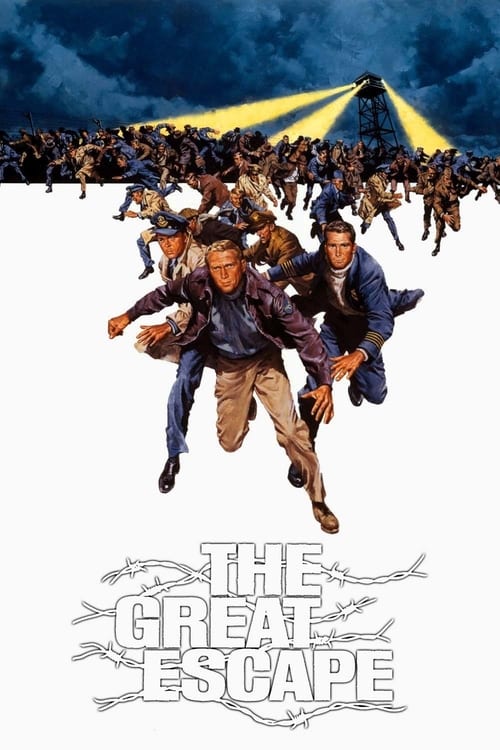
The Great Escape
1963 · John Sturges
For a lazy Sunday afternoon or a family movie night when you want pure, old-fashioned entertainment — heroes to root for, a plan to marvel at, and one of cinema's all-time great crowd-pleasers. Comfort viewing of the highest order.
What it's about
Fed up with Allied airmen constantly tunneling out of their prison camps, the Germans concentrate the worst offenders in one supposedly escape-proof camp — and hand them, in effect, a dream team. The prisoners promptly organize the most ambitious breakout of the war: three tunnels, forged papers, tailored civilian clothes, and hundreds of men in on the plan. Based on the real 1944 mass escape from Stalag Luft III.
The experience
Rousing, funny, and endlessly watchable — nearly three hours that fly by on the pleasure of watching clever people solve problems, with real stakes gathering underneath the fun. The final stretch turns into a sprawling chase that still gets pulses going sixty years on.
Performances
Steve McQueen, as the incorrigible American who keeps getting thrown in the cooler with his baseball and glove, became a superstar off this film — effortless cool that defined a screen persona — with James Garner, Richard Attenborough, and Charles Bronson filling out a stacked ensemble.
The craft
Sturges balances a huge cast and a procedural's worth of detail — how you dig, how you hide the dirt, how you forge a travel pass — without ever losing momentum, and Elmer Bernstein's jaunty march theme is one of the most whistled tunes in movie history. The widescreen scale and the famous motorcycle stunt work reward the biggest screen you can find.
Why it matters
A template for the ensemble mission movie and the caper procedural alike, it minted Steve McQueen's stardom and turned a documented wartime tragedy into an enduring pop-culture touchstone.
Snapshot
The Great Escape is John Sturges's expansive, near-three-hour dramatization of the March 1944 mass breakout from Stalag Luft III, the German Luftwaffe-run prison camp for Allied airmen near Sagan in what was then Lower Silesia. Adapted from Paul Brickhill's 1950 nonfiction account — Brickhill was himself a prisoner at the camp, though excluded from the escape — the film converts a meticulously documented true event into a star-driven ensemble adventure. It is at once a war film, a procedural caper, and a showcase for a transatlantic cast assembled by the independent Mirisch Company and released through United Artists. Its reputation rests on an unusual combination: rigorous attention to the mechanics of escape (the digging of three tunnels, "Tom," "Dick," and "Harry"; forged papers; tailored civilian clothing) and a handful of indelible star turns, above all Steve McQueen's. Across six decades it has hardened into a cultural fixture, less for its sober back half — in which most of the escapers are recaptured and fifty are murdered by the Gestapo — than for Elmer Bernstein's jaunty march and McQueen's motorcycle. The dossier below treats both the film's craftsmanship and the historical compression that shaped it.
Industry & production
The film was produced by the Mirisch Company, the independent outfit founded by brothers Harold, Marvin, and Walter Mirisch that supplied United Artists with much of its prestige product in this period. Sturges, who had directed The Magnificent Seven (1960) for Mirisch/UA, had long wanted to film Brickhill's book and reportedly held the rights for several years before the project came together. Production was mounted largely in Bavaria, West Germany, where a full prison-camp set was built near Munich (in the Perlacher Forest), and where exterior and location work — including the celebrated motorcycle sequences — could be staged across the surrounding countryside. The Geiselgasteig studios outside Munich (the Bavaria Film facilities) handled interiors.
The cast was deliberately international and commercially calculated, mixing established American stars (McQueen, James Garner, Charles Bronson, James Coburn) with British actors (Richard Attenborough, Donald Pleasence, James Donald, Gordon Jackson) and continental performers. This blend reflected the realities of a UA picture seeking both the American and the lucrative overseas market, and it caused some friction with the historical record: the actual Stalag Luft III escape was overwhelmingly a British-and-Commonwealth operation, with comparatively few Americans involved and none, in fact, among the escapers on the night itself (the Americans had been moved to a separate compound months earlier). The film's foregrounding of American characters — McQueen's Hilts, Garner's Hendley, Coburn's Sedgwick (here improbably rendered Australian) — was a commercial accommodation. The screenwriting passed through several hands; W. R. Burnett and James Clavell receive the principal credits, with reports of substantial uncredited work and on-set revision, some of it reportedly developed around McQueen, whose participation came with negotiated enhancements to his role.
Technology
The Great Escape was shot in color on 35mm and presented in a widescreen anamorphic format (Panavision), the standard prestige configuration for a 1963 roadshow-scale release. The wide frame is integral to the film's strategy: it accommodates the long horizontal lines of the camp — fences, huts, the cleared "death strip" — and the ensemble groupings, while leaving room for the open landscape that the escape eventually opens onto. The production used real locations and large built sets rather than relying on optical trickery, and the film's most technologically conspicuous achievement is practical rather than photographic: the motorcycle stunt work. The jumps and chases were performed by stunt riders — Bud Ekins executed the famous barbed-wire fence jump in McQueen's place — using period-appropriate machines dressed to read as German military bikes (the actual mounts were postwar Triumphs disguised for the camera). The tunnel sequences depended on cramped practical sets that could be lit and shot in confined spaces, conveying the claustrophobia and danger (cave-ins, the constant threat of discovery) of the real digging operation.
Technique
Cinematography
Daniel L. Fapp, an experienced studio cinematographer (an Academy Award winner for West Side Story), shot the film. His work is functional in the best sense: clean, legible, and organized around the geometry of confinement and escape. Interiors of the huts and tunnels are handled with a controlled, often low-key palette that emphasizes the grime and tension of the digging, while the camp exteriors are bright and exposed, the prisoners always visible to the guards and to us. As the film moves outward in its final act — onto roads, rails, rivers, and open country — the cinematography opens up correspondingly, the constricted compositions giving way to landscape. The motorcycle pursuit is staged for clarity and momentum, favoring readable wide shots of McQueen (and his stunt doubles) against rolling alpine terrain.
Editing
The editing, credited to Ferris Webster (a frequent Sturges collaborator), is the film's quiet structural achievement. The Great Escape runs nearly three hours and carries a very large ensemble, and Webster's cutting is what keeps its many parallel operations — tunneling, forging, tailoring, manufacturing, surveillance-evasion — intelligible and propulsive. The first two-thirds are essentially a braided procedural, intercutting among specialists ("the Forger," "the Scrounger," "the Tunnel King," "the Manufacturer") so that the audience grasps the breakout as a complex logistical system. The breakout night itself is a sustained suspense set piece built on cross-cutting between the tunnel, the surface, and the guards. The film then shifts gears into the dispersal sequences, where editing tracks multiple escape routes simultaneously before converging on the grim recapture and the massacre.
Mise-en-scène / staging
The camp set is the film's central scenographic invention: a credible, lived-in environment whose every element — the warning wire, the watchtowers, the huts raised off the ground to deter tunneling, the cleared perimeter — is established early so that the escape's obstacles are concrete and legible. Sturges stages the procedural material with an almost pedagogical clarity, letting us see exactly how sand is dispersed from trouser bags, how documents are forged, how air is pumped into the tunnels. The staging of the recreation and bluff — the prisoners' performance of normalcy for their captors — is a recurring motif, with the camp functioning as a stage on which the men must continuously act.
Sound
Elmer Bernstein's score is the most famous element of the film's soundtrack and one of the most recognizable march themes in postwar cinema; its brisk, whistling-on-the-way-to-work cheerfulness has become inseparable from the film's identity and arguably colors popular memory of it as lighter than its narrative actually is. Bernstein modulates the theme across the film, and the back half darkens considerably as the tone turns. Beyond the score, the film's sound design leans on the tense quiet of the tunneling sequences — scraping, breathing, the creak of shoring timber — against which sudden noises register as threats.
Performance
The performances are the film's enduring draw. Steve McQueen, as the American flyer Virgil Hilts ("the Cooler King"), embodies a laconic, motorcycle-and-baseball-glove cool that became a template for his stardom; his role was reportedly enlarged and reshaped to capitalize on his screen presence, and the solitary-confinement and motorcycle sequences are essentially star vehicles within the ensemble. Richard Attenborough gives the film its dramatic spine as Bartlett ("Big X"), the RAF officer who masterminds the escape and pays for it; his performance carries the moral weight the McQueen material does not. James Garner brings easy charm as the scrounger Hendley, paired affectingly with Donald Pleasence's Blythe, the forger going blind — a relationship that supplies the film's most direct emotional pathos. Charles Bronson (the claustrophobic tunneler Danny), James Coburn, James Donald (the senior British officer Ramsey), and Gordon Jackson round out an ensemble in which each actor is given a clearly defined function and a moment to register.
Narrative & dramatic mode
The film operates in two distinct movements. The first and longer is a procedural ensemble drama — closer in structure to a heist film than to a battlefield war picture — that derives its tension from process and from the constant risk of discovery. It is, for long stretches, surprisingly comic and warm, organized around competence, camaraderie, and ingenuity. The second movement, beginning with the breakout, is a dispersal-and-pursuit thriller that turns progressively bleaker: the escapers are hunted across occupied Europe, most are recaptured, and fifty are executed by the Gestapo on Hitler's orders. The film's dramatic gamble is this tonal turn — the abrupt collapse of the caper's buoyancy into atrocity. The closing emphasis on the cost of the escape, and on the survivors' grim resolve to continue resisting, complicates the entertainment that precedes it, though the film's popular reception has often privileged the lighter first half and the McQueen iconography over the somber conclusion.
Genre & cycle
The Great Escape belongs to the robust cycle of POW-escape films that flourished in British and American cinema from the late 1940s through the 1960s — a lineage that includes The Wooden Horse (1950), The Colditz Story (1955), Albert R.N. (1953), and Brickhill's other filmed book, The Dam Busters (1955). These films treated the prison camp as a theater of ingenuity and stoic resistance, and The Great Escape is in many respects the genre's grandest, most expensive, and most internationally cast iteration. It also sits within the broader post-war war-film tradition and overlaps with the men-on-a-mission ensemble adventure that Sturges himself had helped popularize with The Magnificent Seven; the assembling of a team of specialists, each with a defined skill, is common to both. Its commercial Americanization of a British story marks it as a transitional artifact between the austere British escape pictures and the larger, star-driven international productions of the 1960s.
Authorship & method
John Sturges was a director of large-scale, classically constructed action and adventure cinema — Bad Day at Black Rock (1955), Gunfight at the O.K. Corral (1957), The Magnificent Seven — known for clean staging, ensemble management, and an unfussy command of widescreen space. The Great Escape was in many ways his passion project, the culmination of a long-held ambition to film Brickhill's book, and it bears his characteristic virtues: narrative clarity across a huge cast, confident handling of suspense and spectacle, and an unsentimental but humane view of male collective enterprise. His key collaborators were well chosen: editor Ferris Webster, whose cutting holds the sprawling structure together; composer Elmer Bernstein, who had scored The Magnificent Seven and whose march defines the film's public image; cinematographer Daniel L. Fapp; and the screenwriting team of W. R. Burnett — a veteran of hardboiled crime fiction and film — and James Clavell, later famous as a novelist. The historical consultant tradition of the escape films mattered here too, as the production drew on Brickhill's first-hand account and on the documented record of the real operation, even as it reshaped that record for dramatic and commercial ends.
Movement / national cinema
The film is best understood as a product of the American independent-through-major system — a Mirisch Company production for United Artists — but one deeply hybridized with British cinema and shot in West Germany. It is not the expression of a national "movement" so much as of a particular early-1960s international mode of prestige production: American capital and stars, a partly British creative and acting contingent inherited from the homegrown escape-film tradition, and continental European locations and crews. In that sense it belongs to the runaway-production phenomenon of the period, in which Hollywood films were increasingly mounted in Europe to exploit locations, costs, and overseas markets.
Era / period
Released in 1963, The Great Escape arrived near the end of the classical-Hollywood widescreen epic's dominance and at a moment when the war film could still treat the Second World War as recent, morally legible communal memory — the events depicted were less than twenty years past, and many veterans of such camps were still living. It reflects the confident, large-budget, roadshow-adjacent filmmaking of the early 1960s, before the upheavals of the later decade reshaped both the war genre and Hollywood itself. Its blend of adventure entertainment with a true-atrocity coda also sits at a hinge point, anticipating the more morally ambivalent war films to come while retaining the essential heroism of the wartime-generation picture.
Themes
The film's governing themes are resistance as duty and ingenuity as defiance. Its central premise — articulated by the senior officers — is that escape is itself a form of combat, an obligation that ties down enemy resources and sustains morale even when the odds are hopeless. Closely linked is the theme of collective enterprise: the breakout is a triumph of organized, specialized, interdependent labor, and the film celebrates competence and cooperation under duress. Against this runs the counter-theme of cost. The film insists, in its final movement, that resistance carries a terrible price; the murder of the fifty transforms the caper into a memorial and rebukes any easy reading of the escape as a lark. Confinement and freedom structure the whole — the camp as a space of surveillance and performance, the open country beyond as both liberation and exposure. McQueen's Hilts, repeatedly returned to "the cooler," embodies an individualist strain of irrepressible defiance set against the disciplined collectivism of the British officers.
Reception, canon & influence
The Great Escape was a commercial success and has only grown in stature, becoming a perennial of television scheduling (notably as a holiday fixture in Britain) and a touchstone of popular war-film memory. Critical reception over time has been broadly admiring while consistently registering two reservations: the film's substantial Americanization and fictionalization of an overwhelmingly British-and-Commonwealth operation, and the tonal tension between its buoyant entertainment and the historical massacre it dramatizes. Specific contemporaneous critical quotations and precise box-office figures are beyond what can be reliably stated here without risking invention; the record of the film's enduring popularity, however, is not in doubt.
Looking backward, the film draws on Paul Brickhill's reportage and on the established conventions of the British POW-escape cycle (The Wooden Horse, The Colditz Story), as well as on Sturges's own ensemble-mission template from The Magnificent Seven. Looking forward, its influence is broad. It helped consolidate the "men on a mission" / assembled-team structure that runs through later war and caper films, and its procedural delight in process — the loving attention to how a complex scheme is executed step by step — became a durable mode. Steve McQueen's Hilts crystallized the actor's stardom and contributed a lasting image of laconic American cool, with the motorcycle sequence becoming one of the most quoted moments in popular cinema. Elmer Bernstein's march entered the wider culture, detached from the film and adopted (especially in Britain) as a sporting and comic shorthand. The film is regularly invoked, parodied, and homaged, and its title has become a generic phrase. As both a craftsmanlike ensemble entertainment and a still-debated act of historical adaptation, The Great Escape remains one of the defining war films of its era.
A Deleuzian reading
The image everyone keeps is the ball.
The full Deleuzian reading of The Great Escape →
Reception
A crowd-pleasing hit in 1963 that some critics shrugged at as overlong Hollywood adventure, it has since settled into unassailable comfort-classic status — famously a bank-holiday and Christmas TV fixture in Britain, where it's practically national furniture.
How The Great Escape was received, from release to now →
Influences: the films it descends from and the films it influenced
- Grand Illusion (1937) — Established the POW-escape film's humane multinational camp ensemble and the tunnel-dig as a vehicle for camaraderie and class friction rather than action spectacle.
- A Man Escaped (1956) — Defined escape-as-process: a near-fetishistic close attention to improvised tools and incremental method (sharpened spoon, rope from blankets) that Sturges popularizes as procedural delight.
- Le Trou (1960) — Renders the tunnel dig in near-real-time unbroken takes of manual labor, sharing Sturges's loving fixation on exactly how an escape is physically executed step by step.
- The Wooden Horse (1950) — Supplied the British POW cycle's template of disguised excavation (digging under a vaulting horse) and the methodical escape-committee organization Sturges inherits wholesale.
- The Colditz Story (1955) — Codified the camp ensemble of squabbling national contingents and the centralized 'escape organization' running parallel schemes, the bureaucratic structure behind The Great Escape's X plan.
- Stalag 17 (1953) — Modeled the barracks ensemble's tonal blend of wisecracking comedy and lethal menace, and the cynical American loner-hero archetype that Hilts refines into laconic cool.
- Seven Samurai (1954) — Originated the recruit-by-specialty assembled-team structure (each man defined by one expertise—tunneler, forger, scrounger) that Sturges first adapted in The Magnificent Seven and reapplies to the camp.
- The Magnificent Seven (1960) — Sturges's own ensemble-mission template and Elmer Bernstein's brass march are carried directly forward, including the management of a large cast through clean widescreen staging.
- The Bridge on the River Kwai (1957) — Set the large-scale anamorphic POW epic that fuses process-driven construction spectacle with ironic tragedy underneath crowd-pleasing roadshow entertainment.
- Von Ryan's Express (1965) — Immediately extends the POW mass-escape ensemble into a moving-train scenario, retaining the multinational-prisoner organization and the downbeat costing of escape in lives.
- The Dirty Dozen (1967) — Hardens the assembled-team formula into an explicit recruit-train-execute three-act structure, adding the training montage as a procedural prelude to the mission.
- Where Eagles Dare (1968) — Carries the step-by-step scheme-execution procedural into WWII infiltration, layering double-crosses over the same fascination with how an elaborate plan unfolds in real space.
- Bullitt (1968) — Inherits McQueen's do-his-own-stunts practical-action ethos and laconic-cool persona, reincarnating the motorcycle jump as the era's defining real-vehicle car chase.
- Ocean's Eleven (2001) — Transposes the assembled-specialist procedural into the heist genre, cross-cutting the simultaneous execution of a multi-part plan with the same ensemble cool and process-pleasure.
- Chicken Run (2000) — An explicit homage that transplants the POW-escape procedural, escape-committee ensemble, and even specific set-pieces into stop-motion, confirming the template's generic legibility.
- Inglourious Basterds (2009) — Revives the men-on-a-mission WWII ensemble through chapter-structured procedural set-pieces and an openly fictionalized counter-history, the same liberty-with-the-record Sturges took with the real escape.
- The Shawshank Redemption (1994) — Provides the tunnel-digging concealment procedural and the cross-cut breakout sequence that intercuts the escape against captors oblivious to it — the structural model for Andy's escape against the warden's morning routine.
- Toy Story 3 (2010) — Supplies the ensemble-escape blueprint TS3 restages beat-for-beat — assign each member a specialized job, then cross-cut the parallel escape mechanics building to one synchronized break.
- War for the Planet of the Apes (2017) — Provides the mechanics of the tunnel breakout — camp geography, sentries, the dug escape route — that War restages for the apes' liberation.
- Maze Runner: The Death Cure (2018) — The ensemble prison-break blueprint — a bonded crew of specialists executing a coordinated, multi-stage breakout as the spine of set-piece structure.
- Papillon (1973) — Built the McQueen star-text of laconic, physical, unbreakable defiance and the episodic ensemble-escape structure that Papillon retools into a two-man survival chronicle.
- The Guns of Navarone (1961) — A contemporaneous men-on-a-mission WWII roadshow built on an assembled specialist team and anamorphic spectacle, sharing the same procedural-objective architecture.
- The Longest Day (1962) — Deploys the same star-ensemble-vignette architecture, allotting each recognizable lead his own self-contained set-piece within one collective operation.
- Don't Look Now... We're Being Shot At! (1966) — Parallel development of the war-caper as an ensemble of comic-contrasting escape specialists, each chase and evasion built as a self-contained bravura set piece.
Similar films
- The Magnificent Seven (1960) — influence & lineage
- Where Eagles Dare (1968) — influence & lineage
- The Dirty Dozen (1967) — influence & lineage
- Le Trou (1960) — influence & lineage
- The Guns of Navarone (1961) — influence & lineage
- Stalag 17 (1953) — influence & lineage
- The Bridge on the River Kwai (1957) — influence & lineage
- Grand Illusion (1937) — influence & lineage
All the films related to The Great Escape →