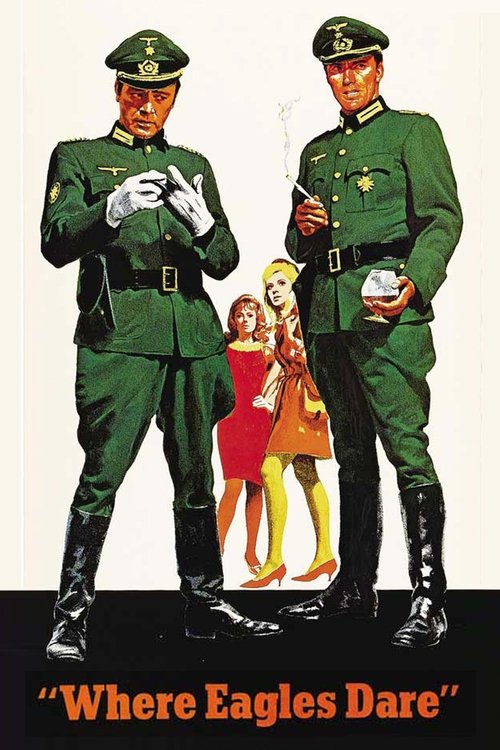
Where Eagles Dare
1968 · Brian G. Hutton
For when you want a big, sturdy men-on-a-mission spectacle — snow, spies, and explosions, zero irony. Comfort viewing of the highest order, ideally with the sound up.
What it's about
An American general with knowledge of Allied invasion plans is being held in a clifftop Bavarian castle reachable only by cable car. A small commando team parachutes into the snowbound Alps to get him out — but the mission keeps twisting, and it becomes clear that the operation is also about flushing out traitors inside British intelligence itself.
The experience
Pure old-school adventure: two and a half hours of infiltration, disguises, double-crosses, and escalating set pieces, played completely straight and paced like a machine. It's the kind of film you sink into on a winter evening and let carry you.
Performances
Richard Burton brings unlikely Shakespearean gravity to the espionage double-talk, and a young Clint Eastwood is the perfect laconic counterweight, doing most of his acting with a submachine gun.
The craft
Alistair MacLean wrote the twist-stacked screenplay directly for the screen, and the production delivers genuinely spectacular alpine locations, a fortress of a castle set, and a cable-car fight that remains one of the great action sequences of its era. Ron Goodwin's martial score drives it all forward. This one was built for the biggest screen you can find.
Why it matters
A benchmark of the WWII mission movie whose set-piece engineering echoed through decades of action cinema, and a key step in Eastwood's rise to international stardom.
Snapshot
Where Eagles Dare is a WWII commando adventure engineered as pure spectacle: a small Allied team parachutes into the Bavarian Alps to extract an American general held in the Schloss Adler, a clifftop castle reachable only by cable car — and the mission's true business, gradually revealed, is to expose double agents inside British intelligence. Directed by Brian G. Hutton from an original screenplay by Alistair MacLean, and pairing Richard Burton with a rising Clint Eastwood, it is a film of set pieces rather than psychology: alpine infiltration, a protracted castle shoot-out, and a cable-car fight that became one of the era's signature action sequences. Its title comes from Richard III ("where eagles dare not perch"), and its enduring reputation rests less on thematic weight than on sustained kinetic craftsmanship and Ron Goodwin's driving martial score. It stands as a high-gloss studio exemplar of the 1960s "men on a mission" cycle.
Industry & production
The project was producer-driven from the outset, and its genesis is one of the more frequently cited facts about it: producer Elliott Kastner approached Alistair MacLean — already a bankable name in adventure fiction and the source author of The Guns of Navarone — to write an original story built for the screen. MacLean is generally reported to have written the screenplay and the tie-in novel more or less concurrently, making the film unusual in that the "adaptation" and its source emerged together rather than the book preceding the picture by years. This detail is well established in accounts of MacLean's career, though the precise sequencing of manuscript and script is the kind of thing later retellings tend to smooth over.
The film was produced for Metro-Goldwyn-Mayer, with Kastner and Jerry Gershwin as the producing team. It was a large-scale international production of the sort MGM still mounted in the late 1960s, combining Austrian and Bavarian alpine location work with studio interiors shot in Britain at MGM's Borehamwood facility. Richard Burton, at the height of his fame and remuneration, anchored the package; the casting of Clint Eastwood — then transitioning from the Leone Westerns and Italian production toward Hollywood stardom — gave the film a second marquee name aimed at a broader and younger audience. The budget was substantial by the standards of the day, reflecting the location logistics, the castle and cable-car work, and Burton's salary, though exact figures should be treated cautiously in the absence of a definitive production ledger. Commercially the film performed strongly and became one of the better-remembered war-adventure hits of its moment; specific gross figures vary across sources and are not reproduced here.
Technology
Where Eagles Dare was shot in Panavision anamorphic and released in Metrocolor, the wide-screen color format that defined big studio action of the period. There is nothing technologically avant-garde about its image-making — this is conventional late-1960s 35mm production — but the film's ambition lay in physical, in-camera execution rather than optical trickery. The cable-car sequences in particular depended on real aerial rigging, elevated platforms, and stunt doubling filmed against genuine mountain drops, supplemented by studio mock-ups and process work for the closer coverage of the stars. The film belongs to an era before extensive optical compositing was routine in action cinema, so its most dangerous-looking moments were built from practical stunt work, careful camera placement, and editing rather than post-production illusion.
Technique
Cinematography
Arthur Ibbetson photographed the film, and his work divides cleanly between two registers. The exteriors exploit the alpine landscape — snowbound slopes, the vertiginous castle on its crag, the strung cable line over a valley — for scale and menace, giving the mission a genuine sense of geographical impossibility that the plot repeatedly insists upon. The interiors, by contrast, are darker, tighter, and more theatrical, staging the castle's corridors, the Gestapo interrogation, and the escape as a series of enclosed confrontations. Ibbetson's anamorphic framing keeps figures legible within busy action and preserves the spatial logic of the castle so that the audience can follow who is where — a discipline essential to a film whose climax is a running gun battle through architecture.
Editing
Cut by John Jympson, the film is fundamentally an editor's showcase in its second half. The extended castle assault and the cable-car sequence are sustained through rhythmic cross-cutting between the stars, their doubles, the pursuing Germans, and the mechanical peril of the moving car. The editing carries much of the tension precisely because so much of the danger is conveyed through juxtaposition — close coverage of Burton and Eastwood intercut with wider stunt footage — rather than through any single unbroken shot. The pacing choice is deliberate: an unusually long first act of quiet infiltration and mounting paranoia gives way to an almost relentless action climax, and the film's tonal architecture depends on that acceleration.
Mise-en-scène / staging
The production design leans on the authenticity of its principal location — the fortress silhouette, the courtyards, the cable station — combined with detailed studio recreations of the castle interiors that allowed for controlled staging of the shoot-outs and the radio-room confrontation. German uniforms, staff-car convoys, and the machinery of the Schloss are dressed with the period-adventure genre's characteristic density of hardware. Staging privileges legibility and momentum: rooms and routes are established so that the later chaos reads clearly, and the recurring motif of the cable car is set up spatially long before it becomes the arena for the film's most famous confrontation.
Sound
The sonic identity of the film is dominated by Ron Goodwin's score, whose martial main theme — brass-forward, propulsive, instantly recognizable — functions almost as a second protagonist, driving the action and lending the mission an air of heroic inevitability. Beyond the music, the sound design foregrounds the machinery of violence: automatic gunfire, explosions, the mechanical groan of the cable car, and the wind of the alpine exteriors. The film's much-noted volume of gunplay is as much an auditory signature as a visual one.
Performance
Richard Burton plays Major Smith with a watchful, controlled gravity, holding the film's central deception close; his performance is deliberately opaque, since the plot turns on how much he is concealing from his own team. It is widely reported that Burton took the role in part to make a picture his children could enjoy — a piece of biographical color that recurs in accounts of the production and squares with the film's straightforwardly heroic register. Clint Eastwood, as Lieutenant Schaffer, is laconic and physically dominant, dispatching enemies with an economy that Eastwood himself is said to have wryly registered — the oft-repeated anecdote that he joked the film might better be called "Where Doubles Dare," given the volume of stunt-double work, is part of the film's lore. Mary Ure brings the principal female presence as the undercover agent Mary, while a strong bench of British and European character actors — including Michael Hordern, Patrick Wymark, Ingrid Pitt, and Derren Nesbitt as the smoothly sinister Gestapo officer — populate the intrigue.
Narrative & dramatic mode
The screenplay is built around concealment and reversal. What presents itself as a rescue mission is progressively revealed to be a counter-intelligence operation designed to unmask traitors, and the film's mid-section is a cascade of double-crosses in which allegiances flip and the "captured general" and the interrogation sequence become instruments of a larger deception. This is the MacLean signature: a puzzle-plot in which the audience, like the characters, must repeatedly revise its understanding of who is loyal and what the objective really is. The dramatic mode is that of the adventure-thriller — suspense generated by hidden information and physical peril rather than by interior character development. The narrative deliberately withholds its true stakes, using the extraction premise as a Trojan horse for an espionage reversal, and then resolves everything through action.
Genre & cycle
Where Eagles Dare belongs squarely to the 1960s "men on a mission" war-adventure cycle — the strain of WWII filmmaking that treated the war as a stage for commando spectacle and elaborate operations rather than for combat realism or moral reckoning. Its clearest lineage runs through The Guns of Navarone (1961), the earlier MacLean property with which it shares an impossible-fortress premise, and it sits alongside The Great Escape (1963) and The Dirty Dozen (1967) as part of a commercial wave of team-mission pictures. Within that cycle it tilts hard toward the fantastical and the escapist: the emphasis is on ingenuity, disguise, and mounting body count rather than on the grinding attrition or ethical ambiguity that other war films of the decade pursued. It is, in effect, a proto-blueprint for the action set-piece movie, closer in spirit to later spy-adventure and action cinema than to the war film's more somber traditions.
Authorship & method
Brian G. Hutton, an American director, is best understood here as a capable craftsman of large-scale action rather than an auteur imposing a personal vision; his direction serves the material's momentum and clarity. He would reteam with Clint Eastwood almost immediately on Kelly's Heroes (1970), another WWII adventure with a more satirical bent, and the two films together mark the most notable stretch of his directing career. The film's authorship is arguably distributed across several key collaborators as much as its director. Alistair MacLean, as screenwriter and originating author, supplies the plot architecture — the reversals, the fortress premise, the intelligence intrigue — that defines the film's structure. Arthur Ibbetson (cinematography) and John Jympson (editing) execute the alpine-versus-interior contrast and the action pacing that give the film its physical impact. Ron Goodwin (composer) provides the martial identity that has arguably outlived the plot in popular memory. Second-unit and stunt work were central to the production's method: the veteran Yakima Canutt is credited with second-unit direction, and the celebrated cable-car and castle stunts were realized by professional stunt performers whose contribution is inseparable from the film's reputation. The specific attribution of individual stunts varies across sources and is best stated with that caveat.
Movement / national cinema
The film is a product of the transatlantic studio system as it operated in the late 1960s: an American major (MGM) financing an English-language production with a British director-of-record's craft base, British and European personnel, Continental locations, and two stars — one Welsh, one American — aimed at a global market. It is not affiliated with any art-cinema movement; rather it exemplifies the internationalised commercial filmmaking, often shot in Europe with British crews and studio facilities, that characterized much big-budget English-language production of the era. In that sense it belongs to the tradition of British-based international spectacle production more than to any national cinema of authorship.
Era / period
Released in 1968, the film arrives at a moment of upheaval in cinema — the loosening of censorship, the rise of the New Hollywood, and a turn toward realism and moral complexity that the same year's more radical pictures embodied. Where Eagles Dare runs counter to that current. It is an unabashedly traditional, escapist studio entertainment, confident in heroism and clean of the era's countercultural anxieties, and its success suggests the continued commercial vitality of classical spectacle even as the industry's center of gravity was shifting. It marks something of a late high point for the old-model, star-driven, location-heavy studio adventure before that mode gave way.
Themes
The film's thematic register is deliberately modest and instrumental. Its dominant preoccupations are loyalty and betrayal — the plot machine of hidden allegiances and double agents — and the professionalism of the mission, the competence and improvisation of skilled men (and one woman) under impossible conditions. Deception is both subject and method: the characters lie, disguise, and misdirect, and the film lies to its audience in parallel, so that the pleasure of the narrative is the pleasure of the reveal. Beyond that, there is little interest in the war's larger meaning; the conflict is a setting for adventure rather than an object of inquiry. Any reading of the film as a serious meditation on war would strain against its own evident intentions.
Reception, canon & influence
Critically, Where Eagles Dare has always occupied the terrain of the crowd-pleaser: admired for its craftsmanship, momentum, and set pieces, and generally judged as accomplished entertainment rather than as art. Contemporary and later commentary has tended to celebrate the cable-car sequence and the sheer sustained energy of the action while noting the improbability of the plot and the film's escapist priorities. It has retained a durable popular following and is frequently revived, particularly in Britain, where its score and its Burton–Eastwood pairing have given it a lasting broadcast presence; broad claims about its exact standing in critical canons should be made carefully, as it is more a beloved genre staple than a fixture of the academic canon.
Looking backward, the film's influences are clear: the fortress-assault premise and puzzle-plot descend directly from MacLean's own The Guns of Navarone, and the team-mission structure sits within the cycle established by The Great Escape and The Dirty Dozen. Its title's borrowing from Shakespeare gestures at a literary frame the film otherwise wears lightly. Looking forward, its most significant legacy is as a template for the action set-piece film. The prioritizing of sustained, spectacular sequences — the extended climactic assault, the vertiginous stunt centerpiece — over character or theme anticipates the grammar of later action cinema, and its high-visibility stunt work contributed to the growing prestige of that craft. The specific claim, sometimes made, that particular filmmakers cite it as a formative favorite is plausible given its cult standing but should be attributed only where the record is firm. What is beyond dispute is that the film helped normalize the notion that a war picture could be, first and foremost, an engine for action — an approach that reverberates through the decades of adventure filmmaking that followed.
A Deleuzian reading
A cable car hangs from a wire over an Alpine valley, and men are fighting on it.
The full Deleuzian reading of Where Eagles Dare →
Reception
A big box-office hit in 1968 that critics largely waved off as preposterous pulp, it's since been canonized as the purest expression of the men-on-a-mission war adventure — the Bank Holiday classic that everyone now admits is exactly as fun as it always was.
How Where Eagles Dare was received, from release to now →
How to watch Where Eagles Dare: what to notice on a first viewing
- Watch how clearly each room and route is established before the chaos. Staging favors legibility, laying out corridors, courtyards, and the cable line early so the later gun battle through the castle stays easy to follow. You can track exactly where everyone is even when the action turns frantic.
- Listen for Ron Goodwin's brass score driving each mission scene. The propulsive martial score returns again and again, functioning almost like a second character pushing the team forward. The music supplies the confidence the plot's plausibility does not always earn.
- Watch how little Burton's face gives away in every briefing scene. Richard Burton plays Major Smith watchful and controlled, keeping his own team at a distance. His opacity is part of the character. Notice how little he says in the briefings.
- Track how the film cross-cuts between the stars and the pursuing Germans. Jympson's editing juxtaposes close coverage of Burton and Eastwood with wider stunt footage, building tension through rhythm rather than a single unbroken shot. The cutting itself generates the danger, not just what's happening in any one shot.
- Notice the shift from wide alpine exteriors to tight, dark interiors. Ibbetson's photography splits into two registers: snowbound scale outdoors, enclosed theatrical confrontation once the team is inside the castle. The contrast keeps reminding you how exposed the mission is outside and how trapped it is once inside.
The whole guide to watching Where Eagles Dare, with the keys for a rewatch →
Influences: the films it descends from and the films it influenced
- The Guns of Navarone (1961) — The originating MacLean template — an 'impregnable' fortified installation that must be infiltrated and destroyed, structured around a concealed-traitor reversal that Eagles Dare simply multiplies into cascading double-crosses.
- The Great Escape (1963) — Codifies the assemble-the-specialists-then-execute-the-elaborate-procedural-plan structure, sustaining tension through the mechanics of a plan unfolding rather than through character interiority.
- The Dirty Dozen (1967) — Supplies the men-on-a-mission briefing-to-assault grammar and specifically the climactic massed assault on a single enemy château, prefiguring Eagles Dare's castle set-piece.
- North by Northwest (1959) — Model for staging a climax as literal physical peril on an architectural monument (Rushmore) and for a plot of nested double-agents where identity is never stable — Eagles Dare's cable-car and castle-cliff work inherits this vertiginous-set-piece logic.
- Stagecoach (1939) — Home of Yakima Canutt's leaping-and-falling-between-moving-vehicles stunt method; Canutt directed Eagles Dare's second unit, making its cable-car stunt grammar a direct continuation of his 1930s vehicular choreography.
- Ben-Hur (1959) — Canutt's second-unit blueprint for large-scale practical action staged for spatial legibility and genuine physical danger, the prestige-stunt craft Eagles Dare draws on for its alpine set-pieces.
- Kelly's Heroes (1970) — Hutton's immediate Eastwood reteam — the same behind-the-lines WWII adventure architecture and laconic-Eastwood staging, tilted toward heist and satire.
- The Eagle Has Landed (1976) — Extends the infiltrate-in-enemy-uniform premise, building suspense from operatives impersonating the occupying force where a slip in disguise, not firepower, is the constant threat.
- Force 10 from Navarone (1978) — Literal MacLean lineage continuation — the demolition-of-a-strategic-structure (the bridge/dam) mission with an embedded-traitor reveal, inheriting Eagles Dare's sabotage-puzzle mechanics.
- The Wild Geese (1978) — Carries the specialist-team-assembled-for-a-fortress-raid structure into the mercenary era, climaxing on the fraught extraction-under-fire that Eagles Dare made a genre fixture.
- Raiders of the Lost Ark (1981) — Makes the sustained practical set-piece (the truck convoy) the narrative engine itself, prioritizing kinetic spectacle over interiority — the war-adventure-as-action-machine ethos Spielberg has named Eagles Dare a formative favorite for.
- Die Hard (1988) — Transposes the single-fortress infiltration into a modern tower: a lone operator exploiting the building's vertical architecture to pick off occupants, the architectural-legibility staging Eagles Dare pioneered.
- Inglourious Basterds (2009) — Men-on-a-mission behind Nazi lines where impersonation and language-fluency are the weapon and the peril — deception-as-method staged as suspense; Tarantino repeatedly cites Where Eagles Dare as a touchstone.
- Mission: Impossible – Fallout (2018) — Combines mask-and-impersonation plotting with a vertiginous, genuinely-performed practical stunt centerpiece (helicopter/cliff), the direct heir to Eagles Dare's cable-car ethos and its elevation of stunt work to headline prestige.
- Top Secret! (1984) — Supplies the men-on-a-mission architecture beat for beat — resistance contact in an occupied town, the infiltrated-uniform ruse, the double-cross reveal, the fortress raid — staged in Top Secret! with the same wide-lens mission geography and no compression of the genre's plot machinery.
- Ice Station Zebra (1968) — Same-year MacLean adaptation running the identical engine: a Cold-War puzzle-plot in a hostile installation, resolved by unmasking a hidden traitor through late-breaking reversal.
- Von Ryan's Express (1965) — Escape-turned-offensive with a laconic American star, converting a WWII-captivity premise into a sustained transit action set-piece (the hijacked train) as its climactic engine.
Similar films
- The Guns of Navarone (1961) — influence & lineage · same viewing thread
- The Great Escape (1963) — influence & lineage
- The Dirty Dozen (1967) — influence & lineage
- Raiders of the Lost Ark (1981) — influence & lineage
- Kelly's Heroes (1970) — influence & lineage
- North by Northwest (1959) — influence & lineage
- Die Hard (1988) — influence & lineage
- Twelve O'Clock High (1949) — same viewing thread
All the films related to Where Eagles Dare →
Watch it with: curated runs of related films
- Against Overwhelming Force — A run for when you want scale and physical punishment — men set against armies, tanks, and the frozen wild, holding a line that by rights should have broken them.