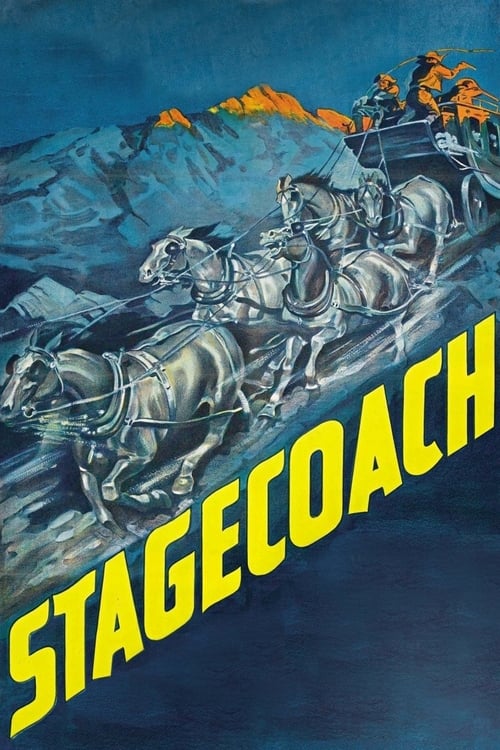
Stagecoach
1939 · John Ford
For when you want a rousing classic adventure that goes down easy — a comfort watch with real heart, and a perfect first old Western if you've never tried one.
What it's about
Nine strangers board a stagecoach crossing Apache territory, with Geronimo's raiders somewhere out in the desert ahead. Among them: a prostitute run out of town, a drunken doctor, a pregnant army wife, a crooked banker, a gambler, a whiskey salesman, a lawman — and an escaped outlaw picked up along the road. Cooped together and in danger, the respectable and the outcast get their pretensions tested mile by mile.
The experience
Brisk, warm, and surprisingly funny for long stretches, then genuinely thrilling when the chase comes — the stunts still quicken the pulse nearly a century on. What sneaks up on you is the tenderness: it keeps siding with the people polite society threw away.
Performances
This is the film that made John Wayne a star, introduced with one of the most famous entrances in movies, and Thomas Mitchell's boozy, rueful doctor won an Oscar — he steals scene after scene without ever begging for it.
The craft
John Ford brought the towering buttes of Monument Valley to the screen for the first time, and the sight of a tiny coach crawling beneath that immense rock still stuns — this one rewards the biggest screen you can find. The chase sequence, with stuntmen leaping between galloping horses, remains a marvel of practical action, and the storytelling is so economical that nine characters all register in under two hours.
Why it matters
It rescued the Western from B-movie disrepute and made it a form for serious drama, launched John Wayne, and gave generations of filmmakers a visual playbook for landscape and action.
Snapshot
John Ford's Stagecoach is the film that rescued the Western from a decade of B-picture obscurity and redefined it as a vehicle for serious dramatic and social inquiry. Shot partly on the alien geology of Monument Valley — terrain Ford was introducing to cinema for the first time — it follows nine passengers aboard a Concord coach crossing Apache territory from Tonto to Lordsburg, New Mexico. The ensemble includes a banished prostitute, a drunken doctor, a pregnant cavalry wife, a fugitive outlaw, a corrupt banker, a professional gambler, a whiskey salesman, and a nervous lawman. Their forced intimacy becomes a laboratory for testing American democratic ideals against the hypocrisies of frontier respectability. The film launched John Wayne's stardom on a single low-angle shot and established a visual grammar — vast landscape dwarfing the human figure, the stagecoach as civilization's fragile vessel — that would define Hollywood's Western for a generation and anchor Ford's own career for the next thirty years.
Industry & production
By the late 1930s the Western had been largely ceded to Republic, Mascot, and other poverty-row studios grinding out cheap Saturday serials. The major studios regarded it as a played-out genre beneath their A-picture ambitions. Ford spent years trying to overturn that prejudice. He acquired the rights to Ernest Haycox's short story "Stage to Lordsburg," published in Collier's Weekly in 1937 — itself a laconic reworking of Guy de Maupassant's 1880 story "Boule de Suif," which concerned a Norman prostitute whose virtue shames the ostensibly respectable travelers sheltering alongside her — and commissioned Dudley Nichols to develop the screenplay. When the major studios passed, Ford took the project to independent producer Walter Wanger, who agreed to finance it for release through United Artists. The relative freedom of independent production allowed Ford to push against the studio Western's habitual economies: a modestly large cast of character players, location shooting in genuinely remote terrain, and a chase sequence designed around dangerous, technically demanding stunt work rather than second-unit shortcuts.
The casting of John Wayne as the Ringo Kid required Ford to outmaneuver the skepticism of both Wanger and United Artists. Wayne had been performing since the early 1930s in B-westerns and had starred in Raoul Walsh's large-scale The Big Trail (1930), which had failed commercially. Ford, who had known Wayne since the late 1920s when the younger man worked as a prop hand on Ford's productions, was convinced Wayne possessed a screen presence that had never been properly directed. He was proven right. The supporting cast — Claire Trevor, Thomas Mitchell, John Carradine, Andy Devine, Louise Platt, Donald Meek, Berton Churchill, George Bancroft — was drawn from Ford's extended professional network and performed with an ensemble coherence that kept the film's social allegory legible without becoming schematic.
Technology
Stagecoach was photographed in standard 35mm black-and-white by Bert Glennon, with second-unit and stunt work supervised by Yakima Canutt, who was simultaneously its principal stunt performer. Glennon and Ford favored wide-angle lenses that could hold the Monument Valley formations — the distinctive sandstone buttes and mesas of what is now Navajo Nation on the Arizona-Utah border — in sharp depth while keeping human figures in the foreground. This approach placed characters in expressive relationship to landscape rather than isolating them against neutral studio backings: the stagecoach perpetually dwarfed, the wilderness never merely decorative.
The film's most celebrated technological achievement is the stagecoach chase sequence across the salt flats. Canutt devised and personally performed the stunt in which a character falls from a team of galloping horses and is dragged beneath the vehicle — the coach wheels threaded between the fallen man's body and the ground. The engineering of the gag, which required the stunt performer to drop, be passed over by the entire team and coach, and then roll clear, was unprecedented in its precision and danger. It remains a landmark in practical stunt choreography. Ford and his editors cut the chase with a momentum and spatial clarity that demonstrated how much kinetic information could be organized through editing alone; the sequence influenced action filmmakers for decades.
Technique
Cinematography
Glennon's work on Stagecoach is inseparable from Ford's compositional instincts, though determining where each man's contribution begins and ends is difficult at this remove. The famous introduction of Wayne — a low-angle, slightly telephoto shot that pulls in rapidly as the Ringo Kid twirls his rifle in the desert, the frame expanding to his figure with an almost aggressive intimacy — is one of cinema's most studied character entrances, and its visual logic (the land behind him, the viewer at a submissive angle) immediately codes Wayne as a figure of natural authority in this landscape. Glennon's lighting in the interior stagecoach scenes adopts a harder, more dramatically contrasted register, isolating faces against shadow in ways that externalize internal moral states. Monument Valley is never treated as merely picturesque: the buttes appear in the background of action sequences as indifferent witnesses, their geological scale a constant reproach to human urgency.
Editing
Dorothy Spencer edited Stagecoach, and her management of its tonal range — from ensemble comedy, to intimate drama, to the extended kinetic violence of the chase — is a model of classical continuity style pushed to near-maximum expressiveness. The cross-cutting during the Apache attack constructs time under duress: shots of the coach, the pursuing warriors, the cavalry riding to the rescue, and the dwindling ammunition inside the stagecoach are interleaved at a tempo that generates suspense while maintaining absolute spatial legibility. Within the stagecoach interior, Spencer uses eyeline matches and shot-reverse-shot patterns to build the social geometry of the passenger group — who watches whom, who is excluded from the frame, who occupies its center — as an ongoing narrative argument.
Mise-en-scène / staging
Ford's staging within the confined stagecoach interior demonstrates his economy as a spatial dramatist. The coach's narrow benches enforce a physical hierarchy — the "respectable" passengers positioned to register their disapproval of Dallas and the Ringo Kid through sustained compositional pressure — and Ford uses this constraint to make social ostracism visible without expository dialogue. The relay station sequences allow the passengers to spread into larger spaces, and Ford consistently stages these scenes so that the formal structure of the social group (who sits beside whom at the table; who remains standing) carries the scene's meaning before a word is spoken. His preference for staging that lets viewers construct the drama from spatial cues rather than close-up reactions is one of the qualities that André Bazin would later identify as central to Ford's cinema.
Sound
Stagecoach arrived four years into the sound era's maturity and uses location-derived ambient sound — the creak of the coach, wind, horses — to anchor the studio-shot interiors to their supposed outdoor context. The Apache attack sequence uses the absence of non-diegetic music for portions of its duration, letting the percussion of hooves, gunshots, and wagon noise build its own sonic tension. The film's sound design is not particularly experimental by contemporary standards but is purposeful in its avoidance of the over-composed audio environments common to prestige pictures of the period.
Performance
Thomas Mitchell's Doc Boone became the template for the Ford stock-company performance: large, generous, and precisely timed, modulating between broad comedy and sudden pathos without rupturing the dramatic surface. Mitchell won the Academy Award for Best Supporting Actor, and the performance remains the film's most technically accomplished piece of acting. Claire Trevor brings a restraint to Dallas that the film's social parable requires — her dignity cannot be announced, only quietly demonstrated. Wayne, working under intensive direction from Ford (who treated him with deliberate severity on set, in part to establish authority over the unit), discovered in the Ringo Kid the persona he would inhabit for the next four decades: unhurried, morally certain, physically fluent. John Carradine's Hatfield, all cadaverous gentility and faded honor, is a minor masterwork of suggestion.
Narrative & dramatic mode
Dudley Nichols's screenplay adapts Haycox's already Maupassant-inflected story with close attention to the "ship of fools" structure — a socially mixed group confined together, their pretensions stripped away by crisis — while Americanizing its moral geometry. Where Maupassant's story is acidly pessimistic (the respectable bourgeois exploit the prostitute's sacrifice and repay her with contempt), Ford and Nichols tilt toward democratic redemption: the outcast characters (Dallas, Ringo, Doc Boone) prove their virtue under pressure; the respectable ones (Gatewood the embezzling banker, the prim passengers who snub Dallas) are exposed as either corrupt or merely conventional. The film's major innovation on its source material is the introduction of the Ringo Kid's revenge quest — a classical Western plot engine — which gives the journey a teleological drive that Maupassant's static structure lacked. The dual climax (the Apache attack, then Ringo's settling of accounts with the Plummer brothers) allows the film to satisfy generic expectations while the social drama has been fully resolved in the relay-station scenes preceding it.
Genre & cycle
Stagecoach arrived after roughly a decade in which the Western had been defined by B-picture serials aimed at juvenile Saturday audiences — formulaic, quickly shot, narratively thin, and performed by a new generation of cowboy stars (Gene Autry, Roy Rogers) whose appeal was to childhood fantasy rather than adult dramatic engagement. The film's success demonstrated to studio executives that the Western could be an A-picture genre, capable of earning critical prestige and adult box office. It directly preceded and enabled a wave of major Western productions from the major studios in the 1940s and 1950s: Northwest Passage (1940), Ford's own cavalry trilogy (Fort Apache, She Wore a Yellow Ribbon, Rio Grande), My Darling Clementine, High Noon (1952), Shane (1953), and eventually the psychologically revisionist Westerns of the late 1950s. The film's model of the journey Western — geographically structured, ensemble-driven, landscape-saturated — remained central to the genre's A-picture manifestations throughout this period.
Authorship & method
By 1939 John Ford had been directing since 1917, with earlier Western features — including The Iron Horse (1924) — and the prestige drama The Informer (1935) establishing his critical reputation. Stagecoach marks the moment his characteristic aesthetic crystallized: the use of landscape as moral counterpoint, the stock company of trusted performers, the preferring of reticent staging over explanatory close-ups, and the recurring examination of community formation under duress. His working method was authoritarian and often psychologically brutal toward cast and crew, but produced a consistency of tone that allowed him to move between broad comedy and genuine pathos within a single sequence.
Dudley Nichols was Ford's most important screenwriting collaborator of the 1930s and 1940s, having previously written The Informer and Mary of Scotland for him. Nichols shared Ford's interest in social allegory and brought structural rigor to material Ford might have approached more intuitively.
Bert Glennon's cinematographic contribution was decisive for the film's visual identity, though he never became as celebrated as Gregg Toland (who worked with Ford immediately after on The Grapes of Wrath, 1940) and his specific contribution to Stagecoach's distinctive visual character is somewhat underwritten in the critical literature. The score, which adapted existing American folk songs into a continuous dramatic underscore, was the work of Richard Hageman, W. Franke Harling, John Leipold, and Leo Shuken; it won the Academy Award for Best Original Score and established the model of traditional-folk-song orchestration that would define the Western musical idiom.
Movement / national cinema
Stagecoach is a foundational document of what critics from Robert Warshow onward have called the mythological Western — a genre whose ostensible subject is historical (the late-nineteenth-century frontier) but whose actual content is an ongoing American argument about violence, civilization, individual freedom, and social contract. The film is specifically located within the Hollywood studio system's classical period, sharing with its contemporaries (Gone with the Wind, The Grapes of Wrath) a tendency to process social trauma — the Depression, the coming war, anxieties about American democratic virtue — through mythological narratives set safely in the national past. Ford's Irish-American background inflected his relationship to that mythology: his Westerns consistently return to communities of displaced, marginalized, or outcast figures finding solidarity in extremity, a pattern legible as both frontier mythology and ethnic immigrant experience.
Era / period
1939 has acquired a retrospective significance as perhaps the most productive year in Hollywood's classical era: Gone with the Wind, The Wizard of Oz, Mr. Smith Goes to Washington, Ninotchka, Wuthering Heights, and Stagecoach all appeared within the same calendar year. The timing is in part a function of the studios' accumulated resources and talent reaching a creative peak, and in part a response to the darkening European situation — American cinema in 1939 oscillating between escapism and a renewed interest in dramatizing democratic values under threat. Stagecoach belongs to the latter tendency: its critique of false respectability and its vindication of the outcast and marginalized carry a legible democratic charge.
Themes
The film's central dramatic argument — that social respectability and genuine moral worth are inversely correlated — plays out along two intersecting axes. The horizontal axis is the stagecoach journey, which strips away social pretense under the pressure of shared danger. The vertical axis is the class and gender hierarchy the passengers bring aboard: the cavalry wife and the whiskey drummer occupy its legitimate center; the banker claims authority through wealth; the prostitute and the outlaw are expelled from its margins. By the film's end this hierarchy has been comprehensively reversed: the banker is a thief, the cavalry wife's rigid propriety has softened through crisis, and Dallas and Ringo are granted a provisional happiness that the film carefully stages as an escape from the town's hypocritical civilization ("saved from the blessings of civilization," as Doc Boone remarks at the close — a line whose irony the film has fully earned).
The treatment of Native Americans is the film's most conspicuous historical liability. Geronimo and the Apache are rendered as undifferentiated mortal threat — effective as a narrative pressure device, but without any characterization, cultural specificity, or historical context. The film reflects the conventions of its era and genre unreflectingly on this point, and subsequent critical engagement with the Western (from Thomas Schatz through contemporary indigenous film scholars) has consistently marked it as a founding instance of the genre's structural erasure of Native American interiority.
Reception, canon & influence
Stagecoach was both a critical and commercial success on release. The New York Film Critics Circle named it the best film of 1939 and Ford its best director. It received seven Academy Award nominations, winning for Thomas Mitchell's supporting performance and for its adapted folk-song score. Its critical reception positioned it immediately as a benchmark: reviewers who had dismissed the Western as a minor form were compelled to reckon with a film that used the genre's conventions in service of genuine dramatic intelligence.
The film's backward influences are traceable and acknowledged: Haycox's story formalized a Maupassant template Ford and Nichols adapted directly; Ford's own earlier Western The Iron Horse (1924) and James Cruze's The Covered Wagon (1923) established the form of the landscape epic that Stagecoach refined; and the B-western tradition against which the film was consciously reacting gave it its generic coordinates.
The forward influence is vast and precisely documented. Orson Welles, preparing to direct Citizen Kane (1941), reportedly screened Stagecoach repeatedly as a study in how narrative information could be distributed across a large ensemble while maintaining momentum, and how the camera's relationship to landscape could establish dramatic meaning economically. André Bazin's extended analysis of the film — arguing that it achieved an ideal equilibrium between the Western's mythological, historical, and psychological dimensions within a classical dramatic form — placed it at the center of his theoretical account of the genre and of the classical Hollywood style generally.
Sergio Leone's Italian Westerns engaged with Ford's landscape aesthetics and with the moral architecture of the Western hero as Stagecoach had defined it, refracting them through an alienated, ironic sensibility that took Ford's moral certainties as its point of departure. Sam Peckinpah's revisionist Westerns — particularly Ride the High Country (1962) and The Wild Bunch (1969) — are only comprehensible against the horizon Stagecoach established: the idealized Ford Western is what Peckinpah's elegiac violence was explicitly undoing.
More broadly, the film established the ensemble journey as a durable Hollywood structure — disparate characters thrown together, social hierarchies tested by external pressure, individual virtue proved in crisis — that has migrated across genres. Its management of a large cast within a confined setting influenced the road movie, the disaster film, and the ensemble drama in ways that are by now too thoroughly absorbed into Hollywood convention to be easily traced to their source. The Monument Valley visual language Ford inaugurated here became so pervasive it functioned as a default shorthand for the American West for three decades of film production and continues to carry that associative charge in contemporary cinema.
A Deleuzian reading
Start with the shot everyone remembers.
The full Deleuzian reading of Stagecoach →
Reception
A hit on release and credited with dragging the Western out of the B-movie ghetto into prestige territory — today it's canonized as the genre's foundational text, though modern viewers wrestle with its depiction of the Apache.
How Stagecoach was received, from release to now →
Influences: the films it descends from and the films it influenced
- The Birth of a Nation (1915) — Griffith's last-minute cavalry rescue through cross-cutting between pursuer, victim, and relief force is the direct structural model for Stagecoach's climactic Apache-attack sequence; Ford inherits and tightens this parallel-editing grammar into a single sustained kinetic period.
- The Covered Wagon (1923) — Cruze's prestige Western established the A-picture journey Western as a vehicle for national-myth spectacle; Stagecoach consciously revives this template a decade after the genre fell into B-picture disrepute, upgrading it with ensemble psychological drama in place of pageant.
- The Iron Horse (1924) — Ford's own prior Western epic pioneered genuine location terrain as dramatic protagonist; Stagecoach inherits this method and concentrates it, replacing panoramic sweep with deep-focus wide-angle compositions that lock human figures in expressive spatial tension with the surrounding geology.
- The Big Trail (1930) — Wayne's first starring vehicle overwhelmed him with wide-format spectacle; Stagecoach is partly Ford's corrective, reframing Wayne in a scaled role and introducing him with a single pulling low-angle shot that channels the screen presence Walsh's panoramic production had diffused.
- Grand Hotel (1932) — Goulding's ship-of-fools ensemble — social types from different classes forced into intimate coexistence in a single building — is Stagecoach's direct dramaturgical template; Ford substitutes the moving stagecoach for the hotel and transposes Vicki Baum's class critique onto American frontier mythology.
- My Darling Clementine (1946) — Ford returns to Monument Valley and the Wayne persona, now deliberately mythologizing Tombstone through the same low-angle deep-focus compositions Stagecoach invented; the visual grammar first assembled in 1939 becomes the self-conscious foundation for his entire post-war Western project.
- Wagon Master (1950) — Ford's most direct reprise of Stagecoach's structure — a wagon train of social outcasts crossing hostile territory — using the same Monument Valley locations, the same compositional approach to convoy-in-landscape, and the same ensemble of Ford stock players; the clearest formal extension of the 1939 film.
- Fort Apache (1948) — The first cavalry-trilogy film extends Stagecoach's ensemble-of-social-types structure into the military unit, using the Ford stock company to populate a garrison community; Monument Valley wide-angle landscape cinematography is reprised as a stable visual vernacular now applied to institutional rather than fugitive life.
- Red River (1948) — Hawks takes Wayne and the journey Western Stagecoach established and recasts it as psychological conflict between authority figures; the cattle drive as social crucible directly engages Ford's ensemble-under-pressure model but replaces communal redemption with an Oedipal power struggle that Wayne's Fordian persona makes legible.
- Shane (1953) — Stevens and cinematographer Loyal Griggs extend Stagecoach's wide-angle low-angle landscape grammar into Technicolor and the Teton panorama; the mythological gunfighter's introduction mirrors the Ringo Kid entrance — hero placed against open sky at a submissive angle — as a conscious citation of Ford's compositional authority-coding.
- Seven Samurai (1954) — Kurosawa — who cited Ford directly — transplants Stagecoach's ship-of-fools ensemble into feudal Japan: seven social types assembled from different class positions each carrying a distinct moral function, inheriting Ford's dramaturgy of the outcast group tested under sustained collective violence.
- The Searchers (1956) — The culmination of the formal language Stagecoach invented: the low-angle Wayne introduction, Monument Valley as moral register, and the doorframe composition placing the hero at civilization's threshold are all reprised and psychologically darkened into Ford's most complex revision of his own mythological grammar.
- Once Upon a Time in the West (1968) — Leone quotes and deconstructs Stagecoach's specific visual vocabulary — Monument Valley locations, low-angle wide-lens hero introductions, the mythological landscape as moral space — reproducing them at an ironic remove that systematically dismantles the Fordian visual language through the same images that first constructed it.
- The African Queen (1952) — Ford's template for the prestige adventure using a moving vehicle as crucible for ensemble character — spatial constraint of the coach as intimate arena, classical invisible cutting achieving both action clarity and emotional intimacy, UA independent-release model — all inherited wholesale by Huston.
- The Hidden Fortress (1958) — Ford's picaresque structure—a socially stratified group traversing hostile open terrain in a single sustained journey, with landscape framing encoding class position—provided the narrative architecture Kurosawa adapted, including the convention of organizing characters horizontally against vast exterior space to signal vulnerability and distance.
- The Treasure of the Sierra Madre (1948) — Ford's compositional grammar of wide shots dwarfing human figures within vast landscape at moments of moral or physical crisis — the visual argument that individual drama is simultaneously urgent and cosmic — gives Huston the logic he deploys at Sierra Madre's conclusion when the camera watches from distance as gold dust disperses without editorial comment.
- Mad Max: Fury Road (2015) — Ford's stagecoach as social microcosm traversing hostile landscape is the structural template for Fury Road's War Rig: a cross-section of society under pressure moving in linear geometry, with civilian passengers requiring protection from mounted attack in choreographed pursuit sequences.
- High Noon (1952) — Zinnemann constructs a structural argument against Stagecoach's social myth: where Ford's community ultimately validates the outcast's virtue, Zinnemann's refuses to mobilize, inverting the Fordian model of frontier solidarity through real-time editing and oppressively compressed spatial grammar that forecloses the open-landscape escape.
- Rio Bravo (1959) — Hawks inverts Stagecoach's journey structure by confining his own ensemble of social misfits inside a jail rather than across open country, but retains Ford's model of outcasts proving virtue under duress; the film is Hawks's explicit counter-statement to High Noon and to the Fordian communal-rescue tradition.
- The Wild Bunch (1969) — Peckinpah extends and explosively revises the cross-cutting action grammar of Stagecoach's salt-flat chase: the same parallel-editing technique between pursuer and pursued is deployed with slow-motion multi-camera fragmentation and graphic violence, treating Ford's classical action syntax as raw material for post-Hays Code dismantlement.
- H-8... (1958) — Confines a moral cross-section of society inside one vehicle in transit, using the shared journey to force disparate strangers' fates into a single suspense structure.
- Destry Rides Again (1939) — The other 1939 film that restored the A-budget Western by importing an outside grammar — Ford borrows Murnau's low-ceilinged interior blocking where Marshall borrows screwball's overlapping verbal combat — and both rehabilitate the saloon woman by making her the moral center of a confined ensemble.
Similar films
- The Searchers (1956) — influence & lineage · same viewing thread · often watched together
- Wagon Master (1950) — influence & lineage · same viewing thread
- Rio Bravo (1959) — influence & lineage · same viewing thread
- My Darling Clementine (1946) — influence & lineage · often watched together
- Once Upon a Time in the West (1968) — influence & lineage · often watched together
- Fort Apache (1948) — influence & lineage
- Red River (1948) — influence & lineage
- Shane (1953) — influence & lineage
All the films related to Stagecoach →
Watch it with: curated runs of related films
- The Classical Hollywood Frontier — Watch these to see the American Western at its studio-era height — from Ford's frontier poetry to the tight one-room standoff — the bedrock that Leone and everyone after would later inherit and invert.