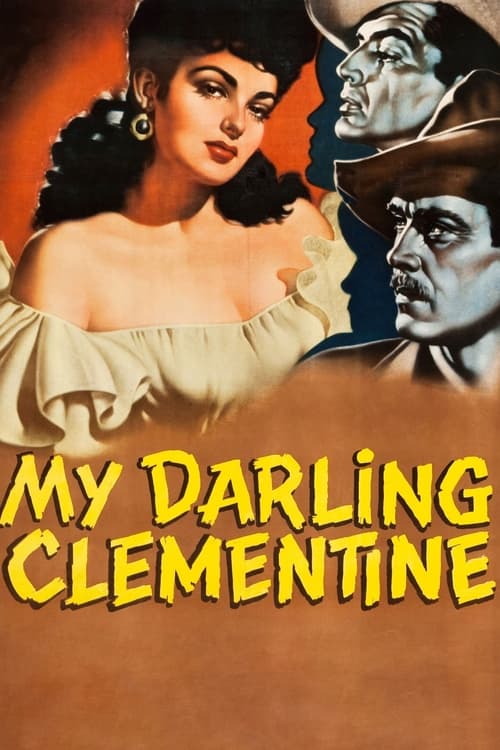
My Darling Clementine
1946 · John Ford
For a Sunday-evening classic when you want something soulful and steady rather than loud — the film to reach for when you want to feel what old Hollywood could do with silence, sky, and a slow dance.
What it's about
The Earp brothers are driving cattle through Arizona when a stopover in Tombstone turns to tragedy: one brother is found dead, the herd stolen. Wyatt Earp pins on the marshal's badge to find whoever did it, and along the way strikes up a wary, fascinating friendship with Doc Holliday — a brilliant, tubercular gambler drinking himself toward the grave — while a woman from Doc's past, Clementine, arrives from the East and quietly changes the town's temperature.
The experience
Unhurried and quietly beautiful — more front-porch twilight than shootout, though the violence lands hard when it comes. It's a Western that feels like an elegy: warm, melancholy, and lit like a dream of the frontier.
Performances
Henry Fonda's Wyatt Earp is a masterclass in stillness — the famous moment of him tilting back in a chair on the porch says more than most monologues. Victor Mature, as the doomed Doc Holliday, brings surprising wounded depth to a man at war with what he's become.
The craft
Ford shoots Monument Valley's buttes in luminous black and white, framing tiny human figures against enormous sky. The church-dance sequence — a whole community celebrating under a half-built steeple — is one of the most quietly moving scenes in the genre, and the film's images genuinely deserve the biggest screen you can find.
Why it matters
It set the poetic standard for the Western: the template of the reluctant lawman, the civilizing town, and the O.K. Corral legend that decades of films would retell and argue with.
Snapshot
John Ford's mythologization of the Gunfight at the O.K. Corral stands as one of Hollywood's most formally assured Westerns — a film less interested in historical accuracy than in the poetic architecture of national myth. Shot in black and white on Fox contract with Monument Valley's sandstone buttes as its moral backdrop, My Darling Clementine transforms the Earp brothers' cattle-drive stopover in Tombstone, Arizona, into an elegiac meditation on the founding violence of civilization. It is equally a film about masculinity's contradictions — embodied in the dying, brilliant Doc Holliday — and about the twinned desires of the Western hero: to build a community and then to leave it. The church-dance sequence alone, with Wyatt Earp and Clementine Carter moving beneath an open sky and a half-built steeple, constitutes one of the most sustained lyrical passages in American cinema.
Industry & Production
Twentieth Century Fox released My Darling Clementine in November 1946, produced by Samuel G. Engel, who also co-wrote the screenplay with Winston Miller. The script drew heavily on Stuart N. Lake's Wyatt Earp: Frontier Marshal (1931), a biography that historians have long regarded as more hagiography than record — Lake shaped his material in close consultation with Earp and his widow Josie, producing a heroic narrative that suited both commercial and self-promotional purposes. Ford, who had been fascinated by the Earp legend since his earliest years in Hollywood, claimed to have met Earp personally during the silent era, when the aged marshal was a marginal presence on Western film sets in California. Whether the specific details Ford later recalled from these conversations were accurate is unverifiable; Earp died in 1929, and Ford's account was retrospective. What is clear is that Ford approached the material as myth-in-the-making rather than documentary reconstruction, and that Fox gave him the latitude to pursue a personal vision within the constraints of the studio A-picture.
The film was subject to post-production interference by studio head Darryl F. Zanuck, who oversaw editing changes to Ford's preferred cut. The released version is shorter than what Ford assembled, and the specific nature of those alterations — which scenes were trimmed or restructured — has been a point of scholarly discussion, though the documentary record on the precise differences between Ford's assembly and the release print is incomplete.
Technology
Shot in 35mm black-and-white, My Darling Clementine belongs to the last sustained period in which monochrome photography was the prestige format for the prestige Western. Fox's technical infrastructure in 1946 was among the most sophisticated in Hollywood; the choice of black and white over Technicolor (which Ford had used for Drums Along the Mohawk in 1939) was deliberate, orienting the film toward a documentary-adjacent gravitas rather than the heightened chromatic pageantry associated with the genre. The format suits the film's elegiac register — the landscape reads as both real and timeless, dust and shadow carved without the distraction of color spectacle.
Technique
Cinematography
Joseph MacDonald, a Fox contract cinematographer who would go on to shoot Call Northside 777 (1948) and Niagara (1953), brought a characteristically clean, high-contrast visual language to the film. The Monument Valley sequences — shot on location in Utah and Arizona, the same terrain Ford had introduced to cinema in Stagecoach (1939) — make systematic use of the landscape as compositional weight: the buttes appear as sentinels, dwarfing human figures and anchoring the frame with vertical mass. MacDonald and Ford compose shots that place the human drama against an almost abstract geological sublime, converting geography into moral argument.
The deep-space staging favored throughout the film — figures distributed across multiple planes with sharp focus — derives from classical Hollywood norms rather than from the Wellesian deep-focus experiments of the early 1940s, but the effect is similar: space has consequence, and the relationship between foreground and distance carries meaning. Ford's characteristic framing of figures through doorways, under archways, or against threshold spaces — the margin between interior and exterior, between civilization and open land — is present throughout and would be theorized by later critics as a structural signature.
Editing
Dorothy Spencer, one of Hollywood's most accomplished editors of the period, cut My Darling Clementine. Spencer had previously worked with Ford on Stagecoach, and her editorial sensibility was well matched to his tendency to compose in long, contemplative takes. The film's rhythm is unhurried by contemporary standards — scenes are allowed to breathe, and the gunfight at the O.K. Corral, when it finally arrives, derives much of its force from the patience with which the film has withheld it. Spencer's work is least visible precisely where it succeeds most: the church-dance sequence unfolds with the organic continuity of lived experience, the cuts motivated by choreography and feeling rather than narrative urgency.
Mise-en-scène / Staging
Ford's staging is the film's most celebrated technical dimension. The church-dance scene is the canonical instance: Wyatt and Clementine take their places on the raw plank floor of a half-constructed church, open to the sky, while the community gathers around them. Ford frames the scene so that the incompleteness of the building — the absent walls, the sky above — becomes an image of the frontier community's own tentative formation. What is being danced into existence is not just a relationship but a social order. The American flag is present; the preacher presides; music is communal and participatory. It is Ford's most direct statement of what the Western hero's violence is ostensibly for.
Equally precise is the introductory staging of Wyatt Earp: Ford presents him sitting in a barber's chair in front of the Tombstone saloon, his chair tilted back, his feet propped high against a post, his hat pulled low. The image is at once idle and alert — a figure of frontier ease that also carries authority. It is a characterization accomplished through posture and framing before a word is spoken.
Sound
The film's use of the folk song "Oh My Darling, Clementine" is woven throughout — in the score, in the diegetic music of the dance sequence, and in the title's own echo. Cyril Mockridge composed the underscore under Alfred Newman's supervision as Fox's music director. The score is conventional in its orchestral grammar but effective in its restraint; the film knows when to let landscape and silence do the work. The sound of horses, of wood under boot, of the wind in Monument Valley — these textures accumulate into an environmental presence that is as characterizing as any scored cue.
Performance
Henry Fonda's Wyatt Earp is the performance against which all subsequent screen Earps have been measured. Fonda brings his characteristic quality of inhabited stillness: a physical economy and moral legibility that reads, under Ford's direction, as a form of American plainness elevated into heroism. Victor Mature's Doc Holliday is the more complex creation — a Shakespearean actor manqué, a man of Eastern cultivation dissolving into frontier dissolution, his tuberculosis a literalized form of the self-destruction that civilization cannot accommodate. Mature was often underestimated as a performer, but Ford's framing gives him room to project genuine pathos. Walter Brennan's Old Man Clanton is a remarkable piece of villainy — folksy and venomous, a patriarch of violence with no redeeming social purpose. Linda Darnell and Cathy Downs occupy structurally opposed positions in the film's gender economy, the former figuring ungovernable desire, the latter a domesticating ideal — a schematic that Ford would interrogate more critically in later Westerns.
Narrative & Dramatic Mode
The film operates in the mode of classical tragedy inflected with pastoral elegy. The Earp brothers' cattle drive is interrupted by Old Man Clanton's theft and fratricide; the task of vengeance gradually transforms into the task of civilization-building, with Tombstone as the arena. The dramatic arc is built around a series of dualities — law and lawlessness, East and West, life and death, permanence and vagrancy — whose resolution is always partial, always shadowed. Doc Holliday dies; Wyatt Earp does not stay to inhabit the community he has helped make possible. Ford is too honest a mythmaker to provide a comfortable settlement: the Western hero's function is precisely to be transitional, to clear the ground and then yield it.
Genre & Cycle
My Darling Clementine arrives at a pivotal moment in the genre's evolution. The classical Western of the 1930s — typified by Ford's own Stagecoach — had established the genre's iconographic grammar. The late 1940s and early 1950s would produce the so-called "adult Western," a cycle of films that introduced psychological complexity, moral ambiguity, and social critique into what had previously been a more schematically heroic form. My Darling Clementine sits on the cusp: it is formally classical, its hero unambiguously virtuous, its landscape mythically charged — but its treatment of Holliday's dissolution and the film's elegiac tone point toward the introspective Westerns that would follow. André Bazin, writing on the Western in the early 1950s, argued that the genre had achieved a kind of classic perfection; My Darling Clementine is among the films that licensed that claim.
Authorship & Method
Ford's working method involved intense pre-production visual planning alongside improvisational authority on set; he was notoriously terse with actors about motivation, communicating through atmosphere, blocking, and the angle of the camera. His collaboration with Fonda across multiple films — including Young Mr. Lincoln (1939) and The Grapes of Wrath (1940) — had established a shorthand of gesture and posture that My Darling Clementine draws on extensively. Ford's dismissiveness of his own thematic seriousness — his habitual deflection of interpretive questions in interviews — has long been understood as a screen for the deliberateness of his formal choices rather than evidence against it.
MacDonald's contribution as cinematographer was significant but subordinate to Ford's compositional instincts; Ford was known to plan his framings in detail and to allow little deviation. Dorothy Spencer's editorial partnership gave the film its measured cadence. The screenplay's mythologizing framework — Lake's legend filtered through Engel and Miller — provided a scaffolding that Ford could populate with his own iconographic obsessions.
Movement / National Cinema
My Darling Clementine is a central text in classical Hollywood cinema and in the tradition of the American Western as a national form. Ford's use of Monument Valley as a mythic space — neither naturalistic landscape nor abstract set, but something between — consolidated a visual shorthand for the American frontier that would persist for decades. The film belongs to a specifically postwar inflection of the Western: released in the same year as a wave of demobilization and national self-examination, it participates in a broader cultural effort to reimagine American identity through its founding myths.
Era / Period
1946 situates the film at the threshold of several transformations: the end of the studio system's high period; the beginning of television's encroachment on film audiences; the emergence of a darker, more psychologically troubled American cinema associated with noir; and the first stirrings of the social-problem film. My Darling Clementine is in many respects a late classicism — a film that consolidates rather than innovates, that perfects a mode at the very moment the conditions sustaining that mode are beginning to dissolve.
Themes
The film's deepest concern is with the founding paradox of community: the violence required to make peace, the outsider who must create a civilization he cannot inhabit, the law that emerges from lawlessness. Clementine Carter's presence in Tombstone maps this thematic territory precisely: she is the Eastern order that the frontier must eventually become, but her arrival is predicated on Doc Holliday's decline and Wyatt Earp's transitional violence. Mortality haunts the film — Holliday's tuberculosis is its most insistent image — and with it the question of what survives: not the individual hero but the social form he makes possible. There is also, threading through Ford's treatment of the Earp legend, a meditation on friendship between men — the bond between Wyatt and Doc is the film's most emotionally charged relationship, its ambivalences more openly felt than the romantic plot.
Reception, Canon & Influence
My Darling Clementine was commercially successful on its release, confirming Ford's standing as a premier director of prestige Westerns. Critical reception was broadly positive, though the film's reputation has grown substantially in the decades since, as auteurist and genre critics have excavated its formal sophistication. Tag Gallagher's comprehensive study of Ford placed the film among the director's major achievements. Peter Bogdanovich's extended interviews with Ford provided primary material for understanding the director's intentions, even as Ford's characteristic evasions complicated any simple account of authorship.
Looking backward, the film's influences include not only the Lake biography and the dime-novel Earp mythology but also the broader tradition of the classical Western that Ford himself had helped establish with Stagecoach. The deep-focus, wide-landscape aesthetic and the moral architecture of the Western hero are Ford's own inheritance from silent-era directors including W.S. Hart and James Cruze.
Looking forward, My Darling Clementine has shaped virtually every subsequent treatment of the Earp legend on screen — John Sturges's Gunfight at the O.K. Corral (1957), Lawrence Kasdan's Wyatt Earp (1994), and George P. Cosmatos's Tombstone (1993) all negotiate with Ford's version, whether by homage or revision. More broadly, the film's elegiac register — its sense of a heroic age already passing at the moment of its dramatization — became a template for the late Western, reaching its fullest development in Sam Peckinpah's work and in Clint Eastwood's revisionist Westerns of the 1990s. The church-dance sequence has been cited as an influence on filmmakers across national traditions as an instance of cinema's capacity to make a community visible to itself in the act of formation. Ford's Monument Valley, consolidated here as a mythic rather than merely geographic space, became one of the most reproduced and contested landscapes in world cinema — a visual shorthand for American myth that later directors would inherit, parody, and critique in equal measure.
A Deleuzian reading
Wyatt Earp tilts a barber's chair back on two legs, props his boots against the porch post, and pulls his hat low over his eyes.
The full Deleuzian reading of My Darling Clementine →
Reception
A solid hit in 1946 — though Fox boss Darryl Zanuck famously trimmed and reshot parts of Ford's cut over the director's objections — it has since climbed to near-consensus status as one of the most beautiful Westerns ever made, with the studio-altered version being the classic everyone knows.
How My Darling Clementine was received, from release to now →
Influences: the films it descends from and the films it influenced
- Stagecoach (1939) — Bert Glennon's Monument Valley compositions — buttes as vertical moral anchors dwarfing human figures against geological sublime — establish the landscape grammar Joseph MacDonald inherits wholesale; Dorothy Spencer edited both films, carrying her contemplative rhythm of held shots and organically motivated cuts directly forward.
- Young Mr. Lincoln (1939) — Fonda's performance of the national-myth hero as inhabited stillness was first codified here — the reticent, loose-limbed American democrat who carries moral weight without announcement — and Ford transplants this exact register, unmodified, into Wyatt Earp seven years later.
- The Grapes of Wrath (1940) — Gregg Toland's documentary-inflected high-contrast B&W cinematography establishes the visual register of social and moral gravitas that MacDonald channels in Clementine; Ford's elegiac pastoral mode — American rural loss rendered with photographic sobriety rather than genre spectacle — is the shared template across both films.
- The Westerner (1940) — Gregg Toland's deep-focus B&W cinematography applied to the Western — figures sharp across multiple planes against open sky and scrubland — directly models the spatial grammar MacDonald employs in Clementine, where foreground-to-distance clarity carries moral rather than merely pictorial weight.
- The Ox-Bow Incident (1943) — Fonda as the lone ethical conscience in a studio B&W Western moral parable — restrained, shadowless interiors as a refusal of genre pictorialism — establishes the prestige register of the 'serious Western' that Clementine inherits and suffuses with lyrical ceremony rather than moral horror.
- How Green Was My Valley (1941) — Extends the processional rhythm, threshold-doorway framing, and the communal-ritual set piece (the church-floor dance) into Ford's Western elegy for a forming community.
- Shane (1953) — Inherits the transitional-hero grammar wholesale — the stranger who enables settlers to found a civilization and must depart without entering it — while Loyal Griggs's Oscar-winning B&W compositions extend Clementine's deep-space landscape grammar, shifting the vertical sublime from Monument Valley sandstone to the Tetons.
- The Searchers (1956) — Ford's most systematic development of the threshold-framing motif deployed throughout Clementine — doorway and arch compositions that structure the relationship between civilized interior and open wilderness — here theorized as the film's organizing visual argument; Winton Hoch's VistaVision Monument Valley deep-space is Clementine's visual vocabulary at its fullest extension.
- The Man Who Shot Liberty Valance (1962) — Ford returns to B&W as a deliberate elegiac-register choice in the genre's twilight; 'print the legend' makes discursive and argumentative the myth-versus-history tension that Clementine stages in purely aesthetic terms; the transitional hero who enables civilization and must be written out of its official record receives his fullest and most melancholy elaboration.
- Once Upon a Time in the West (1968) — Leone casts Henry Fonda against type as the film's most brutal villain — a direct citation and inversion of his Wyatt Earp — and Morricone's harmonica leitmotif extends Clementine's folk-song device to obsessive formal centrality; the entire film is structured as an operatic elegy for the same pastoral Western mythology Ford's film consecrates.
- McCabe & Mrs. Miller (1971) — Vilmos Zsigmond's heavily flashed, desaturated cinematography inverts Clementine's B&W monumentalism — the founding vision rendered murky and intimate rather than granite-clean — while Leonard Cohen's folk songs as nondiegetic score directly extend Clementine's folk-leitmotif structure while stripping it of all consolatory function.
- Unforgiven (1992) — The transitional hero who founds civilization through violence is made morally accountable here — the elegiac pacing and restrained cinematographic sobriety that Clementine established as genre norms are inherited intact but redirected to examine rather than consecrate the founding act.
- Sanjuro (1962) — Ford's deep-focus staging of genre confrontations with horizontal group blocking — comic community sequences yielding to abrupt deadly violence — is the acknowledged compositional template Kurosawa adapted for the chambara genre's interior and courtyard settings.
- The Last Picture Show (1971) — Ford's frontal, architecturally austere compositions of a frontier main street—people small against weathered false-front buildings—are restaged as Anarene's wind-scoured town center.
- Tombstone (1993) — Establishes the Earp–Holliday partnership and the tubercular-gentleman-gunfighter archetype, plus the O.K. Corral rendered as an elegiac set piece of civic order, the staging template Tombstone reprises.
- Silverado (1985) — The purpose-built town as moral architecture — boardwalk, porch and one street shot laterally so the whole community reads in a single composition — is Ford's, as is the marshal who cleans the street out of temperament rather than office.
- Winchester '73 (1950) — The Dodge City prologue lifts Ford's treatment of the marshal's disarming ordinance as civic ritual staged across the width of a main street, with Will Geer's Wyatt Earp carrying the same Stuart Lake mythography but repurposed as a bureaucratic gatekeeper who confiscates the guns and stages the shooting contest.
- Drunken Angel (1948) — Ford's composed exterior — an entire community blocked in depth along one dusty thoroughfare, with a tubercular gunman coughing his way through it — is the model for Kurosawa's staging around the sump plaza and for tying Matsunaga's diagnosis to the geography of the town itself.
- Duel in the Sun (1946) — Released the same year, Selznick and Vidor's garish Technicolor spectacle and melodramatic excess constitute the formal counter-argument to Clementine's austere B&W contemplation, making Ford's restraint and monochromatic gravitas legible as deliberate positions on what the postwar prestige Western should look and feel like.
- Fort Apache (1948) — Ford's immediate continuation of the Monument Valley B&W grammar, with Archie Stout extending Clementine's deep-space butte-anchored compositions into the cavalry genre; both films stage the gap between sanctified national myth and morally compromised historical record, Fort Apache's ambiguous closing salute anticipating Liberty Valance's explicit legend-printing.
- Red River (1948) — Russell Harlan's B&W deep-space landscape compositions share Clementine's visual grammar of human figures against consequence-laden open terrain; Hawks centers the film on male friendship as the Western's structural core and gives the younger man a dissolution-and-redemption arc that parallels Doc Holliday's tragic curve.
- The Gunfighter (1950) — A Fox B&W Western in which Peck performs the same contemplative stillness in the Fonda mode — the man whose lethal reputation outlives his capacity for peace — and the first explicit elaboration of the transitional hero who cannot cross into the civilized world his presence enables; same studio infrastructure, same prestige monochrome house style.
- High Noon (1952) — Floyd Crosby's high-contrast B&W extends Clementine's monochromatic gravitas into the Cold War Western; Dimitri Tiomkin's 'Do Not Forsake Me' functions as a structural folk-song leitmotif moving between diegetic and nondiegetic registers, extending and formalizing Clementine's use of 'Oh My Darling Clementine' as scored material.
Similar films
- The Man Who Shot Liberty Valance (1962) — influence & lineage · same viewing thread · often watched together
- High Noon (1952) — influence & lineage · same viewing thread
- Shane (1953) — influence & lineage · same viewing thread
- The Gunfighter (1950) — influence & lineage · same viewing thread
- Stagecoach (1939) — influence & lineage · often watched together
- The Grapes of Wrath (1940) — influence & lineage · often watched together
- Fort Apache (1948) — influence & lineage
- The Searchers (1956) — influence & lineage
All the films related to My Darling Clementine →
Watch it with: curated runs of related films
- Print the Legend — A run of frontier myths and their unmaking — town-taming marshals, aging gunfighters, and the stories the newspapers chose to print instead of the truth.