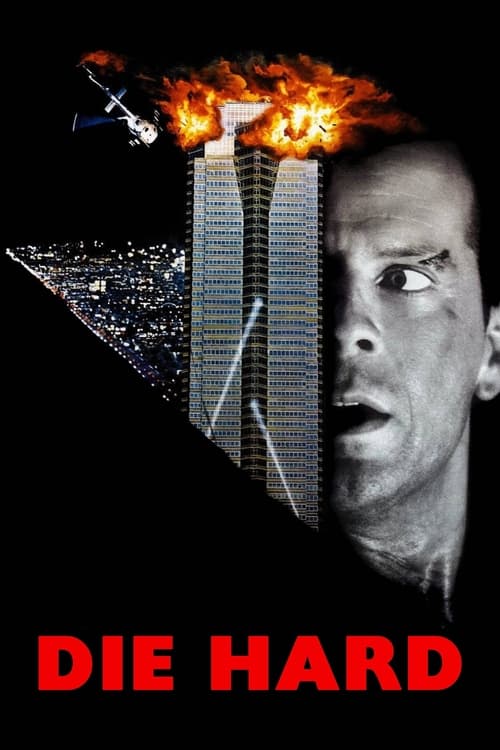
Die Hard
1988 · John McTiernan
For when you want pure, expertly built excitement — the action movie to reach for when you want to cheer, wince, and grin at one-liners. An eternal Christmas-season rewatch argument, and comfort viewing with a body count.
What it's about
A New York cop flies to Los Angeles on Christmas Eve to patch things up with his estranged wife at her company's office-tower party — and is barefoot in a bathroom when armed men seize the building and take everyone hostage. The thieves have a meticulous plan; the one thing they didn't plan for is a lone, exhausted policeman loose in the elevator shafts and air ducts, improvising a one-man war against them.
The experience
Relentless, funny, and genuinely tense — the film tightens like a fist for two hours while its hero bleeds, jokes, and limps his way through it. It's the rare action movie where you feel every stairwell and every bad decision.
Performances
Bruce Willis turns the invincible action hero into a sweaty, wisecracking, visibly frightened human being — the role that made him a movie star — while Alan Rickman, in his film debut, creates one of cinema's great villains: urbane, witty, and scarier for how reasonable he sounds.
The craft
John McTiernan's direction is a machine of clean geography — you always know where everyone is in the tower, which is why the suspense works — and the widescreen photography and orchestral score wring real elegance out of a single location. It plays beautifully loud and big.
Why it matters
It rewired the American action picture: the ordinary-man-in-a-sealed-space template became an industry shorthand ("Die Hard on a...") and dominated the genre for a decade, while launching its star and defining the modern action villain.
Snapshot
Die Hard is the film that rewired the American action picture. Adapted from Roderick Thorp's 1979 novel Nothing Lasts Forever, it strands a single New York cop — John McClane — inside a Los Angeles skyscraper commandeered by heavily armed thieves posing as terrorists, and lets the drama unfold across one Christmas Eve in something close to real time and a single location. Directed by John McTiernan and released by 20th Century Fox in the summer of 1988, it took a mid-tier television actor, Bruce Willis, and made him a movie star, while codifying a template — the ordinary, wisecracking, vulnerable man against a superior, articulate villain in a sealed space — that would dominate studio action filmmaking for at least a decade. Its cultural afterlife is enormous: "Die Hard on a [X]" became an industry shorthand, and the film's Christmas setting has since become a perennial cultural argument. Beneath the one-liners, it is a precisely engineered thriller about space, endurance, and improvisation.
Industry & production
Die Hard arrived at a specific commercial moment. The 1980s action star was typically a muscular, near-invincible figure — Schwarzenegger, Stallone — and Fox's film pointedly moved against that grain by casting a wounded everyman. The project's development is bound to a well-known contractual quirk: because the source material was a sequel to Thorp's earlier novel The Detective (filmed in 1968 with Frank Sinatra as detective Joe Leland), the role was reportedly offered to Sinatra first under a standing obligation before the character was reconceived and renamed. What is firmly established is that the lead passed through the era's star system before landing on Willis, then known chiefly for the television series Moonlighting, a piece of casting widely regarded at the time as a risk. Willis's fee became a talking point precisely because it was large for a TV actor unproven at the box office.
The production centered on Fox Plaza in Century City, the then-newly completed Fox corporate tower, which stood in for the fictional Nakatomi Plaza — a rare instance of a studio's own headquarters serving as its blockbuster's principal set. Producers Lawrence Gordon and Joel Silver shepherded the film; Silver was by then closely associated with muscular, high-gloss action product, and Die Hard is often read as his signature production alongside Lethal Weapon. Screenwriters Jeb Stuart and Steven E. de Souza adapted Thorp's novel, restructuring it substantially while retaining its skyscraper-siege spine. The film was a significant commercial success and spawned a durable franchise; specific grosses I won't quote from memory, but its performance was strong enough to green-light multiple sequels and to establish "Die Hard" as a brand.
Technology
Die Hard is a film of relatively conventional late-1980s technology deployed with unusual discipline. It was shot photochemically on 35mm and relies on practical, in-camera effects rather than the digital tools that were still years from maturity. Its most famous set pieces — the rooftop explosion, the elevator-shaft and ventilation-duct sequences, the collapse of the building's upper floors — were achieved with physical pyrotechnics, miniatures and models, and full-scale stunt work. The production's use of Fox Plaza, much of it still unfinished internally, gave the filmmakers large raw floors to convert into shooting stages, blurring the line between location and set. The film predates the CGI revolution that Terminator 2 would announce in 1991; its spectacle is grounded in the visible, weighty reality of things breaking, which is a substantial part of why it has aged well. Stunt coordination and the physical staging of falls, explosions and gunfire are the film's real technological achievement, executed by an experienced second-unit and stunt team.
Technique
Cinematography
Jan de Bont's photography is central to the film's identity. The camera treats the tower as a genuine three-dimensional labyrinth — verticality is constantly emphasized through shafts, stairwells, atria and windows — and de Bont uses the building's glass, chrome and marble surfaces to bounce hard, glinting light. Christmas-tree and city lights are used as practical sources and background texture, giving the nocturnal interiors warmth and depth. The lensing keeps McClane physically small within cavernous, unfinished spaces, reinforcing the one-against-many premise visually rather than through dialogue. De Bont favors dynamic but legible camera movement; even in chaos, geography remains coherent, which is essential to a film whose suspense depends on the audience always roughly knowing who is where in the building.
Editing
Cut by John F. Link and Frank J. Urioste, the film is a model of clarity under pressure. Its editing sustains a long-form architecture — the picture runs well over two hours yet maintains momentum — by intercutting McClane's guerrilla movements with the villains' operation, the FBI and LAPD outside, and the media, so that spatial and dramatic tension are continuously cross-referenced. Crucially, the cutting preserves cause and effect: we understand how McClane moves through the structure, what each side knows, and how information asymmetries shift. The action sequences are assembled to remain readable rather than fragmented into impressionistic blur, a restraint that distinguishes it from much of the "chaos cinema" it would later, indirectly, help spawn.
Mise-en-scène / staging
The single-location siege is the film's formal signature. Nakatomi Plaza functions almost as a character: its architecture dictates the plot, and set pieces are staged to exploit specific features — a rooftop, an atrium, elevator shafts, ventilation ducts, unfinished upper floors. McClane's bare feet, established early, become a running staging constraint that pays off in the glass-strewn later scenes, an example of the film's disciplined economy in which environmental details are planted and later weaponized. The Christmas-party dressing — tinsel, a Santa hat, festive decor — is used ironically against the violence, and props (a wristwatch, tape, a lighter, C-4) recur as functional plot mechanisms rather than decoration.
Sound
Michael Kamen's orchestral score is notable for weaving in existing music, most memorably Beethoven's "Ode to Joy" from the Ninth Symphony, associated with the villains and their operation — a European, "cultured" motif set against McClane's American improvisation. Kamen also threads Christmas music into the texture, sharpening the seasonal irony. The sound design foregrounds the acoustics of the tower — echoing gunfire, the mechanical groan of elevators and ducts, radio chatter — and the film's dramatic engine runs partly on sound as information: the CB and walkie-talkie communication between McClane and the outside world is both plot device and suspense generator.
Performance
Bruce Willis reoriented the action lead toward vulnerability, exhaustion, fear and humor. His McClane bleeds, panics, jokes to himself, and talks his way through terror, and Willis plays much of the role alone, in monologue or over the radio, which is a considerable performance demand. Opposite him, Alan Rickman — in his film debut — as Hans Gruber delivered one of the era's defining screen villains: urbane, ironic, verbally precise, physically unhurried. The Willis–Rickman dynamic, largely conducted at a distance and through voices, is the film's dramatic spine. Reginald VelJohnson grounds the picture emotionally as Sergeant Al Powell, McClane's radio confidant, and the supporting ensemble — including the smarmy Ellis, the obstructive police and FBI brass, and Bonnie Bedelia as McClane's estranged wife Holly — supplies the friction that keeps the siege human.
Narrative & dramatic mode
Die Hard operates in a compressed, near-continuous timeframe within a unified space — a structure close to the classical dramatic unities, and often cited as such. Its dramatic mode is suspense built on information asymmetry: McClane knows things the villains and the authorities don't, the villains conceal their true motive (theft dressed as ideology) from the hostages and police, and the audience is granted privileged knowledge that the characters lack. The screenplay is tightly plotted around setups and payoffs, and it braids an intimate marital-reconciliation arc (McClane and Holly) through the action, giving the spectacle a personal stake. The tone is a deliberate hybrid — genuine tension undercut by comedy — and the film's control of that register is a large part of its craft.
Genre & cycle
The film sits at the confluence of the action film, the thriller, and the disaster-adjacent "confined siege" picture. It descends from the 1970s all-star disaster cycle — The Towering Inferno in particular shares the imperiled-skyscraper premise — and from the lone-lawman tradition. But Die Hard effectively founded its own cycle. The "Die Hard on a [location]" formula — a lone protagonist against hijackers in a sealed setting — became a recognized subgenre, spawning transparent variations set on ships, planes, trains, buses and mountains through the 1990s. It also helped shift the action hero archetype away from the invincible muscleman toward the improvising everyman, a pivot with lasting consequences for the genre.
Authorship & method
John McTiernan directed Die Hard between Predator (1987) and The Hunt for Red October (1990), a run that established him as one of the era's premier action craftsmen. His method privileges spatial coherence, real physical stakes, and legibility over frenzy; Die Hard demonstrates his ability to sustain suspense through architecture and blocking rather than cutting rate. His key collaborators shaped the film decisively: cinematographer Jan de Bont, who would go on to direct Speed (a film sometimes described as "Die Hard on a bus"); composer Michael Kamen, whose classical borrowings became integral to the film's ironic texture; editors John F. Link and Frank J. Urioste; and screenwriters Jeb Stuart and Steven E. de Souza, who translated Thorp's novel into a leaner, wittier structure. Producer Joel Silver's fingerprints — glossy, star-driven, quotable action — are also part of the film's authorship in the collaborative studio sense.
Movement / national cinema
Die Hard is a thoroughly Hollywood studio product and does not belong to any avant-garde or national art movement. If it participates in a "movement," it is the commercial one of the 1980s American high-concept blockbuster — event films built around a single, marketable premise, muscular production values, and franchise potential. Its villains are coded as European sophisticates and its hero as an American pragmatist, a cultural contrast the film exploits; but this is a genre gesture within mainstream Hollywood, not an engagement with any European cinema tradition beyond the borrowed Beethoven.
Era / period
The film is a document of late Reagan-era America: corporate towers as cathedrals of capital (the Nakatomi Corporation is Japanese, registering period anxieties about Japanese economic ascendancy), news media as an intrusive, sensational presence, and law-enforcement bureaucracy portrayed as ineffectual against a nimble individual. Its "terrorists" are revealed to be thieves cynically exploiting the era's terrorism panic — a knowing 1988 twist that comments on how ideological threat could be performed for cover. The estranged-marriage subplot, with Holly working under her maiden name in a demanding corporate job, gestures at period tensions around dual-career families. These textures situate the film firmly at the close of the 1980s.
Themes
At its core the film concerns the ordinary individual versus institutional and criminal power. McClane succeeds through improvisation, physical suffering and local knowledge where organized authority — police, FBI, media — fails through arrogance and procedure. Marriage and reconciliation run underneath the violence: the siege becomes the crucible in which McClane must prove himself to Holly and heal their rupture. Masculinity is reframed around endurance and vulnerability rather than invulnerability. Class and pretension recur in the contrast between Gruber's cultured avarice and McClane's blue-collar directness, and greed-masquerading-as-conviction is the film's central irony. The Christmas setting layers themes of family, homecoming and grace beneath the carnage.
Reception, canon & influence
Contemporary critical reception was strong for an action picture, with particular praise for McTiernan's control, Willis's against-type lead, and Rickman's villain; some critics of the day registered discomfort with the film's violence and its portrayal of the authorities, a common reservation about the era's action cinema. Over time its critical standing has risen markedly: it is now widely regarded as one of the greatest action films ever made and, in 2017, was selected for preservation in the U.S. National Film Registry by the Library of Congress as culturally, historically, or aesthetically significant.
Looking backward, the film draws on Thorp's novel and its lineage back to The Detective; on the 1970s disaster cycle's imperiled-skyscraper premise (The Towering Inferno); and on the long tradition of the lone-lawman Western and cop thriller. Its formal compression evokes the classical dramatic unities.
Looking forward, its influence is difficult to overstate. It reset the action-hero template toward the vulnerable everyman; it generated an entire "Die Hard in a ——" subgenre of imitators through the 1990s; it launched Bruce Willis as a film star and Alan Rickman as a screen presence; and it established a franchise that ran across several sequels of varying reputation. De Bont's move to directing Speed carried the film's DNA directly forward. And Die Hard seeded one of popular culture's most durable recurring debates — whether it counts as a Christmas movie — a sign of how thoroughly it has embedded in the collective imagination. Where precise figures for its box office and budget are concerned, I've deliberately avoided citing numbers from memory; the safe, verifiable claims are its commercial success, its franchise legacy, and its enshrinement in the National Film Registry.
A Deleuzian reading
A man takes his shoes off.
The full Deleuzian reading of Die Hard →
Reception
Greeted in 1988 with skepticism — a TV comedy guy from Moonlighting getting a then-scandalous $5 million to headline an action movie — it became a smash and is now routinely called the greatest action film ever made. The reappraisal happened fast and never reversed.
How Die Hard was received, from release to now →
Influences: the films it descends from and the films it influenced
- The Towering Inferno (1974) — Supplies the imperiled-skyscraper premise and vertical-space geography — trapped occupants stratified by floor, rescue staged as a climb through architecture — that Die Hard converts from disaster-ensemble spectacle into a single-hero siege.
- The Detective (1968) — Adapts Roderick Thorp's earlier Joe Leland novel; Thorp's sequel 'Nothing Lasts Forever' is Die Hard's direct literary source, carrying over the aging-cop-facing-personal-collapse frame that the screenwriters lean into for the estranged-marriage stakes.
- High Noon (1952) — Establishes the lone-lawman-abandoned-by-authority template played out under near-real-time compression and dramatic unities, the classical structure Die Hard tightens into a single night in a single tower.
- Key Largo (1948) — Prototype of the confined-siege hostage drama — everyman trapped in one building with a witty, articulate criminal ringleader — anticipating the McClane/Gruber dynamic of talk-as-combat within enclosed space.
- Rio Bravo (1959) — The Hawksian professionals-defending-a-single-position siege, built on banter and setup-and-payoff staging of a fixed location's defenses, a structural model McTiernan openly admired and reworks vertically.
- Assault on Precinct 13 (1976) — Modernizes Rio Bravo into a stripped-down single-location siege with a small defender against an overwhelming force, using architecture and sightlines rather than cutting rate to generate suspense — Die Hard's immediate genre grammar.
- Wait Until Dark (1967) — Pioneers information-asymmetry as suspense engine within one apartment — the audience and protagonist tracking who knows what — the exact cat-and-mouse epistemics McClane exploits by radio against the terrorists.
- Lethal Weapon (1987) — Joel Silver's next codification: a Christmas-set, wisecracking everyman cop with domestic-family stakes woven directly into the spectacle — the tonal recipe Lethal Weapon proved, refined for a single-location siege.
- The Taking of Pelham One Two Three (1974) — Extends the contained-siege-plus-outside-procedure template with a radio/CB duel of wits between the trapped criminal ringleader and the authorities coordinating from outside.
- Where Eagles Dare (1968) — Transposes the single-fortress infiltration into a modern tower: a lone operator exploiting the building's vertical architecture to pick off occupants, the architectural-legibility staging Eagles Dare pioneered.
- The Hunt for Red October (1990) — McTiernan reapplies his confined-space suspense and cross-cutting between antagonists inside a single sealed structure (the submarine), extending Die Hard's legible-action-in-an-enclosed-machine craft.
- Speed (1994) — Die Hard's cinematographer directs 'Die Hard on a bus,' carrying forward the real-time confined-vehicle siege, practical stunt spectacle, and vulnerable-everyman-versus-articulate-bomber structure he helped light.
- Under Siege (1992) — Canonical 'Die Hard on a ——' entry (battleship), replicating the lone insider picking off hijackers who control a single vessel through its own layout and internal comms.
- Air Force One (1997) — Transposes the formula to a plane, reusing information-asymmetry, hostage-controlled single location, and setup-and-payoff of the structure's own systems against the villains.
- The Raid: Redemption (2011) — Reboots the vertical-space siege — a lone fighter ascending floor by floor through a single tower held by an enemy force — with Die Hard's legible spatial progression as its architecture.
- Dredd (2012) — Confines its action to one high-rise conquered floor-by-floor from below, extending Die Hard's tower-as-battlefield vertical-geography and elevator/stairwell setup-and-payoff staging.
- Phone Booth (2002) — Distills the single-location + information-asymmetry duel to its extreme, an everyman pinned in one spot in near-real-time by an unseen antagonist controlling the terms — Die Hard's siege abstracted to one square meter.
- Panic Room (2002) — Inverts the siege — defenders inside one architectural node, intruders navigating the building's vertical layout — while preserving practical-light suspense and the house-as-battlefield setup-and-payoff logic.
- Skyscraper (2018) — Explicit homage fusing The Towering Inferno's burning-tower premise with Die Hard's lone-hero-climbing-a-hijacked-high-rise structure, foregrounding vertical space as the film's whole action grammar.
- Terminator 2: Judgment Day (1991) — The single-location siege crosscutting structure — police massing outside, hostages inside, lone protagonist threading between — gives T2 the editorial template for the Cyberdyne sequence, which Cameron extends by splitting the interior into three simultaneous threads and adding Dyson's self-sacrifice as a fourth.
- The Raid (2012) — Codified the siege thriller's spatial grammar that Evans directly inherits: a single building as narrative container, vertical ascent floor by floor as dramatic escalation, and the lone protagonist's accumulating physical attrition as the engine of suspense — The Raid transposes this structure wholesale into the Tench Nasir apartment block.
- The Fugitive (1993) — Direct craft carryover through co-writer Jeb Stuart's resourceful-everyman template—an ordinary man improvising survival against institutional forces.
- Predator (1987) — McTiernan's prior film establishes his method of spatial coherence and legible action — hunter-and-hunted staged through readable geography and practical light — carried directly into Die Hard's architecture-driven blocking.
Similar films
- Predator (1987) — influence & lineage
- Lethal Weapon (1987) — shared sensibility
- Face/Off (1997) — shared sensibility
- Carry-On (2024) — shared sensibility
- The Terminator (1984) — shared sensibility
- Hard Boiled (1992) — shared sensibility
- Kiss Kiss Bang Bang (2005) — shared sensibility
- Escape from New York (1981) — shared sensibility
All the films related to Die Hard →
Watch it with: curated runs of related films
- Grace in the Dead of Winter — A run of cold-season films where a lonely or cynical soul, snowbound and nearly out of hope, stumbles into connection — watch them across one dark week.