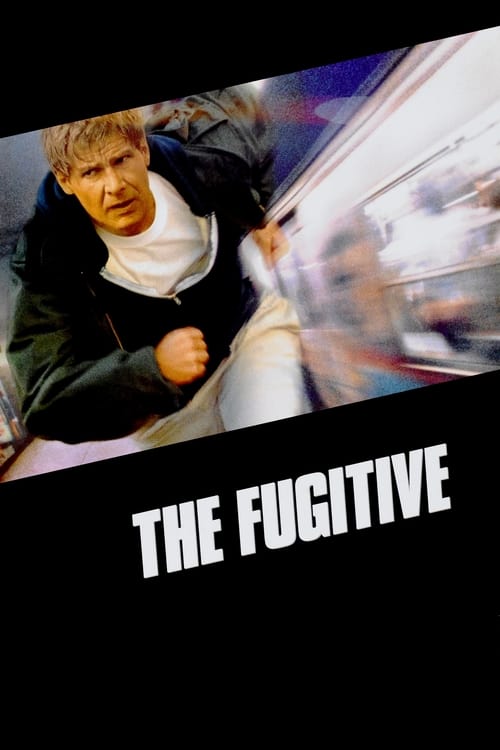
The Fugitive
1993 · Andrew Davis
For when you want a guaranteed great night: a smart, muscular thriller you can put on for anyone and know it will deliver. Total comfort viewing for people who still want to be on the edge of the couch.
What it's about
Dr. Richard Kimble, a respected Chicago surgeon, is wrongly convicted of murdering his wife and sentenced to death. When his prison transport crashes spectacularly, he escapes into the city to hunt the one-armed man who really killed her — while Deputy U.S. Marshal Samuel Gerard pursues him with cold, brilliant professionalism. It's a manhunt where you're rooting for both sides of the chase.
The experience
Two-plus hours of pure propulsion — the film barely stops moving, yet it never feels dumb, because the chase is really a duel between two smart, capable men. Tense, satisfying, and endlessly rewatchable.
Performances
Harrison Ford does haunted decency and improvised desperation as well as anyone ever has, and Tommy Lee Jones won an Oscar for Gerard — dry, relentless, and so charismatic that the pursuer becomes as compelling as the pursued.
The craft
A benchmark of studio craftsmanship: the train-wreck escape remains one of the great practical set pieces, the editing cross-cuts hunter and hunted with ruthless economy, and wintry Chicago locations give it real texture. It rewards a big screen and loud speakers — the crash alone is worth it.
Why it matters
The rare blockbuster to earn a Best Picture nomination, it became the gold standard for the studio action-thriller and the model everyone cites for how to adapt a TV series into a real movie.
Snapshot
The Fugitive is the rare blockbuster that earned both the year's box-office returns and a Best Picture nomination, and it remains a benchmark for the studio action-thriller executed at the highest level of craft. Adapted from Roy Huggins's 1963–67 television series, it strips the property's premise to a clean engine: Dr. Richard Kimble (Harrison Ford), a Chicago vascular surgeon wrongly convicted of murdering his wife, survives a spectacular prison-transport crash and goes to ground in the city to find the one-armed man who killed her—while Deputy U.S. Marshal Samuel Gerard (Tommy Lee Jones) hunts him with relentless, almost amoral professionalism. The film's distinction lies less in its plot, which is a familiar wrongful-accusation chase, than in its construction: a propulsive cross-cut between pursued and pursuer in which neither is a villain, anchored by two performances of contrasting registers—Ford's interior, grieving stoicism against Jones's verbal, kinetic command. Jones won the Academy Award for Best Supporting Actor, and the film became a model that the procedural thriller has imitated for thirty years.
Industry & production
The project originated at Warner Bros. with producer Arnold Kopelson, who had won Best Picture for Platoon (1986) and brought a track record in muscular adult genre filmmaking. The film's most-discussed production fact is that it went into shooting without a finished, locked screenplay—a condition widely reported by those involved and confirmed in the credited writers' arrangement, where scenes were reworked, trimmed, and in some cases improvised against a moving production schedule. Director Andrew Davis, Harrison Ford, and the writing team reshaped material as locations and the practical demands of the shoot dictated. This is unusual for a film of its budget and ambition, and the fact that the result feels so tightly engineered is part of its reputation.
Casting placed Harrison Ford, then at the height of his star power following the Indiana Jones and Jack Ryan films, in a role demanding restraint rather than heroics. Tommy Lee Jones, a respected character actor not yet a leading name, was cast as Gerard and given a supporting role that the production allowed to expand into the film's most quotable presence. The marshals' team—Joe Pantoliano, Daniel Roebuck, Tom Wood, and others—was conceived as an ensemble with overlapping, improvisational dialogue, a texture that contributes much to the film's procedural credibility.
Production centered on Chicago, with the city's architecture, river, El system, and a real St. Patrick's Day environment used as more than backdrop. The signature train-and-bus crash and the dam jump were shot in western North Carolina, around the Great Smoky Mountains Railroad and Cheoah Dam. Warner Bros. released the film in August 1993, and it became one of the year's largest commercial successes—precise grosses vary by source and I won't assign a specific figure, but its standing among 1993's top earners is well documented.
Technology
The Fugitive is a film of practical, photochemical, pre-digital craft, and that grounding is essential to its effect. The defining set piece—the prisoner-transport bus rolling down an embankment into the path of an oncoming train—was executed as a real, full-scale stunt with an actual locomotive and a real bus on a real track in North Carolina. The wreckage was, by multiple accounts, left in place afterward and became something of a local landmark. The sequence works because the audience reads its weight and consequence as physical fact, not as composited illusion; this is a film made on the cusp of the digital-effects era that deliberately stakes its biggest moment on analog reality.
The waterfall/dam jump—Kimble's leap into the spillway to escape Gerard—was likewise built from practical photography, stunt work, and miniature/optical compositing of the period rather than the seamless CGI that would dominate within a few years. The film's technical achievement is one of staging and coverage more than of any novel tool; it represents the high-water mark of a certain kind of location-based, mechanically-realized action cinema just before that approach gave way to digital augmentation.
Technique
Cinematography
Michael Chapman, the cinematographer of Taxi Driver (1976) and Raging Bull (1980), shot the film, and his contribution gives it a gravity rare in the action genre. The palette is cold and urban—steel grays, winter Chicago light, the green of hospital corridors and the river—against which moments of warmth (Kimble's memories of his wife) register as loss. Chapman's camera is mobile but legible; even at high velocity, geographic relationships stay clear, so the audience always understands who is where and how close the hunt has come. The film's visual intelligence lies in this clarity under pressure: chases through a parade, a hospital, a hotel, and the storm-drain system remain spatially coherent, which is precisely what makes them tense rather than merely loud.
Editing
Editing is arguably the film's signal achievement, and the credits list an unusually large team—reflecting the compressed, rewrite-heavy production. The film was nominated for the Academy Award for Best Film Editing. Its method is sustained parallel cutting between Kimble's improvised survival and Gerard's deductive pursuit, so that the two men advance toward each other on separate tracks of the same scene. The cross-cutting does narrative work that dialogue does not: it builds the relationship between hunter and hunted before they ever truly share the frame, and it converts a procedural into a duet. The rhythm tightens and loosens with control—long, methodical investigation beats giving way to bursts of physical crisis—and the celebrated train-crash sequence is a master class in escalating, comprehensible cutting.
Mise-en-scène / staging
Davis stages the film in real, working environments—a county hospital, the Chicago El, the Hilton, a chemical company's offices, the St. Patrick's Day parade—and uses crowds and institutional spaces as both cover and threat. Kimble's recurring tactic is to hide inside systems: he passes as a janitor, as a doctor, moving through institutions that should expose him but instead absorb him. The staging repeatedly contrasts Kimble's improvised, body-level problem-solving with Gerard's commanding orchestration of space and personnel, and the production's preference for authentic locations over sets gives the manhunt a documentary friction.
Sound
James Newton Howard's score—nominated for the Academy Award for Best Original Score—drives the pursuit with percussive, propulsive cues while reserving a more lyrical, mournful theme for Kimble's grief, keeping the emotional stakes audible beneath the action. The sound design of the train crash and the water sequences is built for physical impact and contributes to the practical-realism effect. The film's most famous beat is purely vocal: Kimble's desperate "I didn't kill my wife," answered by Gerard's flat "I don't care"—a line widely reported as Jones's own contribution and a perfect distillation of the character's professional detachment.
Performance
The film is a study in contrasting performance modes. Ford plays Kimble almost entirely from the inside—watchful, exhausted, grief-stricken, a competent man reduced to instinct—giving the audience a hero defined by endurance rather than action-hero bravado. Jones plays Gerard outward: fast, funny, verbally dominant, issuing rapid-fire orders and asides, a man who is thrilling to watch precisely because he is good at a job that is the protagonist's enemy. Crucially, the screenplay and Jones's playing refuse to make Gerard a villain; his arc is the gradual, grudging recognition that he may be chasing an innocent man. The supporting marshals' overlapping ensemble work lends realism, and Jones's Oscar win confirmed the role as the film's breakout.
Narrative & dramatic mode
Structurally the film is a chase intercut with two investigations running in parallel: Kimble's pursuit of the one-armed man and the truth behind his wife's murder, and Gerard's pursuit of Kimble. The dramatic mode is the manhunt thriller crossed with the wrongful-accusation drama, and its sophistication is in dividing audience allegiance: we want Kimble to escape and we admire Gerard for nearly catching him. The conspiracy plot—linking the murder to a pharmaceutical fraud and a trusted colleague—is functional rather than ingenious, and some critics have noted that the mystery is the film's weakest element. But the engine is the relationship between the two leads and the moral clarification of Gerard, who shifts from indifference ("I don't care") to active complicity in the truth, making the film's climax as much about his conversion as Kimble's vindication.
Genre & cycle
The Fugitive sits at the confluence of the action film, the police/marshal procedural, and the paranoid wrongful-man thriller with roots in Hitchcock (The 39 Steps, North by Northwest) and Fritz Lang. It arrived in the early-1990s cycle of adult-skewing, star-driven studio thrillers and helped define a template: the competent ordinary man on the run, hunted by an obsessive but not evil pursuer, in real urban geography. As an adaptation of a television property it also belongs to the wave of 1990s big-screen revivals of vintage TV, but it is the standout of that cycle precisely because it transcended nostalgia and stood as a film in its own right.
Authorship & method
Andrew Davis came to the project from a run of well-regarded action pictures—Code of Silence (1985), Above the Law (1988), and especially Under Siege (1992)—and brought a Chicago native's feel for the city and a preference for grounded, practical action. His method here, by all accounts, was adaptive and collaborative under pressure, shaping scenes with his stars and crew as the unfinished script demanded.
The key collaborators are central to the film's quality. The screenplay is credited to Jeb Stuart and David Twohy (story by Twohy, from the series created by Roy Huggins); Stuart had co-written Die Hard (1988), another touchstone of the resourceful-everyman thriller. Cinematographer Michael Chapman supplied the urban gravity. Composer James Newton Howard delivered a propulsive, Oscar-nominated score. The large editing team produced the film's defining parallel structure, also Oscar-nominated. Producer Arnold Kopelson shepherded the project. The collaboration is notable for how thoroughly its individual strengths—Chapman's eye, the editors' rhythm, Jones's improvisation—compensated for and capitalized on a production that was being written as it was shot.
Movement / national cinema
The film belongs to mainstream American studio cinema at its most polished and is not part of any art-movement. Its identity is strongly regional within that frame: it is a Chicago film, using the city's geography, transit, and civic rituals with a specificity that gives it a sense of place uncommon in the genre. If it has a lineage, it is the American suspense-procedural tradition descending from Hollywood's Hitchcock period rather than any national or stylistic movement.
Era / period
Released in 1993, the film is a product of the pre-digital blockbuster era's final years—the same summer as Jurassic Park, which pointed toward the CGI future that The Fugitive pointedly does not embrace. It reflects an early-1990s appetite for adult, mid-to-high-budget genre films built around stars and craft rather than franchise spectacle, and it carries a period anxiety about institutional betrayal—corporate and medical malfeasance—consistent with the era's conspiracy-tinged thrillers.
Themes
At its core the film concerns the wrongly accused individual's fight to reclaim identity and truth against the inertia of systems that have already judged him. Grief runs beneath the action: Kimble is driven as much by mourning his wife as by self-preservation. The film interrogates the difference between the law and justice—Gerard enforces the former with professional indifference to the latter until the two converge—and explores professional competence as a moral and existential value, with both protagonist and antagonist defined by being supremely good at what they do. Institutional corruption, betrayal by a trusted intimate, and the lone individual's resourcefulness against overwhelming machinery complete its thematic field.
Reception, canon & influence
Critical reception was strong and enduring, with particular praise for the editing, Jones's performance, and the film's intelligence in elevating genre material. It received seven Academy Award nominations, including Best Picture, Best Cinematography, Best Film Editing, Best Original Score, and Best Sound, with Tommy Lee Jones winning Best Supporting Actor—an unusually decorated showing for a summer action film.
Looking backward, the film draws on the wrongful-man suspense tradition of Hitchcock and Lang and on the resourceful-everyman action template that Die Hard (co-written by Jeb Stuart) had recently refreshed, while adapting Roy Huggins's television series and its premise of the relentless pursuit. Looking forward, it became a reference point in its own right. It spawned the 1998 quasi-sequel U.S. Marshals, which followed Jones's Gerard, and it has been credited—loosely and often—as an influence on a generation of manhunt procedurals on film and television. Its most durable legacy is structural: the disciplined parallel cut between hunter and hunted, and the morally neutral, charismatic pursuer, became standard equipment for the genre. The film is frequently cited as one of the best of its kind and as proof that the studio thriller could be both a mass-audience hit and a work of serious craft—a reputation it has held without much erosion in the decades since.
A Deleuzian reading
The image people keep is the leap.
The full Deleuzian reading of The Fugitive →
Reception
No rehabilitation needed — it was a smash in '93, landing a Best Picture nomination and an Oscar for Tommy Lee Jones. What's changed is its symbolic weight: it's now the go-to exhibit in every 'they don't make mid-budget adult thrillers anymore' eulogy.
How The Fugitive was received, from release to now →
Influences: the films it descends from and the films it influenced
- The 39 Steps (1935) — Codified the double-chase engine The Fugitive runs on—a wrongly-accused man fleeing the police while improvising his own investigation toward the real culprit.
- The Wrong Man (1956) — Pioneered the semi-documentary, procedurally-detailed innocent-man thriller, treating the machinery of evidence and arrest with sober realism rather than melodrama.
- M (1931) — Established the parallel cross-cut between two converging hunting parties closing on a single quarry—the divided-pursuit montage that became the film's defining structural device.
- The Naked City (1948) — Originated the on-location manhunt procedural shot in real city streets, the documentary-grounded urban texture Davis and Chapman pursue in Chicago.
- The French Connection (1971) — Model for location-shot, practically-staged urban chase realism and the obsessive lawman pursuer whose geography stays spatially legible amid chaos.
- Bullitt (1968) — Set the standard for geographically coherent, process-shot-free practical vehicular action that the train-wreck and tunnel set-pieces inherit.
- Die Hard (1988) — Direct craft carryover through co-writer Jeb Stuart's resourceful-everyman template—an ordinary man improvising survival against institutional forces.
- Taxi Driver (1976) — Showcases cinematographer Michael Chapman's urban-gravity lensing—the grain, weight, and nocturnal density of city space he brings to the Chicago manhunt.
- The Fugitive (TV series) (1963) — Supplies the adapted premise—the relentless cross-country pursuit and the one-armed-man MacGuffin—that the film compresses into feature structure.
- U.S. Marshals (1998) — Direct spin-off following Jones's Gerard, replicating the marshal-team procedural and the morally-neutral charismatic-pursuer engine wholesale.
- Enemy of the State (1998) — Surveillance-era update of the wronged-everyman-on-the-run thriller, an ordinary man improvising evasion against institutional state power.
- Catch Me If You Can (2002) — Builds its whole engine on the charismatic-pursuer/quarry rapport descended from the Kimble–Gerard dynamic, where mutual respect drives the chase.
- Minority Report (2002) — Reworks the wrongful-man-on-the-run as a lawman framed for a future crime, forced to flee his own institution while solving the case himself.
- The Bourne Supremacy (2004) — Extends the resourceful-fugitive-improvising-against-his-former-handlers template into a kinetically-edited manhunt procedural.
- No Country for Old Men (2007) — Inherits the morally-neutral, charismatic relentless pursuer and the hunter/hunted parallel structure—with Tommy Lee Jones recast as the weary lawman.
- Under Siege (1992) — Davis's immediately prior film, sharing his preference for grounded practical action and the same adaptive, on-set scene-building method under production pressure.
- Heat (1995) — Extends the disciplined parallel cross-cut between pursuer and pursued who professionally mirror each other, building the chase as a duet of equals.
- Clear and Present Danger (1994) — Sibling in the Harrison-Ford 'man of conscience under institutional pressure' mode, pairing his grounded everyman doggedness with a clean discovery-plot structure of evidence assembled against a powerful cover-up.
- In the Line of Fire (1993) — Contemporary high-water mark of the adult, star-driven pursuit thriller built on parallel cutting between hunter and hunted and character over spectacle.
- The Bourne Legacy (2012) — James Newton Howard's propulsive-yet-sober orchestral scoring for an innocent-man-pursued thriller prefigures his Legacy score, which leans on dread and momentum over bombast to dignify the chase.
Similar films
- The French Connection (1971) — influence & lineage
- The Shawshank Redemption (1994) — shared sensibility
- Apollo 13 (1995) — shared sensibility
- GoodFellas (1990) — shared sensibility
- Forrest Gump (1994) — shared sensibility
- 12 Angry Men (1957) — shared sensibility
- Thelma & Louise (1991) — shared sensibility
- The Defiant Ones (1958) — shared sensibility