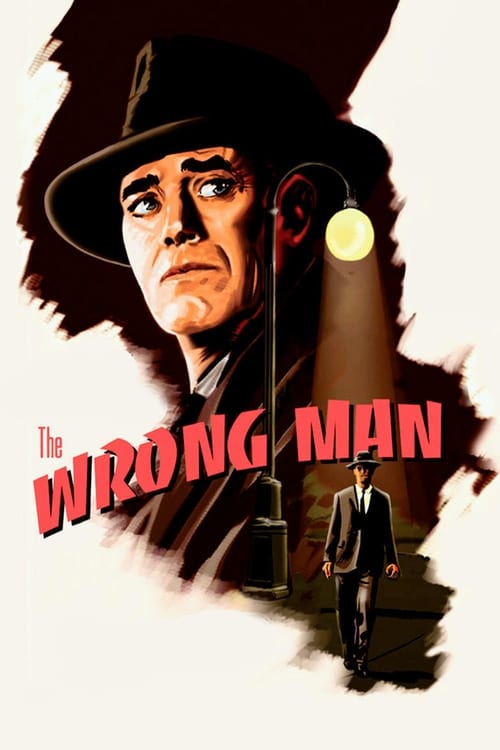
The Wrong Man
1956 · Alfred Hitchcock
For when you want your unease slow and serious rather than fun — a film for a somber, thoughtful night when the question 'what if this happened to me' is exactly what you're after. This is the challenging end of Hitchcock, not the roller-coaster end.
What it's about
Manny Balestrero, a mild-mannered bass player at Manhattan's Stork Club, walks into an insurance office in 1953 and is identified as the man who robbed it. What follows is drawn from a real case and told with near-documentary precision: booking, fingerprinting, arraignment, bail — the machinery of justice closing around an innocent man — while the strain begins to do something quieter and more frightening to his wife, Rose.
The experience
Cold, methodical, and quietly harrowing — Hitchcock strips out the thrills and lets pure procedure generate the dread. You feel the handcuffs, the cell, the averted eyes; it's suspense as suffocation rather than excitement.
Performances
Henry Fonda's stillness is the film — decency under unbearable pressure, registered in the eyes — and Vera Miles is heartbreaking as Rose, whose slow unraveling becomes the story's true tragedy.
The craft
Hitchcock shoots in stark black and white on real New York locations, following the actual case with procedural fidelity and framing Manny through bars, doorways, and mirrors until the whole city feels like a cell. It's his most stripped-down direction: no set pieces, just accumulating weight.
Why it matters
The starkest statement of Hitchcock's lifelong wrong-man obsession, it showed the master of entertainment working in a near-documentary register — a film critics and directors keep returning to as his hidden key.
Snapshot
The Wrong Man is Alfred Hitchcock's most literal treatment of a theme that runs through his entire career: the ordinary innocent swept up by a mechanism of justice that mistakes him for someone else. Where films like The 39 Steps or North by Northwest spin the "wrong man" premise into propulsive chase entertainment, this Warner Bros. production strips out the play. Drawn from a documented 1953 case, it follows Christopher Emmanuel "Manny" Balestrero (Henry Fonda), a mild-mannered bassist at Manhattan's Stork Club, who is arrested after an insurance clerk identifies him as the man who robbed her office. The film traces, in near-procedural detail, the slow catastrophe that follows: booking, arraignment, bail, indictment, and — the true tragedy — the psychological collapse of his wife Rose (Vera Miles) under the strain of a case her husband did not commit. Shot largely on the actual New York locations of the events and prefaced by Hitchcock himself stepping out of the shadows to vouch for the story's truth, it is the closest thing in his filmography to documentary. It is austere, oppressive, and, for many admirers, one of his most morally serious works.
Industry & production
The film originated in journalism. Its immediate source was Herbert Brean's Life magazine account of the Balestrero case, "A Case of Identity" (1953), supplemented by trial records and interviews. Hitchcock, then at the height of his popularity and simultaneously launching the television anthology Alfred Hitchcock Presents (1955–), pursued the project through Warner Bros., the studio for which he had made Strangers on a Train (1951), I Confess (1953), and Dial M for Murder (1954). It was, notably, the last of his Warner pictures before his most fertile stretch at Paramount.
Several accounts hold that Hitchcock made the film on unusually economical terms — reportedly forgoing or reducing his customary fee in exchange for a lean, location-based budget — which suited a project conceived as sober reconstruction rather than star vehicle. The precise financial arrangements are not something I can state with certainty, so I flag them as commonly repeated but not firmly documented here. What is clear is the production's commitment to authenticity: the company shot in the real Jackson Heights neighborhood, at the insurance office in the Victor Moore Arcade, in the actual precinct and courthouse settings, and reportedly consulted the real Manny Balestrero. Henry Fonda, already an emblem of American decency, was cast for exactly that quality; Vera Miles, whom Hitchcock was then grooming as a potential star, took the more demanding role of Rose. Commercially the film was a modest performer, out of step with the escapist appetites of its moment and with the "Hitchcock" brand audiences expected.
Technology
The Wrong Man was made in black-and-white at a time when color and widescreen spectacle were the industry's defensive answer to television. That choice is itself a statement: monochrome aligned the film with the newsreel, the police photograph, and the documentary tradition rather than with glossy studio entertainment. The photography favors a flat, unglamorous register — available-feeling light, real interiors, hard institutional surfaces — over the burnished studio look of Hitchcock's Technicolor pictures of the same decade. The technology here is deployed for suppression rather than display: no saturated color, no VistaVision grandeur, but the plain gray scale of a city and its bureaucracy. The film's technical ambition lies less in apparatus than in the disciplined refusal of ornament.
Technique
Cinematography
Robert Burks, Hitchcock's regular director of photography across most of the 1950s, shot the film against type. In place of the elegant camera movements and rich lighting of To Catch a Thief (1955), Burks and Hitchcock build a visual grammar of confinement and subjective dread. The most celebrated sequence follows Manny into his cell: the camera, locked to his point of view, begins to whirl and tilt as the walls seem to close and spin around him, translating claustrophobia into pure optical sensation. Elsewhere the framing is deliberately frontal and documentary — booking-room compositions that echo mug shots, the mechanical rituals of fingerprinting and lineup rendered with cold precision. Hitchcock repeatedly isolates Manny within the frame, hemmed by bars, doorways, and the shoulders of officials, so that the geometry of the image enacts his entrapment. The recurring motif of hands — filling out forms, taking prints, gripping bars — is photographed in tight, near-fetishistic detail.
Editing
George Tomasini, Hitchcock's editor from Rear Window (1954) onward and one of the great cutters of the studio era, gives the film its measured, accumulating rhythm. Rather than suspense-cutting, much of the picture is built on procedural montage: the step-by-step assembly of Manny's ordeal, each administrative stage clicking into place. The most famous editorial gesture comes near the end, when Manny, at his mother's urging, prays before an image of the Sacred Heart; a superimposition brings the face of the real robber walking toward the camera until it dissolves over Manny's, matching the two men in a single frame. It is a moment of almost devotional montage — deliverance staged as a cut — and it crystallizes the film's central preoccupation with the interchangeability of the guilty and the innocent.
Mise-en-scène / staging
The staging is documentary-realist to a degree unusual for Hitchcock. Real locations do much of the work: the cramped Balestrero apartment, the insurance office, the subway, the somber corridors of the justice system. Hitchcock organizes these spaces around ritual and repetition — the nightly routine of a working family established early, then systematically dismantled. Depth and doorways are used to trap the protagonist; institutional interiors are shot to feel airless and interchangeable. The blocking often reduces Manny to passivity, a body moved through the system rather than an agent acting upon it, which is precisely the film's argument.
Sound
Bernard Herrmann, in one of his earliest collaborations with Hitchcock, supplies a restrained, brooding score that withholds the surging drama audiences might expect. The music is used sparingly, tightening the film's documentary austerity rather than heightening it into thriller mode; the Stork Club scenes admit a diegetic, jazz-inflected texture appropriate to Manny's world as a working musician. Ambient sound — the clang of cells, the murmur of courtrooms, the mechanical noise of process — carries much of the film's oppressive atmosphere. The overall design privileges the flat sound of real spaces over orchestral commentary.
Performance
Henry Fonda gives a deliberately contained, interiorized performance, playing Manny as a fundamentally decent man whose response to nightmare is bewildered stillness rather than protest. The restraint is the point: his passivity indicts the system that grinds on around him. Vera Miles, in the film's most emotionally exposed role, charts Rose's descent from anxious wife to psychological breakdown, and it is her disintegration — not Manny's exoneration — that gives the film its genuine tragedy. Anthony Quayle appears as the defense attorney, and the supporting cast of officials is played with a bureaucratic ordinariness that makes the injustice feel banal rather than villainous, which is far more disturbing.
Narrative & dramatic mode
The film's dramatic mode is its most radical feature. Hitchcock deliberately renounces the "pleasurable suspense" of his usual work in favor of an almost anti-dramatic realism. There is no mystery about Manny's innocence; the audience knows from the outset he is guiltless, so the film generates not whodunit tension but a mounting sense of helplessness. The structure is procedural and cumulative, following the case through its institutional stages. Crucially, the expected catharsis is denied or complicated: even after the real culprit is caught and Manny is cleared, Rose does not recover in step with the plot's resolution. A closing title notes her eventual recovery, but the film's emotional truth is that the damage of a false accusation cannot be reversed by a verdict. In the famous 1962 interview book, Hitchcock told François Truffaut of his reservations about the project — the fidelity to fact denied him the dramatic license he thrived on — and that tension between documentary obligation and dramatic instinct is legible throughout.
Genre & cycle
The Wrong Man sits at the intersection of the crime drama and the semi-documentary "procedural" noir that flourished in postwar American cinema. Films such as Henry Hathaway's The House on 92nd Street (1945) and Call Northside 777 (1948), Jules Dassin's The Naked City (1948), and Anthony Mann's He Walked by Night (1948) had established a mode of location-shot, ostensibly fact-based urban crime storytelling, often narrated with newsreel authority. Hitchcock adopts that idiom but inverts its usual sympathies: where the semi-documentary noir typically celebrates the diligence of the investigating apparatus, The Wrong Man dramatizes that apparatus as an engine of error. It also carries the influence of Italian neorealism's attention to ordinary life and real streets. Within Hitchcock's own oeuvre it belongs to his cycle of guilt-and-Catholicism films alongside I Confess, and to the broader lineage of his "wrong man" thrillers, of which it is the gravest and least escapist instance.
Authorship & method
The film is a concentrated statement of Hitchcock's authorship precisely because it strips his method to essentials. He signals his authorship unmistakably at the outset: instead of his customary fleeting cameo, he appears in silhouette on a bare soundstage to address the audience directly, promising that what follows is true. It is a rare instance of Hitchcock openly framing his own film. His key collaborators are largely the trusted repertory of his golden period. The screenplay is credited to the playwright Maxwell Anderson and Angus MacPhail, working from the documented record. Robert Burks (cinematography) and George Tomasini (editing) were the technical spine of his mid-1950s work, and Bernard Herrmann (music) was beginning the partnership that would produce Vertigo, North by Northwest, and Psycho. The method here is subtractive: Hitchcock suppresses his showmanship — the set pieces, the wit, the star glamour — to test whether his obsessive themes survive in a documentary register. Many critics believe they survive all the more powerfully for the restraint.
Movement / national cinema
As an American studio picture, The Wrong Man is nonetheless in dialogue with international currents. Its debt to Italian neorealism and to the location-realist wing of Hollywood filmmaking places it within the postwar drift toward the real. More consequentially, it became a touchstone for the emerging French New Wave critics at Cahiers du Cinéma, for whom Hitchcock was a supreme artist rather than a mere entertainer. Jean-Luc Godard, then a critic, devoted a substantial essay to the film — commonly cited under the title "Le Cinéma et son double" (1957) — reading it as a metaphysical meditation on chance, identity, and grace. That reception helped install The Wrong Man within the auteurist canon and connects it, across national cinemas, to the New Wave's own fascination with realism and doubling.
Era / period
The film is doubly a period document. It reconstructs a specific 1953 New York — the working-class immigrant milieu of Jackson Heights, the nightclub economy, the pre-Miranda machinery of arrest and arraignment — with an ethnographic care that now reads as social history. And it belongs to the anxious mid-1950s, a moment preoccupied with conformity, institutional power, and the vulnerability of the individual within impersonal systems. Made as Hollywood battled television and as Hitchcock himself became a household face through his TV series, the film's turn to sober, small-scale realism runs deliberately against the industry's spectacular grain. Its vision of an innocent crushed by procedure carries a quiet resonance with the era's broader unease about accusation and due process.
Themes
At its center is the transfer of guilt — Hitchcock's lifelong obsession with the innocent forced to bear another's crime, here rendered without allegorical disguise. Bound up with it is a Catholic sensibility of grace and providence: Manny's release turns, in the film's logic, on prayer, and the superimposition of the true criminal onto his face stages salvation as a kind of divine substitution. Yet the film complicates any easy piety, because faith saves Manny but does not restore Rose. Other governing themes include the fragility of ordinary life, dismantled by a single misidentification; the terror of the bureaucratic and the anonymous, where no individual villain is required for injustice to occur; and the unreliability of eyewitness identification, which the film effectively prosecutes. Finally, there is the theme of collateral damage — the recognition that the deepest wound of a false accusation may fall not on the accused but on those who love him.
Reception, canon & influence
On release the film met a mixed and comparatively muted response. Audiences accustomed to Hitchcock's suspense entertainments found its gray austerity and withheld catharsis disappointing, and it was not a notable commercial success. Its critical fortunes rose chiefly through the French auteurist critics, for whom its seriousness confirmed Hitchcock's stature as an artist; Godard's essay is the emblematic instance of that early championing. Over subsequent decades the film's reputation has grown among scholars, who value it as Hitchcock's most direct engagement with his master theme and as a rigorous experiment in documentary form.
Looking backward, the film draws on the Life magazine journalism of Herbert Brean, on the semi-documentary noir cycle of the late 1940s, on Italian neorealism, and on Hitchcock's own recurring guilt narratives. Looking forward, its influence is felt wherever American cinema pursues procedural realism and Catholic guilt. Martin Scorsese has repeatedly cited The Wrong Man as a formative work — its location-shot New York, its immigrant Catholic texture, and its atmosphere of dread finding echoes in his own films. More broadly, the picture stands as a foundational entry in the enduring genre of the wrongful-conviction drama, prefiguring later fiction and nonfiction accounts of ordinary people caught in the errors of the justice system. Its skepticism about eyewitness testimony and institutional infallibility has, if anything, only gained force with time, securing its place as a small, severe masterwork within the Hitchcock canon.
A Deleuzian reading
A hand is held by another hand and rolled, finger by finger, across an ink pad, then across a card.
The full Deleuzian reading of The Wrong Man →
Reception
A box-office disappointment in 1956 that even Hitchcock himself shrugged off in his interviews with Truffaut — but the French adored it (Godard wrote one of his longest-ever pieces of criticism about it in Cahiers du cinéma), and it's since been reclaimed as one of Hitch's bleakest, most underrated films.
How The Wrong Man was received, from release to now →
How to watch The Wrong Man: what to notice on a first viewing
- Watch hands doing paperwork in extreme close-up. Burks keeps returning to Manny's hands, filling out forms, being inked and rolled for prints, gripping bars, shot tight and almost fetishistic throughout the film. A man is being processed, piece by piece, and the camera shows you exactly which pieces.
- Watch how often bars or doorways box Manny in. Hitchcock repeatedly frames him hemmed by cell bars, office doorways, and the shoulders of officials, so the geometry of each shot enacts his entrapment before anything is said. The image traps him visually well before any verdict has been reached.
- Watch the cell walls seem to tilt and spin. The camera locks to Manny's point of view and begins to whirl as the walls close in around him, translating his claustrophobia directly into how the shot itself moves. You feel his panic physically instead of being told about it through dialogue.
- Listen for silence where a thriller score would swell. Herrmann keeps his music sparse throughout, letting the clang of cells and the murmur of courtrooms carry the film's dread instead of an orchestra pushing the tension. The film refuses to make Manny's ordeal exciting to listen to.
- Watch Fonda react to bad news with almost no movement. He answers questions, signs papers, and stands where he is told, playing terror as stillness rather than protest or visible panic. His passivity is the whole point, a decent man being ground down by ordinary process.
The whole guide to watching The Wrong Man, with the keys for a rewatch →
Influences: the films it descends from and the films it influenced
- In Cold Blood (1967) — Carries the semi-documentary true-crime aesthetic to its severe conclusion — actual case, actual locations, high-contrast reportage — declaring at the outset its fidelity to the documented record.
- Mother (2009) — Procedural entrapment of a socially vulnerable innocent establishes the narrative architecture Bong inverts — where Hitchcock maintains dramatic irony by keeping the audience informed of truth, Bong withholds it, making the viewer complicit in the Mother's deception until the retroactive reveal.
- Minority Report (2002) — Supplies the Hitchcockian innocent-accused engine Anderton runs on — the ordinary man framed by a deterministic system, subjective-POV identification with the hunted, and suspense built from institutional certainty turned against the protagonist.
- The Fugitive (1993) — Pioneered the semi-documentary, procedurally-detailed innocent-man thriller, treating the machinery of evidence and arrest with sober realism rather than melodrama.
- After Hours (1985) — The wrong-man pursuit engine executed through subjective camera that locks onto an innocent and pushes in as the machinery closes, plus documentary-real location texture rather than studio noir — Scorsese's stated Hitchcock touchstone and the model for Paul's mistaken identity as burglar.
- Drishyam (2015) — Makes ordinary testimony the engine of terror: whether a family can prove where it was on a given date, verified by hotel registers, ticket clerks and strangers' recall — Drishyam's second half is that procedure weaponized, with a family drilled to recite a false but corroborated itinerary.
- Rome, Open City (1945) — Establishes the neorealist method Hitchcock adopts wholesale — real streets, available-light interiors, and an ordinary citizen ground down by an impersonal apparatus — treating documentary texture, not staged spectacle, as the source of dread.
- Bicycle Thieves (1948) — Models the passive protagonist whose ruin follows a single trivial mischance; Fonda's affectless helplessness before the machinery of the law is De Sica's everyman transposed to Queens.
- The House on 92nd Street (1945) — Founds the semi-documentary noir contract Hitchcock invokes in his prologue — the on-camera assurance that 'this is true,' plus location shooting of actual institutional sites, borrowed straight from the Fox docu-noir cycle.
- Boomerang! (1947) — Shoots a real wrongful-accusation case on the actual New England locations with newsreel plainness, pioneering the true-crime procedural whose refusal of studio gloss The Wrong Man extends.
- Call Northside 777 (1948) — Direct ancestor of the wrongful-conviction procedural — a methodical, evidence-by-evidence reinvestigation of a real miscarriage of justice, indicting eyewitness certainty exactly as Balestrero's alibi hunt does.
- The Naked City (1948) — Supplies the template of New York itself as documentary subject — subway, precinct, and tenement shot on location with quasi-journalistic narration — the civic-texture realism Burks reproduces for Manny's city.
- Strangers on a Train (1951) — The clearest prior statement of Hitchcock's 'transfer of guilt' — an innocent man made to bear another's crime — which The Wrong Man renders literal through the near-identical double who committed the robberies.
- I Confess (1953) — Immediate precursor in the austere-Catholic mode: an innocent trapped by circumstantial guilt, played by a withholding lead, its grace resolved by an act of faith that prefigures Manny's prayer and the doppelgänger's capture.
- A Man Escaped (1956) — Sibling in the subtractive method released the same year — spectacle stripped to procedural fact and hands-on detail, with deliverance framed explicitly as Catholic grace ('the wind bloweth where it listeth').
- 12 Angry Men (1957) — Extends the film's central skepticism about eyewitness testimony and institutional infallibility into the jury room, dismantling a confident identification the way Manny's fate turns on a shaky witness's certainty.
- Psycho (1960) — Descendant of the same experiment in stripped-down realism — a small-budget, near-monochrome, semi-documentary opening ('Phoenix, Arizona… two forty-three P.M.') — and the mature fruit of the Herrmann partnership that The Wrong Man inaugurated.
- Z (1969) — Inherits the procedural-realism engine that turns an investigation's accumulating factual detail into suspense, applying The Wrong Man's institutional dread to overtly political miscarriage.
Similar films
- Psycho (1960) — influence & lineage
- Strangers on a Train (1951) — influence & lineage
- 12 Angry Men (1957) — influence & lineage
- A Man Escaped (1956) — influence & lineage
- Rear Window (1954) — shared sensibility
- The 39 Steps (1935) — shared sensibility
- Notorious (1946) — shared sensibility
- Vertigo (1958) — shared sensibility