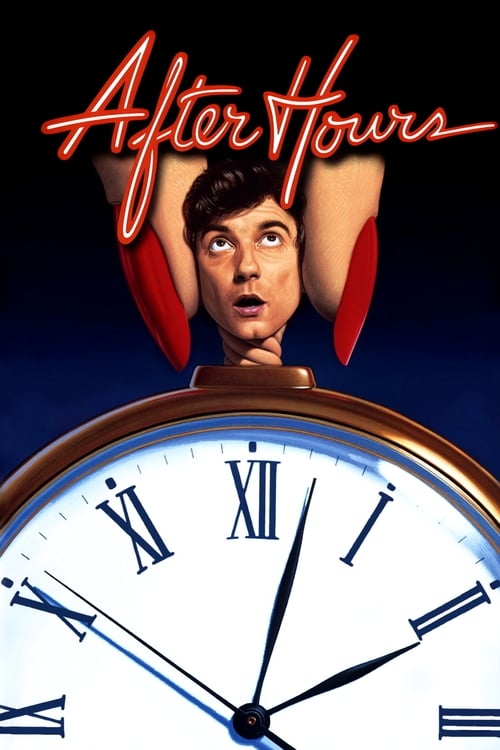
After Hours
1985 · Martin Scorsese
For when you want something wired and strange after midnight — the perfect late-night watch when you're in the mood to feel pleasantly paranoid rather than soothed.
What it's about
Paul Hackett is a bored Manhattan office worker who goes downtown late one night to meet an intriguing woman in SoHo — and then simply cannot get home. Over one escalating night he loses his cash, his bearings, and eventually the goodwill of an entire neighborhood, as chance encounters with artists, bartenders, punks, and vigilantes pile up into a citywide conspiracy of bad luck.
The experience
A comedy that plays like a nightmare — funny in a clenched, can't-look-away manner, with the anxiety cranked steadily upward until you're laughing mostly to relieve the pressure. It moves fast and never lets you or Paul rest.
Performances
Griffin Dunne is superb as an ordinary man watching his politeness fail him, and the night's gallery of women — Rosanna Arquette, Teri Garr, Catherine O'Hara among them — each shifts the film's tone the moment they appear.
The craft
Scorsese turns camera movement into a weapon: whip pans, prowling tracking shots, and razor editing make a few blocks of nighttime SoHo feel like a maze that's actively hostile. Shot fast and cheap after a career setback, it's some of the most kinetic direction of his life — great with the lights off and the sound up.
Why it matters
It won Scorsese the Best Director prize at Cannes and revived his career at its lowest ebb, and it remains the touchstone for every one-crazy-night movie made since.
Snapshot
After Hours is Martin Scorsese's downtown nightmare comedy: a single night in SoHo during which a Manhattan word-processing clerk named Paul Hackett (Griffin Dunne) descends from the Upper East Side to a neighborhood he does not understand and cannot leave. The film runs roughly ninety-seven minutes and behaves like a machine for withholding escape — every gesture Paul makes toward home produces a new obstruction, and the obstructions accumulate into a comic pattern so relentless that by dawn the city itself seems to be conducting a prosecution.
Its importance is double. Formally, it is Scorsese's most concentrated exercise in tempo and paranoid geometry, a chamber film shot almost entirely at night in a handful of Lower Manhattan blocks, in which camera movement is used less to describe space than to persecute a character. Industrially, it is the film Scorsese made after the collapse of his first attempt at The Last Temptation of Christ at Paramount — a small, fast, low-budget picture, financed outside the studio majors and released by Warner Bros., that functioned as a demonstration that he could still work cheaply, quickly, and under control. It won him the Best Director prize at Cannes in 1986.
After Hours also sits at a hinge in American film culture: it is a studio-distributed movie made with an independent's economy, arriving as the American independent scene of the 1980s was consolidating, and it channels a specifically New York anxiety about downtown bohemia as seen by an outsider who wants in and then desperately wants out.
Industry & production
The project originated not with Scorsese but with a screenplay by Joseph Minion, written while he was a graduate film student at Columbia University. The script — circulated under the title Lies before becoming After Hours — attracted producer Amy Robinson and Griffin Dunne, who had produced together (Dunne, an actor, was moving into producing) and who developed it with Robert F. Colesberry. Dunne was attached as star as well as producer, an arrangement that shaped the film's economy: the lead was already in the room, invested in getting it made.
The most consequential context is what Scorsese was not making. Paramount had put The Last Temptation of Christ into pre-production and then canceled it, close enough to the start of shooting that the abandonment was traumatic — a combination of budget anxiety and pressure from religious groups. Scorsese has described the period as a professional crisis. After Hours was the answer: a small picture he could shoot fast, on a modest budget, at night, in a compressed location footprint, to prove — to the industry and to himself — that he was not a director who bankrupted productions. That framing is well attested in Scorsese's own accounts and in the standard critical literature on his career; it is the reason the film is so often read as a displaced allegory of the filmmaker's own predicament, a man punished all night for the sin of wanting something.
The financing came together outside the major-studio development system, with The Geffen Company involved and Warner Bros. handling distribution. Reports of the budget cluster in the very low millions — small even by mid-1980s standards, and small enough that the constraint is legible on screen in the concentrated locations and the almost entirely nocturnal schedule. I'd rather not attach a hard number: the figures circulated in secondary sources vary and I can't verify one.
Production ran through night shoots in SoHo and TriBeCa in 1984–85, with interiors that reuse a small stock of apartments, a diner, a bar, and a club. The night-shoot discipline is the film's central production fact. Everything — the crew's fatigue, the emptiness of the streets, the way light sources become characters — follows from it.
A further piece of the film's history concerns the screenplay's originality. After release it emerged that a substantial portion of the film's first act closely paralleled a monologue by the writer and performer Joe Frank, and a settlement followed. The episode is part of the film's documented record and worth naming plainly rather than eliding: the film's opening movement — the ride downtown, the lost twenty-dollar bill — has an acknowledged debt outside the credited screenplay.
Technology
After Hours is a 35mm film shot largely at night on location, and its technical character is defined by that combination. Night location shooting in 1984–85 meant working at the edge of available film stock sensitivity. Eastman Kodak's faster color negatives of the early 1980s — the 5293/5294 generation of tungsten-balanced high-speed stocks — had recently made practical the kind of low-light location work that would have required either far heavier lighting packages or heavy push-processing a decade earlier. The film's look, with its deep blacks, saturated practical sources, and hot pools of light in otherwise unlit streets, belongs to that moment of stock capability.
The other technological point is mundane and central: the film is a compendium of the physical infrastructures of pre-digital urban life, and its plot is built from their failure. A twenty-dollar bill that blows out a taxi window. A subway fare increase at a fixed hour of the night. A pay telephone. A door buzzer. An apartment key. A subway token booth. The narrative engine of After Hours is an inventory of small analog technologies for moving through and communicating across a city, each of which betrays Paul in turn. The film is unintentionally a document of a New York whose friction was material — cash, coins, printed schedules, physical keys — and the comedy depends absolutely on that friction. It could not be remade without rewriting every plot point.
Paul's day job is likewise a technological marker: he trains a colleague on word processing in an open-plan office of terminals, the mid-1980s white-collar workplace at the exact moment the computer had become furniture. The film opens on that flat institutional light and never returns to it.
Technique
Cinematography
Michael Ballhaus shot After Hours, and it is the film that established his partnership with Scorsese — they would go on to The Color of Money, The Last Temptation of Christ, GoodFellas, The Age of Innocence, Gangs of New York, and The Departed. Ballhaus came out of the German New Cinema, having shot more than a dozen films for Rainer Werner Fassbinder, and he brought to Scorsese both a facility with elaborate camera movement and a habit of speed — the Fassbinder productions had been famously fast, which suited a film with no money and only the night.
The visual scheme is built on three devices. First, extreme speed: whip pans, fast dollies, and rapid rack focuses that snap attention from object to object with a violence out of proportion to what is being shown. A set of keys, a door buzzer, a bill on a table are attacked by the camera as though they were weapons. This is the film's most imitated technique — an ordinary object rendered ominous purely by the aggression of the move toward it.
Second, low and canted framing that renders SoHo's cast-iron architecture as canyon walls. The streets are shot wide and empty, with the camera often placed low enough that doorways and stoops loom. Paul is repeatedly small in the frame or pressed to its edge.
Third, hard chiaroscuro: interiors lit by visible practicals — bar lamps, a lightbulb, a diner's fluorescents — with blackness beyond. The color palette is a narrow band of amber, sodium-orange, and cold blue-black, so that skin tones sit inside pools of warmth surrounded by nothing. It is expressionist lighting applied to naturalistic locations, and it is what converts a comedy of errors into something that behaves like a horror film.
There is also a running motif of the camera arriving at a place before Paul does, or lingering after he leaves — the film's point of view is not strictly his, which produces the uncanny sense that the night has intentions.
Editing
Thelma Schoonmaker cut the film, in the ongoing collaboration that began with Raging Bull (after their much earlier work together on Woodstock and Scorsese's student films) and has continued across his entire subsequent career. Her work here is a study in comic escalation through rhythm.
The cutting does two things at once. Within scenes, it uses abrupt, sometimes jarring cuts on movement and on reaction, refusing the smoothing that conventional coverage provides — a punchline lands and the film has already moved. Across the film, it builds an accelerating structure: the early sequences have room to breathe, the middle contracts, and the last third moves in short bursts as Paul is handed from one antagonist to the next. The film's comedy is fundamentally an editing comedy, dependent on timing rather than dialogue.
Schoonmaker also handles the film's repeated gag structure — the return to the same locations, the same faces reappearing in new roles as accusers — so that recurrence reads as tightening rather than repetition. The audience learns the map slightly faster than Paul does, which is where much of the laughter comes from.
Mise-en-scène / staging
The film's world is built on a strict binary. Uptown is flat, evenly lit, beige, corporate, and legible. Downtown is a warren of lofts, sculptures, papier-mâché, plaster of Paris, bare bulbs, mattresses on floors, and objects whose function is unclear. The loft of the sculptor Kiki (Linda Fiorentino) is full of half-finished work; the bagel-and-cream-cheese paperweight is a joke about art objects that becomes a plot device. The film stages downtown bohemia as an environment where everything is either art or evidence, and Paul cannot tell which.
Staging is claustrophobic by design: Paul is repeatedly placed in doorways, on stairs, at thresholds he cannot cross. Scorsese uses the geography of walk-up apartments — buzzers, stairwells, roofs, fire escapes — as a vertical maze. The recurring return to the same three or four blocks converts a real neighborhood into a closed set, which is both a budget solution and the film's principal formal idea.
The final image, a plaster-encased Paul deposited by dawn back at the doors of his office, is the mise-en-scène's argument made literal: the character is delivered as an art object to the place he tried to escape.
Sound
Howard Shore composed the score — one of his early Scorsese collaborations, preceding his long association with the director. The score is spare, using pulse and drone more than melody, and it withholds the reassurance a comedy score would normally provide. There are also pointed uses of pre-existing music: Peggy Lee's rendition of "Is That All There Is?" is deployed as an ironic thesis statement, and the Monkees' "Mary, Mary" scores a sequence with a jaunty aggression at odds with Paul's terror. Mozart and other classical selections appear in the mix as well, part of a scheme in which sourced music is nearly always at the wrong emotional register for the action.
The sound design is equally important: the film is loud with New York — sirens, distant shouts, the specific rattle of a subway, buzzers, telephones ringing in empty rooms. Because the streets are visually empty, the noise implies a populated city just out of frame, which sustains the paranoid sense of being watched. Silence, when it arrives, is used as threat.
Performance
Griffin Dunne's Paul is the film's structural achievement. The role requires an ordinary man who is neither hero nor fool, whose reasonable reactions become increasingly unreasonable in aggregate, and Dunne plays escalation with real precision — from bemusement through irritation to genuine terror and, finally, exhausted surrender. His comic mode is reactive; he is a straight man surrounded by people who behave as though their behavior were normal.
The supporting cast is a gallery of downtown types, each played with total sincerity. Rosanna Arquette's Marcy is unstable in a manner that is genuinely sad rather than merely eccentric; her scenes contain the film's only real tenderness and its cruellest turn. Linda Fiorentino's Kiki is deadpan and unbothered. Teri Garr's Julie is a Sixties holdover, all beehive and hurt. Catherine O'Hara's Gail runs the mob-with-a-Mister-Softee-truck sequence with terrifying cheerfulness. John Heard tends bar with hangdog defeat, and Cheech Marin and Tommy Chong appear as burglars — a casting joke that also imports a whole counterculture register. Verna Bloom, Will Patton, and Dick Miller fill out the night. Scorsese himself appears, briefly, operating a spotlight in the club.
The ensemble strategy matters: nobody plays comedy. Every performance is pitched as though this were a drama about that character's own life, into which Paul has intruded. The comedy is generated entirely by the collision.
Narrative & dramatic mode
The film observes a near-classical unity of time and place — one night, a few blocks — and uses that unity as a trap rather than an elegance. Its dramatic mode is the odyssey of obstruction: a protagonist with a single, trivially achievable goal (go home) who is prevented by an escalating series of unrelated events that gradually reveal themselves as related.
Structurally it is closer to farce than to comedy of character. Paul does not change; the world's pressure on him increases. Coincidence, which conventional dramaturgy treats as a flaw, is here the organizing principle — the film keeps returning the same people and objects into Paul's path until coincidence stops feeling like chance and starts feeling like design. This is the mechanism that converts the film's genre from comedy to paranoid thriller without any change in the events themselves. The escalation ends with Paul literally hunted by a mob of neighbors, an innocent man pursued as a criminal.
Kafka is the obvious literary comparison and a fair one: the film shares with The Trial the structure of an ordinary man prosecuted by a system whose rules are never stated, and with The Castle the structure of a destination that recedes as it is approached. The film's ending — a circular return to the office at dawn, the whole night sealed off as though it never happened — is a farcical resolution that resolves nothing, restoring the exact condition of unhappiness the protagonist set out to escape.
Genre & cycle
After Hours sits inside a distinct mid-1980s American cycle: the yuppie nightmare comedy, in which a comfortable, usually white, usually male professional is dropped into a hostile milieu and stripped of his assumptions. The cycle includes John Landis's Into the Night (1985), Jonathan Demme's Something Wild (1986), and, in a lighter register, Blake Edwards's and others' fish-out-of-water comedies of the period; Desperately Seeking Susan (1985), Susan Seidelman's downtown comedy, is a close cousin in setting and released the same year. Critics at the time noticed the convergence. What distinguishes Scorsese's entry is that it plays the premise for genuine dread rather than for liberation — in Demme's film the encounter with the wild is transformative; in Scorsese's it is punitive.
Generically the film is a deliberate hybrid that never settles. It uses horror grammar (isolation, pursuit, the false sanctuary), noir grammar (the night city, the femme fatale who may be neither, the innocent man mistaken for guilty), and screwball grammar (rapid reversals, a chain of eccentrics, an escalating misunderstanding). The refusal to resolve into one mode is the point; it keeps the audience unsure whether to laugh, and that uncertainty is the film's most durable effect.
It also belongs to the small tradition of the one-night film — narratives bounded by a single night in a city — alongside works as varied as The Out-of-Towners (1970) and, later, Judgment Night, Collateral, and Good Time.
Authorship & method
The film complicates Scorsese authorship usefully. It is not a personal project in origin — Minion's script came to him — and it is not obviously a Scorsese subject: no Catholic guilt made explicit, no organized crime, no boxing, no rock-and-roll bildungsroman. Yet it is intensely Scorsesean in method and, arguably, in obsession. The persecuted innocent, the city as a moral environment, the sexual anxiety, the comedy that curdles, the sense of a protagonist who has done something wrong without knowing what — all of it is continuous with Taxi Driver and The King of Comedy, with which it forms a loose New York trilogy of alienated men. The King of Comedy (1982) is the closest formal sibling: another comedy played without comic protection, another protagonist whose behavior is legible to nobody around him.
Joseph Minion (writer) supplied the film's structure and its best jokes; the acknowledged borrowing from Joe Frank's monologue for the opening section complicates but does not erase the achievement of the script's overall architecture. Minion's subsequent career was slight, which has made After Hours something of an orphan masterpiece in his filmography.
Michael Ballhaus (cinematography) brought Fassbinder-trained speed and a European expressionist palette, and this film began one of the major director–cinematographer partnerships of the following two decades.
Thelma Schoonmaker (editing) shaped the escalation. Her contribution to Scorsese's work is not stylistic decoration but dramaturgy, and After Hours is one of the clearest small-scale demonstrations of that.
Howard Shore (music) provided a score that refuses to signal comedy, an early instance of his ability to write against a film's apparent genre.
The production team — Amy Robinson, Griffin Dunne, Robert F. Colesberry — deserves naming because the film is as much a producer's picture as a director's: they found it, developed it, and brought a director in crisis a project he could complete.
Method, here, is the argument. Scorsese has spoken of shooting fast, of a rediscovered pleasure in low-budget improvisation, of returning to the conditions of his earliest films. The film's kinetic style is partly a solution to having no time.
Movement / national cinema
After Hours is a New York film in the strong sense — not merely set there but structured by the city's specific geography and social stratification. The uptown/downtown axis it dramatizes was real and legible in 1985: SoHo was mid-transition from an artists' district of illegally occupied lofts to a gentrifying neighborhood, and the film catches it at the moment when its bohemian reputation was still intimidating to outsiders and its real-estate future was already visible. The film is, incidentally, a valuable document of that transition.
It also belongs to the American independent formation of the mid-1980s in method if not in financing — the small-crew, location-shot, character-driven picture — while retaining studio distribution. It stands next to Stranger Than Paradise (1984), Desperately Seeking Susan (1985), and Blood Simple (1984) as part of the moment when American film began to look small again.
Its stylistic lineage, though, is European. Ballhaus imports German New Cinema camera practice; the narrative structure imports Central European literary absurdism; the mode of comedy — anxious, non-cathartic — is closer to Buñuel's The Exterminating Angel or The Discreet Charm of the Bourgeoisie, with their characters unable to complete a simple action, than to any American comic tradition.
Era / period
1985 is late in the New Hollywood story and early in the era of the high-concept blockbuster. Scorsese, a founding figure of the former, was in the position of many of his peers: the freedoms of the 1970s were gone, budgets were being scrutinized, and personal projects were being canceled. After Hours is a direct artifact of that industrial contraction — the small film made because the large one was killed.
Culturally, the film is saturated in Reagan-era class anxiety. Paul is a white-collar worker with no capital, adrift in a decade that had begun to celebrate capital openly; his fatal error is a monetary one (the lost twenty), and his humiliations are consistently financial — no cash for the subway, no cash for the fare increase, dependence on strangers. The downtown characters, by contrast, live outside the wage economy in ways he finds both alluring and incomprehensible. The film's punchline is that the city returns him, intact, to work.
It also carries an unmistakable, largely unspoken charge of mid-1980s sexual dread. Paul goes downtown for a hookup and the encounter turns first grotesque, then fatal, and then criminal. The film never names AIDS, and it would be wrong to claim it as an intentional allegory — but the atmosphere of a sexual encounter that becomes catastrophe is very much of 1985, and critics have read it that way since.
Reception, canon & influence
Contemporary reception. The film was well received critically on release, admired for its control and its nerve, though it was a modest performer commercially — a small film given a modest release, and not the kind of hit that resets a career on box office terms. Its most consequential validation came in 1986, when Scorsese won Best Director at the Cannes Film Festival for it. That prize did real work: it re-established him as a filmmaker of standing at exactly the moment he most needed it, and the path to The Color of Money (1986), The Last Temptation of Christ (finally made in 1988), and GoodFellas (1990) runs through it. The film also received Independent Spirit Award recognition, marking its position at the edge of the emerging independent sector.
Some contemporary critics found it cold, or found the treatment of its female characters — a gallery of unstable, threatening women seen entirely through a frightened man's eyes — objectionable. That criticism has persisted and is worth stating: the film's misogyny question is genuinely open. A defense holds that the perspective is diagnosed rather than endorsed, that the film is about male panic and therefore renders women as panic renders them. A prosecution holds that the film enjoys the panic too much. Both readings are available in the critical literature.
Influences on the film (backward). The Kafka lineage is primary and acknowledged in the general critical discussion. Buñuel's surrealist comedies of thwarted action are a clear ancestor. Film noir supplies the nocturnal city and the wrongly accused man — the Cornell Woolrich strain of noir in particular, with its innocents caught in one terrible night. Hitchcock's wrong-man pictures inform the pursuit structure. Within Scorsese's own work, Taxi Driver (1976) supplies the nocturnal New York and The King of Comedy (1982) the tonal strategy of comedy without release. The acknowledged debt to Joe Frank's monologue belongs in this list as a matter of record.
Legacy (forward). After Hours has grown steadily in stature and now sits comfortably in the second rank of the Scorsese canon — below Taxi Driver, Raging Bull, and GoodFellas, but firmly canonical, and increasingly cited as his most purely formal achievement. A Criterion Collection release consolidated that status for a later generation of viewers.
Its influence runs along three lines. First, the one-night urban odyssey has become a durable structure, and After Hours is its most cited modern template — the Safdie brothers' Good Time (2017) and Uncut Gems (2019) are the clearest inheritors, sharing its escalating panic, its urban specificity, and its refusal of relief; Scorsese's own Bringing Out the Dead (1999) revisits the nocturnal New York material in a religious register. Second, the aggressive-object camera — the whip-pan and rush-in on an inanimate thing to generate dread from nothing — passed into general circulation and is now a standard tool of comic-horror hybrid style. Third, the tonal hybrid itself: the film is a foundational text for the strain of contemporary cinema and television that plays anxiety as comedy without ever letting the audience settle, a mode now common enough to be almost a default register.
For Scorsese's own career the legacy is simplest to state: After Hours is the film that got him back to work. He has said as much in substance, repeatedly. That it is also one of his most disciplined and least sentimental pictures is the additional dividend.
A Deleuzian reading
A twenty-dollar bill blows out the window of a moving cab.
The full Deleuzian reading of After Hours →
Reception
In 1985 it looked like a minor detour — a small, scrappy comedy from a director in career limbo after Paramount pulled the plug on The Last Temptation of Christ — even though it won Scorsese Best Director at Cannes. Now it's fully reappraised as one of his best: a Criterion edition, a Letterboxd darling, and the template for every 'one bad night' movie since.
How After Hours was received, from release to now →
How to watch After Hours: what to notice on a first viewing
- Watch the camera rush at keys, buzzers, and money. Michael Ballhaus whip-pans, dollies fast, and snaps focus onto small objects with a force completely out of proportion to what they are. A twenty-dollar bill, a set of keys, a doorbell. Ordinary things stop being furniture and start demanding to be read. Downtown, Paul cannot tell art from evidence and neither can the camera.
- Count the reasonable things Paul tries in order to leave. He explains himself, asks for change, finds a phone, buzzes an apartment, tries the subway, tries a bar, asks strangers. He is competent and he is right. None of it moves him closer to home. He acts constantly and nothing he does registers on the world. The comedy and the fear both come out of that gap.
- Look at the bare bulbs and bar lamps lighting the interiors. Every source is visible in the shot and everything past it is black. The palette runs a narrow band of amber, sodium orange, and cold blue-black, so faces sit in small pools of warmth. This is horror lighting applied to real locations, which is what tips a comedy of errors toward something that behaves like a chase.
- Listen to the city noise while the streets look empty. Sirens, distant shouting, subway rattle, buzzers, telephones ringing in rooms with nobody in them. The image gives you wide deserted SoHo blocks. The track gives you a crowded city just out of view. You are never alone here and you never see anyone, which is the exact mechanism of feeling watched.
- Watch how often Paul gets stuck in a doorway. Buzzers, stairwells, landings, fire escapes, roofs. Scorsese turns walk-up geography into a vertical maze and keeps putting Paul at thresholds he is not allowed through, low in the frame or pressed to its edge. The architecture does the refusing. He is never locked in a room, only kept from getting out of the block.
The whole guide to watching After Hours, with the keys for a rewatch →
Influences: the films it descends from and the films it influenced
- The Trial (1962) — Renders Kafkaesque bureaucratic logic as spatial impossibility — wide-angle deep-focus corridors, ceilings pressing into low canted setups, rooms that reconfigure behind the innocent — the exact grammar Scorsese uses to make SoHo lofts and stairwells feel like a closing apparatus.
- The Exterminating Angel (1962) — Builds an entire comedy out of a trivial goal (leaving a room) that is obstructed by a rule never explained and never broken, escalating purely by accumulated failure — the structural engine of Paul Hackett's inability to travel sixty blocks home.
- The Discreet Charm of the Bourgeoisie (1972) — Serial-interruption construction: each attempt at a simple objective is deferred by a fresh, self-contained absurd episode chained onto the last without resolution, which is precisely how Minion's script and Schoonmaker's cutting sequence Paul's encounters.
- Phantom Lady (1944) — The Woolrich strain of noir — one nocturnal New York night in which every witness denies what the protagonist knows, staged in Bredell's expressionist chiaroscuro on rain-slick streets and elevated platforms — supplies After Hours its night-that-erases-your-alibi architecture.
- The Wrong Man (1956) — The wrong-man pursuit engine executed through subjective camera that locks onto an innocent and pushes in as the machinery closes, plus documentary-real location texture rather than studio noir — Scorsese's stated Hitchcock touchstone and the model for Paul's mistaken identity as burglar.
- The Tenant (1976) — Turns the walk-up apartment building into a vertical maze of hostile neighbors, shot with wide-angle distortion from doorframes and stairwell POVs, so architecture itself performs the persecution — the direct template for After Hours' buzzers, landings, and interrogatory apartment interiors.
- Martha (1974) — Ballhaus's 360-degree circular track around the couple established the machine-precise, pre-choreographed camera move as a dread-generating device; he brought that same mechanical exactitude to After Hours' whip-pans, crane descents, and rush-ins.
- Taxi Driver (1976) — Establishes the sodium-vapor, steam-vented night location New York as a psychological weather system, with slow lateral dollies that detach from the protagonist's eyeline — the sensorium After Hours re-enters, minus the gun.
- The King of Comedy (1982) — Perfects comedy without a release valve: sustained held two-shots on humiliation that withhold the cut which would let an audience laugh and reset — the tonal discipline After Hours applies to escalating panic.
- The Evil Dead (1981) — The aggressive subjective camera that rushes at and around inanimate objects to manufacture dread from nothing; Scorsese publicly championed it, and After Hours redirects the device at a set of keys, a plaster bagel, and a doorbell.
- Adventures in Babysitting (1987) — The commercial teen distillation of the one-night urban odyssey: suburban innocents stranded downtown, each obstruction built as a discrete set piece, release withheld until dawn returns them home.
- Miracle Mile (1988) — Pushes unity of time and place toward real time — a single misheard phone call escalating across one night within a few fixed blocks — with the Tangerine Dream score doing Howard Shore's job as an anxiety motor rather than emotional commentary.
- Bringing Out the Dead (1999) — Scorsese's own explicit revisit: night-shift New York as an odyssey of obstruction, Schoonmaker's ellipsis-heavy and step-printed panic cutting, ironic needle-drops over sirens, and a passive protagonist who receives the city's grotesques rather than acting on them.
- Good Time (2017) — Adopts the escalation law in which every attempted fix produces a worse problem within a single night, keeping the protagonist pinned in long-lens close coverage while the city mutates around him; Oneohtrix Point Never's synth score performs Shore's function.
- Uncut Gems (2019) — Inherits the comic-escalation rhythm with no release — overlapping dialogue as pressure, and a predatory camera that lunges at objects (the opal, the ring) with the same whip-pan-and-rush-in Ballhaus aimed at Paul's twenty-dollar bill and keys.
- A Hard Day (2014) — The single-night urban-nightmare escalation structure — an ordinary man's evening spiraling into dark-comedy catastrophe through compounding misfortune — with the city staged as a closed hostile system that consistently withholds exit, the tonal register A Hard Day inherits for its nocturnal second half.
- On the Count of Three (2022) — Codifies the single-day errand-run that escalates through a chain of increasingly dark-comic encounters across a city, each stop ratcheting the protagonist deeper into catastrophe.
- Beau Is Afraid (2023) — Escalating nightmare-odyssey comedy where a passive man is punished by an increasingly hostile night, the anxiety-comedy engine of tonal whiplash Aster inherits.
- Joni's Promise (2005) — Defines the compressed single-run urban odyssey where each neighborhood hands the protagonist a fresh comic-menacing episode, the episodic-escalation rhythm Joni's Jakarta night follows.
- Good Luck, Have Fun, Don't Die (2026) — The one-crazy-night escalation engine cited in Verbinski's interviews: each scene hands the protagonist off to a new grotesque, propelled by wide-angle whip-pans, snap zooms and clock-anxiety cutting, with the city's geography closing rather than opening as the night proceeds.
- Into the Night (1985) — Same-year variant of the unity-of-night gauntlet: an insomniac straight man is towed through one Los Angeles night as a chain of escalating encounters with cameo-cast eccentrics, with the reactive-nonentity performance carrying the comedy.
- Desperately Seeking Susan (1985) — Works the identical 1985 downtown-Manhattan club-and-loft locations and the uptown/downtown class binary as a mistaken-identity engine, with Rosanna Arquette positioned on the opposite side of the same exchange between bourgeois order and bohemian chaos.
- Something Wild (1986) — Extends the tonal-hybrid method — a continuous trip that slides from screwball to genuine menace without a genre marker to warn the audience — using ironic needle-drops laid against rising threat exactly as Scorsese does.
- Blood Simple (1985) — Produced in the same American independent moment and premiering in the same festival circuit, both films use nocturnal confined geography and cascading misidentification to trap a protagonist in a paranoid spiral where each attempt at escape generates a new layer of entrapment — the dark comedy and the genuine menace are equally inseparable in both.
- Broadcast News (1987) — Ballhaus's Scorsese-honed kinetic camerawork from the year before — the same restless fluid mobility he then applies to Brooks's walk-and-talk staging.
- Lost in America (1985) — The other 1985 yuppie-nightmare film built on circular picaresque structure — an office worker's night of escalating negotiations that deposits him back at his desk with nothing learned, the same refused redemptive reversal Brooks ends on.
Similar films
- Taxi Driver (1976) — influence & lineage · often watched together
- The King of Comedy (1982) — influence & lineage
- The Departed (2006) — often watched together
- Casino (1995) — often watched together
- GoodFellas (1990) — often watched together
- Heat (1995) — often watched together
- La Haine (1995) — often watched together
- Mulholland Drive (2001) — often watched together