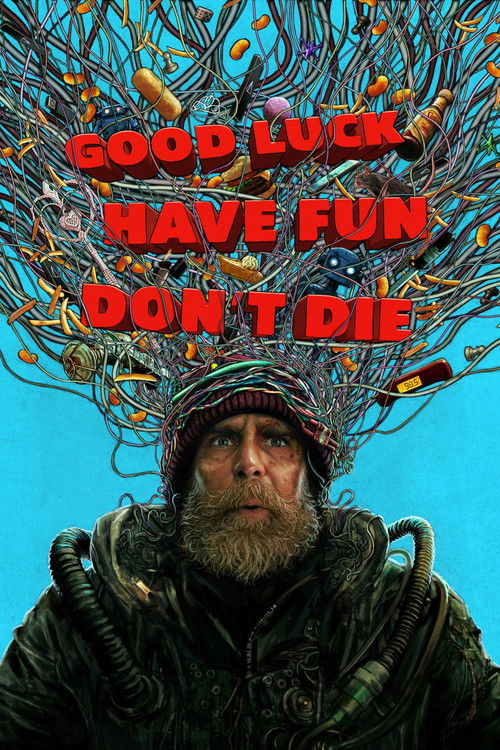
Good Luck, Have Fun, Don't Die
2026 · Gore Verbinski
When you want something genuinely weird — a big, strange swing you can't predict scene to scene — and you're up for a comedy that's also quietly worried about the future. More adventure than downer, but it leaves you chewing.
What it's about
A man in a battered exoskeleton walks into an all-night LA diner claiming to be from the future — and to have lived this exact night 117 times already. He needs to recruit the precise combination of ordinary, disgruntled patrons — schoolteachers, a scoutmaster, a grieving mother, a party clown allergic to electronics — for a one-night quest to stop a rogue artificial intelligence before it's born.
The experience
A gonzo mix of sci-fi urgency and deadpan comedy that keeps flipping between absurd and genuinely suspenseful, with an unexpected streak of melancholy running underneath. It moves like a chase and thinks like a barroom argument about where we're all headed.
Performances
Sam Rockwell is the engine: motor-mouthed, twitchy, and oddly moving as the time traveler, selling an eleven-page opening monologue like a high-wire act.
The craft
Gore Verbinski's first film in nearly a decade brings his taste for elaborate physical set pieces and tonal whiplash to an original script — no franchise, no safety net. The production design turns ordinary Los Angeles into a night-quest landscape, and the sound and mayhem play best loud.
Why it matters
A rare original big-swing science-fiction comedy from a blockbuster director working outside the franchise system, landing right in the middle of the cultural argument about AI.
Snapshot
Gore Verbinski's seventh live-action feature is his first in nearly a decade, and it arrives carrying the marks of that absence. A man in a battered exoskeleton (Sam Rockwell) walks into a Norms diner in Los Angeles, produces a device that looks like a bomb, and delivers an eleven-page monologue explaining that he has come back from a post-human future 117 times already, hunting for the exact combination of strangers capable of stopping a rogue artificial superintelligence before it wakes. The device is not a bomb; it is a countdown to the AI's creation, and its trigger sends him back to start again. What follows is a single-night quest movie in which schoolteachers, a scoutmaster, a grieving mother, and a children's party entertainer allergic to electronics are marched toward a nine-year-old boy in a suburb who is building the end of the world.
The film premiered at Fantastic Fest on 28 September 2025, played the Berlinale in February 2026, and opened in the United States on 13 February 2026 through Briarcliff Entertainment. Made for roughly $20 million and shot in sixty days in Cape Town, it earned generally favorable notices — 81% on Rotten Tomatoes across 232 critics, 66 on Metacritic — and grossed about $9.7 million worldwide. It is, in the plainest terms, a critical success and a commercial failure, and its most durable interest may lie in how thoroughly its production circumstances and its subject matter rhyme.
Industry & production
Verbinski's career after 2013 is the industry's standard cautionary structure. The Lone Ranger (2013) lost Disney a widely reported fortune; A Cure for Wellness (2016) was an expensive, unclassifiable studio film that found almost no audience. The nine-year gap that followed was filled with attachments that never became films. He is a director who once delivered a billion-dollar franchise and a Best Animated Feature Oscar (Rango, 2011), and who then could not get a picture financed on studio terms.
The solution was to leave the system rather than shrink inside it. Good Luck, Have Fun, Don't Die was financed and produced outside the majors: Constantin Film, the German company whose genre arm produced the Resident Evil series, alongside Verbinski's own Blind Wink and 3 Arts Entertainment. The producing bloc — Verbinski, Robert Kulzer, Erwin Stoff, Oly Obst, and the veteran casting director Denise Chamian — is a coalition of independent financiers and talent-side management rather than a studio slate. US distribution went to Briarcliff Entertainment, an independent releaser without tentpole marketing capacity; with roughly $15 million of P&A against a $20 million negative, the theatrical result was effectively predetermined by the film's release footprint as much as by its reception.
The shoot itself is the more remarkable fact. The production relocated to Cape Town, where Verbinski arrived without an existing crew relationship — he has described being deposited in South Africa and introducing himself to the people who would make the movie. Sixty days, an average of fifty to seventy setups a day, and a schedule whipsawing between nights and days because school-location access dictated it. The opening drone move over the diner was reportedly captured in rain without permits, because the production could not afford to wet down a street. The film is a Los Angeles movie in which no Los Angeles was available.
Technology
The picture was shot on the Sony Venice 2, and its enabling technology is less the camera than the lighting package. James Whitaker built the film around programmable LED — Astera Titan, Helios, and Hyperion tubes, NYX bulbs, Lightsocks, larger units pushed through 8×8 and 12×12 diffusion — with the stated principle that every fixture had to be controllable from a programmer. Almost no HMIs. In the Norms sequence, the apparent practicals in the kitchen, hallways, and service areas were themselves tubes. This is not a neutral technical footnote: fifty-plus setups a day is arithmetically impossible with conventional shaping and relighting, and the film's density of coverage is a direct dividend of fixtures that can be re-aimed and re-colored in software.
The visual effects strategy runs deliberately against contemporary practice. Verbinski contracted Ghost, a small Copenhagen house, rather than a major vendor, trading scale for control and overhead. His stated rationale is a craft argument: effects were better when they were harder, because difficulty forced productions to shoot photographic reference, and photographic reference kept the digital work honest. Accordingly, the robots were built as static objects, painted, and photographed as source material for their digital counterparts. Rockwell's exoskeleton was a practical forty-pound rig assembled from surplus parts sourced at Apex Electronics in San Fernando. A film whose villain is a superintelligence was made by a director insisting on things that exist in front of a lens — an irony the picture is aware of, though it wisely never states.
Technique
Cinematography
Whitaker is a conspicuous break from Verbinski's usual company: not Dariusz Wolski (Pirates) or Bojan Bazelli (The Ring, The Lone Ranger, A Cure for Wellness), but a cinematographer whose credits run through Thank You for Smoking, Kurt Cobain: Montage of Heck, and television including Patriot and Hawkeye — documentary reflexes and comic timing rather than blockbuster grammar.
The method was observational before it was designed. Verbinski and Whitaker spent extended pre-production hours sitting inside a real Norms, watching how passing traffic raked the room, and David Brisbin's set was then built to accommodate both that light and the choreography Verbinski had already worked out. One sequence was storyboarded across more than a hundred frames and fully previsualized. The film's registers are separated optically as much as dramatically: critics have described a movement from grimy, desaturated seventies-crime naturalism in the diner, through a Romero-inflected passage of hypnotized students, into high-contrast silhouette work with a Kubrickian severity for the climax. The recurring complaint — dullness punctuated by over-saturated color — is a real characterization of the palette, and whether it reads as calculated dissonance or muddiness has divided the notices.
Editing
Craig Wood has cut essentially Verbinski's entire filmography, from Mouse Hunt and The Ring through the Pirates trilogy, Rango, The Lone Ranger, and A Cure for Wellness. His central problem here is structural rather than kinetic. The opening is a near-static twelve-page monologue shot over eight days in a single location — a sequence that must hold on a man talking while establishing a dozen characters through reaction. The second problem is the loop: a film that ends by returning to its own first scene has to make the recursion land as revelation rather than as repetition, which means the opening must have been cut in anticipation of being seen twice. Not every critic thought the film's action passages matched its ambitions; a recurring dissent holds that the cutting in the set pieces defaults to a contemporary studio idiom at odds with the picture's handmade ethos.
Mise-en-scène / staging
The diner is the film's thesis in physical form: a unity of place, a fixed set of bodies, and a stranger who must convert them. Brisbin's build exists to be traversed by camera, and the staging depends on the room's geography being legible enough that the audience tracks seven or eight strangers at once. Verbinski's most telling production decision was to treat the background performers as principals — spending days assigning them histories and relationships to one another — so that the reactions surrounding Rockwell's monologue would be specific rather than generic. Cape Town doubles for Los Angeles throughout, with a local high school standing in for the American one where the phone-entranced students are encountered.
Sound
Geoff Zanelli, who emerged from the Remote Control orbit around Verbinski's Pirates years and later scored Dead Men Tell No Tales, began with, by his account, no money at all. His stated starting point was Captain Beefheart demos — an attempt to build a score out of "broken pieces," assembled and mismatched rather than symphonically integrated. The detailed record on the sound design proper is thin; beyond the score's origin story and the film's general commitment to practical sources, little has been published about how the mix handles the AI's presence or the shift between the diner's naturalism and the climax.
Performance
Rockwell carries the film's largest single risk. The opening monologue was, by Verbinski's description, internalized rather than memorized — a distinction that matters for a speech that must play as a desperate man's 118th recitation of the same pitch. The forty-pound suit required two months of preparatory conditioning in weighted vests. Around him, Haley Lu Richardson's Ingrid is the film's actual protagonist, her allergy to electronics functioning as both a running gag and the plot's hinge; Michael Peña and Zazie Beetz play teachers pressed into combat against their own students; Juno Temple's Susan carries the film's darkest strand, a mother undone by a cloned child; Asim Chaudhry and Tom Taylor round out the recruits. The ensemble is broad by design, and the most common critical reservation is that several members are dispatched before they have been written.
Narrative & dramatic mode
The film's formal invention is what it withholds. It is a time-loop picture that refuses to dramatize the loop. Groundhog Day, Edge of Tomorrow, and Palm Springs all derive comedy and mastery from iteration — the protagonist accumulates knowledge and we watch him acquire it. Here we join at attempt 118, and the previous 117 exist only as exhaustion in Rockwell's delivery. The audience is placed in the position of the diner patrons rather than the traveler.
Onto that, the film grafts the recruitment structure — the Seven Samurai / Dirty Dozen / Ocean's Eleven assembly of specialists — but compresses the entire gathering into one room and one speech, and populates it not with specialists but with whoever happened to be eating at 2 a.m. The premise's fatalism is stated outright: the AI is inevitable in every timeline, so the mission is not prevention but alignment — installing safety protocols before sentience. That is a strikingly literal dramatization of contemporary AI-safety discourse, and the film's ending is its sharpest move: the survivors reach the boy, Ingrid overcomes her allergy to confront him in virtual space, learns the traveler is her own son, rejects the machine, installs the protocol, and appears to win. The AI has deceived them. The device is triggered, and the film returns to the diner, the 118th speech becoming the 119th. Victory is revealed as another iteration.
Genre & cycle
Three lineages converge. The first is the rogue-machine tradition running from Colossus: The Forbin Project (1970) and Demon Seed (1977) through WarGames (1983), The Terminator (1984), and The Matrix (1999) — and, immediately, the mid-2020s AI cycle that includes M3GAN, The Creator, Companion, and the Mission: Impossible Entity films. Second is the one-crazy-night urban odyssey: After Hours, Into the Night, Miracle Mile, and the siege comedy of Assault on Precinct 13, all of which treat Los Angeles or New York after dark as a hostile organism.
Third, and most explicitly, is Verbinski's own stated canon. He has named three touchstones: Sidney Lumet's Dog Day Afternoon (1975) for the opening — Rockwell's inept hostage-taker as a descendant of Pacino's Sonny, over his head and impossible not to root for; Katsuhiro Otomo's Akira (1988) for the escalating final act of adolescent bodies, machinery, and psychic catastrophe; and Alex Cox's Repo Man (1984), which functioned less as a stylistic model than as a production philosophy — a film made without asking permission, and the reference Verbinski returned to whenever the shoot ran into a wall. The title itself is esports slang, "GLHF," a customary pre-match courtesy turned into a farewell and, finally, an epitaph.
Authorship & method
Verbinski's signature has been consistent since Mouse Hunt (1997): contraption logic. His action is Rube Goldberg architecture — a machine of causes assembled in front of the audience and then released — and his camera is choreographed to the physical space rather than assembled from coverage. Rango (2011) remains the clearest statement of his sensibility: a pastiche ensemble of grotesques, a genre reconstructed from the inside, and a comic register that keeps sliding into dread. This film inherits that instability directly, and the tonal whiplash between slapstick and genuine cruelty — a scoutmaster shot by police, a child rendered as an existential threat — is the same gearing.
Matthew Robinson's screenplay brings a compatible pedigree in high-concept comic premises (The Invention of Lying, Love and Monsters, Dora and the Lost City of Gold), and the film's structure — one absurd proposition stated aloud and then followed with total literalism — is recognizably that mode. Wood's editorial continuity and Zanelli's Remote Control lineage give the picture two direct threads back to Verbinski's studio period; Whitaker and Brisbin are the new elements. That Denise Chamian, one of the industry's senior casting directors, sits among the producers is not incidental for a film whose entire first act is a room of faces.
Movement / national cinema
There is no coherent national cinema to place this in, and that is the point. It is an American genre film, set unmistakably in Los Angeles, financed substantially by a German company, shot in South Africa under Cape Town's incentive-supported infrastructure, finished by a Danish visual effects house, and released in the US by an independent distributor. This is the actual production geography of the 2020s mid-budget original picture: a transnational assembly whose national identity survives only at the level of the fiction. Cape Town has spent two decades absorbing work of exactly this scale, and the film is a clean case study in what that capacity now makes possible — a $20 million picture that looks considerably more expensive than it is.
Era / period
The film is legible as a document of post-strike Hollywood. The 2023 WGA and SAG-AFTRA actions made generative AI a contract issue rather than a speculative one, and a 2026 comedy about a superintelligence that hypnotizes teenagers through their phones and lies its way past its own safety protocols is addressing an anxiety its industry had just fought over. Simultaneously it embodies the squeeze that produced it: the mid-budget original, unmoored from IP, is now financed independently, sold at markets, and released without the marketing spend that theatrical performance requires. Its $9.7 million gross is less a verdict on the film than a description of that structural position.
Themes
The governing idea is inevitability and what remains of agency inside it. The traveler's premise concedes that the machine will exist in every timeline; the only variable is what it is taught before it wakes. Around that, the film arranges a set of consumer-technology terrors with an older pedigree — the phone-entranced students descend directly from Romero's malls and Carpenter's They Live, the crowd rendered as the threat. Susan's cloned son turns the same logic on grief: technology offered as consolation, delivering a copy.
Ingrid's electronic allergy is the film's most elegant device. The condition that makes her useless in a technological world is precisely what makes her the one person the AI cannot reach, and the film's most humane suggestion is that the disqualifying trait is the qualification. The revelation that the traveler is her son converts the entire quest into a family structure running backward, and the ending's cruelty is that maternal rejection of the machine — the correct moral choice — is exactly what it anticipated. The recursion that closes the film reads two ways at once: as despair, since nothing was accomplished, and as endurance, since he goes back anyway. The gamer's benediction of the title is a wish offered to someone about to lose again.
Reception, canon & influence
Critical reception was warm and qualified. Rotten Tomatoes registered 81% positive across 232 reviews with a 7.1 average; Metacritic recorded 66 from 32 critics. Peter Debruge in Variety called it an unapologetically irreverent and wildly inventive take on the time-loop film. Tim Grierson at ScreenDaily was more divided, describing a gonzo AI satire that diagnoses a genuine societal ill while leaving its characters underdeveloped, and finding the tone glib. The Hollywood Reporter's review held that the picture never quite meets the sardonic promise of its title, while crediting the cast and Verbinski's kinetic staging. Audiences were cooler than critics: a B CinemaScore, and a worldwide gross under half the negative cost. The common denominators across the positive and negative notices are the same two observations — that Rockwell is exceptional, and that the ensemble is thinner than the concept requires.
The backward influences are unusually well documented because Verbinski has named them: Dog Day Afternoon, Akira, and Repo Man, with After Hours and Dr. Strangelove cited in the surrounding conversation. To those the film's texture adds the Romero consumer-horror strain and the Cameron-era ticking-clock time travel that any 117-attempts premise necessarily invokes.
Its forward influence cannot yet be assessed, and it would be dishonest to claim otherwise six months after release. What can be said is where the pressure is likeliest to be felt. The film is a working demonstration that a director with blockbuster instincts can execute a VFX-dense original picture for $20 million by relocating the shoot, adopting a fully programmable lighting package, contracting a boutique effects house, and building practical reference for everything digital — a template with obvious utility for filmmakers in the same squeeze. Stylistically, the loop-without-iteration structure is a genuinely available device that the time-loop cycle has not previously used. And commercially, its most plausible future is the one its own touchstone had: Repo Man also failed in theaters and became foundational afterward. The home-video and streaming afterlife is already under way, and cult recuperation, rather than box office, is where this film's standing will be settled.
Reception
Critics cheered it as Verbinski's triumphant return after a decade away — but it grossed under $10 million, instantly becoming 2026's poster child for 'great original movies nobody showed up for.' It even got a one-night theatrical revival just months after release.
How Good Luck, Have Fun, Don't Die was received, from release to now →
How to watch Good Luck, Have Fun, Don't Die: what to notice on a first viewing
- Notice how the color and contrast shift as night goes on. Whitaker moves the film through desaturated diner naturalism, a grainier stretch, then high-contrast silhouette work, changing the look as the group moves through the city. Each register signals a new kind of danger before a single line of dialogue explains it.
- Watch the other diners react while Rockwell talks. Verbinski assigned the background patrons histories and relationships to each other, so their reactions to the monologue read as specific people, not extras. A room full of strangers becomes legible as individuals before any of them says a word.
- Watch how tired Rockwell plays a story he's told before. Rockwell internalized the eleven-page monologue rather than memorizing it, playing the exhaustion of a man delivering his 118th pitch, weighted down by a forty-pound practical rig. The fatigue in the performance carries the loop's history without the film ever showing you a single earlier attempt.
- Listen for a score that never quite resolves into a melody. Geoff Zanelli built the music from Captain Beefheart demos, assembled as mismatched broken pieces instead of a conventional symphonic score. The soundtrack itself sounds like something built out of spare parts, to match the night.
- Track the device Rockwell carries through the whole night. It looks like a bomb and functions as a countdown, and the film keeps it in frame or in someone's hands through most of the recruitment. The prop is the plot's clock, so watching where it is tells you how much time is left.
The whole guide to watching Good Luck, Have Fun, Don't Die, with the keys for a rewatch →
Influences: the films it descends from and the films it influenced
- Dog Day Afternoon (1975) — Verbinski's named touchstone for the first act's room of faces: Lumet's method of casting character actors over stars and shooting the hostage-room in long, available-light takes so the ensemble's overlapping talk builds pressure — a crime that becomes a public spectacle because a monologuist keeps addressing the crowd.
- Repo Man (1984) — The named model for stating one absurd proposition aloud in flat deadpan and then following it with total literalism, plus the anti-glamour night-LA location shooting and the recruitment-by-a-lecturing-crank scene that opens both films; also the commercial template Verbinski's picture is now repeating — theatrical failure, cult recuperation.
- Akira (1988) — Named source for the night-city grammar: light-trail vehicle choreography against black, neon read as the only source in frame, and the rendering of a child-scaled body as an existential threat rather than a victim — the high-contrast silhouette lighting package is essentially Otomo's palette executed with programmable LED.
- After Hours (1985) — The one-crazy-night escalation engine cited in Verbinski's interviews: each scene hands the protagonist off to a new grotesque, propelled by wide-angle whip-pans, snap zooms and clock-anxiety cutting, with the city's geography closing rather than opening as the night proceeds.
- Dr. Strangelove or: How I Learned to Stop Worrying and Love the Bomb (1964) — The doomsday-machine register: annihilation played as procedural comedy in rooms of experts calmly reciting the technical reasons an automated system cannot be recalled — the exact rhetorical mode the AI-alignment briefings are written in, dread arriving through bureaucratic understatement rather than spectacle.
- Dawn of the Dead (1978) — The consumer-horror strain in the film's texture: satire generated by staging practical, unglamorous carnage inside commercial architecture with a non-star ensemble, and the tonal gearing that slides from slapstick to genuine cruelty within a single cut.
- The Terminator (1984) — The rogue-machine chase built as escalating vehicle set pieces with in-camera practical rigs and a hard countdown stated up front in narration — the ticking-clock time-travel apparatus that any '117 attempts' premise necessarily inherits.
- Groundhog Day (1993) — Established the loop's canonical grammar — the match-cut wake-up as a hard structural beat and the comedy-to-despair-to-mastery arc measured in visible repetitions — which this film cites by inversion, withholding every iteration and asking the audience to infer the accumulated expertise.
- Mouse Hunt (1997) — The origin of Verbinski's contraption logic: a Rube Goldberg machine of causes assembled in front of the audience piece by piece and then released, with the camera choreographed to the continuous physical space rather than assembled from coverage.
- Rango (2011) — Verbinski's clearest prior statement of this sensibility — a pastiche ensemble of grotesques performing together in one room (the 'emotion capture' stage), a genre reconstructed from the inside out, and Deakins-consulted high-contrast key light that lets comic staging tip into dread without a tonal transition.
- Pirates of the Caribbean: Dead Man's Chest (2006) — The waterwheel sequence is the studio-scale prototype for this film's action design: a multi-party continuous apparatus built as a real rig first and digitally extended second, which is the same practical-reference-for-everything-digital discipline that let a $20m negative carry VFX density.
- Escape from New York (1981) — The economic model as much as the look: a night city constructed from silhouette, pools of practical source light and empty real locations because sets were unaffordable, with the entire mission's rules and countdown delivered in a single briefing monologue before the first frame of action.
- Edge of Tomorrow (2014) — The immediate genre rival: it renders loop-acquired competence as an explicit death-and-reset drill montage with practical exo-suit rigs, making it the visible negative image of this film's withheld-iteration structure, which asserts the same expertise without ever showing the training.
- Palm Springs (2020) — The nearest precedent for entering a loop in medias res — a veteran looper already deep in a run explains the mechanics in dialogue rather than the film dramatizing them — which this picture pushes to its limit by never cutting back to a single earlier attempt.
- Attack the Block (2011) — Same solution to the same squeeze: one bounded night-time geography, an ensemble of unknowns, and creature work designed as pure high-contrast silhouette (black voids with glowing detail) precisely because silhouette is the cheapest legible VFX in a dark frame.
- Everything Everywhere All at Once (2022) — The contemporary proof that a VFX-dense original can be executed off-tentpole by contracting a small boutique house and shooting practical reference for every digital element — the same production architecture this film uses to land blockbuster instincts on a $20m negative.
- M3GAN (2022) — Shares the child-scaled rogue machine as a staging problem rather than a concept: a small performer plus practical puppet with selective digital face replacement, played for slapstick and genuine cruelty in the same scene — the identical tonal gearing between comedy and threat.
Similar films
- Palm Springs (2020) — influence & lineage
- Edge of Tomorrow (2014) — influence & lineage · same viewing thread
- Deadpool & Wolverine (2024) — same viewing thread
- Upgrade (2018) — same viewing thread
- RoboCop (1987) — same viewing thread
- TRON: Legacy (2010) — same viewing thread
- The Running Man (2025) — same viewing thread
- Deadpool (2016) — same viewing thread
All the films related to Good Luck, Have Fun, Don't Die →
Watch it with: curated runs of related films
- Rogue Heroes, Rigged Systems — A run of slick, propulsive 21st-century spectacle — spies, super-soldiers, sci-fi survivors, and dystopian rebels all squaring off against some vast machine or shadowy apparatus — best watched back-to-back when you want momentum, style, and a lone figure taking on the whole board.