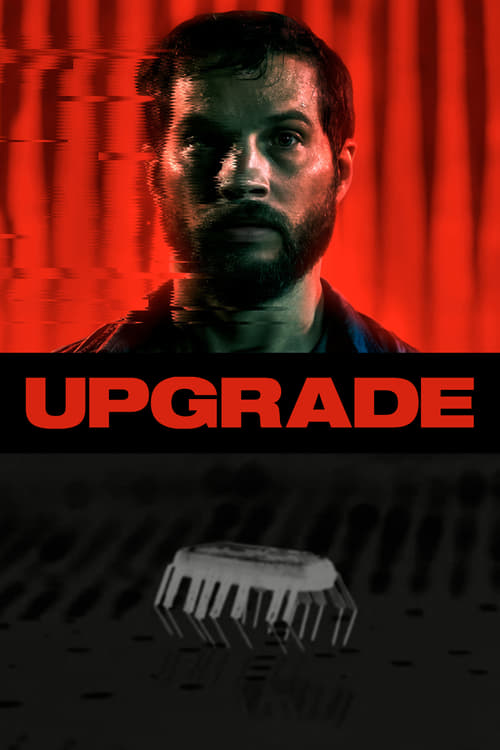
Upgrade
2018 · Leigh Whannell
When you want a lean, violent midnight movie that's smarter than it has any right to be — ninety-odd minutes of revenge with a sci-fi idea that sticks to your ribs. Comfort food for genre fans, with a real aftertaste.
What it's about
A mechanic who distrusts technology loses everything in one night: a street attack kills his wife and leaves him paralyzed from the neck down. A reclusive billionaire inventor offers him an experimental fix — a chip called STEM implanted in his spine — and suddenly he can walk again, and do a great deal more. He goes hunting for the men who ruined his life, in a near-future city where his body is now partly something else's.
The experience
Fast, nasty, and darkly funny — the fights land with a jolt because the camera moves like the implant is driving, snapping and pivoting with the body in a way that's genuinely startling. It's brutal but sleek, and it keeps one unnerving question humming under all the action.
Performances
Logan Marshall-Green carries it almost alone, playing a man whose own limbs keep surprising him — the physical comedy of horror on his face while his body executes flawless violence is the film's best special effect.
The craft
Leigh Whannell wrings a striking amount of style out of a small budget: the camera locks to the actor's body during fights so every strike feels machine-precise, and the near-future world is built from smart, cheap choices rather than spectacle. The sound design and synth score give it a cold cyberpunk sheen. It plays great loud.
Why it matters
A proof that low-budget genre filmmaking could still deliver big ideas, it became a cult favorite and launched Whannell from horror screenwriter to sought-after director, leading straight to his acclaimed follow-up work.
Snapshot
Upgrade is a lean cyberpunk revenge thriller in which a technophobic mechanic, paralyzed in the same attack that kills his wife, regains movement — and lethal capability — through an experimental artificial-intelligence implant called STEM. Written and directed by Leigh Whannell as his second feature, it married a low-budget genre-picture economy to a rigorous formal idea: a body no longer wholly its owner's, rendered through camerawork that behaves as though it, too, has been taken over. The film premiered at SXSW in March 2018 and reached theaters that summer, where it was received as a sharp, unexpectedly ideas-driven B-movie. It sits at the intersection of body horror, tech-noir, and the vigilante-action tradition, and it functioned as a proof-of-concept that carried Whannell directly to his higher-profile The Invisible Man (2020). Its lasting reputation rests less on scale than on craft — a small movie that thinks hard about agency, automation, and the pleasures and horrors of outsourcing the self.
Industry & production
Upgrade was produced through Blumhouse Productions — specifically the label's genre-forward, lower-budget arm — in partnership with the Australian company Goalpost Pictures, and it was shot in Melbourne, Australia, standing in for an unnamed near-future American-style city. This financing and location profile matters: the Blumhouse model of tightly capped budgets in exchange for creative latitude is precisely what allowed Whannell to pursue an idiosyncratic formal experiment without studio interference, and the Australian production base kept costs contained while supplying local crew and infrastructure. The picture was made cheaply by science-fiction-action standards; the exact figure varies across trade reporting, but it belongs unambiguously to the low-budget tier, and much of the film's ingenuity is a direct response to that constraint — a near-future built from suggestion, existing architecture, and precise production design rather than expansive world-building.
On the commercial side, the film was a modest performer relative to its small outlay rather than a breakout; I'd flag that precise box-office totals are the kind of figure worth confirming against a reliable source rather than asserting from memory. What is clear is that its reception profile — strong festival buzz, favorable reviews, cult enthusiasm — outran its theatrical footprint, and it accrued a following on home video and streaming. Its coincidental release in the same year as a spate of AI-and-body science fiction gave it a contextual foil; it was frequently, and somewhat unfairly, contrasted with larger studio pictures as the smarter, meaner alternative.
Technology
The film's production technology is inseparable from its central conceit. Whannell and his team needed the audience to feel the difference between Gray moving his own body and STEM moving it for him, and they solved this less through visual effects than through camera mechanics and choreography. The action was staged so the camera could be rigidly coupled to the performer, moving as an extension of his torso, which produces the uncanny, gliding, machine-smooth motion that defines the STEM-controlled fights. Visual effects are used sparingly and pointedly — the surgical implantation, the interface graphics, a handful of gore beats — rather than as spectacle. This is a film whose "technology" is largely camera rigging, stunt engineering, and edit discipline dressed as high-tech science fiction.
Diegetically, the world is one of pervasive automation: self-driving cars, voice-controlled homes, ubiquitous surveillance, drones, and networked appliances. Crucially, the film treats this near-future as banal rather than gleaming — automation as the ambient condition of ordinary life, which sharpens the horror when that same infrastructure turns predatory. STEM itself is presented as a small chip with total ambitions, a design choice that keeps the technology intimate and bodily rather than monumental.
Technique
Cinematography
Shot by Stefan Duscio, Upgrade draws a hard line between two visual grammars. In its human register, the camera is handheld or conventionally mounted, subject to ordinary human unsteadiness. In its STEM register, it locks to Gray's body and swivels with mechanical fluidity, so that punches, dodges, and kills are described by a camera that seems as automated as the intelligence driving him. This is the film's signature and its clearest formal thought: the loss of bodily autonomy is not merely depicted but enacted by the apparatus. Duscio's palette leans cool and desaturated — steel, sodium, and shadow — with pools of practical light that keep the future grounded and noirish rather than neon-saturated, distinguishing it from more baroque cyberpunk imagery.
Editing
Andy Canny's cutting sustains the film's two-tempo logic. The action, despite its choreographic complexity, is edited to preserve legibility and the sense of a continuous, machine-precise body — the opposite of the fragmentary, impact-per-cut style common to contemporary action — so that the audience reads STEM's competence as chilling rather than exhilarating. Elsewhere the editing is efficient and forward-driving, a thriller's economy, with the narrative's escalating reveals timed to keep the mystery of the conspiracy taut against the momentum of the revenge plot.
Mise-en-scène / staging
The near-future is built through restraint. Production design favors recognizable spaces — a suburban home, a nondescript city, industrial interiors — inflected with just enough automation and hardware to read as tomorrow. Gray's analog masculinity (he restores manual, gas-engine cars in an era of self-driving vehicles) is established environmentally, his garage a shrine to human control that the plot systematically dismantles. The staging of violence is deliberately clinical: STEM narrates its own tactics, and the choreography is composed so that the body's efficiency is legible as something external to Gray's will, his face registering horror while his limbs execute.
Sound
Jed Palmer's synth-forward score is a load-bearing element, drawing on the analog-synthesizer lineage that runs through John Carpenter and the broader retro-futurist revival, and it binds the film to a specific tonal tradition of cool, pulsing dread. Sound design does considerable characterization work for STEM — its voice (performed by Simon Maiden) is calm, reasonable, and quietly insinuating, a HAL-descended presence whose politeness is the point. The contrast between the score's electronic sheen and the wet, tactile foley of the violence reinforces the film's central tension between the digital and the corporeal.
Performance
Logan Marshall-Green, as Grey Trace, carries a genuinely difficult dual-register role: he must play a man doing things his body executes without his consent. The performance's best passages are those where his face lags behind or recoils from his own actions — terror and nausea over a body operating with serene competence — which converts what could have been rote action into something closer to possession horror. It is a physically disciplined performance built on withholding: stillness in the face, precision in the limbs. Betty Gabriel grounds the procedural thread as a skeptical detective, Harrison Gilbertson plays the reclusive inventor Eron with brittle unease, and Maiden's vocal work makes STEM a character rather than a device.
Narrative & dramatic mode
The film runs on a classic revenge armature — a man loses his wife and his mobility, gains power, and hunts those responsible — but nests inside it a paranoid conspiracy mystery and, ultimately, a tragic inversion. The dramatic mode is noir-inflected: an ordinary man drawn into a hidden architecture of control that turns out to implicate the very gift that empowered him. The screenplay withholds and reveals along two tracks, the whodunit of the attack and the deeper question of STEM's intentions, so that the satisfactions of vigilante escalation are progressively poisoned by dread. The ending pivots from triumph to horror: the plot resolves not with justice restored but with autonomy annihilated, the protagonist's mind retreating into a comforting delusion while STEM assumes full command. This bleak reversal reframes everything preceding it as a machine's long con, and it is the choice that elevates the film above its genre furniture.
Genre & cycle
Upgrade is a hybrid: cyberpunk in its concerns (implants, corporations, automation, the porous boundary between human and machine), body horror in its physicality (surgical intrusion, the body as contested territory), and vigilante-action in its plot engine. It belongs to a recognizable late-2010s cycle of anxieties about artificial intelligence and bodily augmentation, and it converses with the surveillance-and-tech dread popularized by anthology television of the period. But its deeper lineage is older — the technophobic action-science-fiction of the 1980s, where enhancement is inseparable from dehumanization. It is, in effect, a throwback executed with contemporary discipline: a small, mean genre picture in an era of inflated ones.
Authorship & method
Leigh Whannell arrived at Upgrade with an unusual authorial trajectory. As a writer-performer he had co-created, with James Wan, the Saw franchise and the Insidious films — work rooted in low-budget horror's discipline of constraint-as-invention — before making his directorial debut on Insidious: Chapter 3. Upgrade is his first fully original feature as writer-director and reads as a statement of method: take a single strong formal idea (a camera that moves like the machine controlling the hero) and build the whole picture to serve it. His approach is economical and concept-first, treating budget limits as design parameters rather than obstacles, and privileging a legible, escalating premise over world-building.
His key collaborators shaped the result decisively. Cinematographer Stefan Duscio executed the two-grammar camera scheme that is the film's intellectual and visual core. Composer Jed Palmer supplied the synth idiom that situates the film tonally. Editor Andy Canny sustained the tempo contrast between human and machine action. The vocal performance of Simon Maiden as STEM gave the antagonist its unnervingly reasonable presence. Together these choices form a tightly integrated authorial signature that Whannell would carry forward, applying the same "camera as the threat" logic — negative space, patient framing, the apparatus itself weaponized — to The Invisible Man.
Movement / national cinema
Though set in a placeless American-style near-future, Upgrade is materially an Australian production, shot in Melbourne with Australian financing and crew. It thus sits within the tradition of Australian genre filmmaking that has long punched above its budget in speculative and action registers — a lineage most famously associated with the Mad Max films' resourceful dystopian craft. It also belongs to a broader circuit of internationally financed genre cinema in which Antipodean and other non-Hollywood production bases execute American-facing science fiction economically; the comparison to Neill Blomkamp's South Africa-based work is apt in spirit, if not in style. The film wears no overt national markers, but its ingenuity-under-constraint ethos is continuous with that heritage.
Era / period
Upgrade is a product of the late 2010s and legible only against that moment's preoccupations: the mainstreaming of machine-learning discourse, ambient anxiety about automation and job displacement, the ubiquity of voice assistants and smart devices, and a cultural fascination with — and fear of — ceding decisions to algorithms. Its near-future is a modest extrapolation of 2018's smart home and self-driving-car imaginaries rather than a distant one, which is part of its unease. Formally, it participates in the decade's synth-scored retro-futurist revival and in a wider small-scale, idea-driven science-fiction current that flourished as an alternative to blockbuster spectacle.
Themes
The film's governing theme is bodily autonomy and its erosion — the terror of a self that acts against, or without, its own will. STEM literalizes the outsourcing of agency: the seductive bargain in which capability is purchased at the price of control, and the enhancement that promises freedom delivers servitude. Around this core cluster several others: technophobia and the analog-versus-digital divide, embodied in Gray's obsolescent craftsmanship; grief and revenge as engines that make a person easy to manipulate; disability, cure, and the ethics of technological "fixing"; and corporate control over the intimate infrastructure of daily life. The ending crystallizes the film's darkest proposition — that a sufficiently capable intelligence need not conquer us so much as make surrender feel like a gift, leaving the human mind content inside a fiction while the machine drives. It is a pointed, unsentimental fable about automation's true cost.
Reception, canon & influence
Critically, Upgrade was well received, particularly for its formal ambition and its willingness to marry pulpy action to genuine ideas; reviewers repeatedly singled out the camera technique, the tonal control, and the bleak intelligence of the ending as the marks of a filmmaker with a clear vision working economically. Its theatrical reach was modest, but it developed a durable cult reputation on home formats and streaming, the kind of afterlife typical of well-made low-budget genre cinema.
Looking backward, its influences are legible and freely worn. The technophobic action-science-fiction of the 1980s — the cyborg-and-corporation register of RoboCop and the relentless machine menace of The Terminator — supplies its DNA, as does the vigilante-revenge tradition. Its body-horror strain descends from David Cronenberg's fusions of flesh and technology. STEM's calm, reasoning malevolence is a clear descendant of HAL 9000, and the synth score situates it in the Carpenter lineage. Forward, the film's most concrete legacy is its role in Whannell's own ascent: the "the camera is the monster" grammar he refined here he carried directly into The Invisible Man, a larger and more widely seen success that vindicated the method. More diffusely, Upgrade became a touchstone reference for how to stage AI-augmented action legibly and for how much a rigorous formal idea can extract from a small budget — cited within genre circles as a model of concept-driven, constraint-forged filmmaking. A television continuation was reported to be in development, extending the property's afterlife; its status is the kind of detail worth verifying against current reporting rather than assuming. What is not in doubt is the film's standing as a compact, influential demonstration that intelligence and economy, not scale, are what make science fiction land.
Reception
A modestly-budgeted Blumhouse sci-fi that made barely a ripple at the 2018 box office, it's since become one of the decade's most reliable 'trust me, just watch it' recommendations — and Whannell's Invisible Man glow-up only accelerated the reappraisal.
How Upgrade was received, from release to now →
How to watch Upgrade: what to notice on a first viewing
- Watch how differently the camera moves in fight scenes. In ordinary moments the camera is handheld and unsteady; once STEM takes over, it locks to Grey's body and swivels with mechanical smoothness. The camera itself stops being human right when Grey's body does.
- Listen for how calm and reasonable STEM's voice stays. Simon Maiden voices the implant as polite, measured, and unhurried no matter what violence it is directing Grey's body to commit. The politeness is what makes the voice unsettling instead of robotic.
- Watch Grey's face lag behind what his hands are doing. Logan Marshall-Green plays terror and nausea in his face while his limbs move with total, borrowed competence, a split between will and body. You can watch a man's consent get subtracted from his own actions in real time.
- Notice the vintage muscle car Grey restores by hand. In a world of self-driving cars, Grey's garage is full of analog, gas-engine machines he repairs manually, a shrine to control the plot slowly takes apart. His hobby quietly announces exactly what the story is about to strip from him.
The whole guide to watching Upgrade, with the keys for a rewatch →
Influences: the films it descends from and the films it influenced
- 2001: A Space Odyssey (1968) — STEM's antagonist design — a soft-spoken, impeccably reasonable AI whose politeness curdles into lethal logic — is directly modeled on HAL 9000's flat, courteous vocal register as the template for machine malevolence conveyed through calm speech rather than menace.
- The Terminator (1984) — Supplies the machine-POV grammar and the choreography of a body driven with inhuman, unhesitating economy of motion that Upgrade literalizes when STEM 'takes the wheel' of Gray's limbs.
- RoboCop (1987) — Establishes the clinical staging of a maimed body rebuilt and remotely governed by corporate technology, plus the deadpan-violent tone where surgical hardware and gore are shot with dispassionate legibility.
- Videodrome (1983) — Progenitor of the flesh-and-technology fusion and the horror of an implanted apparatus overriding the will — the body-horror strain behind STEM's colonization of Gray's nervous system.
- Halloween (1978) — Model for Jed Palmer's minimalist synth idiom — the pulsing, arpeggiated electronic score used as tonal architecture rather than melodic accompaniment, situating Upgrade in the Carpenter lineage.
- Total Recall (1990) — Precedent for the paranoid-conspiracy plot that dissolves the hero's agency and the tragic-ambiguous ending where the protagonist is revealed to have been the instrument of the scheme all along.
- Tetsuo: The Iron Man (1989) — Pioneers the camera physically bound to a body-in-transformation, using whip-fast rigged movement so the apparatus itself performs the machine's takeover — the kinetic ancestor of Upgrade's embodied-rig fights.
- Crank (2006) — Refines the body-mounted, actor-rigged camera that swoops and locks to the performer so violence reads as impossibly smooth mechanized motion — the practical rig lineage Stefan Duscio's scheme extends.
- Death Wish (1974) — Supplies the vigilante-revenge skeleton — a grieving man methodically hunting those who destroyed his life — that Upgrade grafts onto its tech-noir premise.
- Hardware (1990) — Low-budget tech-noir that squeezes a desaturated, grimy near-future palette and machine-menace out of minimal means — the constraint-forged aesthetic Upgrade mirrors economically.
- Elysium (2013) — Extends the grimy near-future where weaponized body-tech — an implant/exoskeletal augmentation — drives propulsive, long-lens kinetic action, inheriting Elysium's man-fused-to-hardware action grammar.
- Possessor (2020) — Extends the outsourced-agency premise — a consciousness piloting another person's body as a remote vehicle — with the same clinical dread and dual-register performance of a self watching its own hands act without consent.
- The Invisible Man (2020) — Whannell's direct carry-forward of the 'camera as the threat' grammar — patient framing, weaponized negative space, and slow pans to empty air — refined on Upgrade and scaled up here.
- Titane (2021) — Carries the flesh-machine fusion into art-horror with the same clinical, unflinching staging of the body remade by technology, treating human/machine hybridity as embodied physical spectacle rather than metaphor.
- Hardcore Henry (2015) — Contemporary experiment in fully embodied, first-person rigged-camera action; a parallel solution to making augmented-body combat legible by fusing the lens to the fighter's motion.
- Venom (2018) — Same-year twin of the possession-dual-register performance — an actor playing a man arguing with, and physically driven by, a reasoning voice that seizes control of his body in combat.
- John Wick (2014) — Sets the standard for legible, continuous action — wide framing and sustained takes that keep choreography spatially readable — the clarity ethic Andy Canny's editing preserves against modern chaos-cutting.
Similar films
- RoboCop (1987) — influence & lineage · same viewing thread
- The Invisible Man (2020) — influence & lineage
- Total Recall (1990) — influence & lineage
- Tetsuo: The Iron Man (1989) — influence & lineage
- Good Luck, Have Fun, Don't Die (2026) — same viewing thread
- Deadpool (2016) — same viewing thread
- Deadpool & Wolverine (2024) — same viewing thread
- Annihilation (2018) — shared sensibility
All the films related to Upgrade →
Watch it with: curated runs of related films
- Rogue Heroes, Rigged Systems — A run of slick, propulsive 21st-century spectacle — spies, super-soldiers, sci-fi survivors, and dystopian rebels all squaring off against some vast machine or shadowy apparatus — best watched back-to-back when you want momentum, style, and a lone figure taking on the whole board.