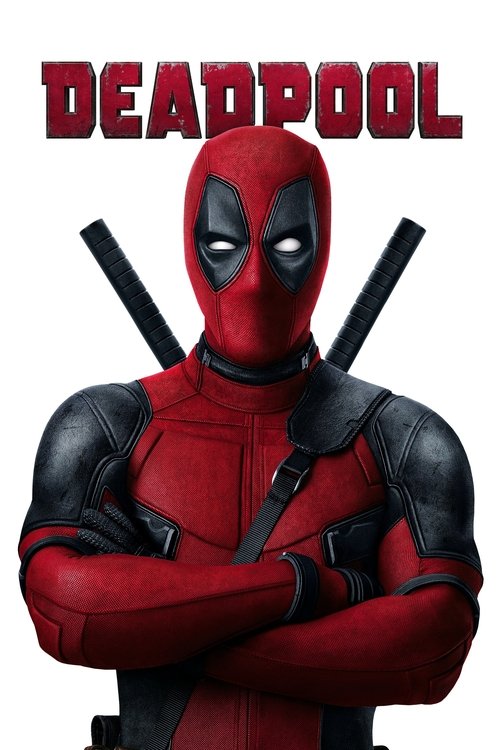
Deadpool
2016 · Tim Miller
For a rowdy night when you want to laugh at something loud and inappropriate — pizza-and-friends comfort viewing that never asks you to take it seriously. Reach for it when regular superhero movies feel too polished and polite.
What it's about
Wade Wilson is a wisecracking mercenary whose life is derailed by a terminal cancer diagnosis. A shady experimental program cures him — at the cost of leaving him disfigured and lethally hard to kill — and he reinvents himself as Deadpool, hunting the man responsible while cracking jokes directly at the audience. It's a revenge story wearing a superhero costume it refuses to take seriously.
The experience
Fast, filthy, and relentlessly self-aware — the movie mocks its own genre, its budget, and its star while delivering genuinely bruising action. It plays like a stand-up set with swordplay: crude, quick, and gleefully juvenile, with a surprisingly sincere love story buried under the gags.
Performances
Ryan Reynolds spent years fighting to make this role happen and it shows — his motormouth timing and total commitment to the bit make a character who narrates his own movie feel effortless rather than exhausting.
The craft
The screenplay is the engine: a nonlinear structure that opens mid-action and doubles back, jokes layered into freeze-frames, credits, and asides that constantly puncture the fourth wall. The action is scrappy and inventive rather than massive, turning a modest budget into a running gag. It plays great with a crowd that laughs out loud.
Why it matters
Its runaway success proved an R-rated superhero movie could be a blockbuster, cracking open studio thinking about what comic-book films were allowed to be and cementing Reynolds's career-defining role.
Snapshot
Deadpool is the rare studio superhero film that succeeds by ridiculing the form that produced it. Adapted from the Marvel Comics character created by Fabian Nicieza and Rob Liefeld in 1991 (debuting in The New Mutants #98), the film tells the origin of Wade Wilson, a mercenary whose terminal cancer is "cured" by a sadistic experimental program that disfigures him while granting him a regenerative healing factor. The plot is a lean revenge story, but the film's identity rests almost entirely on tone: a foul-mouthed, hyper-violent, fourth-wall-breaking comedy that addresses the audience directly and treats its own genre conventions as punchlines. Produced by 20th Century Fox as part of its X-Men film franchise, it was the first major American superhero blockbuster to embrace an R rating as a feature rather than a liability, and its commercial success reshaped industry assumptions about what such films could be.
Industry & production
The production history of Deadpool is itself a well-documented part of its legend. Ryan Reynolds had been attached to the character for years, having played a heavily altered version of Wade Wilson in X-Men Origins: Wolverine (2009) — a portrayal widely disliked by fans for sewing the "merc with a mouth" character's mouth shut. Screenwriters Rhett Reese and Paul Wernick developed a faithful script, but Fox was reluctant to greenlight an expensive R-rated comic-book film. The decisive event was the 2014 leak of test footage directed by Tim Miller; the strongly positive online response is generally credited with pushing Fox to approve the project. The film was made on a budget modest by blockbuster standards — reported in the range of the high-$50-million mark, though exact figures should be treated cautiously — which the marketing and the film itself repeatedly joke about. It became, on release in February 2016, an enormous commercial success and was widely reported at the time as the highest-grossing R-rated film to that point. Because the X-Men screen rights sat with Fox rather than Marvel Studios, Deadpool exists in a distinct corporate lineage from the Marvel Cinematic Universe — a fact the film exploits for jokes about budget and the limited roster of X-Men it is "allowed" to use.
Technology
Deadpool was shot digitally, consistent with the prevailing practice for effects-heavy studio features of the mid-2010s; contemporary technical reporting associates the production with Arri Alexa cameras, though specific configuration details are best verified against primary technical sources. The film's most ambitious technological component is its visual effects, which is unsurprising given Miller's background. Before directing, Miller co-founded Blur Studio, a visual-effects and animation house, and his fluency in digital production shaped the film at the planning stage. The character Colossus is rendered as a fully computer-generated figure — a seven-foot organic-steel mutant performed through motion capture and voice work rather than a practical suit — and the opening highway sequence relies on extensive digital set extension, CG vehicles, and simulated destruction. The film's relatively contained budget meant VFX had to be deployed selectively and efficiently, and much of the technological achievement lies in making a comparatively cheap film read as a full-scale superhero production.
Technique
Cinematography
The cinematography, credited to Ken Seng, serves the film's two registers: kinetic action and intimate comedy. The marquee set piece — the freeway ambush that frames the entire narrative — is staged for legibility and impact, with the camera following Deadpool's acrobatic, bullet-counting violence in clean, comprehensible compositions rather than the disorienting shaky-cam style common to the era's action cinema. Elsewhere the visual approach is workmanlike and bright, prioritizing the timing of jokes and the readability of Reynolds's masked performance. The film's signature visual device is less a matter of lensing than of breaking the frame's contract with the viewer: Deadpool repeatedly turns to look into the lens, and on occasion the staging acknowledges the camera's presence as a participant in the gag.
Editing
Julian Clarke's editing is arguably the film's most important technical contribution, because Deadpool is structurally a comedy first and an action film second. The screenplay's nonlinear design — opening in the middle of the climactic freeway fight, then cross-cutting backward through Wade's romance, diagnosis, and torturous transformation — depends entirely on cutting to control information and tone. The editing also governs the film's comic rhythm: the freeze-frames, the direct-address asides, the abrupt tonal pivots from sentiment to splatter. The celebrated opening-titles sequence, a slow push through a frozen instant of the crash, uses editing and graphics to deliver jokes in place of conventional credits ("God's Perfect Idiot," "A British Villain," and so on), establishing the film's self-aware contract before a single line of dialogue.
Mise-en-scène / staging
The film's staging oscillates between two scales. The action is choreographed for clarity and wit — Deadpool's fights are designed so that each kill registers as a beat in a comic routine, and his physical agility (he is masked throughout much of the film, allowing extensive stunt doubling) is used for sight gags as much as spectacle. The non-action world is deliberately unglamorous: Weasel's dive bar, Blind Al's apartment, the grim industrial "workshop" where Ajax conducts his experiments. This grubby, lived-in production design grounds the character's outrageous humor in a recognizably seedy milieu, distancing the film from the gleaming, monumental look of contemporaneous Marvel Studios productions.
Sound
The score is by Tom Holkenborg, working under his Junkie XL alias, and it mirrors the film's irreverence — propulsive in the action sequences while leaving room for the comedy. The film's most discussed sonic strategy, however, is its use of pre-existing pop music against tone: needle-drops deployed for ironic counterpoint, contrasting sentimental or upbeat songs with graphic violence. This juxtaposition is central to the film's voice, weaponizing the gap between what we hear and what we see.
Performance
Ryan Reynolds's performance is the film's engine, and it doubles as an act of career reclamation. Having previously been miscast (in the eyes of fans) as Deadpool and having starred in the poorly received Green Lantern (2011) — both of which the film explicitly jokes about — Reynolds plays Wade Wilson as a manic, wounded, motor-mouthed performer who is always partly addressing us. Because the character spends much of the film masked, the performance is heavily vocal, carried by line delivery and physical comedy. The supporting cast is sharply drawn: Morena Baccarin as Vanessa, whose romance with Wade gives the film its emotional stakes; T.J. Miller as the acid-tongued Weasel; Ed Skrein as the affectless villain Ajax/Francis; Gina Carano as the powerhouse Angel Dust; Brianna Hildebrand as the deadpan teenage mutant Negasonic Teenage Warhead; Leslie Uggams as Blind Al; and Stefan Kapičić voicing the earnest, morally upright Colossus, whose squareness is played against Deadpool's vulgarity.
Narrative & dramatic mode
Deadpool operates in a metafictional comic mode that is unusual for a studio tentpole. Its dramatic spine is conventional — a love story interrupted by disease and disfigurement, and a quest for revenge against the man who mutilated the hero — but this is continuously interrupted and commented upon by the protagonist himself. Deadpool's direct address breaks the fourth wall not merely for jokes but as a structural principle; he is aware he is in a film, references the actors and the studio, and narrates his own origin while mocking the clichés of the origin story. The nonlinear chronology, the self-deprecating titles, and the recurring asides all serve a single aim: to let the film have a sincere emotional center (Wade's love for Vanessa and his shame at his appearance) while maintaining ironic distance from the genre machinery surrounding it. The result is a hybrid — at once a satire of superhero narrative and a fully functioning instance of one.
Genre & cycle
The film belongs to the superhero cycle that dominated 2010s Hollywood, but it positions itself as that cycle's gadfly. It is a genre satire that depends on the audience's deep familiarity with the conventions it lampoons — origin stories, training montages, the obligatory third-act CGI showdown, the chaste PG-13 violence of its peers. By foregrounding sex, profanity, and graphic bloodshed, Deadpool defined itself against the family-friendly Marvel Studios model and against its own X-Men franchise siblings. It draws on adjacent traditions — the R-rated action-comedy, the buddy and revenge picture, and a lineage of self-aware genre films — to carve out a distinct niche: the irreverent, adult-oriented comic-book movie.
Authorship & method
Deadpool is best understood as the product of a tight collaboration among a first-time director, a committed star-producer, and a pair of screenwriters, rather than as a singular auteur statement. Tim Miller, making his feature directorial debut after a career in visual effects and animation at Blur Studio, brought technical fluency and a clear sense of how to stage action and effects economically. Reese and Wernick's screenplay supplied the structural ingenuity and the relentless comic voice. Ryan Reynolds functioned as more than a star: his long advocacy for the project, his shaping of the character's tone, and his producer-level investment make his authorship inseparable from the film's identity. Key craft collaborators — cinematographer Ken Seng, editor Julian Clarke, and composer Tom Holkenborg — translated this comic-metafictional sensibility into a coherent audiovisual style. The film's method is one of constraint turned to advantage: a modest budget, a niche rating, and a marginal corporate position became the basis for its scrappy, self-mocking voice.
Movement / national cinema
Deadpool is a product of the American studio system, specifically the franchise-driven, intellectual-property-centric Hollywood of the 2010s. It belongs to no art-cinema movement; its lineage is industrial and commercial. Within that context it is significant as a film that tested the boundaries of the franchise blockbuster from the inside — using the resources and reach of a major studio to make something deliberately coarser and more self-critical than the form's prevailing norms.
Era / period
The film is firmly of its moment: the saturation point of the superhero boom, when audiences were fluent enough in the genre's grammar to enjoy seeing it dismantled. Released in early 2016, Deadpool arrived as the major studios were producing multiple comic-book films per year, and its success registered a kind of appetite for variation within the cycle. It is also a product of the social-media and internet-fan era in a concrete way: the leaked-footage origin of its greenlight, and its marketing's embrace of meme culture and direct fan address, reflect a period in which online enthusiasm could materially shape studio decisions.
Themes
Beneath the jokes, the film circles a few persistent concerns. The most sustained is disfigurement and self-worth: Wade's transformation makes him nearly immortal but scars his body, and his refusal to let Vanessa see him is the film's true conflict, with the climax less about defeating Ajax than about Wade accepting that he can still be loved. Related is the theme of identity and performance — the mask, the persona, the constant performing-for-an-audience that the fourth-wall device literalizes. The film also reflects, satirically, on heroism itself: Deadpool insistently denies being a hero, and the film treats conventional superheroic virtue (embodied by Colossus) as something to be mocked even as it is, finally, partially affirmed.
Reception, canon & influence
Deadpool was both a critical and commercial success, praised in particular for Reynolds's performance and its comic invention, while some critics noted that beneath the meta-comedy lay a fairly conventional origin-and-revenge structure. Its commercial performance was the more consequential fact: as a runaway hit made cheaply with an R rating, it overturned a long-standing industry assumption that mainstream superhero films had to be PG-13 to succeed.
Looking backward, the film's influences are primarily the source comics, whose decades of fourth-wall-breaking and self-referential humor it faithfully translates; the character was conceived partly in that satirical register, and the film inherits it. It also draws on the broader traditions of the R-rated action-comedy and of self-aware genre cinema, and it pointedly metabolizes Reynolds's own prior films as comic material.
Looking forward, its legacy is substantial. It directly produced a sequel, Deadpool 2 (2018), directed by David Leitch, and its success is frequently cited alongside Logan (2017) as evidence that R-rated, adult-oriented superhero films were commercially viable, encouraging studios to greenlight more tonally adventurous comic-book projects. After the Disney acquisition of 20th Century Fox, the character was eventually folded into the Marvel Cinematic Universe with Deadpool & Wolverine (2024), reuniting Reynolds's Deadpool with Hugh Jackman's Wolverine — a development that made the franchise's once-marginal, rights-bound position into a central narrative joke. More broadly, Deadpool helped license a wave of irreverence and self-awareness within the superhero genre, demonstrating that the form was secure enough to laugh at itself and profitable enough to do so on its own terms.
A Deleuzian reading
Start on the title sequence, because the whole film is already there.
The full Deleuzian reading of Deadpool →
Reception
In 2016 it landed as a genuine shock — a raunchy R-rated superhero hit nobody at Fox believed in until it out-grossed most of the X-Men films. A decade on it's oddly divisive: still beloved as a crowd-pleaser, but also blamed for a wave of smug, fourth-wall-winking imitators that made its irreverence feel like the new house style.
How Deadpool was received, from release to now →
Influences: the films it descends from and the films it influenced
- Blazing Saddles (1974) — Characters acknowledge they are inside a movie and the action literally bursts through its own set into the studio backlot, the demolition-of-diegesis-from-within that Deadpool weaponizes against the superhero frame.
- Annie Hall (1977) — Alvy repeatedly turns from the scene to address the lens directly, recruiting the viewer as confidant mid-action — the conspiratorial to-camera aside that becomes Wade Wilson's default register.
- Ferris Bueller's Day Off (1986) — The hero narrates his own caper straight down the barrel of the camera with winking complicity, the audience-buddy direct-address template Deadpool adopts wholesale.
- Fight Club (1999) — The narrator halts the film to annotate and freeze-frame his own image and flash captions onto it; Deadpool's image-manipulating fourth-wall narration and freeze-frame opening descend straight from this device.
- Robocop (1987) — Deploys graphic R-rated violence as ironic satirical punctuation rather than straight spectacle, the gleeful-gore-as-comedy tone Deadpool inherits.
- Kiss Kiss Bang Bang (2005) — Robert Downey Jr.'s narrator openly mocks the film's own structure, rewinds it, and apologizes for botched exposition — the self-auditing meta-noir patter Reese & Wernick echo in Deadpool's voice.
- Kick-Ass (2010) — Demonstrated an R-rated, profane, comic-accurate deconstruction of the superhero could play commercially, the tonal and box-office precedent Deadpool directly extends.
- Zombieland (2009) — Written by the same Reese & Wernick, it pairs onscreen graphic text (the 'Rules') with a fourth-wall-aware narrating protagonist — the direct screenwriting DNA of Deadpool's voice and title-card gags.
- Guardians of the Galaxy (2014) — Established the curated ironic needle-drop and wisecracking comedic register inside a Marvel tentpole, the soundtrack-as-irony craft Deadpool's needle-drops run alongside.
- Scott Pilgrim vs. the World (2010) — Extends the comic-adaptation self-awareness into fourth-wall address and on-screen graphic gags, treating the frame as an annotatable comic page like Wright.
- Hellzapoppin' (1941) — Sustained direct-to-camera address and apparatus-aware gags (jokes about the budget, the studio, the movie's own construction) inside a studio genre vehicle — the presentational fourth-wall comedy Hellzapoppin' prototyped.
- Megamind (2010) — Inherits the in-medias-res-then-flashback parody scaffold — open at the disaster, arrest the image, let the protagonist narrate the audience back through his own origin while mocking genre convention from inside a film that still obeys it in the third act.
- Logan (2017) — Cited alongside Deadpool as proof the R-rated adult superhero film was viable, it takes the same rating freedom toward elegiac gravity rather than comedy — the serious twin of the same liberation.
- Deadpool 2 (2018) — Direct sequel in which stunt-director Leitch sharpens the legible, choreographed action while preserving the meta-comedy, extending the same constraint-to-advantage method.
- Birds of Prey (2020) — Harley Quinn's unreliable fourth-wall-breaking voiceover and scrambled nonlinear timeline port Deadpool's narrating-antihero device into the DC universe.
- The Suicide Squad (2021) — An R-rated, gleefully violent, irreverent comic-book ensemble greenlit in the commercial space Deadpool and Logan pried open for tonally adventurous adult fare.
- Deadpool & Wolverine (2024) — Folds the character into the MCU and makes its once-marginal, rights-bound corporate history the literal subject of its fourth-wall jokes — the lineage's self-referential apotheosis.
- Crank (2006) — Hyperkinetic, self-mocking R-rated action that treats its own absurdity as the joke, sharing Deadpool's irreverent register where stunts and snark are inseparable.
- Free Guy (2021) — Reynolds reprises the star-producer-driven, self-aware comic-metafictional register in a meta action-comedy, the same Reynolds authorship engine that shaped Deadpool's identity.
- Kingsman: The Secret Service (2015) — Shares the metafictional fourth-wall reflexivity and R-rated comic-violence-to-pop-soundtrack register that Kingsman helped prove commercially viable.
- Kingsman: The Golden Circle (2017) — The other R-rated comic-book hit fusing transgressive fourth-wall comedy with stylized ultra-violence, sharing Kingsman's 'crude humor over a slick action chassis' wager.
- Guardians of the Galaxy Vol. 3 (2023) — R-rated superhero mixing pop needle-drops and gross-out prosthetic gags with a sincere emotional core, sharing Gunn's tonal register.
- Guardians of the Galaxy Vol. 2 (2017) — Irreverent needle-drops and fourth-wall tonal risk demonstrating, alongside Vol. 2, that a franchise superhero film could foreground an idiosyncratic authorial sensibility over house style.
- The Lego Batman Movie (2017) — Parallel proof that fourth-wall-breaking, continuity-mocking superhero satire could thrive commercially — validating the same self-aware-IP mode from the live-action side.
Similar films
- Deadpool & Wolverine (2024) — influence & lineage · same viewing thread
- Logan (2017) — influence & lineage
- Guardians of the Galaxy (2014) — influence & lineage
- RoboCop (1987) — influence & lineage · same viewing thread
- Thunderbolts* (2025) — same viewing thread
- Iron Man 2 (2010) — same viewing thread
- The Avengers (2012) — shared sensibility
- Sin City (2005) — shared sensibility
All the films related to Deadpool →
Watch it with: curated runs of related films
- Rogue Heroes, Rigged Systems — A run of slick, propulsive 21st-century spectacle — spies, super-soldiers, sci-fi survivors, and dystopian rebels all squaring off against some vast machine or shadowy apparatus — best watched back-to-back when you want momentum, style, and a lone figure taking on the whole board.